Sorting by

×

The Bible as History and Theology

QUESTION: Would you please explain more on the differences between Biblical history and theology? Is it difficult as an historian to keep these separate in your personal beliefs? RESPONSE: I was all set to write up an answer to this question, but then as I was plotting it out, it occurred to me that I was just going to say what I had already said in the Excursus to the first chapter of my Bible Intro. And so I’ve decided just to give that. I hope you don’t mind! If there are further questions from anyone, or need for clarification, do let me know. Here’s what I tell my student-readers at the beginning of the book, to explain the difference between a theological (or confessional) approach to the Bible and a historical approach. __________________________________________________________________________ EXCURSUS Most of the people who are deeply interested in the Bible in modern American culture are committed Jews or Christians who have been taught that this is a book of sacred texts, Scripture, unlike other books.  For many of these [...]
2025-09-10T12:18:54-04:00September 26th, 2012|Reader’s Questions, Teaching Christianity|

Does Luke Combat a Docetic Christology?

QUESTION: There are some scholars who believe that the resurrection story found in Luke's gospel is an antidocetic narrative ( Gerd Ludemann and Charles Talbert, for instance). According to these scholars when the risen Jesus performs acts designed to show his disciples that he has an actual body of flesh and isn't some phantom or demon, the story is designed to refute the heresy of docetism that existed during the time that Luke wrote his gospel. I have never seen convincing evidence for this. What is your take on this? Do you agree with these scholars? If so, why? If not, what is your opinion? RESPONSE: Yeah, this is a tough one. I think I need to provide some background for some of the people reading the blog. The term “Docetism” comes from the Greek word dokeo which means “to seem” or “to appear.” The term came to be used in reference to certain Christians and Christian groups who maintained that Jesus was not a real flesh and blood being, but that he only “seemed” [...]

Peter, The Smoked Tuna, and the Flying Heretic

IN MY BIBLE INTRODUCTION I INTRODUCE STUDENTS TO NON-CANONICAL LEGENDARY ACCOUNTS ABOUT THE APOSTLES, INCLUDING THIS LITTLE GEM ABOUT PETER. Among the pseudepigrapha connected with the apostle Peter, none is more interesting than the apocryphal Acts of Peter, a document that details Peter’s various confrontations with the heretical magician Simon Magus (cf. Acts 8:14-24). The narrative shows how Peter outperforms the magician by invoking the power of God. Consider the following entertaining account, in which Peter proves the divine authorization of his message by raising a dead tuna fish back to life. FOR THE REST OF THIS POST, log in as a Member. Click here for membership options. If you don't belong yet, JOIN NOW!! But Peter turned round and saw a smoked tunny-fish hanging in a window; and he took it and said to the people, “If you now see this swimming in the water like a fish, will you be able to believe in him whom I preach?”  And they all said with one accord, “Indeed, we will believe you!”  Now there [...]

2025-09-10T12:18:54-04:00September 23rd, 2012|Book Discussions, Christian Apocrypha|

Is the New Gospel Fragment a Modern Forgery?

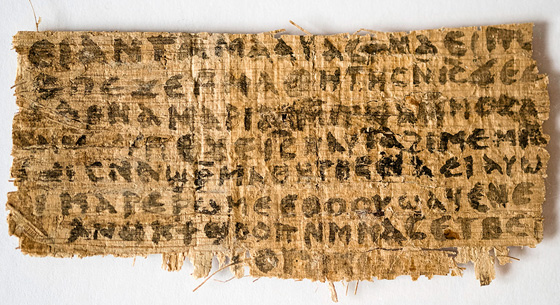
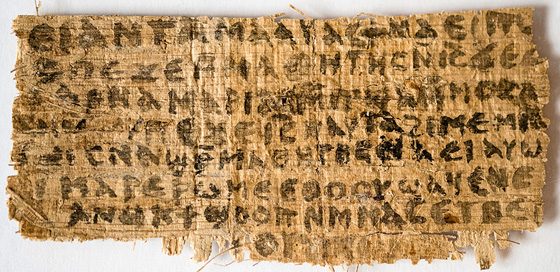
The so-called “Gospel of Jesus’s Wife” has been publicly available for only three days now, and already New Testament scholars and scholars of Coptic and Gnosticism are hard at work on it. Most of the effort so far has been in deciding whether it is authentic or forged. And it ain’t lookin’ good for those who think it’s authentic! Some have pointed out that the fragment looks too neat around the edges to be believable; others have noted that the writing looks fake; others have argued that there are grammatical problems; and some have thought that it really is just absolutely too good to be true that of eight lines out of an entire Gospel, with only a couple of words surviving per line, two of those surviving words would just happen to involve Jesus saying “My wife”! As this all is unfolding, I am reminded once again that there are some *amazing* scholars out there who can do  brilliant work on very short notice.   The following was sent out by my colleague at Duke [...]

A Problem with My Textbook

Writing any kind of book whatsoever is really difficult. But each *kind* of book is difficult in its own way. I tend to write three kinds of books: scholarly works for scholars (not for general consumption!); popular trade books for broader audiences of intelligent adults; and textbooks for college kids. As I’ve repeatedly said, I’m now finishing up my new textbook on the Bible for introductory level classes. The audience is, basically, American 19 and 20-year olds. And I’m finding it hard! There are several things that are just inherently hard for this kind of thing.  It is hard to take something that can so easily be made dull and lifeless and make it interesting and even intriguing.  It is hard to write at the right level so that the readers are treated like adults but not too much knowledge is assumed.  It is hard to take complicated ideas and concepts and make them simple and understandable enough for 19-year-olds who may be having the first introduction to the subject matter ever.  It is hard [...]

2025-09-10T12:18:53-04:00September 20th, 2012|Bart’s Biography, Book Discussions, Teaching Christianity|

The Gospel of Jesus’s Wife

The new Gospel “discovery,” the fragment of the so-called “Gospel of Jesus’s Wife”: I’m afraid I don’t have anything much to add to the conversations going on among experts and available to you by a simple Internet search. If you’re really interested, read around on the net. But I should say a few things, perhaps, from where I sit. First and most important for this post.  The big initial question is whether or not it is authentic.  I am not a Coptic palaeographer or a papyrologist, and so I cannot render an independent judgment.  A palaeographer is an expert in ancient handwriting, and is the kind of scholar who can look at a manuscript or a fragment of a manuscript (very carefully, magnified, from various angles!) and determine whether it is authentic or forged and if authentic when it probably dates from.   A papyrologist is an expert in ancient papyrus, especially papyrus manuscripts, who also can make judgments – based on the physical specimen rather than on the handwriting – about authenticity.   The initial appraisal [...]

BREAKING NEWS! A Significant New Non-Canonical Gospel Fragment

There is potentially exciting news just out this afternoon. Karen King, scholar of Coptic and Gnosticism at Harvard Divinity School, an expert on the Gnostic Gospels, has just released information about a newly discovered papyrus manuscript – a small fragment the size of a credit card. It is a Gospel fragment of only eight lines. But they are significant lines. On them, Jesus appears to refer … to his wife!! FOR THE REST OF THIS POST, LOG IN AS A MEMBER. IF YOU DON"T BELONG YET -- BETTER JOIN!! Here are the graphics and some links.   This is just breaking news, so I don’t have anything more to say about it. Front of fourth-century papyrus fragment Karen L. King's translation of the 8 lines from the front. Papyrus front text: Karen L. King 2012 Karen L. King's translation of the 6 lines on the back. Fourth-century CE codex in Coptic on reverse side.   Papyrus reverse side text: Karen L. King 2012.   http://www.nytimes.com/2012/09/19/us/historian-says-piece-of-papyrus-refers-to-jesus-wife.html?src=me&ref=general&_r=0 http://religion.blogs.cnn.com/2012/09/18/fragment-suggests-jesus-was-married/ And here’s a draft of [...]

How My Loss of Faith Affected My Scholarship

As I was making the long series of posts about my relationship with Bruce Metzger, in response to a question of how he reacted to my loss of faith, I got a number of interesting questions from readers. One that particularly struck me – as it caused me to think for a bit – was about how my loss of faith affected my scholarship. That’s a really good question. And now that I’ve thought it over a bit, I think the answer is a little surprising. To my knowledge, my loss of faith has had almost ZERO effect on my scholarship. That seems weird, since my scholarship is on the New Testament and the history of early Christianity, and you would think that if I were no longer a believer, that it would certainly change how I look at both the NT and the history of the early church.  But in fact, I don’t think I have had any change of scholarly views at all to accompany my loss of faith. FOR THE REST OF [...]

On the Blog Itself

  I am taking a moment out from a hectic life (who *doesn’t* have a hectic life?!?) to think a bit about the blog, and how it is going.   Here are just a few reflections. We got it up and running at the beginning of April, so we have been at it now for just over five months. My goals at the outset were to disseminate knowledge about the New Testament and early Christianity as much as was within my abilities, and to raise money for charities dealing with hunger and homelessness. As I’ve stated frankly before, it was the charity that drove the idea at the outset, and that keeps me going now as we are well into things.   As much as I enjoy answering questions and dealing with hard (and not so hard) historical and literary issues involving early Christianity and its literature, if it weren’t for the charity angle, I simply wouldn’t be doing this.   It’s too much work! In terms of the work, I think I’ve been averaging about 6 posts [...]

2025-09-10T12:18:53-04:00September 16th, 2012|Public Forum|

Possibilities for the Afterlife

IN MY BIBLE INTRODUCTION, I INTRODUCE STUDENTS TO SOME OF THE OPTIONS WITH RESPECT TO THE AFTERLIFE, IN VIEW OF PAUL’S INSISTENCE IN 1 CORINTHIANS THAT THE FUTURE WILL INVOLVE A PHYSICAL RESURRECTION OF THE DEAD FOR ETERNAL LIFE – A VIEW NOT SHARED BY MANY OF HIS READERS, BOTH THEN AND NOW! ******************************************************************************************************************** Some interpreters have thought that Paul and his Corinthian opponents disagreed about the resurrection because they had fundamentally different understandings about the nature of human existence, both now and in the afterlife. Perhaps it would be useful to reflect on different ways that one might conceive of life after death. Annihilation.  One possibility is that a person who dies ceases to exist.  This appears to have been a popular notion in the Greco-Roman world, as evidenced by a number of inscriptions on tombstones that bemoan the brevity of life which ends in nonexistence.  One of the most widely used Latin inscriptions was so popular that it was normally abbreviated (like our own R.I.P. for “Rest in Peace”) as N.F.N.S.N.C.: “I was [...]

2025-09-10T12:18:53-04:00September 15th, 2012|Afterlife, Book Discussions, Paul and His Letters|

The Need for Context

I AM NOW REVISING THE NEW TESTAMENT PORTION OF MY BIBLE INTRODUCTION, AND THOUGHT THAT SOME OF THE SECTIONS IN IT MAY BE OF BROADER INTEREST. AND SO I WILL POST A FEW OF (WHAT STRIKE ME AS) THE MORE INTERESTING PARTS HERE ON THE BLOG OVER THE NEXT WEEK OR SO. THE FOLLOWING IS HOW I BEGIN THIS SECOND SECTION. BEFORE THIS PORTION ARE AN OPENING EIGHT CHAPTERS DEVOTED TO THE HEBREW BIBLE. THEN THERE IS THIS TRANSITIONAL CHAPTER, FOLLOWED BY FIVE ON THE NT. TO GET GEARED UP FOR THE NT, I START AS FOLLOWS. THIS WILL SOUND FAMILIAR TO YOU IF YOU’VE READ SOME OF MY OTHER BOOKS ********************************************************************************************************************** Throughout our study so far we have seen why it is important to know the context of a biblical writing if we want to interpret it correctly. You cannot understand what Isaiah meant when he said that “a young woman has conceived and will bear a son, and you will call him Immanuel,” without knowing that he spoke these words in the context [...]

2025-09-10T12:18:53-04:00September 14th, 2012|Book Discussions, Greco-Roman Religions and Culture|

Autobiographical. Metzger and My Loss of Faith

I have come now, by an unusually circuitous route, to answer the question that got me started in talking about my relationship with Bruce Metzger, my work for the NRSV Bible translation committee, my view of the NRSV as a translation, the textual problems of Luke 22:19-20 and 22:43-44 and, well sundry other things. The reader’s question was how Metzger responded to my loss of faith. When I first got to know him, I was a strong evangelical Christian. In the years before he died, I had become an agnostic. How did he respond to that. After all that I’ve written in these posts, I’m afraid the direct answer will be a bit of a disappointment.  The answer is: I don’t know. FOR THE REST OF THIS POST, log in as a Member. Click here for membership options. If you don't belong yet, JOIN!! Metzger and I never talked about either my faith or his.  He was my teacher and I was his student, and we talked almost exclusively about scholarship:  New Testament studies, [...]

Autobiographical: Back to Metzger and Me

After all the tangents and side-tracks, I can return now to my reminiscences of my relationship with Bruce Metzger. Perhaps I should say a few things about his personality, as I perceived and experienced it. I think everyone who knew him would say that he was a true Christian gentleman. He was respectful of all people, polite to a fault, and cordial. But he was not someone that anyone became intimate with. I am absolutely positive that I came to be closer to him than any PhD student he supervised in his 40 plus years teaching at Princeton Theological Seminary. He as much as told me so. I knew his wife and his two sons (a bit); he invited my family to Christmas dinner; for several weeks I lived with him and his wife in their home. But there was always a kind of distance to him as well. He never let down his hair. The best I can put it is that he was cordial rather than warm and intimate. He was a shy [...]

Why Did Scribes Add the Bloody Sweat?

I have explained why it is almost certain that Luke did not himself write the passage describing Jesus “sweating blood” in Luke 22:43-44: the passage is not found in some of our oldest and best manuscripts, it intrudes in a context that otherwise is structured as a clear chiasmus, and it presents a view of Jesus going to his death precisely at odds with what Luke has produced otherwise. Whereas Luke goes out of his way to portray Jesus as calm and in control in the ace of death – evidently to provide a model to his readers about how they too suffer when they experience persecution – these verses show him in deep anguish to the point of needing heavenly support by an angel, as he sweats great drops as of blood. But if the verses were not originally in Luke, why were they added by scribes? The key to answering the question comes from considering two data.   First, when were the verses added to the text?  And second, how were they first “used” [...]

Jesus’ Death in Mark and Luke

It is one thing to be able to establish the emphases of both Mark and Luke in their accounts of Jesus going to his death.  (See my previous post).  It is harder, and more speculative, to establish why they chose to portray Jesus in these ways.   But there are some good, plausible views of the matter.  I’ll start with Mark. In Mark Jesus appears to be in shock, is silent the entire time, seems not to understand why this is happening to him, up to the end, when he cries out asking God why he has forsaken him.  And then he dies, never having received an answer.  What is most striking is that even though Mark’s Jesus may not know why, when it comes to the time, he has to suffer like this, the reader does (and so, of course, does Mark).  The moment that Jesus dies, two things happen: the curtain in the temple is ripped in half and the centurion confesses that he is the son of God.   The curtain was the barrier [...]

2025-09-10T12:18:40-04:00September 10th, 2012|Canonical Gospels|

Jesus Going to His Death in Luke

In previous posts I have given some of the reasons for thinking that Luke did not write the account of Jesus “sweating blood” in his prayer before his arrest. A lot more could obviously be said, but anyone who wants more can just look up the discussion in my book The Orthodox Corruption of Scripture. For the purposes of the blog, two BIG questions remain: why does Luke change Mark’s portrayal of Jesus going to his death so that now he is so clearly calm and collected? And why did later scribes change Luke’s portrayal by adding the two verses in question? I’ll answer the first question in this post and the next, the second in a third post in a couple of days. The first thing to stress is that Luke’s emphasis can be found not only in this passage but in others as well, as a redactional comparison with Mark shows (i.e., seeing what Luke has edited – or “redacted” -- in Mark’s version, by what he has added, omitted, and changed) FOR [...]

2025-09-10T12:18:40-04:00September 9th, 2012|Canonical Gospels, Reader’s Questions|

An Interlude: My Other CIA

This post is a one-day interlude from my posting on the textual problem of Luke’s passage on the “bloody sweat,” which was a sidetrack from my postings on problems I had with the NRSV, which were a sidetrack from my postings on my relationship with Bruce Metzger, which got started by a question about how he reacted to my loss of faith, a question I have not yet answered. This post is irrelevant to all that, but if I don’t post on it now, I never will. So, this blog is not the one and only Christianity in Antiquity in my life. The other is a reading group that I host once a month, of graduate students and faculty (mainly graduate students) from UNC and Duke, which I started, I don’t know 15 years or more ago, and that I called Christianity in Antiquity (CIA) because I thought I would be clever. My self-deception on such points, obviously, has still not worn off. FOR THE REST OF THIS POST, log in as a Member. Click [...]

2025-09-10T12:18:40-04:00September 7th, 2012|Book Discussions, Reflections and Ruminations|

More on The Bloody Sweat

I mentioned that I first got interested in the textual problem of Luke 22:43-44 (“the bloody sweat”) when I was taking a graduate seminar at Princeton Theological Seminary, my first year in the doctoral program.  The seminar was devoted (the entire semester) to the Greek exegesis of Luke.   My fellow student, Mark Plunkett, presented a seminar paper in which he dealt with the passage.  He was not at all interested in the textual question of whether vv. 43-44 were original.  He was assuming that there were not, but it had nothing to do with his presentation.  In his presentation he argued that there was a clear structure to the passage of Jesus’ prayer before being arrested (in Luke’s source this takes place in the Garden of Gethsemane, but Luke doesn’t say so) and he made a convincing argument (to my mind).  And then I realized that the structural argument was relevant to the textual problem of whether the verses were original or not.   While we moved on to other things in the seminar that afternoon, [...]

Problems with the NRSV (Part 5)

My problems with the NRSV continued - Part 5! Trust me, I eventually get back to the question of my relationship with Bruce Metzger. I keep getting sidetracked, but the tracks on the side are interesting.  At least I *think* they are!! In my last post, I pointed out that the famous passage of the so-called “bloody sweat” in Luke 22:43-44 is thought by some scholars not to have been original to the Gospel of Luke. I count myself in that number. Problems with the NRSV - The Bloody Sweat One of my very first scholarly articles was devoted to the question.  I wrote it when I was a first-year graduate student – or rather, co-wrote it, with a friend of mine who was in the Ph.D. program at Princeton Seminary with me. A fellow named Mark Plunkett did a study of the passage of Jesus’ prayer before his arrest and realized something about the structure of the passage. In turn, I realized that if he was right, the two verses about the bloody sweat [...]

Problems with the NRSV (Part 4)

My problems with the NRSV - Part 4 of a 5 Part series. I will give just one other textual disagreement that I have with the translators of the NRSV. By “textual” disagreement I mean a disagreement over what the original Greek text of a passage was that should have been translated. For this second example, I’ll stick with Luke, and again with the Passion narrative. Luke & the NRSV The full passage of Jesus’ prayer in the garden in Luke 24:39-46 reads as follows in the NRSV: FOR THE REST OF THIS POST, log in as a Member. Click here for membership options. If you don't belong yet, JOIN!! 39 He came out and went, as was his custom, to the mount of Olives; and the disciples followed him.  40 When he reached the place, he said to them, “Pray that you may not come into the time of trial.”  Then he withdrew from them about a stone’s throw, knelt down, and prayed, “Father, if you are willing, remove this cup [...]

Go to Top