



The Ascension of Christ into Heaven has been recalled at the end of Luke and the beginning of Acts. Images where Christ’s ascension is pictured as climbing to Heaven go back to at least the start of the 5th century.
In art, there are different ways to portray Christ rising into the sky. But, if the resurrection has to be taken as a real physical move we shall consider the full dimension of it.
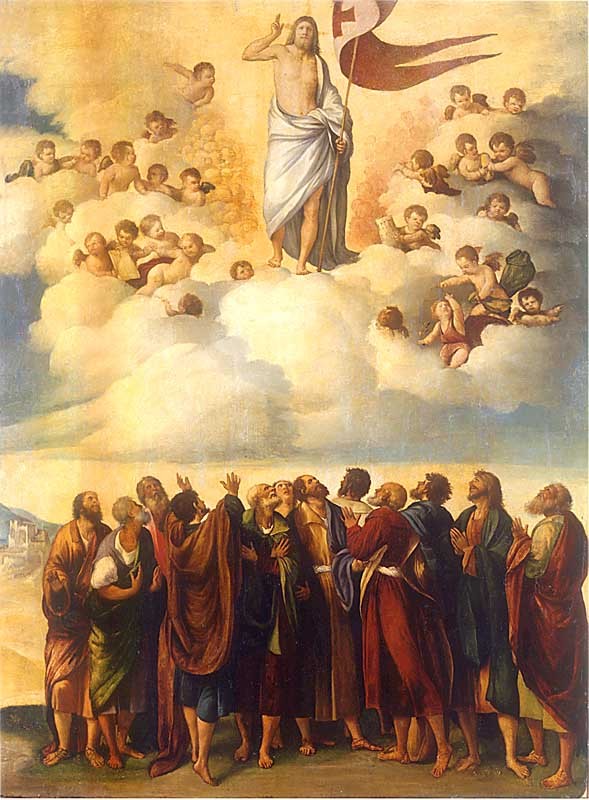
(Attribution Giorgio Vasari ~ 1520 The Ascension, Dosso Dossi)
After eating with the Apostles, Jesus Christ told His followers they would be baptized with the Holy Spirit, so they could go “to the uttermost part of the Earth” to evangelize. Then He rose into the sky and passed into Heaven.
Now the fabric of spacetime does not remain static over time. The Universe that we know must evolve by either expanding or contracting. Observationally, the evidence that our Universe is expanding is overwhelming.
Today, the most distant objects we can see are more than 30 billion light-years away, although only 13.8 billion years have passed since the Big Bang.
If we consider Special Relativity, and length contraction, and time dilation of an object traveling close to the speed of light, how long would Jesus take to reach the end of the Universe?
The speed of light is a constant for all observers, no matter what their speed. So, if Jesus was moving at speed v equal to 0.9 times the speed of light, c distances would be shortened by a factor equal to 1/Sqrt( 1 – 0.92 ) = 2.29.
And it would take 25,000 years only to get to the closest galaxy if He traveled at the full speed of light. That’s the amount of time it would get for the Christians living in our world to witness it. From the perspective of the messiah moving at the speed of light, it would appear to take a different time at all. That’s not because of a miracle but for relativistic “time dilation.”
So as far as we know, Jesus didn’t get anywhere near to the truth of the Universe.
Like many of us.


Ancient cosmology is an old and and abiding interest of mine and this thread raises an important issue. Just what is the view of the universe that we find in the New Testament? I had an opportunity to actually ask Prof Ehrman about this a couple years ago and his opinion is that the writers of the NT would have been educated in and aware of the pervading view of the Greeks that the earth was a sphere. But…I’m not so sure. When Jesus is tempted by Satan he is taken up on a high mountain and views all the kingdoms of the world. How would that be possible if you didn’t have some idea that the world was flat? In this example of the Ascension Jesus physically rises up into the clouds because in the very ancient three tired view of the cosmos Heaven is literally UP. Paul famously describes being lifted up into the Third Heaven. This is usually interpreted through the lens of Greek conceptions where there were as many as Seven Heavens. But in the venerable three tiered flat earth cosmology the first heaven is the sky. The second heaven is the realm of the stars and planets, thought to be living creatures. The third heaven is the realm of God and the angels.
One other thing to remember is that although the Greeks viewed the earth as a sphere as far back as the third century b.c.e., the Book of Enoch, portions of which were written about the same time, definitely evinces the older primordial viewpoint. And the apocalypticism of the NT is heavily influenced by the Book of Enoch, quoted even. I submit that it’s likely that the reactionary tendencies of apocalyptic thought held on, at least metaphorically and poetically, to the older view.
You should agree that reality is either complex and contradictory.
People still believe that the earth is flat, and we live in a society where information and public education have been enforced into our throats. Recent studies have shown that people who do not follow every reasonable practice, like wearing a mask, watch a satellite picture, and so on, have a cognitive bias. They cannot retain information in what is called the short memory part of the brain.
I don’t see why in the First Century, people should have had a homogenous view of the world. But if we look at the text, two thoughts arise.
The first is that if we had a poetic stand then precision would not be the point. If the Devil took Jesus up on the higher mountain, he could not have to say: I’m giving you power on this part of the hemisphere. From a poetic point of view, the sentence in the NT works better.
“Again, the Devil taketh him up into an
exceeding high mountain, and sheweth him all
the kingdoms of the world, and the glory of them”
Second, as many observed, and I commented before, the Devil could have shown Jesus a flat map on paper or parchment.
In that case, a question arises: what kind of projection did he use? Since the Devil is deceptive, I think he used a Mercator projection. That, as you know, by construction, it is perfectly accurate, k = 1, along the equator and nowhere else. Close to the pole the accuracy changes. “At a latitude of ±25° the value of sec φ is about 1.1 and therefore the projection may be deemed accurate to within 10% in a strip of width 50° centered on the equator.”
BDEhrman
FreedomBen
evgendob
Robert
1 Guest(s)