
Here now is the final installment of James McGrath’s series of posts on his book, in which he shows how the kind of knowledge experts on the New Testament have can affect those who are questioning their faith or have left the faith, which people these days often refer to as “deconstruction.” This issue of deconstruction is the topic of another now-forthcoming book of his that will be appearing soon. Here is what he has to say about it.
******************************
There is a natural connection between the first book I wrote that was published by Eerdmans, The A to Z of the New Testament, and the most recent, Beyond Deconstruction, due out in early February. The term “deconstruction” has become the popular term for what happens when you start taking a close look at elements of your worldview, especially as a Christian, and find that there are elements of it that you can no longer subscribe to. For some it is a thoughtful investigation and careful selective replacement of beliefs and values. For others, it is a traumatic experience of the whole thing coming crashing down as piece after piece is removed and discarded.
You like this post? It's free! However, you'll need to be a blog member to read most articles here. Get access to Dr. Ehrman's library of 4,000+ articles plus five new articles per week. Membership starts at $2.99/mth and every cent goes to charity!
Unlock 4,000+ Articles Like This!

This experience might be called the “dejengafication” of one’s faith or worldview, but calling it that might get you sued. Jenga means “build” in Swahili. Eerdmans wanted the book to feature the word “deconstruction” in the title so as to connect with those for whom that term is meaningful, but my original working title was Reconstructing Your Faith. The positive imperative is the heart of the book’s message. Jenga! Build! Don’t just tear down.
The experience that nowadays is labeled “deconstruction” is one that is familiar to academics who study the Bible. Many of us got into this line of work because of our faith and the role the Bible played in it. Imagine our shock when the very act of studying the Bible forced us to rethink the things that we had been told about the Bible in our faith communities!
What this means is that biblical scholars have been doing the “deconstruction” thing for as long as there has been academic biblical scholarship.
In the wake of deconstruction, people often define themselves over against what they used to believe, whether as agnostic, atheist, or “not that sort of Christian.”
The book reflects my own journey of trying to articulate my worldview, my values, and my beliefs in a positive way.
A book that was particularly helpful on my journey was Keith Ward’s What The Bible Really Teaches. At the point in my life that I read it, I was at the phase of saying things like “I’m still a Christian even though I don’t subscribe to inerrancy.” Ward’s book convinced me to stop apologizing. It made unambiguously clear something that I ought to have figured out by that stage. I was never a “Bible-believing Christian” who accepted the biblical texts as inerrant. No one is. Whenever someone who subscribes to the doctrine of biblical inerrancy encounters something that is clearly an error if it means what it says, you know what they do. They insist that the text doesn’t mean what it says! That’s not inerrancy.
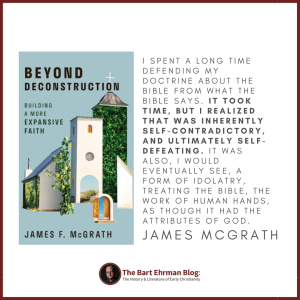
It is also not accepting the Bible as the ultimate authority. I spent a long time defending my doctrine about the Bible from what the Bible says. It took time, but I realized that was inherently self-contradictory, and ultimately self-defeating. It was also, I would eventually see, a form of idolatry, treating the Bible, the work of human hands, as though it had the attributes of God.
Marketing churches and individuals as “Bible-believing” is thus one of the most effective false advertising campaigns in history! I bristle every time I hear someone talk about “biblical literalists” as opposed to people who claim to be literalists but in fact pick and choose in precisely the way they accuse others of doing.
My writing of The A to Z of the New Testament and my writing of Beyond Deconstruction both reflect my conviction that people in churches should not treat biblical scholarship, and simply being honest about the Bible, as at odds with Christian faith. It only seems that way because there are people who have turned the Bible into an idol. Human beings instinctively desire certainty. Close examination of reality challenges that. The false claim that God has provided a book that offers absolute certainty is a sinister temptation away from the very things the texts in the book emphasize, such as “trust in Yahweh with all your heart and lean not on your own understanding.” In fundamentalism, that gets twisted into “trust in the book with all your heart, and then you can claim that your own understanding of that book is in fact what God says.”
I understand the meaning of the divine speech at the end of the Book of Job to be making a similar point. Norman Habel’s commentary emphasizes that the Book of Job, as wisdom literature, belongs to a genre that doesn’t appeal to divine revelation. It shouldn’t have a theophany, an appearance of God. So what is going on? Habel suggests that the author is engaging in irony. The author has God show up and talk about the weather, and other things that people can observe. At that time, things like snow were inexplicable. Today we understand them, but the universe shows no sign of running out of mysteries. Yet then as now, as human beings we arrogantly think we have a handle on it all and can declare its meaning.
The divine speech in Job also mentions the birthing of deer and the feeding of young lions. What do lions eat? The deer, among other things. How did people ever look at the world and claim that everything works in a nice neat fashion, so that only the wicked suffer? The Book of Job is ultimately about the limits of the wisdom tradition, and the limits of human wisdom itself.
The book ends with God praising Job for speaking rightly about him, unlike Job’s friends, with whom God is said to be angry. What did Job’s friends do? Defend their theology (imagining that in doing so they were defending God). What did Job do? Complain a lot, and insist that the theology he used to hold was disproven by experience. The Book of Job insists that God prefers the latter to the former.
Studying the Bible, working through a process of deconstruction if studying the Bible challenges things that we were told about the Bible, should ultimately all be positive things if we approach them in the right way. Whereas fundamentalism praises the Bible while silencing many of its voices, honest reading of the Bible provides example after example of people wrestling with reality and figuring out what values and beliefs make sense in light of it. Both of my recent books, The A to Z of the New Testament and Beyond Deconstruction, are invitations to engage with these ancient texts and with our current understanding of the world in a way that is humble and honest, and that leaves room for mystery and poetry, for agnosticism but also conviction.
We have two goals at Ehrman Blog. One is to increase your knowledge of the New Testament and early Christianity. The other is to raise money for charity! In fact, in 2022, we raised over $360,000 for the charities below.
You must be logged in to post a comment.Over $2 Million Donated to Charity!





Share Bart’s Post on These Platforms
16 Comments
Leave A Comment
Way off-topic: You have said that “Truly I tell you, today you will be with me in Paradise” cannot be translated as “Truly I tell you today, [eventually] you will be with me in Paradise,” because the Greek does not allow that meaning. Assuming Jesus actually said those words, he would have spoken in Aramaic. Would Aramaic grammar allow the alternate translation?
Thanks.
Great question. I’m not sure where I said that, but I may have. Unless one wants to deal with hypothetical reconstructions into Galilean Aramaic, the best guide is the Syriac translations. There it is even clearer than in Greek, the meaning of the words being in essence “I say to you that today you will be with me in paradise.”
Taking a cue from Sissela Bok’s “Lying” (pages 6, 7), I came to realize that generally speaking, those who claim the Bible to be inerrant tend to impute inerrancy to their interpretation of it. In our salad days, we trusted our beloved spiritual mentors only to find out later they were wrong in many ways. Now, as older and wiser adults, we’re confronted with the question of whether to remodel the house (like Pete Enns) or tear it down and start over (like Bart or Paul Ens).
Thank you for a fascinating series of posts Dr McGrath. I’ll certainly check out your book, which sounds right ‘up my street.’
Much of what you said struck a chord with me as I act as an amateur ‘historical consultant’ to a (sort of) Bible study zoom group (we’re all VERY liberal/progressive Roman Catholics). My expertise is in Greek and Roman history so most of my NT knowledge comes from Bart’s blog and books. Anyhow, my fellow zoomers tend to be okay with most of what I tell them until it comes to the Christmas story. They like all the different aspects even though some are historically incompatible timewise (eg. Herod dying in 4 BC and Quirinius’ census in 6 AD).
Furthermore the flight to Egypt (which probably didn’t happen) underpins lots of Christmas sermons on the topic of the refugee crisis etc.
But, thanks again for some very helpful posts. Your next book also sounds like a boon to us Christians hanging on by our fingertips.
If your Zoom group decides to read one of my books together, please let me know. If the scheduling can be made to work, I’d be happy to make a guest appearance!
Thank you, Dr McGrath. I appreciate the offer and will bear it in mind. Your book’s on order. Happy New Year
Prof McGrath, sorry, waaay off topic.
I’ve been following and enjoying your writings about the Mandaeans over the years. I recently stumbled on an older post of yours (Musical Hell) at your site describing an honors thesis you were supervising about Mandaean views of music. Did any published material ever come out of this? I am a non-specialist totally fascinated by the Mandaeans.
Thanks!
It hasn’t been published, but I will be trying to return to that project and perhaps create something that the author of the thesis and I can consider to be jointly authored.
Thanks for your series of posts Dr. McGrath! I’m very eager to read your forthcoming book emphasizing reconstructing faith once scholarship has taken the blinders off. I really want to remain true to my faith, but sometimes it’s hard to see what’s left to hang onto. I’m sadly starting to feel like a closet humanist, perhaps not sincerely Christian anymore.
Well, there is such a thing as Christian humanism, and so it may not be necessary to remain in a closet about any part of your worldview. I hope you find the book helpful. Please, please let me know whether you do, and if you have follow up questions, I’m easy to connect with on social media or via email.
I have not read your books, but will. I have read Ward’s book. I applaud you advocating to be real about what the books of the OT and NT REALLY say. However, to me we must accept the truth that is all-encompassing across cosmological physics, evolution of life on earth, geology and plate tectonics, etc. Regarding human evolution, a very recent documentary series ‘Human’ by PBS and Ella Al-Shamahi is quite convincing that humans evolved and spread across the earth. No supernatural explanation involved.
Limited space restricts a full bibliography but I recommend Martin Hengel’s Crucifixion, 1970, to counter any support that Jesus was buried and resurrected.
Let’s be honest about what ALL THE EVIDENCE on the earth and the cosmos indicates.
While this is a counter post, I wish you all the best. We are all humans riding the surface of this third rock from the sun. No reason we can’t get along or be nice to each other.
I don’t disagree with anything you wrote and likewise recommend the same, honesty about all evidence.
On the burial of Jesus, I have a little book on the topic. I’m not dogmatic about the possibility that Jesus was denied burial. However (and see also Bart’s post on the topic here on the blog) two things sway me to consider it likely that he was, to which I’ll then add a third. First, Josephus explicitly mentions the importance of burial before sundown, something mentioned in other Jewish literature, and explicitly says that they bury even those who have been crucified. Second, there were uproars about violations of major Jewish sensibilities in this era and they left evidence in our sources. I would expect to see something similar if the Romans regularly prohibited burial in Judaea and especially in the vicinity of Jerusalem where the temple was. Given that, the fact that Jesus’ burial is mentioned in passing by Paul as something he simply assumes also carries some weight.
So can you explain how believing in supernatural beings can be supported? Is not that your position, i.e. that you can still have faith in Jesus and his resurrection?
Regarding Jesus’ burial. Josephus states a lot of things that are bogus. Trick is to determine what is corroborated by other evidence. Perhaps when Jews crucified other Jews the crucified were buried before sundown but that was not the Roman practice. The gospels are clear that the Romans crucified Jesus.
Also, I wouldn’t give any credence to Paul’s passing statement. He didn’t know Jesus nor was present at Jesus’ crucifixion. Most likely he heard of the crucifixion and burial by those who believed that is what happened. Your statement ‘…also carries some weight.’ seems to be the exact type of assumption and extrapolation opposed by your theme of being honest about what the bible really says.
I got kicked out of my church for questioning the bible.
Reading this post is like a breath of fresh air.
So sorry to hear that. I you haven’t already, I hope you find a community, formal or informal, that can provide encouragement, support, and challenges as you and they and we all proceed on our journeys!
Dr McGrath, I thank you for writing this book. It really helped me find the way of my spirituality after I lost it. I was once a Christian who belonged to the evangelical fundamentalists’ group. I just kept having questions about the Bible translations and interpretations, being a professional translator/interpreter in the business field. I noticed that there is much room for errors and inaccuracies of the Bible translations we read as “inerrant” today. I also had questions on various doctrines and then people’s behaviors that come from believing these doctrines. I have been a follower of Bart since the first printing of his “Misquoting Jesus” book, for all these years. I finally deconstructed about three years ago. For a while I didn’t know that is what I was going through. I came here and found out about your book. The sense of loss of my spirituality was traumatic at that time. But I see now that it can turn into a positive life experience. I totally understand Bart’s choice and I have a tremendous respect to him. At this time, having read your book, I am keeping my Christian faith that has evolved into something much bigger.