Sorting by

×

Should You Say It Like You Mean It? Those Inoffensive Critical Scholars…

Yesterday I was listening to my weekly Misquoting Jesus Podcast (I do that each week to make sure I didn’t make any egregious mistakes in the interview) (I did make a couple, as usual, but so it goes…) and was struck by how, at the end, I described the topic for our next podcast:  why “Luke has gotten rid of the idea that ‘Jesus died for your sins.’” I had forgotten I put it that way, and when I heard it said out loud, head-on and clear-as-day, I realized I had never heard anyone put it that way before. And that struck me as interesting – especially because it is what most of my classmates in my PhD program at Princeton Seminary also were taught and thought but they never said/say it this way. What did/do they say instead?  The said/say what we learned from our teachers, a far more innocuous way of putting it:  “Luke doesn’t have a theology of the cross.” What that means (as my peers and teachers knew) is [...]

2026-02-22T17:59:55-05:00February 17th, 2026|Canonical Gospels, History of Biblical Scholarship|

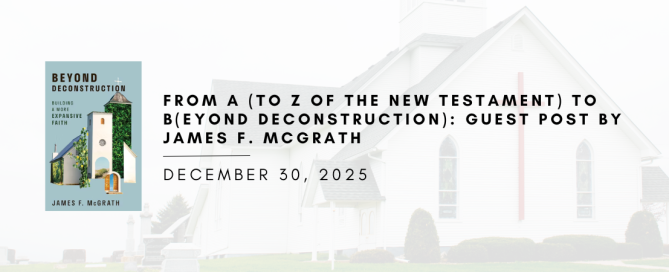
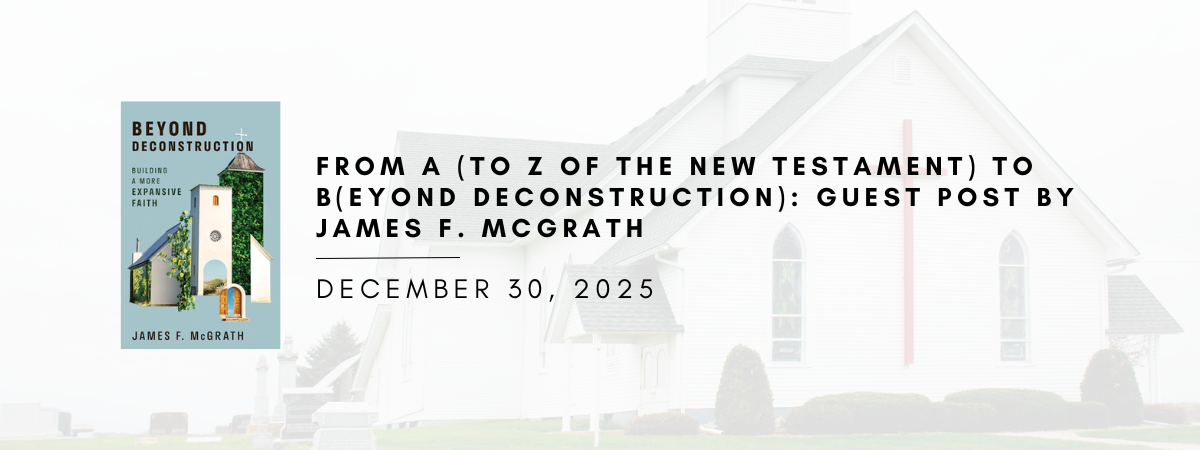
From A (to Z of the New Testament) to B(eyond Deconstruction): Guest Post by James F. McGrath

Here now is the final installment of James McGrath's series of posts on his book, in which he shows how the kind of knowledge experts on the New Testament have can affect those who are questioning their faith or have left the faith, which people these days often refer to as "deconstruction."  This issue of deconstruction is the topic of another now-forthcoming book of his that will be appearing soon.  Here is what he has to say about it. ****************************** There is a natural connection between the first book I wrote that was published by Eerdmans, The A to Z of the New Testament, and the most recent, Beyond Deconstruction, due out in early February. The term “deconstruction” has become the popular term for what happens when you start taking a close look at elements of your worldview, especially as a Christian, and find that there are elements of it that you can no longer subscribe to. For some it is a thoughtful investigation and careful selective replacement of beliefs and values. For others, it [...]

2025-12-29T21:23:58-05:00December 30th, 2025|History of Biblical Scholarship|

Alphabet Soup of the New Testament: Guest Post by James F. McGrath

Here now is the second guest post of James McGrath on his book that provides an introduction to New Testament scholarship for people who are not, will not be, and possibly never would dream of being New Testament scholars.  The full title and subtitle give a great sense of what it is all about:  The A to Z of the New Testament: Things Experts Know That Everyone Else Should Too. Here now is his fuller explanation. ****************************** For much of the time that I was working on The A to Z of the New Testament, the title was The ABCs of New Testament Study. I envisaged the cover having children’s blocks on it, or perhaps the title of the book spelled in alphabet soup. The folks at Eerdmans wisely went in a different direction with the cover. It was after running drafts of chapters by a couple of ministers at my church, each telling me that they learned things from it, that it became clear that I was doing more than just [...]

2026-01-02T09:52:50-05:00December 28th, 2025|History of Biblical Scholarship|

The A-Z of the New Testament: Guest Post by James McGrath

Bart:  I often get asked if there is some kind of simple guide to what scholars say about the New Testament, something that is competent, by an expert, but expressly for lay folk who want to know the most important findings of scholarship.  A couple of years ago James McGrath published a book that is just that kind of thing, and I realized, it's "bloody well time" (as they say in England) for us to have some posts about it.  James has kindly agreed to provide them. James is the Clarence L. Goodwin Chair in New Testament Language and Literature at Butler University, and occasional guest-poster on the blog.   Here is his first post of three. ****************************** Among the things that Bart Ehrman and I share in common is that we both care deeply about informing a general public about biblical scholarship. About 10 years ago, around the same time that his blog was really taking off, I was getting into my groove making silly parody song videos, often [...]

2026-01-02T09:52:10-05:00December 27th, 2025|History of Biblical Scholarship|

Problems with the Gospels: A Primer for the Study of the Historical Jesus (Part 2)

This now is the second part of the Primer on the Historical Jesus prepared by Marko Marina, which deals head on with the hardest question of all: how do scholars deal with the Gospels of the New Testament "critically" (not "criticizing" them but providing an honest assessment of their historical value) Marko provides a very clear summary and set of insights, as you'll see: To Begin With For me as a historian, it’s self-evident that no narrative source from the ancient world can be taken at face value. All texts reflect the perspectives, interests, and cultural assumptions of their authors -- even ones that are discussing historical events.  This is all the more true for writings that come from a time and place so distant from our own. When we turn to the canonical Gospels from a historical perspective, we must therefore be prepared to recognize both their immense value and their serious limitations. Canonical Gospels and Their Historical Value  On the side of value, the Gospels remain our earliest extended narratives [...]

Can We Trust You When You Say “Most Scholars” Think Something?

As I've pointed out, most critical scholars do not think that Paul actually wrote the letter to the Ephesians, even though the author claims to be Paul.  We will see that is true for five other Pauline letters.  I should stress: the fact that most critical scholars think something does not mean they are right.  For millenia, "most scientists" agreed the sun revolved around the earth, but that was not evidence.  Apart from whether scholarly views are right, why should you think that I myself am right when I say "most critical scholars" think one thing or another?  Have I taken a survey? I dealt with a similar question on the blog years ago.  This was in response to my similar claim that "most scholars" don't think John the son of Zebedee wrote the Gospel of John.  It was in response to a reader's question and follow up.  I'd say pretty much the same thing today, about Ephesians.  Here's what I said back then: ****************************** I have received a particularly interesting question that has led to a [...]

2025-09-10T13:11:44-04:00May 3rd, 2025|Bart's Critics, History of Biblical Scholarship|

The Jesus Seminar and the Non-Apocalyptic Jesus. Hey, Why Not?

I have recently received several questions more or  less out of the blue about what I think about the “Jesus Seminar” and its views of Jesus.  I looked and it appears I’ve only had one brief posting on this issue, so I thought I should say a few things, first by explaining what the question means. The Seminar was made up of a group of about fifty New Testament scholars who, in the 1980s and 1990s, met twice a year to discuss the ancient Gospels (mainly the canonical Gospels and the Gospel of Thomas) to determine which traditions about Jesus were likely to be authentic, and which, as a corollary, were likely to have been later creations of the early church as they told stories about Jesus. The members of the seminar would then vote on each tradition – after extensive, learned discussion -- and publish the results of their votes. The voting procedure proved to be controversial. The Seminar’s original raison d’être was to establish what Jesus actually said, and so they [...]

How to Sugarcoat Scripture but Seem Sophisticated. Final Guest Post by Jill Hicks-Keeton

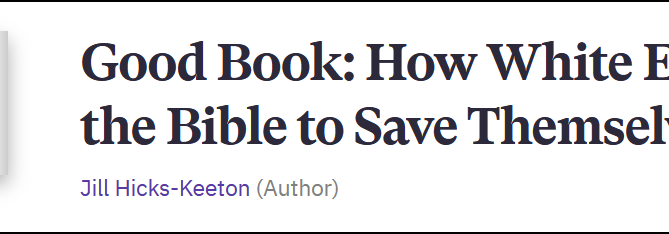
It's amazing how committed New Testament scholars often try to tame the Bible, making it upbeat and relevant for today when, on the surface, it affirms views that most of us, when we're honest about it, simply can't abide.  And not just the Old Testament celebration of slaughter (those damn Canaanites) and execution (for, say, disobeying parents) but also the New Testament (and not just the grotesque torture and annihilations of Revelation).  Jill Hicks-Keeton, professor of Religious Studies at Oklahoma, deals with how evangelical Christians (one could pick other groups!) try to whitewash the Bible in her book Good Book: How White Evangelicals Save the Bible to Save Themselves.   This now is Jill's third and final guest post for us on the topic. Once again, she names names. Any comments?  Bring 'em on! ****************************** The ancient people who wrote the texts that would become “the Bible” lived in patriarchal societies. Modern Bible readers who see these texts as scriptural and who also deem patriarchy an undesirable way to order society have a problem to solve: [...]

How To Make the New Testament Non-Patriarchal. Good Luck with *That* One. Guest post by Jill Hicks-Keeton

I'm very pleased to post this second contribution by Jill Hicks-Keeton, professor of religious studies at the University of Oklahoma, and an author who does not appreciate "experts" who try to explain away the problems of the Bible (e.g., with respect to women) and sees no need to pull her punches!  This is an unusually effective and interesting instance; here she reveals the the flaws of a recent attempt by a  New Testament scholar to make Paul patriarchally palatable.  She names names. The post is an adaptation from her recently published Good Book: How White Evangelicals Save the Bible to Save Themselves.  ****************************** In my last post, I introduced the concept of Bible benevolence, which is the rhetorical and intellectual work that people do to make ancient texts in the Bible square with modern moral sensibilities. The Bible is not good by itself. People have to make it so. My recent book, Good Book: How White Evangelicals Save the Bible to Save Themselves, uses white evangelical Protestants in the U.S. as a case study to illustrate [...]

Making the Bible Benevolent: Guest Post by Jill Hicks-Keeton

Is the Bible "Good News" for everyone, or, does it just seem good to those who want it to be? And how do readers make it good in places that on any honest reading are not (think violence and the treatment of women and slaves).  Jill Hicks-Keeton, Associate Professor of Religious Studies at the University of Sourthern California, has recently published an intriguing book that is highly controversial in some circles (those who do what she describes) and a breath of fresh air in another, an analysis of how evangelical Christians work to make the Bible not just acceptable but good through and through.  Her study is called The Good Book: How White Evangelicals Save the Bible To Save Themselves.  (Available here:  Good Book: How White Evangelicals Save the Bible to Save Themselves: Hicks-Keeton, Jill: 9781506485850: Amazon.com: Books) I've asked Jill to talk about the book in a couple of posts on the blog.  Here's the first, with a teaser for the second! ****************************** Millions of Americans report understanding the Bible as the Word of [...]

Putting Final Polish on a Bible Translation. Ouch.

In my previous post I mentioned how I started a full-time research position for the New Revised Standard Version in 1987-88.  I had several roles to play in that position.  Probably the most difficult involved trying to make sure that there was a consistency in the translation, from one biblical book, passage, and verse to another. How does one determine if a translation is internally consistent?  It’s not easy.  I had to work through the entire translation, and whenever I came across a key term in the Hebrew or Greek that had been rendered into English in one way in one passage, I had to check whether it was rendered similarly in other passages where the same word occurred. I should stress that the translators were absolutely not bound and determined to translate the same Hebrew (or Greek) word the same way every time it appeared in the Bible.  In some contexts a word will be better translated one way, in others another.  But they at least had to be aware of the [...]

A Sensible Approach to Inclusive Language in Bible Translation?

The policy of the NRSV translation committee on inclusive language, as I began to discuss in the preceding post, was sensible, in my view.  It involved a three-pronged approach. Any passage that was referring to both men and women was to be rendered inclusively, even if the original language (Hebrew or Greek) used masculine terms (“men,” “man,” “brothers,” “he” etc.). Any passage that was explicitly referring only to men, or only to women, was to be left as referring only to men or to women. All references to the Deity that in the original used masculine terms were to be left masculine. Here I will say a few things about each of these policies, in reverse order.  First, the deity.  No one on the committee thought that the deity actually has male genitalia or other sexual distinctions.  But changing every reference to God (a masculine term, since there is a feminine alternative: Goddess) or Lord (again, a feminine alternative: Lady) or … anything else, would be hugely cumbersome and distracting.  And there are not literarily [...]

Should Bible Translations Be Gender-Neutral?

More of my reflections from years ago about working with the New Revised Standard Version translation committee in the early 1980s.  (With  a few updates in brackets [ ]) One of the problems the committee had to address involved the use of gender-inclusive language.  Part of the problem was that this issue was not a generally recognized issue (by the wider reading public) when the translators began their work, but was very much an issue when they were already finished with a large chunk of it.  [And oh boy is it a big issue now...]  The translators were mainly senior scholars who had acquired their linguistic skills before virtually anyone in the academy knew (or at least said) that there even was a problem with inclusivity, and so they themselves were learning how to communicate in the new idiom.  And it took a while before they figured out how exactly to handle it. I myself was first introduced to the problem when I entered graduate school, and like a lot of people from my generation [...]

2025-09-10T13:05:42-04:00December 31st, 2023|History of Biblical Scholarship|

Problems with Translating a Single Greek WORD

In my last post I began to talk about my involvement with the translation committee for the New Revised Standard Version.  My Doktorvater, Bruce Metzger, was the chair of the committee and he asked me, during my graduate studies, to be one of the scribes for the Old Testament subcommittee.  In that capacity I recorded all the votes that were taken by the translators for revisions of the text of the Revised Standard Version, in whichever subsection of the committee I was assigned to.  Normally the subsection would have, maybe, five scholars on it.  They would debate how to modify the text of the RSV, verse by verse, word by word; they would then take a vote by show of hands; and I would record their decision. This was an eye-opening experience for me.  Bible translation (or the translation of any foreign-language work, for that matter) is an inordinately complicated procedure.  It is impossible to replicate the exact meaning of one language in another, since the nuances of words vary from one language to another.  [...]

2025-09-10T13:05:42-04:00December 30th, 2023|History of Biblical Scholarship|

How Do You Translate the Bible? My Work for the New Revised Standard Version Committee

About two or three times a month I get asked about translations of the Bible.  Usually the questions are about which one I prefer (answer: The New Revised Standard Version, i.e. the NRSV, and also an annotated edition, such as the Harper Collins Study Bible, which gives brief introductions to each of the biblical books and notes at the bottom of the page for difficulty passages, a kind of mini-commentary).  But sometimes a questioner wants to know about the process of biblical translation and what it entails. I've been interested in this question for, well, roughly 50 years, but my interest reached a peak in the early 1980s when, as a lowly graduate student, I got invited to be a secretarial assistant for the committee producing the NRSV.  Years ago on the blog I talked about that over a series of posts, both what the translation entailed, what problems it (and every other translation committee or individual scholar) had to confront, what I did for the committee over the years, etc. (For the first post [...]

How the Canon Itself Tames the Diversity of the New Testament

The writings of the New Testament do not provide good evidence that Christianity started out as an original unity, only to come to be fragmented with the passage of time into the second and third Christian centuries -- so I argued in the previous post.  Quite the contrary.  And yet having them all in the same book (between covers) does seem to readers to suggest an overarching unity.  That's what I want to talk about here. For the most part, the books of the NT are the earliest Christian writings we have, and most of the books can probably be dated to the first Christian century.  Probably not 2 Peter.  Possibly not Acts.  But the others?  Probably.  Only a couple of other Christian books are to be dated this early.  None of the other Gospels (including the Gospel of Thomas, I would say).  But 1 Clement, is usually dated to the mid 90s CE and the Didache in its final form may be from around 100 CE (they are both in the collection known as [...]

2025-09-10T13:05:27-04:00November 22nd, 2023|History of Biblical Scholarship|

Wasn’t Early Christianity Basically Unified? Why Fret About Occasional Diversity?

I have spent three posts talking about the terms “orthodoxy” and “heresy” and why they are problematic; in doing so I have been explaining both the traditional view of the relationship of orthodoxy and heresy (as found, for example, in the writings of Eusebius) and the view set forth, in opposition, by Walter Bauer.   So, where do we now stand on the issue, some 90 years after Bauer’s intervention? As I indicated in my last post, there are some problems with Bauer’s analysis, but also much positive to say about it.   Conservative scholars continue to hold to a more traditional view (e.g., conservative Roman Catholic and evangelical scholars); others find it *basically* convincing, even if they would write the details up very differently from Bauer. I am very much, and rather enthusiastically, in this latter camp.  It was when I was in graduate school, as a committed evangelical myself, but as one who was moving away from my conservativism based on my detailed research into the New Testament and the history of the early Christian [...]

Are There Really Good Reasons to Doubt the Story of the Discovery of the Gnostic Gospels? My Response to Mark Goodacre

A couple of days ago we enjoyed a guest post on the blog by Mark Goodacre, Professor of New Testament at Duke University.  In this post Mark provided five reasons for doubting if the story of the discovery of the Nag Hammadi Library – as that story has been recounted by scholars for many years – is in fact accurate.  Mark’s post was a summary of a longer, more detailed, and scholarly article that he has published on the subject. In 2015, when I first discussed this issue on the blog, I asked Mark’s permission to respond to his five points, and he gladly agreed; I in turn agreed to let him respond to my responses.   Rather than asking you to reread his post, I have reproduced each of his five reasons here, and then dealt with them one at a time. Let me say that I really don’t have a horse in this race, and my sense is that Mark doesn’t either.  We would both love to be able to keep telling the story, [...]

2025-09-10T13:05:01-04:00October 22nd, 2023|Christian Apocrypha, History of Biblical Scholarship|

Why We Might Doubt the Story of the Discovery of the Gnostic Gospels: Guest post by Mark Goodacre

A few days ago I posted about the Discovery of the Nag Hammadi Library, giving the remarkable story that scholars -- for as long as I myself have been a scholar -- have been telling about how it happened.  I also mentioned that my New Testament colleague at Duke, Mark Goodacre – who is on this blog and who has an important blog of his own – has written an article calling this story into question. Years ago when I was discussing this matter on the blog, I asked Mark if he would be willing to summarize his objections to the story as it is typically recited, and he did so in the following post.   He's asked me to add a couple of links at the end in case you want to look more deeply into the matter. ****************************** Five Reasons to Question the Story of the Nag Hammadi Discovery  I am grateful to my friend and colleague Bart Ehrman for mentioning me in his blog in connection with the fascinating and compelling story of [...]

2025-09-10T13:05:01-04:00October 21st, 2023|Christian Apocrypha, History of Biblical Scholarship|

What Is Actually In the Nag Hammadi Library?

For near fifty years now the "books that did not make it into the New Testament" have been a source of fascination, not just for scholars but for regular ol' folk intrigued by the idea that there may have been alternative forms of Christianity, a wide range of seemingly bizarre beliefs and practices out there in the early centuries of the church. In my previous post I gave the standard tale of how the most significant discovery of such books occurred in 1945 somewhere near the village of Nag Hammadi Egypt (and therefore called the Nag Hammadi library).  The story I told has fallen into some disrepute over the past decade, for reasons we'll see in the next post.  Before dealing with that issue, however,  it's important to see what this library/collection of books actually is.  Here is how I describe it in my textbook, The New Testament: A Historical Introduction to the Early Christian Writings (Oxford University Press).  ****************************** What was this ancient collection of books?  The short answer is that it is the [...]

2025-09-10T13:05:01-04:00October 19th, 2023|Christian Apocrypha, History of Biblical Scholarship|
Go to Top