
Search
Advanced search
Christian Churches Steadfastly Refusing To Help Those in Need….
Here is an article that I wrote to connect my forthcoming book (Love thy Stranger) to an intriguing news event a couple of months ago. I had thought about publishing in a journal but, well, never did. So here it is, just for you Blog Members! ****************************** Jesus introduced a new kind of altruism into the world, and it is fading before our very eyes. This has been graphically illustrated by a recent TikTok sensation. A woman from Kentucky, Nakalie Monroe, had the inspired idea of testing the moral commitments of communities of faith. She recorded phone calls to over forty churches of various denominations, asking if they could help her starving baby. All she needed was a can of formula. This was a scam: there wasn’t actually a baby; but an infant screaming (from a recording) could be heard loud and clear in the background. The great majority of churches
January 15, 2026
Important Questions About Matthew and Paul
Here are some intriguing questions I have received about Matthew and Paul, with my best attempt at brief responses. QUESTION: I’ve been debating my adult son on the tie between Jeremiah 7:11 (NRSV: “Has this house , which is called by my name, become a den of robbers in your sight?”) and what Jesus said in the gospels, (Matthew 21:11: “It is written: ‘My house shall be called a house of prayer; but you are making it a den of robbers’”) which are translated to robbers or thieves (depending on the translation). Is there a consensus among scholars on what the term used in the original Hebrew of Jer 7:11 meant prior to the later translations into Greek (lestes) and English (robbers)? Also Is there any other verse in the Hebrew Bible where that term was used for a comparative analysis of meaning? Thank you for your insight. RESPONSE: The Hebrew uses a kind of unusual word that means something like “person of violence,” which can be used of a murderer or robber, so […]
January 20, 2026
Why Did Early Christians Want a New Canon of Scripture?
In previous posts I discussed how we got the canon of the Hebrew Bible/Old Testament. I now will discuss the formation of the New Testament canon. Why these 27 books? Who decided? When? On what grounds? This will be the focus of my next book, which I am beginning to read and think seriously about. The following is the basic overview that I provide in my book The Bible: A Historical and Literary Introduction 2nd ed (Oxford University Press). This will take two posts. ****************************** We are much better informed about the formation of the canon of the New Testament (than for the OT), in no small part because we have the writings of later church fathers who explicitly discuss the matter. We do not have nearly as much information as we would like—as is true for almost every set of historical events from the ancient world—but we have enough to give us a good idea of what motivated Christians to come up with a list of canonical books, what criteria they followed in deciding […]
January 21, 2026
How and When Did Christians Decide What Should Be in the New Testament Canon?
In my post yesterday I discussed the factors that motivated Christians to come up with a canon of the New Testament. Now I can talk about how they decided which books should belong and how the process played itself out as leaders debated the issues over time. ****************************** The Criteria Used The “orthodox” church fathers who decided on the shape and content of the canon applied several criteria to determine whether a book should be included or not. Four criteria were especially important. A book had to go back to the very beginning of the Christian movement or it could not be accepted. If a really good and important book that was fully informed and “true” were written, say, last year, that would not be good enough for it to be part of Scripture. The canon of Scripture contained books from
January 22, 2026
Authors, Authorities, and Who Gets To Write the Bible
I provided a very brief overview of key aspects of how we got the canon of the NT (these 27 books and only these 27) in my previous two posts. Now I want to move into a deeper look found in my book Lost Christianities: The Battles for Scripture and the Faiths We Never Knew (Oxford University Press, 2003). This was the second trade-book (for general audiences) I wrote, and it is the one that launched my career writing books for non-experts. The book is about the various forms of Christianity in the first several centuries (Ebionites, Marcionites, various kinds of Gnostics, various kinds of Proto-orthodoxy, etc.) and the books they used as their authoritative sacred texts. Toward the end of the book I have a chapter on how the orthodox canon emerged out of that mess. I will be excerpting parts of the book here. This will take a few posts. ****************************** So far as we can tell, all the Christian groups of the period came to ascribe authority to some written texts; and […]
January 24, 2026
Why Was the Canon Still Up For Grabs in the Second Century?
Why did it take so long to decide on which books would be in the canon? I continue my reflections on the issues connected with fixing a canon of Scripture in early Christianity, drawing from excerpts of my book Lost Christianities (Oxford University Press, 2003). ****************************** It may seem odd that Christians of earlier times, while recognizing the need for authoritative texts to provide guidance for what to believe and how to live did not see the need to have a fixed number of apostolic writings, a closed canon. But in fact there is no evidence of any concerted effort anywhere in proto-orthodox Christianity (or anywhere else, for that matter) to fix a canon of Scripture in the early second century, when Christian texts were being circulated and ascribed authority. And different proto-orthodox Christians had different attitudes toward sacred texts. Let me illustrate the point
January 25, 2026
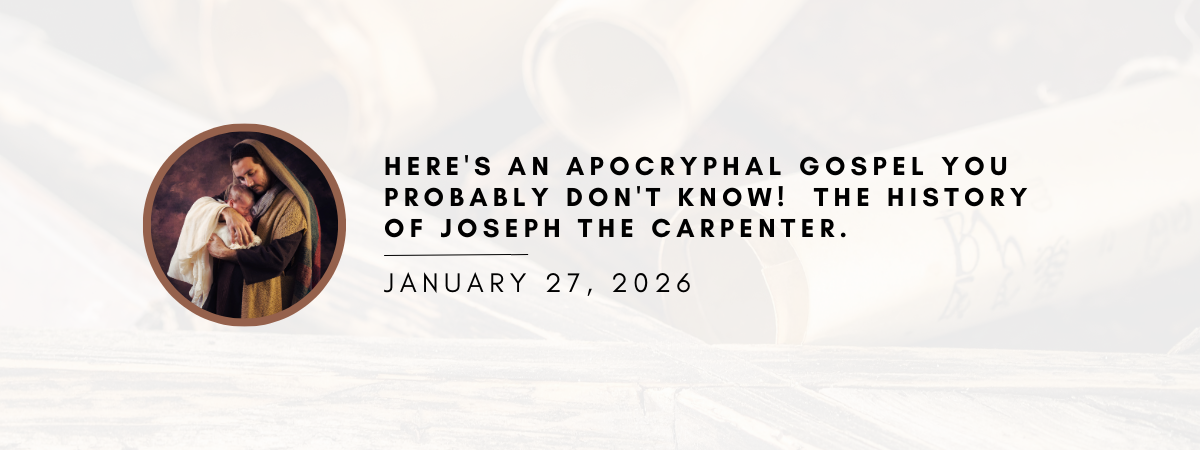
Here’s an Apocryphal Gospel You Probably Don’t Know! The History of Joseph the Carpenter.
I was recently asked by a blog reader about an intriguing but little known apocryphal Gospel called The History of Joseph the Carpenter, an account of Jesus’s (alleged) father “according to the flesh” Joseph told by Jesus himself. It’s not a widely known account in part because it is preserved only in Arabic and Coptic (no manuscripts in Greek or Latin). But it is fascinating and worth knowing about. My colleague Zlatko Plese and I included a fresh translation of it (done by Zlatko) in our book The Other Gospels: Accounts of Jesus from Outside the New Testament (Oxford University Press, 2014). Here is an explanation of it we give in an Introduction; in the next post I’ll excerpt a part of the translation. (If you’re interested in such things, check out our book; we include over forty non-canonical Gospels – either entirely preserved or in fragments – from the early centuries of Christianity) Here is a description of the book: ****************************** Like other infancy gospels, the History of Joseph the Carpenter attempts to fill […]
January 27, 2026
The Death of Joseph the Carpenter, as Told By Jesus
Here now is a translation (from the Coptic) of a section of the intriguing apocryphal Gospel, The History of Joseph the Carpenter, by my colleague Zlatko Plese, as found in our book The Other Gospels (Oxford Press, 2014). As you’ll see there are eleven chapters before this and yet more after it; for the whole thing – along with some forty other apocryphal Gospels! – check out our book. This is Jesus speaking to his disciples, in the first person. ****************************** Joseph’s Death Draws Near 12 (1) But then the death of Joseph, my father, drew near, as is appointed to all people. (2) When his body grew ill, his angel announced to him, ‘In this year you will die.’ (3) And as his soul was troubled,
January 28, 2026
When Did Paul and the Gospels Become Canonical Scripture?
There’s no way to put a precise date on the canonical process, but it is worth nothing that the formation of the canon was a long, drawn-out process. Here are some thoughts on some of the key issues of the late second century drawn again from my book Lost Christianities (Oxford University Press). ****************************** Justin Martyr of Rome was one of the most productive proto-orthodox authors of the second century (martyred around 165 CE). Still preserved are two “apologies” that he wrote – intellectual defenses of the faith against its pagan detractors – and a piece called the “Dialogue with Trypho,” in which he tries to show the superiority of Christianity over Judaism, largely by appealing to a Christian interpretation of the Jewish Scriptures. Others of his works were lost, though, including
January 29, 2026
The Muratorian Canon (The first “list” of Christian canonical books)
One of the best ways to follow the proto-orthodox line of reasoning for what to include in the canon of the new testament is to consider the earliest surviving canonical list, a fragmentary text, subject to considerable debate in recent years, that is commonly known as the Muratorian Canon. Here is what I say about it in my book Lost Christianities (Oxford University Press) ****************************** This “canon” is a list of books that its anonymous author considered to be part of the New Testament Scriptures. It is named for the eighteenth-century scholar, L. A. Muratori,. who discovered the manuscript that contains it in a library in Milan. Muratori published the manuscript in 1740, not so much to provide the world access to the documents it contained — principally treatises of several fourth- and fifth-century church fathers — but in order to show how sloppy copyists could be in the Middle Ages. In a treatise of Ambrose, for example, the scribe inadvertently copied
January 31, 2026
From Eternal Torment to Styles of Greek to the Dating of Ignatius: Interesting Readers’ Questions
QUESTION: You seem reluctant to view any of the early major figures in Christianity (Jesus, Paul, the author of Revelation) as endorsing the idea of eternal torment for the damned. Who do you think is the first figure in Christianity to endorse the idea unambiguously? RESPONSE: Yes, I try to show in my book Heaven and Hell that none of these figures subscribed to the idea of eternal torment. They talk about the ultimate punishment as “destruction” and “annihilation” rather than torture. They do call it an “eternal” punishment, but that is because it will never be reversed (not that it will be eternal conscious torment). We don’t know who first among the Christians came to the view of eternal torment; it starts finding expression at least by the time of the writing of the Martyrdom of Polycarp, which is often said to have been from around 155 CE or so, but may have been written some decades later. By the third century eternal torment was starting to become the standard Christian view. (it […]
February 5, 2026
Just How Careless Could an Ancient Christian Scribe Be?
I have often talked about scribes of the New Testament sometimes being careless, occasionally making rather amazing mistakes. Most of the time, of course, scribes were careful and accurate, but every now and then they would make a mess up by, say, leaving out a word or three, or an entire line, or copying the same word twice, etc. And sometimes they added things they thought ought to be in the text but were not. Only in a few places does that involve MAJOR additions, the two largest and most significant by far are
February 3, 2026
The Most Egregious Copying Mistake by a New Testament Scribe
Did scribes of the New Testament ever make astoundingly bad errors when making a copy? Yesterday I mentioned a rather amazingly bad copy of a Christian text (connected with the Muratorian Fragment). Anything like that for any of the books of the New Testament, inattention taken to a rather incredible length? The reality is that most copyists of the books of the New Testament even in the early years/decades/centuries were doing their best mostly to reproduce the text they were copying. They did make mistakes (more in the early centuries than later) and intentionally changed the text in places (probably, we might assume with good intentions), but copying is by its very nature a “conservative” practice: a scribe is trying to reproduce a text as he has inherited it. There are some truly major changes in the NT manuscripts, but very few of them are of the rather outrageous sort. The most egregious one I know of was certainly (surely!) made by accident, and it is rather humorous. It involves a copy of the genealogy […]
February 4, 2026
About Work Habits and Productivity…
Now that I have retired from UNC (but not from anything else!) I’ve had several people ask me about my personal work habits. In reply to the most recent query from a blog member, I remembered I wrote a post about them some years ago. Looking back (and looking now), I don’t necessarily recommend my approach. More than a bit excessive, and I’ve eased up a good deal! But, if you like getting a lot done…. Here’s what I said then, in the first year of Covid…. ****************************** Blog members sometimes ask me about my work habits: I seem to get a lot of writing done in addition to the day job as a university professor and doing the blog and what not. How’s that happen exactly? I should say that
February 7, 2026
Interested in Q? Did It Exist?
One of the most frequent questions I get asked about (who woulda thought?) is whether the source called “Q” really existed and why I think so. I’ll explain what that means in a second, but first: if you are interested in hearing two of the world’s experts talk about it (taking opposite sides!), do we ever have an event for you! It is not connected with the blog, but it would be a shame not to let blog members know about it in case they (you!) want to attend. Here’s a link for more information and registration: Did Q Exist? So, for those who don’t know, “Q” is the hypothetical document allegedly used independently by both Matthew and Luke for a good many passages in their Gospels, mainly sayings of Jesus (the Lord’s Prayer, the Beatitudes, a number of parables, one-liners, etc.). The deal is this: it is almost universally agreed that both Matthew and Luke used Mark for many of their narratives (they have verbatim agreements all over the place, and there are solid […]
February 1, 2026
The Second Coming (Yeats)
It is impossible to understand, let alone appreciate, many aspects of modern culture (“high” culture — art, music, poetry, fiction, etc.) without a relatively deep knowledge of the Christian tradition going back to the New Testament itself. I repeatedly tell my students this — becoming religiously literate in the western tradition is not simply for those who are religious, or are committed the Christian faith in particular, or are even just curious about ancient religion. It is important for making sense of many of the cultural glories of the modern world. As a New Years Resolution this year my wife Sarah decided to memorize a poem every week. She’s an English professor who has no trouble knowing the best of the best. Her first week it was W. B. Yeats, “The Second Coming,” a familiar poem to literary buffs but not universally, and one with deep resonances that take a lot of pondering, even if
February 8, 2026
Why I Wrote Love Thy Stranger and Significant Benefits that Can Come Your Way
As many of you know, my book Love Thy Stranger: How the Teachings of Jesus Transformed the Moral Conscience of the West (Simon & Schuster) is coming out next month: March 24. The issues I address in the book are obviously central to what we do here on the blog, and I’m unusually excited about this one. It is now available for pre-order, and later in the post I’ll explain why it might be worth ordering-pre. But first I’d like to say something in general about it. The only reason an author writes a book of non-fiction (OK, or SHOULD write a book!) is because it deals with something that is both significant and of interest to readers. I’ve tried to write books for a general audience that cover issues important and even intriguing to people interested in the Bible, the historical Jesus, the history of early Christianity, and the Christian religion in general. This book is a different because I think it is IMPORTANT. To lots of things. To be sure, for anyone who […]
February 6, 2026
Greek Island Trip: Cancellation
On January 26 I announced on the blog a lecture cruise I was planning to take to the Greek Islands. I have decided I will not be doing this trip. Many apologies to any of you who expressed interest in coming.
February 5, 2026
An Ancient Apocalypse Among the Apostolic Fathers: The Shepherd of Hermas
I have taken a hiatus in a thread I was doing on the “Apostolic Fathers in a Nutshell.” In case you need a reminder: the Apostolic Fathers are a group of early proto-orthodox Christian writers/books, most of them from the first half of the second century (a couple were contemporaneous with New Testament writers; a couple were later in the second century). These writings were originally gathered together because the authors were thought to have been companions with the apostles, though now it’s clear none of them was. I have discussed in several posts each the writings of 1 Clement, the Didache, Ignatius of Antioch, Polycarp of Smyrna, the Epistle of Barnabas – all of them striking on their own terms and quite different in many ways from one another. I now turn to the longest and apparently most widely read writing in the collection, called
February 11, 2026
A Great Story of a Deceived Deceiver
I sometimes look back on books I’ve written just to see what I still think of them. My scholarly books usually don’t have a ton of humor in them (OK, some; at times I just can’t resist); but I start my academic study of forgery (Forgery and Counterforgery: The Use of Literary Deceit in Early Christian Polemics) with an amusing anecdote from the annals of ancient forgery, a case where a forger was intentionally deceived by someone else’s forgery, to his deep chagrin. Here’s the excerpt from the book. ****************************** Heraclides Ponticus was one of the great literati of the classical age. As a young man from aristocratic roots he left his native Pontus to study philosophy in Athens under Plato, Speusippus, and eventually, while he was still in the Academy, Aristotle. During one of Plato’s absences, Heraclides was temporarily put in charge of the school; after the death of Speucippus he was nearly appointed permanent head. His writings spanned a remarkable range, from ethics to dialectics to geometry to physics to astronomy to music […]
February 10, 2026