
Did scribes of the New Testament ever make astoundingly bad errors when making a copy?
Yesterday I mentioned a rather amazingly bad copy of a Christian text (connected with the Muratorian Fragment). Anything like that for any of the books of the New Testament, inattention taken to a rather incredible length?
The reality is that most copyists of the books of the New Testament even in the early years/decades/centuries were doing their best mostly to reproduce the text they were copying. They did make mistakes (more in the early centuries than later) and intentionally changed the text in places (probably, we might assume with good intentions), but copying is by its very nature a “conservative” practice: a scribe is trying to reproduce a text as he has inherited it.
There are some truly major changes in the NT manuscripts, but very few of them are of the rather outrageous sort. The most egregious one I know of was certainly (surely!) made by accident, and it is rather humorous. It involves a copy of the genealogy of Jesus as found in Luke 3.
To make sense of the mistake, I need to provide some background that some of you will know and others … not!
You like this post? It's free! However, you'll need to be a blog member to read most articles here. Get access to Dr. Ehrman's library of 4,000+ articles plus five new articles per week. Membership starts at $2.99/mth and every cent goes to charity!
Unlock 4,000+ Articles Like This!

Chief among the accidental changes made in our manuscripts are the misspellings, as I’m mentioned repeatedly. They don’t count for much — usually for next to nothing; though sometimes they matter because the “misspelled” word is sometimes an actual (but incorrect) word. But even when they don’t matter for anything, they are nonetheless mistakes.
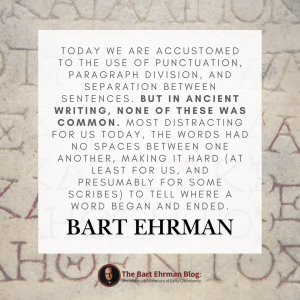
Other kinds of accidental changes were commonly made as well. It was not at all unusual for an inattentive or careless scribe to leave out a letter, a word, or a line — or more! Sometimes this kind of mistake arose because of the way books were written in antiquity. Today we are accustomed to the use of punctuation, paragraph division, and separation between sentences. But in ancient writing, none of these was common. Most distracting for us today, the words had no spaces between them, making it hard (at least for us, and presumably for some scribes) to tell where a word began and ended. Butifsomeonedoesntseparatewordsorusepunctuationitsnothardtoseehowlettersormaybeevenwordsorwhateverswouldbeskipped.
Of yet more importance for the omission of a line or group of words, occasionally two lines of a text would end in the same exact words. A scribe who copied the words at the end of a line would look back at the page, and sometimes his eye would land on the second line (which ended with the same words), and think that that was the line he had just copied. He would continue on then copying the words on the next line, and as a result leave out the entire second line.
This happened, for example, in copies of Luke 12, where Jesus indicates that:
Everyone who confesses me before humans, the son of man will confess before the angels of God and everyone who denies me before humans will be denied before the angels of God
Some scribes who copied the text wrote out the first occurrence of “before the angels of God,” but then when their eye returned to the page at the wrong place thought they had written out the second occurrence, and so when they continued writing, they left out the second line.
The technical term for this kind of “eye-skip” from one set of words to another is “parablepsis” (“looking around”); when the same words end different lines, it is called “homoioteleuton” (“ending the same way”). And so, as I try to teach my students at Chapel Hill, this kind of mistake is called parablepsis occasioned by homoioteleuton!
BUT, sometimes scribes made accidental mistakes simply because they were not paying attention to what they were doing. Probably the most notorious instance of this is in a fourteenth-century manuscript of the Gospel of Luke known as manuscript 109 (because it was the 109th manuscript to be catalogued). This one is a bit mind-boggling.
The scribe of this manuscript was copying a copy of Luke that gave the genealogy of Jesus in two columns on the page. If you remember, in Luke 3, Jesus’s genealogy is traced through Joseph (“supposedly” Jesus’s father, says Luke), who was the “son of Heli, the son of Matthat,” etc.
The genealogy goes back to “Jacob, the son of Isaac, the son of Abraham” and further on back to “David, the son of Jesse” and then all the way back to “Seth, the son of Adam, the son of God.” An amazing genealogy! I have an aunt who was a genealogist, who was quite proud of having traced our family line back to the Mayflower. The Mayflower?! That’s nothing!! Here is a genealogy that goes all the way back to Adam — as in Adam and Eve! And even more: it goes further back, to God himself, the “father” of Adam.
In any event, the scribe of manuscript 109 had a copy of the genealogy in front of him in two columns, the first of which evidently went down to the bottom of the page, but the second of which did not go all the way down to the bottom. And for some inexplicable reason, our inattentive scribe did not realize that the genealogy was in columns, and so he copied the text not one column at a time, but across the columns.
This, as you might imagine, led to some very interesting results. In manuscript 109 we learn that the father of the human race was not Adam, but a man named Phares. And God, whose name now occurs in the middle of the genealogy rather than at the end, is the son of a man named Aram!
We have two goals at Ehrman Blog. One is to increase your knowledge of the New Testament and early Christianity. The other is to raise money for charity! In fact, in 2022, we raised over $360,000 for the charities below.
You must be logged in to post a comment.Over $2 Million Donated to Charity!





Share Bart’s Post on These Platforms
16 Comments
Leave A Comment
It seems to me that common sense would cause spaces to be between words. Why did it take them so long to institute the practice?
Would many scribes have the capacity to translate the Greek the original manuscripts were written in to the local lingo of did this involve additional training and education?
I’m looking forward to the upcoming lectures on Q. When I took German, quelle was also translated as spring, as in water coming out of the ground.
Keep up the good work!!
Most of the things we are so deeply accustomed to seem like common sense. That’s because they are today!
Scribes weren’t translating but copying.
At the event, we’ll see if the spring has dried up….
Back in my own fundamentalist days, we were (quite seriously) told that scribal mistakes did not happen with Bible texts. Scriptural transmission was consistent through the generations. The reason for that, we were told, was that these are (obviously) sacred texts, so they were treated with the utmost care. Only the most skilled scribes were allowed to copy them. They worked diligently, and checked each other’s work. Sacred texts demanded only perfection, and that was achieved.
Again, so we were told.
(OK, you can stop laughing now.)
We were also told that biblical text transmission was much more reliable than the transmission of other ancient texts. A common comparison was made with Julius Caesar’s Commentarii de bello Gallico. Supposedly, biblical texts are far more consistent, through all of their copies, than those of Caesar.
(That point, I’m sure, was made as a way of reflecting historicity. We believe Caesar existed and wrote his commentary on the Gallic War, so by the same token we have even more historically-accurate Biblical texts. Or something like that.)
Whoa. OK, ignorance rules!
Reminds me of the old song “I’m my own Grandpa”!
Interesting post!
Great song! I recommended it highly (its in many versions on Spotify) to my students last semester.
“The genealogy goes back to “Jacob, the son of Isaac, the son of Abraham” and further on back to “David, the son of Jesse” and then all the way back to “Seth, the son of Adam, the son of God.” ”
Is this your own scribal error or in the original?
I don’t think David is further back than Isaac, right? 🙂
Whoa. Sribal corruptions abount.
In our modern era that type of mistake would have a dual responsibility, i.e. the scribe and the editor. In situations where the scribe did not notice, the editor should, resulting in a correction.
Two questions: First, even in the 14th century could not some careful reviewer have noticed this problem then requested or required a correction of the incorrect pages? Yes, this is a hypothetical so I’m assuming the answer is ‘sure’.
Second, any historical information regarding how well educated regarding the bible religious scribes were by the 14th century? Certainly a scribe who had read both the Luke genealogy and Genesis creation myth would have caught the mistake fairly quickly, probably saying the equivalent of “Ehhh, you screwed up that one. Better correct this before my boss sees it.” The fact that the manuscript still exists could indicate both that no equivalent of an ‘editor’ either existed or at least did not review this manuscript; and that religious scribes seem to not have been very knowledgeable about the biblical stories.
Thoughts?
1. yes, sometimes manuscripts were reviewed by a second scribe for correctoins. And sometimes obvoiusyl not! (liek those two sentences I just wrote…)
2. Yes, the 14th c. scribes were principally monks for whom Scripture was well known. But most people today who are deeply familiar with Scripture and even have much of it memorized don’t recognize the contradictions and problems. If you have no doubt and have never questioned that it is perfect, you don’t see the imperfections.
Parablepsis came to mind today as I was rereading an old Carolyn Hax Christmas hootenanny. The carolers decided to sing ‘What Child is This,’ which was new to them so they had to read the words carefully. The result? Take a look:
“Now, for those unfamiliar with the carol, the first verse goes: “What Child is this, who laid to rest, on Mary’s lap is sleeping?” The second verse reads “Why lies he in such mean estate where ox and ass are feeding?” Well… I did the unforgivable and let my eyes drop down the lines as I sang, accidentally combining the first and second verse. So my solo turn, sung with great gusto and emotion, was: What child is this Who laid to rest On Mary’s ass is feeding… “
Ha! I don’t know if that’s “historical” but it’s hilarious!!
Not a parablepsis but, this past season someone turned me to a youtube signing group that had a whole song, to the tune of God Rest Ye Merry, Gentlemen, quite funny if you like this sort of thing
The versus considered where the comma should go, based on meaning, and old-timey English usage.
for example,
“God, rest ye merry gentlemen” as a kind of oath followed by and exhortation to merry gentlemen
Apparently the correct placement is
God rest ye merry, gentlemen
where “rest ye merry” is a phrase meaning something like “bring you good fortune”
Yup, that’s right. We all learned it incorrectly!
Proofreader here, I used to work at lawfirms that really worked the composition people. They made those same errors—drop/repeat a line, or several, type fast too! They, like the proofreaders, were tired and hungry after several hours, day after day, 2nd/3rd shift. It is entirely possible for someone to repeat an entire paragraph. I have seen the elephant.
Thanks!