
Search
Advanced search
The Letter of Polycarp to the Philippians (Another Apostolic Father) in a Nutshell
The next “Apostolic Father” we will consider is Polycarp, Bishop of Smyrna, a friend of Ignatius, who like him came to be martyred on account of his Christian faith (see chapter 26), Polycarp was himself the recipient of one of the surviving letters of Ignatius around 110 c.e., some forty-five years or so before his own death. Soon after he received this letter, he wrote to the Philippian Christians, evidently in response to their requests on several matters (Pol. Phil. 3:1). Here is what I say about him and his writing in my textbook, The New Testament: A Historical Introduction to the Early Christian Writings (Oxford University Press). **************************** The Philippians had requested from Polycarp
December 18, 2025
Light Cast on the Formation of the Christian Canon in Polycarp’s Short Letter
Polycarp’s letter to the Philippians, which I began discussing yesterday, consists largely of general moral exhortations. The Philippians are to love one another and to pray for one another and to give alms whenever possible; their wives are to
December 20, 2025
Comics from My Office Door
Here are some of my favorite comics — pinned to my office door for many years. I’ve just moved out of it — I’ve had it for 37 years! And these were the last things to take down. I’ve always especially like the last one here. De-Parting is such sweet sorrow…
December 21, 2025
Reflecting on the Christmas Tree and Faith
One of my favorite parts of Christmas for most of my life was the tree. I’m not sure why exactly. When I was a kid we had those old bubble lights, and I found them fascinating. I loved sitting in the dark room by myself just looking at them – something like sitting in front of a fire and watching it burn, thinking deep thoughts. Well, as deep as thoughts can be for a 10-15 year old. I don’t recall any content, just the deep quiet satisfied feeling of peace. The first Christmas I was married, in 1977, my wife and I were living in a tiny apartment in Oak Lawn Illinois, where I was a youth pastor at an Evangelical Covenant Church (and a senior at Wheaton College). There really wasn’t much room for a tree, but we were bound and determined to get one. It was a very cold winter, with snow, and the nearest Christmas tree lot had trees that were bundled shut and frozen, making impossible to see how good it […]

December 23, 2025
Pubs and Churches on Christmas Eve
Some years ago Sarah and I were in England celebrating Christmas with her brother in Saffron-Walden, a market town just south of Cambridge. After a lovely Christmas eve dinner, Sarah decided she wanted to go to the midnight service at the local Anglican Church. We, both of us agnostics, decided to go with her. I had always had a soft spot for Christmas eve services. All the way through high school in Lawrence Kansas I had served as an acolyte in the Episcopal church, which held a very moving candlelight service that I always regarded as the most deeply profound service of the year. But I hadn’t been to a service in years and thought I would really like to go. As we were walking through the streets to the service
December 24, 2025
My Interview about Christmas with Nicholas Kristof (New York Times)
I had an interview with Nicholas Kristof, columnist for the New York Times, which appeared electronically this past Saturday. It was based on my book Love Thy Stranger (coming out in March) with a focus on Christmas. These kinds of interviews are very frustrating because it is impossible to back up a single thing you say and if you say anything that needs backing up, it is just sitting there for someone to take a potshot at. Or at least when given as a bare statement seems really dubious. But, it’s the nature of the beast (kind of like being interviewed as a talking head for a documentary film/TV show; they interview you for three hours and then take ten or fifteen ten- or fifteen-second soundbites!) So many of the comments the (NYT) interview has received show how many people in the world who have opinions about the Bible, Jesus, and early Christianity would really benefit from learning more. There are so many commonplaces out there that simply seem true to people because they’ve heard […]
December 25, 2025
The A-Z of the New Testament: Guest Post by James McGrath
Bart: I often get asked if there is some kind of simple guide to what scholars say about the New Testament, something that is competent, by an expert, but expressly for lay folk who want to know the most important findings of scholarship. A couple of years ago James McGrath published a book that is just that kind of thing, and I realized, it’s “bloody well time” (as they say in England) for us to have some posts about it. James has kindly agreed to provide them. James is the Clarence L. Goodwin Chair in New Testament Language and Literature at Butler University, and occasional guest-poster on the blog. Here is his first post of three.
December 27, 2025
Alphabet Soup of the New Testament: Guest Post by James F. McGrath
Here now is the second guest post of James McGrath on his book that provides an introduction to New Testament scholarship for people who are not, will not be, and possibly never would dream of being New Testament scholars. The full title and subtitle give a great sense of what it is all about: The A to Z of the New Testament: Things Experts Know That Everyone Else Should Too. Here now is his fuller explanation. ****************************** For much of the time that I was working on The A to Z of the New Testament, the title was The ABCs of New Testament Study. I envisaged the cover having children’s blocks on it, or perhaps the title of the book spelled in alphabet soup. The folks at Eerdmans wisely went in a different direction with the cover. It was after
December 28, 2025
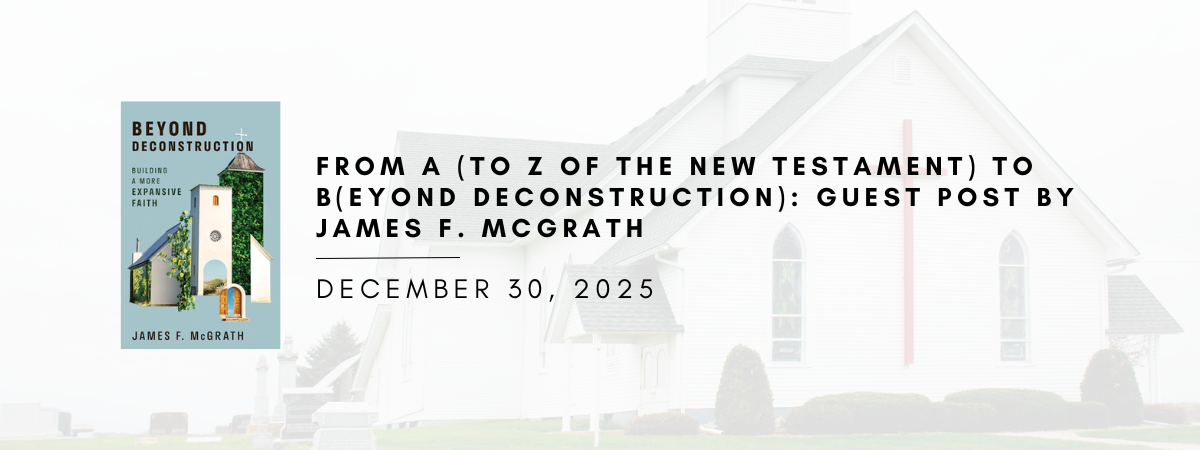
From A (to Z of the New Testament) to B(eyond Deconstruction): Guest Post by James F. McGrath
Here now is the final installment of James McGrath’s series of posts on his book, in which he shows how the kind of knowledge experts on the New Testament have can affect those who are questioning their faith or have left the faith, which people these days often refer to as “deconstruction.” This issue of deconstruction is the topic of another now-forthcoming book of his that will be appearing soon. Here is what he has to say about it. ****************************** There is a natural connection between the first book I wrote that was published by Eerdmans, The A to Z of the New Testament, and the most recent, Beyond Deconstruction, due out in early February. The term “deconstruction” has become the popular term for what happens when you start taking a close look at elements of your worldview, especially as a Christian, and find that there are elements of it that you can no longer subscribe to. For some it is a thoughtful investigation and careful selective replacement of beliefs and values. For others, it […]
December 30, 2025
Uh, Duh. What I SHOULD Have Said. (Bethlehem)
Last week, in the lead up to Christmas, I had a remote, live event, a back and forth with Roman Catholic apologist Jimmy Akin on the question of whether Jesus was actually born in Bethlehem. This was part of Paths in Biblical Studies, my online courses and events venue that is not directly connected with the blog; you can learn more about it on my website http://www.bartehrman.com. This particular event was one of our “Face to Face on the Bible series. It was not set up as a formal debate but a conversation. But we did have disagreements! Jimmy has a highly unusual way of reconciling the birth narratives of Matthew and Luke. I naturally responded to it — I explained why I didn’t think it was plausible — but after it was over I realized that there was a killer argument that a forgot to mention. Ever do that? Come away from a disagreement and later say, “Ah, I should-a said that!!”? The issue concerns the
December 3, 2025
Rarely Asked Questions About Why THESE Letters of Paul Are in the Canon
Now that the semester is over and, well, I’m retired from teaching (!), I am able to start in seriously on doing research for my next book project, on how we got the canon of the New Testament. There are 27 books in the canon. Why these 27 in particular? Why were others excluded – other Gospels, Acts, Epistles, Apocalypses, etc.? Who decided? On what grounds? And when? I’ve blogged about the book in recent months (back when I thought I’d be able to do some serious research in it during the fall semester! Oh well…); if you’re interested, here are two posts: My Next Book: Creating the Bible — How We Got the Canon of the New Testament My First Scholarly Encounter with the Canon of the New Testament Here I can explain how I’m starting to approach the issue. There are tons of books
January 3, 2026
The Year in Review: 2025!
Here on the last day of 2025 it is time to write my annual Blog-Year-in-Review post. This year I have been helped considerably in the task by our fantastically gifted and efficient CEO, Jen (Olmos), whom many of you have had contact with over the course of your (and her) time with us. Jen has been the greatest gift to the blog since we started in 2012, and has eased my workload significantly. Among a zillion other things, she dug out all the data for me and has summarized our most important accomplishments. As you’ll see, well done us! As y’all know, over the course of its thirteen years the Blog has had two major objectives, to spread knowledge of biblical (and related scholarship) more broadly among non-scholars and to raise money for charity doing it. I’m more or less responsible for the scholarship and all YOU, the paying members and donors, are responsible for the funds, and Jen and our generous team of volunteers makes it all happen and keeps it all running.
December 31, 2025
Getting the Hebrew Bible: A Primer (What is the Old Testament…)
How did we get the Bible, these 66 books in particular? Over the next couple of years I’m planning on reading massively on the Canon Part 2 (the New Testament), in particular on what we know about why certain books came to be included and yet others were left out, as the topic of my next book. And I’ll be talking a good bit about what I’m thinking about that here on the blog. The topics that I’ll need to be covering are so wildly varied that I’m guessing that about two-thirds of time it won’t even be obvious to blog readers that a post is even related to questions of canon. We’ll almost certainly have to be dealing with such widespread issues as Roman imperial efforts to obliterate Christianity; teachings of universalist salvation in the early church; The Arian Controversy (think: the Council of Nicea); Paul’s confrontation with a talking lion he had earlier baptized; letters allegedly written by Jesus himself and…. and oh, there is so much to cover! I’ve decided that here […]
January 4, 2026
Charts Showing the Organization of the English Old Testament and the Hebrew Bible
The Hebrew Bible/Old Testament is a big book. Well, OK, a big collection of books. In my previous post I discussed its basic contents, organization, and structure, both as found in English translations (which 99% of the Bible readers you know use!) and in the original Hebrew itself. In this post I will provide two charts to clarify the matter. AFTER that I will give some additional lists that show how different Christian denominations actually have more extended canons of the Old Testament because they accept works that are called the “Apocrypha” by Protestants, but known as “The Deuterocanonical” books by Catholics and others. (Again, all this taken from my book The Bible: A Historical and Literary Introduction, Oxford University Press) CHARTS OF HEBREW AND ENGLISH BIBLES THE HEBREW BIBLE The Torah (5 books) Nevi’im (= The Prophets) (8 books) Kethuvim (= The Writings) (11 books) Genesis Former Prophets (4 books) Job Exodus Joshua Psalms Leviticus Judges Proverbs Numbers Samuel (count as one book) Ruth Deuteronomy Kings (count as one book) Song of Songs […]
January 6, 2026
When Was the Hebrew Bible Canonized? The Traditional View
Now that I have spent two posts explaining the contents, structure, and organization of the Hebrew Bible/Old Testament, I can move on to explain how it is we got these books in particular. Why not other books? Who decided? On what grounds? And when? This will take two posts. In this one, I give a brief overview of the understanding that was widely held for a very long time among scholars. It was the one I was raised on! First I need to explain what we mean by “canon.” The term comes from the Greek word for
January 7, 2026
The Formation of the Hebrew Bible: The Common Scholarly View Today
In my previous post I discussed the traditional view of when the Hebrew Bible became a fixed canon in stages, with the final decisions being made at the end of the first century CE at the “Council of Jamnia.” Today scholars tend to present a somewhat fuzzier picture of when and why the canon came to be formed, although there do seem to be some fixed points. It is widely held that the five books of the Torah were accepted by nearly all Jews as a set canon by the fifth century BCE, in the early post-exilic period. One piece of evidence comes from the Bible itself, in a post-exilic book, Ezra. The scribe Ezra himself is described as being “skilled in the Torah of Moses that the LORD the God of Israel had given” (Ezra 7:6). This suggests that it was widely known that there was a “Torah of Moses” and that the educated elite were sometimes being trained in understanding and interpreting it. The Torah is and always has been
January 8, 2026
Do We Know if Our Copies of the Hebrew Bible (Old Testament) Are Accurate?
When talking about “how we got the Bible,” there is obviously a lot more involved than understanding how and when the canon came to be collected and more or less fixed. Knowing which books are in the canon is not the same thing as knowing what words were originally in the books. For that we have to move to the related question of the “textual tradition” of the books, of how they were copied for many centuries before the invention of the printing press. I have talked a good deal about that with respect to the New Testament on the blog, but far less about the Hebrew Bible. Since I’ve just finished with some posts on the canon, now I can turn to the question of the text: what do we know about how it was copied? Can we trust that we have what the authors wrote? What are the complexities involved? This will take two posts. I will be drawing from my discussion in my textbook, The Bible: A Historical and Literary Introduction, 2nd […]
January 10, 2026
Weren’t Jewish Scribes Fully Accurate to the Letter?
In my previous post I started to explain which manuscripts we have of the Hebrew Bible and broached the question of whether we know they were “accurate.” That is, if we read the stories of Genesis, or the book of Isaiah, or the Psalms, can we be sure we’re reading what the authors originally wrote? Or could things have been changed? In this post, I explain some of the complications of knowing what the original authors of the Hebrew Bible wrote, based on what we know about Jewish scribal practices over the centuries. It turns out that what we know is not actually what we often hear, that Jewish scribes going all the way back to the beginning had ways of making sure they never changed a single letter of what they copied. We start with ….
January 11, 2026
When Did We Get Chapters and Verses? A Quick Answer
After doing this blog for going on fourteen years now, I’ve gotten better at anticipating questions that my posts will get. I’ve just finished a short thread dealing with “How We Got the Old Testament/Hebrew Bible” (both how the canon was formed and how the texts were copied). And I’d bet my bottom dollar (whatever a bottom dollar is) I’ll be getting questions on when we got the chapters and verses in the Bible. I’ve dealt with the question on the blog before, but it’s been years and it’s the kind of thing that is a bit hard to recall without reiteration. So here I reiterate. ****************************** Given the fact that ancient manuscripts did not use punctuation, paragraph divisions, or even spaces to separate words, it will come as no surprise to learn that the chapter and verse divisions found in modern translations of the Bible are not original (as if Isaiah, or centuries later Paul, would think to number his sentences and call them verses!). In order to facilitate the reading of these books—especially […]
January 13, 2026
The New Testament in a Nutshell: The 50 Word Summaries of Each Book (All of them!)
When I started the “New Testament in a Nutshell” series I promised to provide one-sentence, fifty-word summaries of each book of the New Testament, and promised, when I was done, to put them all together in one post. Here is the post! (It includes a few other 50-worders on the Gospels and Paul). The idea behind this is that if someone asks you, “What is the letter to the Galatians about?” — you should be able to give a brief statement that covers what it is in a way that is distinctive (so what you say for Galatians is not the same thing you would say for Romans or Ephesians, etc.). So here they are. You may well be able to improve upon them! But hopefully you will find them of some good use. The Gospels as a Whole Matthew, Mark, Luke, and John are our oldest narrative accounts of Jesus, the Son of God who fulfilled Scripture in his life, death, and resurrection, who taught the way of salvation, performed miraculous deeds, was […]
January 14, 2026