
Search
Advanced search
Differences in the Gospels and Redaction Criticism
In my previous two posts I stressed that knowing that there are differences, even discrepancies, among the Gospels does not need to be considered in a purely negative light. There are very serious positive pay-offs. These differences/discrepancies open up possibilities for interpretation, because they (in theory) prevent a person from importing a meaning into a text that is difficult to sustain from the words of the text itself. When John says that Jesus died on the day before the Passover meal was eaten, but Mark says that Jesus died on the day *after* the meal was eaten (both are quite explicit), then the interpreter’s energy really should not be taken up with showing that they both are saying the same thing. They are saying different things, and not recognizing this means failing to recognize what each Gospel is trying to say. In this particular case, John almost certainly is the one who changed the historical datum (although, OK, this is debated). It allows John to portray Jesus as the “lamb of God” who is killed, […]
Tags: redaction criticism
February 14, 2014
How To Study the Gospels
I’ve been speaking about the importance of the differences of the Gospels. So far I’ve argued that these show that each Gospel has to be read for the message that *it* is trying to convey; no one should assume that the message of one Gospel is the message of another, that the portraits of Jesus are the same among all the Gospels, that none of the differences matter for much of anything because they can all be reconciled. That is to miss out on a real opportunity of determining the message of each of these authors. I think that’s important. These are important books. Whether you’re a Christian or not, no one can much doubt that the New Testament is the most important book, historically and culturally, in the history of Western Civilization. Knowing what it’s authors have to say really matters. And if you wear blinders when trying to interpret these books, you’ll simply see what you’re programed to see. And that’s not good. In my last post I argued that one of the […]
Tags: genre criticism, redaction criticism
February 15, 2014
The Gospels as Biographies
In my last post I indicated that among the different ways to study the Gospels, one is what I call the “literary-historical” approach. This approach determines the literary genre of a writing, and then sees how that genre “worked” in its own historical context (as opposed to how a similar genre make work today). The Gospels of the NT are widely seen as examples of ancient biography. So it would help to know how biographies worked in Greek and Roman antiquity. There are numerous examples of biographies from the Greco-Roman world, many of them by some of the most famous authors of the Roman literary scene, such as Plutarch, Suetonius, and Tacitus. As I indicated in my previous post, and need to stress here, these biographies, understood in their own historical context, are different from the biographies we read today. Understanding the differences can be key to recognizing the way any particular ancient biography “worked,” including the Christian examples such as Mark (and the other Gospels). As I contrast ancient with modern biographies here, it […]
Tags: genre, Greco-Roman biographies
February 17, 2014
The Beginning of Mark’s Gospel/Biography
OK, I won’t do this for all the Gospels, but I thought rather than trying to type up at length how the beginning of Mark’s Gospel portrays Jesus (on the assumption that since it’s an ancient biography, it will lay out the character of the subject at the very outset), I should simply reproduce what I already say about this in print elsewhere, in my Introduction to the New Testament. Here is the first part of that discussion. The second part I’ll give in my next post. **************************************************************** One of the first things that strikes the informed reader of Mark’s Gospel is how thoroughly its traditions are rooted in a Jewish world view. The book begins, as do many other ancient biographies, by naming its subject: “The Beginning of the Gospel of Jesus Christ” (1:1). But readers living in the Greco-Roman world would not recognize “Christ” as a name; for most of them, it was not even a meaningful title. It came from the verb “to anoint,” and typically referred to someone who has just […]
Tags: Christology, Gospel of Mark
February 18, 2014
More on the Beginning of Mark’s Gospel
In this post I resume what I began yesterday, an explanation of how the Gospel of Mark can be read as a biography of Jesus, with the “character” of the main subject shown in the stories told about him at the early part of the account. I’ve pointed out that Jesus is portrayed in a very Jewish light as the messiah, the Son of God (and I have said a few words about what that would mean to a Jewish audience). And then, in Jesus’ first actions, we learn more about who he is – specifically, what kind of Son of God. Again, the following is taken from my textbook on the New Testament. ************************************************************** Jesus the Authoritative Son of God The reader is immediately struck by the way in which Jesus is portrayed as supremely authoritative. At the outset of his ministry, he sees fishermen plying their trade; he calls to them and without further ado they leave their boats and family and hapless co-workers to follow him (1:16-20). Jesus is an authoritative leader; […]
Tags: Christology, Gospel of Mark
February 19, 2014
More on Mark
I started this thread by mentioning that when I teach my undergraduate class on the NT, I not only teach them about the four Gospels, but I teach them different *methods* for studying the Gospels – for example redaction criticism and “literary-historical” criticism. In my class I use the latter to explore the Gospel of Mark, and in order to illustrate here, on the blog, how it works (establishing the genre of a writing then seeing how that genre “worked” in the relevant historical period) I started showing how Mark can be interpreted as an ancient biography. But now that I’ve given several posts on that, I realize that I’m deep into the interpretation of Mark but haven’t actually pointed out the really important themes of the Gospel in its portrayal of Jesus. So that seems unsatisfying. I’ve decided to continue on to the end, and give the rest of my discussion of Mark from my textbook, to show what a fuller interpretation (which, of course, just scratches the surface) would reveal. This will take […]
Tags: Christology, Mark, son of God
February 20, 2014
Snake-Handling and the Gospel of Mark
Here is something to break up a bit my thread on the Gospel of Mark, studied from a literary-historical perspective (to be resumed in my next post). This current post is related to Mark but it’s well, different. There was a recent CNN report that some of you may have seen. I include it here, below, with the link to the site at the bottom. This practice in some southern circles (especially in the Appalachians) of handling deadly snakes as part of a worship service is based on the saying of Jesus in Mark’s Gospel, after his resurrection, where he tells his disciples that those who come to believe in him will be able to speak in foreign tongues (as happens in Pentecostal churches, e.g.), that they will be able to handle deadly snakes, and if they drink any poison, it will not harm them. Offhand, I don’t know what in additional to snake-handling churches, we don’t have poison-drinking churches. Maybe we do? I’m sure someone on the blog can tell me. In any […]
Tags: Gospel of Mark, snake handling
Mark’s Suffering Son of God
In this post I continue my literary-historical study of Mark’s Gospels, and get to a very big point. After this will be one more post on Mark, in which I discuss the ultimate point. ******************************************************************** Jesus The Suffering Son of God Throughout the early portions of Mark’s Gospel the reader is given several indications that Jesus will have to die (e.g., 2:20; 3:6). After Peter’s confession, however, Jesus begins to be quite explicit about it. Even though he is the Christ, the Son of God — or rather, because he is — he must suffer death. Three times Jesus predicts his own impending passion in Jerusalem: he is to be rejected by the Jewish leaders, killed, and then raised from the dead. Strikingly, after each of these “Passion predictions” Mark has placed stories to show that the disciples never do understand what Jesus is talking about. FOR THE REST OF THIS POST, log in as a member. If you don’t belong yet, JOIN ALREADY!!!
Tags: Mark, suffering Messiah
February 21, 2014
Jesus’ Death and Resurrection in Mark
Here is my final post on Mark, following a literary-historical method. After this post I’ll have a reflection or two on the method, and then talk in much briefer fashion about other methods one might use to study the Gospels. ************************************************************ Jesus’ Death as the Son of God It is clear from Mark’s Gospel that Jesus’ disciples never do come to understand who he is. As we have seen, he is betrayed to the Jewish authorities by one of them, Judas Iscariot. On the night of his arrest, he is denied three times by another, his closest disciple, Peter. All the others scatter, unwilling to stand up for him in the hour of his distress. Perhaps Mark wants his readers to understand that the disciples were shocked when their hopes concerning Jesus as messiah were thoroughly dashed: Jesus did not bring victory over the Romans or restore the kingdom to Israel. For Mark, of course, these hopes were misplaced. Jesus was the Son of God; but he was the Son of God who had to […]
Tags: death, Gospel of Mark, resurrection
February 24, 2014
Video: Does It Matter If Jesus Was Married?
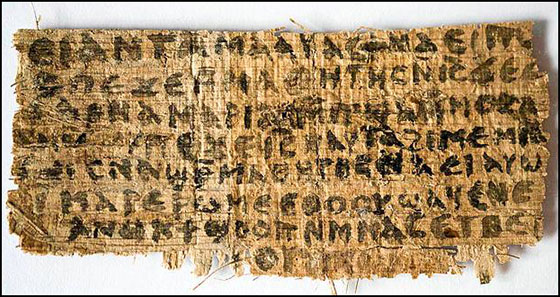
As I think I’ve indicated on the blog before, on January 23, 2014 there was an interesting discussion, on stage, between Karen L. King (Hollis Professor of Divinity at Harvard Divinity School), Mark Jordan (Distinguished Professor at Washington University, Saint Louis; he is returning to Harvard next year), and me on the topic “Does It Matter if Jesus Was Married?” The discussion was hosted by the Black Mountain Institute at the University of Nevada, Las Vegas, in the Beam Music Center, Doc Rando Hall, UNLV. The Black Mountain Institute is an International Center for Creative Writers and Scholars. The event was moderated by the former President of UNLV, Carol Harter, who did a very fine job indeed keeping us all on target and on topic. The basic underlying question was: what would a married Christ mean for the theology, practices, and politics of Christian traditions as they grapple with changing times? I did manage to say a few words about the prior question: *Was* Jesus married? The Black Mountain Institute was motivated to invite us […]
Tags: Gospel of Jesus' Wife, Karen King
February 26, 2014
The Literary-Historical Method and History
COMMENT BY A READER: I like the “literary-historical” approach, but only up to a point, just so long as the claims of primitive history, the interpretations of bible scholars, and the anti-Semitic pronouncements of its religious authors, don’t outweigh or override the literature. After all, Jesus did NOT have personal biographers who took notes and reported what was going on throughout his lifetime. We only know of him as the protagonist within an ill-defined genre, someone carefully crafted after-the-fact in order to appear more god-like than human. Thus, it seems a mistake to treat the Gospel of Mark, or any similar ancient narrative (whether canonized or not), either as the legitimate retelling of history, or merely as one particular form of Greco-Roman storytelling. RESPONSE: Yes, it anyone thinks the literary-historical approach involves making historical claims about the narrative they have misunderstood what it is trying to do. Let me explain. There are numerous ways, of course, that one can approach the Gospels of the NT, just as there are numerous ways that one can […]
Tags: literary historical method
February 25, 2014
Books and Response Books
So, in almost exactly a month, my new book How Jesus Became God, gets published, March 25. The book is completely done and produced. I received a preliminary copy a couple of days ago. I think it looks *great* — a very interesting piece of cover art, good blurbs on the back, interesting explanations about what the book is. HarperOne has done a terrific job with it. Naturally I’m interested, concerned, and invested in how well it does. Any author who thinks s/he has something to say – which, by definition, is every author — very much wants lots and lots of people to read their work. And with a book like this, which in my opinion deals with what is arguably the most important question in the history of Western religions, it’s especially important (to me). So I am eager for this to happen. There are several things that authors really want when they’ve written a book that will be seen as controversial. For one thing, the author wants a lot of controversy! Not […]
Tags: How Jesus Became God
February 28, 2014
More on the Response Book
Another post on the forthcoming “response book,” titled How God Became Jesus, written in reaction to my book How Jesus Became God. As I indicated in my previous post, I gave my publisher permission to share my manuscript with the five scholars who produced the response, so they were not simply guessing about what I had to say. They had it in their hands. They responded in kind and allowed their publisher to share with me their book. I haven’t read it yet. The reason that they shared their book with me in advance of its appearance is that we are being asked to do some media events that will require knowledge of each others’ books. The event that has been set up already is a kind of on-radio debate with one of the five authors, Simon Gathercole, who teaches at Cambridge University. Next week I’m heading over to London for Spring break, mainly to see family and so on. But I’ve agreed to do a taped radio show. Unlike the States, in England (as […]
Tags: How God became Jesus
March 1, 2014
The Comparative Method
With this post I am returning to my discussion of methods available for studying the Gospels. I will devote probably three posts to a method that I call the “comparative method.” Like the other two methods I’ve discussed (the literary-historical method and redaction criticism) this method is not *at all* concerned with establishing what really happened in the life of Jesus. It is a method meant to help one understand a Gospel as a piece of literature, to see what its *portrayal* of Jesus is. In my textbook on the New Testament I show how the method works by applying it to the Gospel of Luke. It could obviously be used for any of the Gospels – or for any other literature, for that matter. Here is how I describe it in the book, in relation to the method that it most resembles, redaction criticism (remember: in redaction criticism one sees how an author has changed his source – by what he has added, deleted, or altered – so as to determine what his overarching […]
Tags: comparative method, Gospel of Luke
March 3, 2014
The Comparative Method and Luke
In this post I continue discussing the “comparative method” of analysis (see yesterday’s post), by showing how it works in relation to the Gospel of Luke, again, as taken from my textbook on the NT. ********************************************************************* A Comparative Overview of the Gospel We begin by rehearsing several basic points that we have already learned about Luke’s Gospel, in relationship to Matthew and Mark. Like them, it is a kind of Greco-Roman biography of Jesus. It too is anonymous, and like them appears to have been written by a Greek-speaking Christian somewhere outside of Palestine. He evidently penned his account somewhat later than the Gospel of Mark, perhaps at about the same time as the Gospel of Matthew. In the second century, the book came to be attributed to Luke, the traveling companion of the apostle Paul; we will consider the merits of this attribution in the following chapter.
Tags: Gospel of Luke
March 4, 2014
Jesus’ Birth: Some Comparisons
Here is another illustration of how the Comparative Method works with Luke, as described in my textbook on the New Testament. A personal anecdote. It was precisely the differences between Matthew and Luke in the birth narratives that led me to formulate the comparative method. Unlike the other methods I discuss in my book, this is one that is not widely discussed in scholarship. In fact, I had never heard of it until, well, I came up with it. But it occurred to me while thinking of the birth narratives (and genealogies) that it didn’t *matter* if Matthew and Luke had the same source for their narrative. If they did have, one could do redaction criticism on them; but they don’t have. Does that mean comparing their two accounts cannot yield results? I decided that in fact interesting results *did* matter. Their similarities and differences were important in and of themselves, and that this could be formulated into a method of study. (It may be that others had come up with a similar approach before: […]
Tags: comparative method, Gospel of Luke, Gospel of Matthew
March 5, 2014
The Gospel of John from a Literary-Historical Perspective
I have talked so far about several of the methods scholars use in order to study the Gospels of the NT: the literary-historical,redactional, and comparative methods. As I’ve stressed, each of these can be used for any one Gospel (or for any other piece of writing, in theory). In my textbook, when I come to the Gospel of John, I show how they all can be applied to the *same* book, before introducing an altogether different method known as the socio-historical approach. I will explain all this in a series of posts, starting with this one. ********************************************************** As I have argued, historians are responsible not only for interpreting their ancient sources but also for justifying these interpretations. This is why I have self-consciously introduced and utilized different methods for each of the books we have studied: a literary-historical method for Mark, a redactional method for Matthew, a comparative method for Luke, and a thematic method for Acts. As I have indicated, there is no reason for a historian to restrict him or herself to any […]
Tags: Gospel of John, historical criticism, literary criticism
March 8, 2014
More Literary-Historical Perspectives on John
Here I continue showing how a literary-historical method can be applied to the Gospel of John, before (in later posts) showing how it can be studied following the other methods as well. ************************************************** Since ancient biographies typically established the character traits of the protagonist at the outset of the narrative, it is perhaps best to assume that an ancient reader, once he or she realized that this book is a biography of Jesus, would be inclined to read the rest of the story in light of what is stated about him here in the mystical reflection at the outset. This is no biography of a mere mortal. Its subject is one who was with God in eternity past, who was himself divine, who created the universe, who was God’s self-revelation to the world, who came to earth to bring light out of darkness and truth out of error, a divine being who became human to dwell here and reveal the truth about God. This Gospel will present a view of Jesus that is far and […]
Tags: Gospel of John, historical criticism, literary criticism
March 9, 2014
Radio Debate with Pete Williams on Textual Variants
I’m in the midst of a thread on the textual variants of the New Testament, and whether they matter, and thought that it might be good to give an alternative perspective. On January 3rd, 2009, Peter J. Williams and I appeared as guests on the radio show “Unbelievable,” a weekly program on UK Premier Christian Radio, moderated by Justin Brierley. For this show we discussed my book “Misquoting Jesus” (In the UK the book, for some reason, is titled is “Whose Word Is It?”). Pete Williams is a British evangelical Christian scholar — a very smart one, who knows a *lot* about the manuscripts of the NT — who believes in the reliability of the New Testament and that thinks that my position is too pessimistic and extreme. He did his PhD at Cambridge. Peter is the author of Can We Trust the Gospels? and C S Lewis vs the New Atheists. Here’s our back and forth. Please adjust gear icon for 720p High-Definition:
Tags: Peter J. Williams, textual criticism
June 22, 2014
The Gospel of John from a Thematic Perspective
In previous posts I’ve discussed how a literary-historical approach to John can yield interesting results. Other methods of analysis are available as well. Here I discuss another one that I have not yet explained, but should be understandable simply from the following extract from my textbook. I call this other method, simply, the “thematic” approach. Here is what I say about it, in relation to the Gospel of John. ********************************************* The Gospel of John from a Thematic Perspective Whereas the literary-historical approach to the Gospels focuses on the conventions of the biographical genre, and so determines how a book portrays its main character through the unfolding of the plot as he interacts with those around him, the thematic approach isolates prominent themes at key points of the narrative, and traces their presence throughout, more or less overlooking questions of plot and character interaction. If we were to examine John from a strictly thematic point of view, we might look at some of the salient motifs established at the outset of its narratives (since biographies set […]
Tags: Gospel of John, thematic perspective, themes
March 11, 2014