
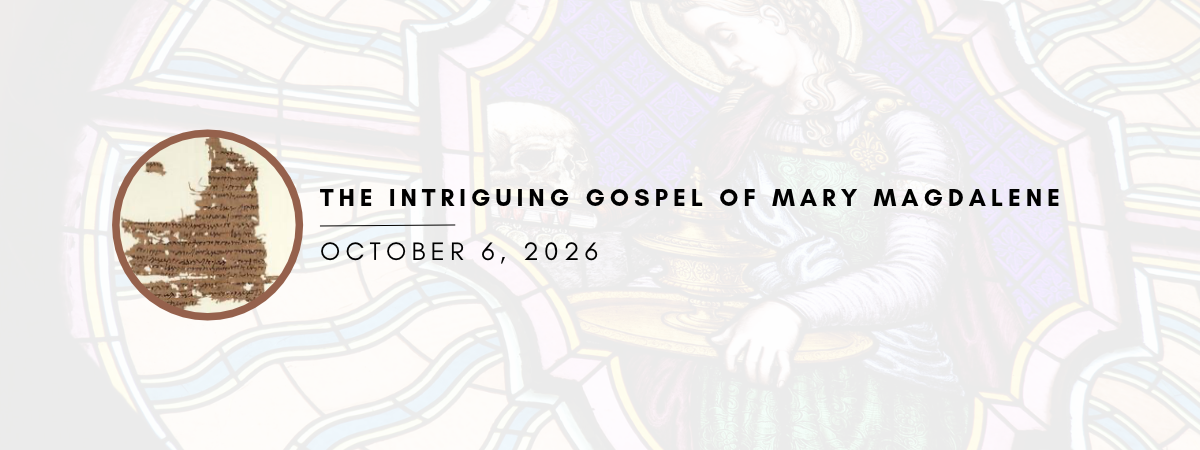
This past weekend I hosted an online conference on the relationship of Christian apocrypha to the New Testament canon (apocrypha = Gospels, Acts, Epistles, and Apocalypses that in the end were not included in the New Testament). There were a number of terrific talks given, one of them by Nicola Denzy Lewis (at Cornell), on the Gospel of Mary Magdalene. As she was giving it I realized that even though many people are intrigued by Mary Magdalene, few actually know much about this Gospel.
I taught it when I did my undergraduate class on ancient Gospels and modern Jesus films, and thought I should say some things about it here on the blog.
You like this post? It's free! However, you'll need to be a blog member to read most articles here. Get access to Dr. Ehrman's library of 4,000+ articles plus five new articles per week. Membership starts at $2.99/mth and every cent goes to charity!
Unlock 4,000+ Articles Like This!

It is a second-century Gospel does not claim to be written by Mary Magdalene, but she is the main figure in it – the one to whom Jesus gave a secret revelation about ultimate reality, much to the chagrin of the male disciples who can’t believe that Jesus would reveal the secrets of the world to a *woman* instead of them.
It is a Gnostic Gospel – by which I mean that it is based on “gnostic” myths about how humans are trapped here in their material bodies and need to learn the secrets about themselves, about the world, and about how to escape their physical prisons – all this through the secret “knowledge” (Greek = gnosis) that Jesus can provide.
We have no record of a Gospel according to Mary (Magdalene) from the early church. The book was, in fact, unknown until its discovery at the end of the nineteenth century. Despite the sensational nature of the find, the book was not widely known for many decades: its first publication did not come until 1955–a marked contrast to the treatment accorded other Gospels discovered in the late nineteenth and early twentieth centuries, such as the Gospel of Thomas, the Gospel of Peter or the intriguing fragmentary collection of several Gospel passages called Papyrus Egerton 2. Some of these are of less inherent intrigue than the Gospel of Mary, but they all were published almost immediately upon discovery (well, Thomas was about a decade later, for various reasons).
Whether the relative lack of scholarly interest in the Gospel of Mary was related to (a) the fact that this was a Gospel allegedly by, or about, a woman disciple, (b) the circumstance that it embodied a relatively complex gnostic cosmology rather than a more straightforward narrative, or (c) something else, is hard to determine. But the publication was also delayed by some mindboggling and frustrating events that I explain in my Introduction to the work in my book The Other Gospels (co-edited with my colleague Zlatko Pleše.)
Here is how I describe the book in that edition:
******************************
The account s begins in medias res, with Jesus responding to a question from the disciples about whether “matter [will be] destroyed or not.” Jesus’ reply shows the gnostic orientation of the text from the outset. All things, including especially this material world, will be dissolved into their primal elements. Matter itself is evil, or at least susceptible of evil, in this text; its co-mingling with spirit is termed “adultery” and is what leads to “sin.” But all things, Jesus indicates, will return to their original state.
After delivering several exhortations to his disciples, Jesus departs. Immediately forgetting what Jesus has just taught them — that this material world is not what ultimately matters — the male disciples are overcome with fear that they may share Jesus’ fate and also be executed. Mary (almost certainly Mary Magdalene — the Coptic text calls her MARIHAM, the Greek MARRIAMH; neither spelling was normally used for Jesus’ mother) then appears and comforts them. Peter asks her, as the one “the Savior loved …more than the other women” to tell them, the male disciples, the revelation Jesus had given to her alone. She complies by beginning to describe a vision that she had of Jesus, but that is where the second major lacuna of four pages occurs.
When the text resumes Mary is in the middle of a gnostic discourse describing the ascent of the soul back to its heavenly, spiritual, home, by escaping the “powers” of the heavenly spheres separating this world from the divine world above. These powers, in fact, are emblematic of the material trappings of the body, its desires, ignorance, and passions. Escaping this material prison of the body is to find eternal rest at last.
When Mary has finished relating this revelation a dispute breaks out among the male disciples, who wonder if it is possible that Jesus would reveal his truths to a woman.
******************************
Here is what the conclusion of the account actually says (as translated in our book by Zlako, from the Coptic):
When Mary said these things, she fell silent, as though the Savior had spoken to her up to this point. Now Andrew responded and said to his brothers, “Say what you will about what she has said, but I do not believe that the Savior said these things. For these teachings are strange thoughts indeed.” Peter replied and spoke about these things as follows. He asked them about the Savior, “Did he really speak with a woman secretly from us, not openly? Should we turn about, too, and all listen to her? Did he choose her over us?”
Then Mary wept and said to Peter, “My brother Peter, what are you thinking? Do you think that I have thought up these things alone in my heart or that I am telling lies about the Savior?” Levi responded and said to Peter, “Peter, you are always angry. Now I see you disputing with this woman like the adversaries. If the Savior made her worthy, who are you then, for your part, to cast her aside? Surely the Savior knows her full well. That is why he has loved her more than us. Let us rather be ashamed, and put on the perfect human and bring it forth for ourselves, just as he commanded us; and let us preach the Gospel, laying down no rule or law other than what the Savior has spoken.” When Levi said these things, they began to go out to teach and proclaim.
******************************
I find the entire account terrifically interesting – both the gnostic revelation and the conclusion. In terms of the latter, it’s interesting that Peter and Mary are elsewhere thought of as competitors in the early Christian tradition. I’ll say more about that in the next post.
We have two goals at Ehrman Blog. One is to increase your knowledge of the New Testament and early Christianity. The other is to raise money for charity! In fact, in 2022, we raised over $360,000 for the charities below.
Over $2 Million Donated to Charity!





Share Bart’s Post on These Platforms
Leave A Comment
You must be logged in to post a comment.