
In my previous post I pointed out that there seems to be an irony in the teachings of Jesus about the coming Kingdom of God. On one hand, it seems like it should be a completely utopian place where there are no longer any enemies of God or animosity and strife among humans, a return to the glory days (maybe literally only days) of the Garden of Eden. On the other hand, Jesus will be the “king” and his twelve disciples will be “co-rulers” in this kingdom. But why will they need a king and rulers? There is only now peace, harmony, love, and an eternal ecstatic existence without sin, suffering, pain, or misery caused by illegal or illicit activity, right? So what are the rulers going to be doing exactly?
This same irony is found in even more pronounced terms in the final book of the New Testament, the book of Revelation. In my book Armageddon I argue at some length that the values and priorities of Jesus are almost completely missing from this book. Rather than embracing views of mercy, forgiveness, service to others, we find a Christ who is out is out for blood (that’s not too strong a term for it: read the book!) in revenge for how he was treated here on earth. He destroys all of his enemies: the Devil, the “beast” (the anti-Christ figure), their superhuman supporters, all humans who have rejected Christ (in this book, it’s the vast majority of the human race), Hades, and Death itself – all of them are thrown into the Lake of Fire. Gone. Out of the way.
That takes up most of the opening chapters 1-20. And then in chapters 21-22 we learn of the New Heaven and the New Earth that God brings for his beloved saints, the only survivors of the massive onslaught against the world and its inhabitants. But the description of this new world, especially the “New Jerusalem,” not only beggars belief; it creates some serious narrative confusion.
Here is how I discuss the matter in my book Armageddon (Simon & Schuster, 2023).
You like this post? It's free! However, you'll need to be a blog member to read most articles here. Get access to Dr. Ehrman's library of 4,000+ articles plus five new articles per week. Membership starts at $2.99/mth and every cent goes to charity!
Unlock 4,000+ Articles Like This!

******************************
Throughout his narrative John has described untold pain, misery, and suffering, but his book ends on a happy note, at least for the followers of Jesus who have survived. The universe as humans have known it – “the first heaven and first earth” – is taken away and God brings in a new one. This “New Jerusalem” will be the eternal home for the people of God, corresponding, though in much glorified fashion, to the original Jerusalem, site of God’s king, his temple, and his people. Those who enter this new city will feel no more sorrow: God will “wipe away every tear from their eyes and there will be no more death, suffering, weeping or pain” (Rev 21:4). They have “conquered” and now will inherit God’s gifts. They and no one else: all other inhabitants of earth, we are told again, have been tossed into the lake of fire.
The New Jerusalem is a marvel to behold. It is said to be a 12,000 “stadia” cube – that is, about 1500 miles long, wide, and high (Rev 21:16). Its length would be from about New York City to Oklahoma City, its width from Miami to Toronto, and its height, well, 1500 miles. We are never told why it needs to be so high. (Many levels? Amazing skyscrapers? Just on principle?) The city is made of “pure gold” (Rev 21:18). It has twelve foundations made of precious stones, and twelve gates (just twelve? for a city 1500 miles on each side?), each featuring a single pearl. The street (singular!) of the city is pure gold (Rev 21:21). There is no temple in the city – none is needed. God and his Lamb are worshiped directly. And there is no need for light. The glory of God provides all the light needed and the Lamb is the lamp (Rev 21:22).
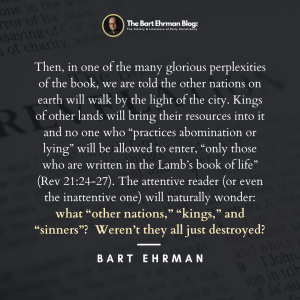
Then, in one of the many glorious perplexities of the book, we are told the other nations on earth will walk by the light of the city. Kings of other lands will bring their resources into it and no one who “practices abomination or lying” will be allowed to enter, “only those who are written in the Lamb’s book of life” (Rev 21:24-27). The attentive reader (or even the inattentive one) will naturally wonder: what “other nations,” “kings,” and “sinners”? Weren’t they all just destroyed?
That particular mystery continues in chapter 22, where we are told that the tree of life in the middle of the street of the city will bring “healing for the nations,” and that the slaves of God (the saints) will worship him and “rule as kings forever” (Rev 22:2, 5). But rule whom? Who else is there? We are then told that outside the city of God are the “dogs, sorcerers, sexually immoral, murderers, idolaters, and liars” (Rev 22:15). But how did they escape the final judgment and the lake of fire? The book of Revelation is nothing if not puzzling.
******************************
But not more puzzling than the teachings of Jesus himself. Is it possible that he and his followers did NOT think of the eternal kingdom as a place of all perfection? Seems possible, but it’s hard to figure out.
I’d welcome your thoughts.
We have two goals at Ehrman Blog. One is to increase your knowledge of the New Testament and early Christianity. The other is to raise money for charity! In fact, in 2022, we raised over $360,000 for the charities below.
Over $2 Million Donated to Charity!





Share Bart’s Post on These Platforms
Leave A Comment
You must be logged in to post a comment.