
In my previous post I pointed out that there seems to be an irony in the teachings of Jesus about the coming Kingdom of God. On one hand, it seems like it should be a completely utopian place where there are no longer any enemies of God or animosity and strife among humans, a return to the glory days (maybe literally only days) of the Garden of Eden. On the other hand, Jesus will be the “king” and his twelve disciples will be “co-rulers” in this kingdom. But why will they need a king and rulers? There is only now peace, harmony, love, and an eternal ecstatic existence without sin, suffering, pain, or misery caused by illegal or illicit activity, right? So what are the rulers going to be doing exactly?
This same irony is found in even more pronounced terms in the final book of the New Testament, the book of Revelation. In my book Armageddon I argue at some length that the values and priorities of Jesus are almost completely missing from this book. Rather than embracing views of mercy, forgiveness, service to others, we find a Christ who is out is out for blood (that’s not too strong a term for it: read the book!) in revenge for how he was treated here on earth. He destroys all of his enemies: the Devil, the “beast” (the anti-Christ figure), their superhuman supporters, all humans who have rejected Christ (in this book, it’s the vast majority of the human race), Hades, and Death itself – all of them are thrown into the Lake of Fire. Gone. Out of the way.
That takes up most of the opening chapters 1-20. And then in chapters 21-22 we learn of the New Heaven and the New Earth that God brings for his beloved saints, the only survivors of the massive onslaught against the world and its inhabitants. But the description of this new world, especially the “New Jerusalem,” not only beggars belief; it creates some serious narrative confusion.
Here is how I discuss the matter in my book Armageddon (Simon & Schuster, 2023).
You like this post? It's free! However, you'll need to be a blog member to read most articles here. Get access to Dr. Ehrman's library of 4,000+ articles plus five new articles per week. Membership starts at $2.99/mth and every cent goes to charity!
Unlock 4,000+ Articles Like This!

******************************
Throughout his narrative John has described untold pain, misery, and suffering, but his book ends on a happy note, at least for the followers of Jesus who have survived. The universe as humans have known it – “the first heaven and first earth” – is taken away and God brings in a new one. This “New Jerusalem” will be the eternal home for the people of God, corresponding, though in much glorified fashion, to the original Jerusalem, site of God’s king, his temple, and his people. Those who enter this new city will feel no more sorrow: God will “wipe away every tear from their eyes and there will be no more death, suffering, weeping or pain” (Rev 21:4). They have “conquered” and now will inherit God’s gifts. They and no one else: all other inhabitants of earth, we are told again, have been tossed into the lake of fire.
The New Jerusalem is a marvel to behold. It is said to be a 12,000 “stadia” cube – that is, about 1500 miles long, wide, and high (Rev 21:16). Its length would be from about New York City to Oklahoma City, its width from Miami to Toronto, and its height, well, 1500 miles. We are never told why it needs to be so high. (Many levels? Amazing skyscrapers? Just on principle?) The city is made of “pure gold” (Rev 21:18). It has twelve foundations made of precious stones, and twelve gates (just twelve? for a city 1500 miles on each side?), each featuring a single pearl. The street (singular!) of the city is pure gold (Rev 21:21). There is no temple in the city – none is needed. God and his Lamb are worshiped directly. And there is no need for light. The glory of God provides all the light needed and the Lamb is the lamp (Rev 21:22).
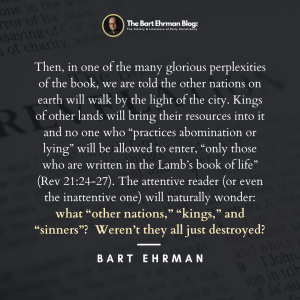
Then, in one of the many glorious perplexities of the book, we are told the other nations on earth will walk by the light of the city. Kings of other lands will bring their resources into it and no one who “practices abomination or lying” will be allowed to enter, “only those who are written in the Lamb’s book of life” (Rev 21:24-27). The attentive reader (or even the inattentive one) will naturally wonder: what “other nations,” “kings,” and “sinners”? Weren’t they all just destroyed?
That particular mystery continues in chapter 22, where we are told that the tree of life in the middle of the street of the city will bring “healing for the nations,” and that the slaves of God (the saints) will worship him and “rule as kings forever” (Rev 22:2, 5). But rule whom? Who else is there? We are then told that outside the city of God are the “dogs, sorcerers, sexually immoral, murderers, idolaters, and liars” (Rev 22:15). But how did they escape the final judgment and the lake of fire? The book of Revelation is nothing if not puzzling.
******************************
But not more puzzling than the teachings of Jesus himself. Is it possible that he and his followers did NOT think of the eternal kingdom as a place of all perfection? Seems possible, but it’s hard to figure out.
I’d welcome your thoughts.
We have two goals at Ehrman Blog. One is to increase your knowledge of the New Testament and early Christianity. The other is to raise money for charity! In fact, in 2022, we raised over $360,000 for the charities below.
You must be logged in to post a comment.Over $2 Million Donated to Charity!





Share Bart’s Post on These Platforms
41 Comments
Leave A Comment
In regard to the other John – is there anything in the Gospel of John which is not in the synoptic gospels that you feel is worth saving to discover something about the actual, historical Jesus? Is John useful for understanding Jesus or just early Christians?
I’d say that every source, John included, that makes historical claims needs to be taken seriously and evaluated based on plausibility etc. My view is that there is little that is found in John and only in John that can be seen as likely historical.
When assessing whether a claim is historical or not, isn’t it first necessary to decide whether the author is actually making a historical claim, rather than simply using a literary device, say?
Is that easy to do or do you just assume that it’s all meant to be historical?
Absolutely. But if a source is telling stories about what a historical person said, did, and epxerienced, the default assumption is that the author is making historical claims; only if there are reasons in what the author writes to think s/he means it to be literary/ not historical, can the assumption be trumped. So too the other way around: if a person is writing fiction and a reader wants to think s/he is meaning in places to make historical claims, there needs to be some kind of textual clue to that end.
Could John 1’s theological description of the word not be that clue for them at that time? I assume it wasn’t just because it doesn’t sound it was received that way but perhaps they thought it would be?
I’m not quite sure what you’re asking, but I will say that most readers of John assume that this theological descriptoin of Christ is “historically” true — that is, he really was with God in the beginning and it was through him God created the world.
Hello, Veronica. Forgive my intrusion. I propose that a community of former Essenes is responsible for the content of the Synoptic Gospels. I propose that the Gospel of John was written by the Christian community who buried their “Beloved Apostle”. I propose that the actual Jesus of Nazareth was 20 years younger than John the Baptist. Jesus was a young disciple of John and eventually was dispatched upriver to a site in Samaria. Mary, the mother of Jesus, and John stood alongside the Cross during Jesus’s ordeal. John remembered the result when the Roman soldier thrust his short sword (or spear) under the sternum to pierce the heart (a maneuver taught to gladiators and soldiers for a quick death). Blood and water exited the wound. The “water” was blood plasma. The cardiac membrane was swollen from the spontaneous aortic rupture. The RBCs rise like cream in whole milk. Have you seen raw milk separate into cream and the nonfat milk? Whole blood separates similarly. Plasma is the color of wheat – a pale yellow pastel. Have a good day.
In regards to this, I don’t fully get the objection to there being Jesus as King with 12 dukes. Isn’t that the point of Jesus being the Moschiach? At some point he is to rule – and he had 12 disciples to rule over each tribe of Israel?
It also seems you are making Marx’s mistake – he thought once the higher stage of communism was achieved that the state would wither away and be useless. The myth is that God saved Noah as the most righteous and blameless – but had his descendents not included the nonrighteous? Does it say there would be no new souls at that point? Could those who are righteous on judgement day not stray from this? Could new cultural contexts not require new laws? What do I do if my full self drive Tesla gores my neighbor? Maybe it’s different than the ox.
I think you may be responding to something I said? If so you mayhave misunderstood me. I was saying that Jesus probably did say he would have the 12 serving under him in the kingdom, and the reason that he probably said that for real (as he is recorded as saying in Matthew) is that Judas was one of the 12, and someone later would be unlikley to make up the idea that *he* (who was one of the 12 Jesus was speaking to) would be one of the future rulers. Since it wouldn’t be made up by a later Christian story-teller, it probably goes back to Jesus.
It was in regards to this from this same blog entry: “On the other hand, Jesus will be the “king” and his twelve disciples will be “co-rulers” in this kingdom. But why will they need a king and rulers? There is only now peace, harmony, love, and an eternal ecstatic existence without sin, suffering, pain, or misery caused by illegal or illicit activity, right? So what are the rulers going to be doing exactly?”
It may be a teaser for the book rather than the implication, but it isn’t about Judas. It’s about Revelation.
Ah, sorry — I didn’t know the context. My point is that if there is a perfect world where there is no sin, no evil, no malice, no crime, no enemies, no aggressions, etc. then there doesn’t NEED to be a king and other rulers. It rules itself.
Yes, I understood that point – but I was challenging it. The position you are taking is one of a static quality of human beings. The author presumably felt they were saved, but likely struggled with impulses they considered impure one way or another and had to actively work to meet their understanding of being saved. If someone is good enough to be saved at the end of days, you assume they will remain that good and disregard the possibility of corruption. It seems impossible without predestination where those who are good are destined to remain good – that they are free of that “sin nature.” Was predestination a concept before Calvinism?
I am less sure on my second point – new souls. Is it in there that there are no new souls at that point which might not be perfect or is that whole there is no man or woman in the kingdom of Heaven thing negate that?
But mainly it’s about change – ebbs and flows. If everything is the same forever – that seems a bit like Hell. A static eternity would drive you insane. Greeks 500 years earlier got that.
One of my questions is, If this new kingdom is so wonderful and free of sin and pain, why didn’t God put mankind there in the first place? Why allow so many to suffer throughout their lives, only to suffer again at death, if it didn’t have to be that way? I guess that’s a variation of the Epicurean paradox.
He did. They mucked it up.
Mucked it up with the help of a tempter. Will there be similar temptations in the new kingdom?
blank slate- John Locke.
tempter didn’t muck it up. it was clarifying what Eve understood of the Order, since God did not directly tell her.
Revelation 19 describes the destruction of the beast’s forces, not necessarily every human being alive. Revelation 20 subsequently describes the judgment of the dead. The question is whether the subsequent vision permits any human population beyond the inhabitants of the New Jerusalem.
The possibility of differentiated roles within the coming kingdom is worth investigating, but the passages don’t tell us explicitly that the nations are a lower class of saved humanity, that kings rule over unredeemed people, or that sinners continue to exist *indefinitely* outside the city.
There’s another possibility: Revelation combines images drawn from different prophetic traditions (here, Isaiah 60:1-11) without resolving every apparent tension into a single systematic account of the afterlife.
Also, the phrase “healing for the nations” in Revelation 22:2 is intriguing. If the nations have already been restored, why do they need healing? I wonder if the imagery describes the ongoing, abundant life of the new creation rather than the treatment of an existing disease. But the wording deserves closer examination.
What I also wonder- is Revelation 22:15 describing people who actually inhabit the eternal world outside the city, or is it describing the excluded as a continuing rhetorical contrast to the holy community?
Everyone who has the mark of the beast is tossed into the lake of fire. And yes, those outside are clearly the non-chosen who reside in other places (e.e. 21:24-27)
Revelation never explicitly identifies the nations in 21–22 as the non-elect. Revelation 20:15 states anyone whose name wasnt found in the book of life was thrown into the lake of fire. If those outside the city are unredeemed, how do they survive final judgment? The distinction between those condemned for bearing the beast’s mark and a separate class of “non-chosen” survivors may be possible, but Revelation never explicitly establishes such a category.
The imagery of ‘nations’ may draw on OT prophetic tradition. Micah 4:1–5 envisions nations streaming to Zion to learn God’s ways, yet returning to their lands/retaining their distinct identities. Verse 5 (after judgment) describes people walking in the names of their gods while Israel walks in the name of YHWH! This suggests an eschatological vision where nations retain distinction from God’s covenant community.
Revelation 21:24–26 and 22:2 similarly depict nations walking by the city’s light, kings bringing their glory into it, and the tree of life bringing healing to the nations.
This doesn’t prove Revelation envisions a separate class of redeemed humanity outside the city. But it cautions against assuming the nations must be identical to its inhabitants and certainly doesn’t establish that unredeemed people escape judgment.
Maybe the author of Revelation got a little crazy with the pen? Perhaps he needed a good editor to make the whole thing fit together and make better sense?
I’ve always been bugged by the height of the walls around the New Jerusalem. Who wants to live in a city whose walls stretch up to outer space and the satellites? Not so long ago, I was watching some stuff about the Israeli Iron Dome, the same day I watched some stuff about someone involved with satellites. I got thinking that maybe the walls of the NJ could be a protective shield instead of a solid enclosed wall.
Regardless, whether the New Jerusalem is science fiction or has something to do with a real thing, I wouldn’t mind living in an area where no one could throw missiles in at me.
Hello, Helen Young. You made a good point. The author was describing high defensive walls. Not high and thin, but high and correspondingly wide at the base. The higher the wall, the wider the base. Thick defensive walls will absorb destructive attacks. Alexander the Great led a murderous thieving army of mercenaries who defeated the defensive walls. Romans defeated defensive fortifications.
“John of Patmos” fused together Jewish, Zoroasterism, Yazidism, Hinduism, Buddhism, and Jainism in a fictional narrative. The Great Dragon and the Pregnant Woman is a myth from Krishna (Vishnu) Hinduism. Romans branded the slaves with hot iron, but the Hindus of India were tattooing all castes. “666” was an ink tattoo and numerically linked to the Roman Emperor Nero. But, the Beast was modeled after Alexander the Great. Have a good day.
Perhaps these are simply the thoughts of the Gospel writers.
After all, isn’t that all we have?
If you strip away the theology and the divinity, then Jesus, as the human king of an earthly theocratic ‘kingdom,’ sounds plausible. We have had other theocratic states, such as Cromwell’s English Republic, modern Iran or even Vatican City; and they have all had some form of governmental structure and their ‘subjects’ were/are far from equal.
The gates of the city remain open, so presimably the dogs etc outside can still repent and find their way in. But yes, its a very bloodthirsty book. The author seems to be imagining the coming of the Kingdom of God in terms of the arrival of a new earthly kingdom, with bloodshed and armies trampling about. The Roman empire was almost destroyed by rebellion and civil war in the 60’s AD – the First Revolt and the sack of Jerusalem was part of that – and the book could be coloured by memories of that.
I don’t think there was any serious threat to Roman rule in the 60s. In the third century, yes.
To me, the heavenly Jerusalem seems to be both a golden city and a something abstract. Some of the description fits a real city with a street (one street) and a wall with gates and a tree inside, but no temple. A city. Some of the description is just absurd. The city is the size of the whole Roman empire and 1500 miles high and made of gold. So I toyed with the idea that the city could be a solid cube. This would account for all the things described in Revelation. It would have three times the mass of the Moon and when approaching Earth the tidal forces would be insane. So there you have it. It would look nothing like a city, but the text is already inconsistent, so…
The more I read New Testament scholarship, the more I wonder whether we sometimes attribute to biblical authors a degree of precision and literary sophistication they neither possessed nor considered necessary. Perhaps they were simply less meticulous storytellers than we assume.
For example, some regard Jesus’ appearance to “the Twelve” (1 Corinthians 15:5), despite Judas’s betrayal, as a historical contradiction. But perhaps “the Twelve” was merely a conventional designation, or the author simply did not care whether there were eleven or twelve. Are we imposing modern standards of consistency on ancient writers?
Another observation concerns heaven. Compared with hell, biblical authors seem to struggle remarkably to describe it. Perhaps this reflects a fundamental truth: human happiness cannot be determined by external circumstances alone.
I once had a very wealthy friend who tragically died by suicide. His experience reminds me that material abundance offers no guarantee of inner fulfillment.
Perhaps the difficulty of describing heaven reveals something profound: **true happiness depends on something far more elusive than our surroundings.” I suspect this is also part of what makes this blog’s contribution to humanitarian causes so meaningful.
It must have been a powerful hallucinogen the author(s) partook of prior to dreaming up this cornucopia of ideas. These are absolutely, fantastic imaginations; it seems our current technology isn’t quite up to par, yet, with the descriptive “new” city, especially the 1,500 miles high part.
Yeah, either there are different levels or God just likes to make things creazily impressive.
Just a few decades after Revelation was penned, a Christian movement called Montanism sprung up in the exact same region. They were fully convinced that the New Jerusalem was physically, literally about to drop out of the sky into a local village in Phrygia. They gathered there to wait for it. They’re still waiting…
I believe it was a about a century later, but yes, they were hopeful…
A few scholars identify “John of Patmos” as Cerinthus of Ephesus. Cerinthus was an early Gnostic Christian whose presence in Ephesus was a concern of the Apostle John, a resident of Ephesus. In earlier posts, I have proposed that former Essenes became the germ nucleus of the Gnostic Christians. Cerinthus might have been a former Therapeutae of Alexandria, Egypt. Same proto-Gnostic group in two locations. Buddhist missionaries had arrived in Egypt by 250 BCE. They were basically Krishna Hindus. The Essenes and Therapeutae had fused together Zoroasterism, Yazidism, Hindu, Jain, and Buddhist ideas on a Jewish foundation. The Great Dragon who chased the pregnant woman is a preserved Hindu myth. (The woman was pregnant with an avatar of Vishnu, possibly Krishna.) Romans branded slaves as cattle is branded, but the Hindu applied ink tattoos to all castes. “666” is an ink tattoo. The Beast was modeled after Alexander the Great. The New Heaven and the New Earth might be Zoroasterism in origin. Armageddon is prophecied in both Zoroasterism and Krishna Hinduism. Have a good day.
I don’t know of any modern scholars or do, but others have said so in the past.
Cerinthus was the atypical Gnostic. He had his own unique synthesis of ideas. He was labeled as a “heretic” and was responsible for the production of some manuscripts. Scholarship is divided whether he wrote the Gospel of John, or if the Ephesus community of Christians who buried their “Beloved Apostle” wrote the Gospel of John in order to counter the message of Cerinthus.
Hey bart is their any conservative Christian’s scholars who you respect who are still active? I’m thinking of like an NT Wright
Sure. Tom Wright is highly learned. We just disagree on many (many) things. But there are many others, e.g., my good friend Michael Holmes. It kinda depend on what we mean by “conservative” and by “respect.” I try to respect most people who do their best and have an honest opinion even if I disagree with it. The peole I disrespect are either (in my judgment) willfully blind and personally unpleasant.
Good people disagree now. Good people compete now. Maybe good people in the heavenly kingdom will do the same, only in peaceable, sportsmanlike, and intelligent ways, which is the ideal even now on earth.
Let the good times roll and death & desctruction really don’t mix well 🤔
Micah 4:1–5, especially verse 5 is fascinating! It seems to suggest a kind of religious pluralism in the eschatological order. The nations come to learn YHWH’s ways, submit to his judgment, and live in peace, yet verse 5 says that each nation walks in the name of its own god, while Israel walks in the name of YHWH. Could the passage envision a universal order of divine justice and peace without requiring every nation to adopt the same religious identity? What’s your take?
Yup, pretty fascinating. Closely parallel to Isa 2:2-4. The key seems to be the opening verse(s) that many peoples of the earth (all of them?) will eventually flock to the God of Israel and there will be peace then among all nations. For now they haven’t done so, but they will.
Maybe the apparent contadictions come from reading the imagery too literally.
Perhaps the New Jerusalem may be less a physical city than a picture of transendant spiritual wholeness — a state in which what was divided is brought back into harmony. To play with this thought, the “nations,” “healing,” and even those outside the city may describe different conditions of consciousness? rather than a literal post-judgment population. That might open for a less inconsistent view and more like a symbolic description of transformation.