
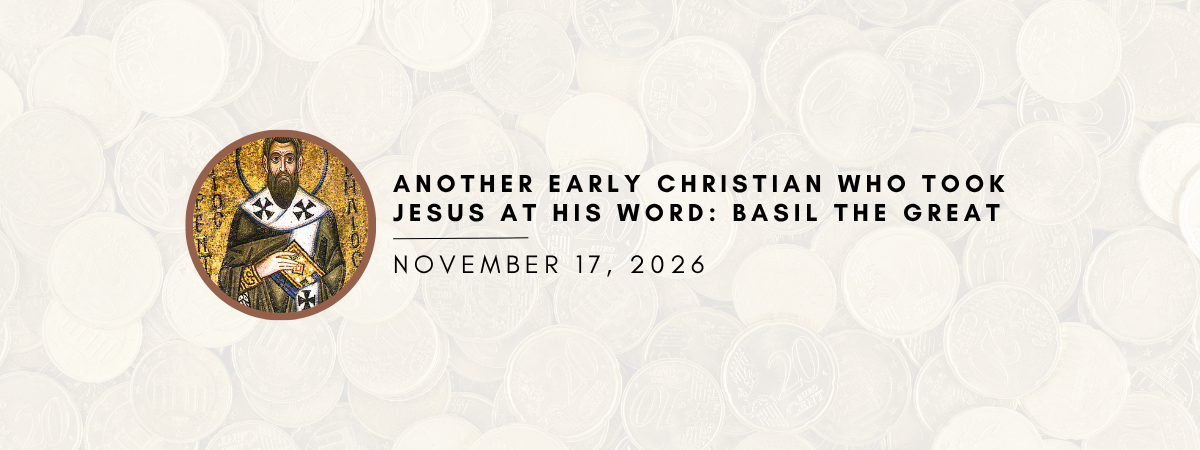
In my last post I discussed “Anthony” the founder of the monastic movement, who took Jesus literally and sold all he had to give to the poor. Here I discuss another important figure from somewhat later, Basil the Great (330-379 CE), who also was connected with monasticism, but a different kind – not living in complete isolation but in a community of like-minded folk. Basil was one of the most influential church fathers of early Christianity both for his theological insights (he helped formulate the orthodox doctrine of the Trinity) and for his institutional inventions (leading to the invention of public hospitals).
Here is some of what I say about him in my book Love Thy Stranger (Simon & Schuster 2026).
******************************
Some Christian monks did not live in isolation (as “anchorites”) but in monastic communities (“coenobitic” monks). An important development in such communities occurred in the middle of the fourth century, at just about the time Athanasius was writing his famous account of Anthony, a development with serious ramifications for the ethical investments and social commitments of the Christian church down till today.
You like this post? It's free! However, you'll need to be a blog member to read most articles here. Get access to Dr. Ehrman's library of 4,000+ articles plus five new articles per week. Membership starts at $2.99/mth and every cent goes to charity!
Unlock 4,000+ Articles Like This!

A key figure in the movement was named Basil (later called “Basil the Great”), born into an affluent, prominent, and pious Christian family in Caesarea, the capital of the province of Cappadocia in Asia Minor.[i]
Basil’s father provided his early schooling, preparing him for a vocation as a rhetorician; later he pursued his education in Constantinople and then Athens before returning to his home city to practice law and teach rhetoric. By then his father had died, and as the oldest son Basil inherited extensive landholdings in several provinces of Asia Minor. In his mid-twenties, he tired of his chosen vocation and converted to an entirely new way of life. As he later wrote:
Then I read the Gospel, and I saw there that a great means of reaching perfection was the selling of one’s goods, sharing them with the poor, giving up all care for this life, and refusing to allow the soul to be turned by any sympathy to things of earth. (Epistle 223, “Against Eustathius of Sebastia”)[ii]
Like Anthony before him, Basil saw the path to “perfection” in Jesus’s words to the rich man in Matthew 19:21 (“Sell all you have and give to the poor”) as one to be taken literally. Spiritual perfection actually did require material divestment.
In 356 CE Basil sold a good deal of his property, shifted to a monastic lifestyle, and within two years had begun his own monastic community. Some eight years later he decided to move back into society, in part to engage in theological debates over Christ and the Trinity that were tearing the Christian community apart. He became a leader of the church in Caesarea and in 369 CE came to face a crisis that shaped his thinking and led to some of his most important writings on wealth and its legitimate use.[iii]
The famine that hit Asia Minor that year was catastrophic almost beyond imagination.[iv] The area had experienced a dry winter and spring. A drought ensued and crops did not grow, leading to massive unemployment (with no jobs in an agricultural economy), school closings, and eventually widespread starvation. In one of his sermons from the time, Basil refers to an unspeakable dilemma facing parents: With so little food, do they sell one or more of their children into slavery to buy enough to keep the rest of the family alive? Or do they simply all go down together?
Consider now the violent struggle that takes place between the desperation arising from famine and a parent’s fundamental instincts. Starvation on the one side threatens a horrible death, while nature resists, convincing the parents rather to die with their children. Time and again they vacillate, but in the end, they succumb, driven by want and cruel necessity. (I Will Tear Down My Barns, 4)[v]
In other sermons, Basil lambasts the many wealthy in his congregation who “Fast, pray, sigh, and demonstrate every manner of piety, so long as it costs them nothing, yet would not part with a penny to help those in distress” (To the Rich, 3). For Basil, hoarding wealth while others are in need violates the very essence of the Christian faith, to “love your neighbor as yourself.” He follows with an argument that is uncommonly simple and difficult to refute: “Those who love their neighbor as themselves possess nothing more than their neighbor.” How could it be otherwise?
Basil gives no wiggle room to anyone who imagines there may be ways to love a poor neighbor without actually sacrificing material resources—for example, by praying for those in need. He is quite explicit: “Care for the needy requires the expenditure of wealth” for “The more you abound in wealth, the more you lack in love” (To the Rich, 1). Indeed, “If you had truly loved your neighbor, it would have occurred to you long ago to divest yourself of this wealth” (To the Rich, 1).
Basil’s sermons are meant not only to guilt-trip his affluent parishioners in this time of dire need, but also to help them think through the issue in Christian terms. What is the use of having far more wealth than necessary? Mortality is inevitable. As Basil puts it in one particularly clever rhetorical flourish: “What is the point of having acres and acres of land, fields, and orchards,” when in the end, “all that awaits you is a six-foot plot of earth?” (ch. 6).
Basil subscribes to the kind of Christian communal sharing modeled by the earliest followers of Jesus in Acts 4:32–35. Those who hoard are robbers who “take for themselves what rightfully belongs to everyone” (I Will Tear Down My Barns, 7). As he says, “If we all took only what was necessary to satisfy our own needs, giving the rest to those who lack, no one would be rich, no one would be poor, and no one would be in need” (I Will Tear Down My Barns, 7).
Those who refuse to do so are in danger of damnation. Basil reminds his congregation of Jesus’s words to the “goats” in Matthew 25:41–43, the ones sent to the eternal flames because they did not provide for the hungry, thirsty, and naked: “Those who are under accusation in this passage are not those who have stolen anything,” he writes, “these charges are rather leveled against those who have not shared with others” (I Will Tear Down My Barns, 8).
******************************
[i] For a good overview, see C. Paul Schroeder, “Introduction,” in On Social Justice: St. Basil the Great (St. Vladimir’s Seminary Press, 2009).
[ii] Translation of Blomfield Jackson, St. Basil: Letters and Select Works, Nicene and Post-Nicene Fathers, series 2, vol. 8 (Hendrickson, 2024; original 1895), 263.
[iii] Susan R. Holman, The Hungry Are Dying: Beggars and Bishops in Roman Cappadocia (Oxford University Press, 2001).
[iv] The three of them formed a kind of triumvirate, known collectively as the Cappadocian Church Fathers, most famous for their roles in establishing the traditional doctrine of the Trinity.
[v] All translations are from Schroeder, On Social Justice.
We have two goals at Ehrman Blog. One is to increase your knowledge of the New Testament and early Christianity. The other is to raise money for charity! In fact, in 2022, we raised over $360,000 for the charities below.
Over $2 Million Donated to Charity!





Share Bart’s Post on These Platforms
Leave A Comment
You must be logged in to post a comment.