Sorting by

×

Early Christian Reactions to “Heresies” in a Nutshell

In recent posts I gave brief overviews of issues from the earliest centuries of Christianity that would take (and have taken) entire books to cover in adequate length -- Christian relations with Jews and their relationship to hostile outsiders (persecutions).   In this post I deal with the third key antagonistic social situation that arose early on in the faith, the relationship of "orthodox" Christians with "heretics." For long-time readers of the blog, this will probably be more familiar territory -- I've dealt with related issues a lot; but whether you have a firm grasp on the matter or no grasp at all, here is a nutshell discussion to provide some of the basics one should probably know. Again, this is from my textbook, The Bible: A Historical and Literary Introduction, 2nd ed. (Oxford University Press). ****************************** Christianity was highly unusual among the religions of the ancient world because it insisted that it mattered what you believed. As we have seen on the blog  before, in pagan religions, “beliefs” played very little role at all: what [...]
2026-03-30T10:05:08-04:00April 2nd, 2026|History of Christianity (100-300CE), Public Forum|

The First Attempts to Wipe Out Christianity

Persecutions of Christians did not become “empire-wide” or generally threatening until the middle of the third century, over 200 years after Jesus’ death.  It is a mistake to think all Christians had to go in hiding in the early years/decades/centuries of the church because they were seen by the Roman state as an impending threat. Here I continue with this short series describing the imperial persecutions of Christians, from my book The Triumph of Christianity (Simon & Schuster).   ******************************   Valerian (ruled 253-60 CE) Two years after Decius (discussed in the previous post), Valerian assumed the mantle of office.  He was the first emperor to issue decrees specifically directed against the Christians and thus the first to sponsor an empire-wide persecution.[1]  The initial decree appeared in 257 CE, requiring church leaders to participate in pagan rituals and banning Christians from meeting en mass in cemeteries.  More significant was a rescript the next year ordering the execution of all Christian bishops, presbyters, and deacons in the city of Rome itself.  Christians at the [...]

2026-03-27T09:39:08-04:00April 1st, 2026|History of Christianity (100-300CE)|

When Emperors Became More Involved in Christian Persecutions

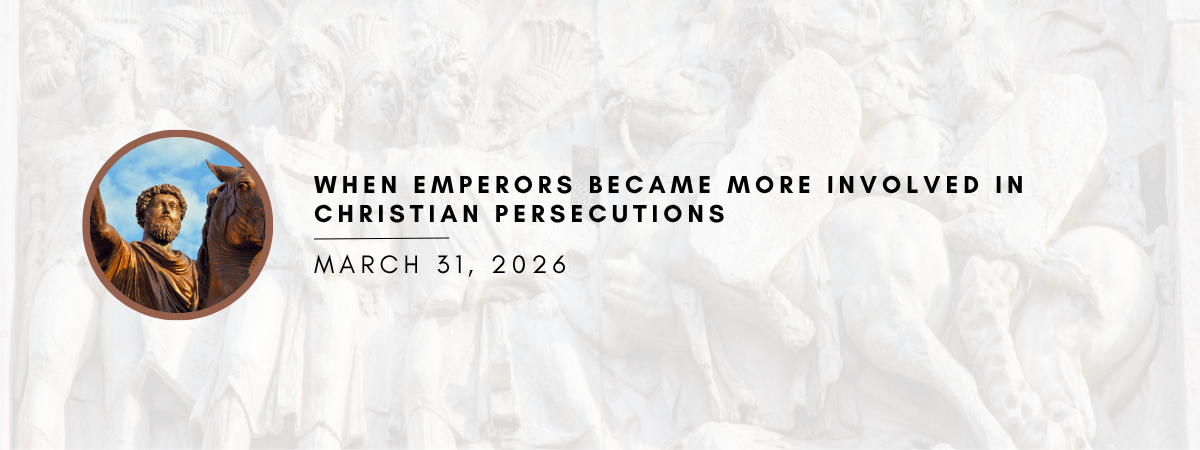
When did Christianity first become “illegal” in the Roman world? In my previous post I described the Christian persecutions in its early decades, including those under Nero in Rome in 64 CE and Papias in Bythinia in 112 CE.   It would be useful to continue the tale, to see just what the known persecutions were about.  This is worthwhile information for anyone interested at all in how Christianity started out and was received in the Roman world. There was no “official” persecution (pursued or permitted by a Roman emperor) for another half century.  I’ll pick up the story from there, based what I say in my book The Triumph of Christianity (Simon & Schuster).  This will take two posts, focusing on the emperors’ roles in each case.  Part of the point will be that persecution rarely happened, at least at an emperor’s bidding, and Christianity was not declared in all effects illegal until the early fourth century – just a decade before the first emperor actually converted (Constantine, in 312 CE).   ******************************* [...]

2026-03-27T11:08:11-04:00March 31st, 2026|History of Christianity (100-300CE), Public Forum|

Early Persecutions of Christians, in a Nutshell

Why were early Christians persecuted?  How extensively?  Were they early on seen as a threat to the state? In my previous two posts I discussed the relationship of Jews and Christians -- and how Christians became anti-Jewish -- in the early church.  It occurred to me it would be good to talk about two other groups Christians had problems with early on, one from outside their ranks with persecutors (unofficial and official) and one with in their own ranks with "false believers" (heretics). This post will be a snapshot look at persecution in the early centuries.  Like the posts on Jews and Christians, this one is taken from an excursus in my textbook, The Bible: A Historical and Literary Introduction, 2nd ed. (Oxford University Press). ******************************     Many people have a false idea about the early persecutions of Christians—possibly because of too many bad Hollywood movies. Contrary to what is often thought, Christianity was not an illegal religion in the early centuries of its existence, and Christians did not have to go into hiding in [...]

2026-03-27T09:27:56-04:00March 29th, 2026|History of Christianity (100-300CE), Public Forum|

A Glimpse of Proto-orthodox Views in the Letters of Ignatius

Yesterday I introduced the letters of Ignatius of Antioch (from around 110 CE), a bishop of the largest church in Syria (and one of the largest in the world at the time), written while en route to his martyrdom in Rome, to several of the churches that he had met with during his journey.  The letters are addressed to churches in Asia Minor, in Ephesus, Magnesia, Tralles, Philadelphia, and Smyrna, along with a letter to the bishop of Smyrna, Polycarp (who also wrote a letter included among the Apostolic Fathers), and a letter to Rome -- seven surviving letters altogether. That has long struck me as interesting: we have seven authentic letters of Paul; seven letters dictated by Christ to churches of Asia Minor in the book of Revelation (including two of the churches addressed by Ignatius); and there are seven letters of Ignatius.  Seven is the perfect number.  How odd.  I've tried to figure out a rhyme or reason for it, but don't think there is one.  We just *happen* to have seven authentic [...]

2025-12-02T15:42:51-05:00December 4th, 2025|History of Christianity (100-300CE)|

Was Jesus Christ Two Beings, One Human (Jesus) and One Divine (Christ)?

Just to show how strange and, uh, detailed scholarship can be even in New Testament studies, I want to conclude this small thread on the five-chapter book of 1 John by discussing a textual variant in its text that I was obsessed with for years.  It involves how different manuscripts word just one verse (1 John 4:3), and in fact just one word in that one verse, which is, as it turns out, only a four-letter word.   Early in my career I wrote a 22-page article on this word.  Ha! (I guess that's over five pages per letter....) The word is "LUEI" (in Greek) and it means "to loose."  It is found as an alternative reading for 1 John 4:3, which in nearly all our surviving textual witnesses says (I've highlighted the key words): "Every spirit that does not confess Jesus is not of God.  This is the spirit of the antichrist, of which you heard that it was coming and now is in the world already."  I talked about the meaning [...]

The Birth of Christianity (My Other Class): Check Out the Writing Assignments!

I am (also) this semester teaching one of my favorite undergraduate courses, The Birth of Christianity, which more or less covers the history and literature of Christianity from just after the New Testament period up to the mid to end of the 4th century, focusing mainly on issues of the second and third centuries.  For that class students have a short writing assignment every week; they come up with a 2-page response to a set of prompts usually based on reading they've done of ancient texts, and then we discuss their views in class. I've always had students do "position papers," as I call them, in which they have to take a stand on a somewhat controversial issue connected with a topic, as a way to get them to THINK about the issue ahead of time.  For these papers I'm not looking for "the right answer," and simply mark them Satisfactory (if they've clearly thought about the issue and established some views about it) or Unsatisfactory (if they more or less blew it off).  Students [...]

How Many of Those Early Christians Could Read?

How many Christians by near the end of the New Testament period – say, 100 CE – could read and write?   In his intriguing article “Christian Number and Its Implications,” Roman historian Keith Hopkins tries to come up with some ballpark figures. As you may recall, he is assuming that there were Christian churches in about 100 communities in the world at the time (we have references to about 50 in our surviving texts, and he is supposing that maybe there were twice as many as we have any evidence for); and he agrees that if Christianity started out with about 1000 believers in the year 40 then with a growth rate of 3.4% per year, by the year 100 there would be just over 7000 Christians in the world. That would mean the 100 churches would have an average of 70 believers.  (Some of course would be larger – think, Rome – others would be much smaller; we’re talking averages here.  And if Rome did have, say 120 believers, they would be meeting [...]

2025-09-10T13:08:51-04:00September 10th, 2024|History of Christianity (100-300CE)|

Women and Gender: Early Christianity in a Patriarchal World

Jesus and his earliest followers, including Paul, may have been unusually open  to women playing an important role in the community of the faithful, but it was not long until women's voices and activities came to be suppressed.  It is interesting to see both how that happened, historically, and how some women found alternative ways to find expression for their faith. This is one of the topics I cover in my book After the New Testament (2nd edition; Oxford University Press, 2014).  As I've said, in some ways it may be the most useful book I've published.  It is an anthology of passages from major Christian writings, both proto-orthodox and "heretical" of the second and third centuries, organized thematically, in modern English translations, with introductions both to the themes themselves and to the individual writings. Here is the introduction to the section where I provide excerpts of early Christian writings on women and gender. ****************************** Women played significant roles in the early Christian movement, starting with ministry of Jesus himself.  In Gospel traditions both early and [...]

Ancient Ways of Interpreting Scripture

Did the earliest Christians interpret texts the way people do today?  I'm not asking if they always had the same interpretation; I'm asking if their approach to and methods of interpretation were the same.  It's a surprising answer.  In particular, the various ways texts got interpreted may not be expected. I deal with it in my book After the New Testament (2nd edition, Oxford University Press, 2014), the anthology of early Christian texts that I discussed on the blog a week or so ago. The book presents modern translations of Christian writings from right after the New Testament roughly up to the conversion of Constantine (so, the second and third centuries, 100-300 CE).  I organized them according to topics and for each topic I gave an explanatory introduction, then gave a brief introduction for each of the writings themselves as they occurred. Here is the introduction for the section dealing with how early Christians interpreted the Bible. Text and Meaning:  The Interpretation of Scripture in Early Christianity The Bible was important from [...]

What If Another Christianity Had Won?

If only one form of early Christianity won the contest for domination, what were the results -- what the gains and losses from that "triumph"?  And what would have happened to world history if things had gone in another direction?  This is my third and final post on my book Lost Christianities, taken from its Introduction (Oxford Press, 2003).   ******************************* The Stakes of the Conflict Before launching into the investigation, I should perhaps say a word about what is, or at least what was, at stake.  Throughout the course of our study I will be asking the question: what if it had been otherwise?  What if some other form of Christianity had become dominant, instead of the one that did?[1] In anticipation of these discussions, I can point out that if some other form of Christianity had won the early struggles for dominance, the familiar doctrines of Christianity may never have become the “standard” belief of millions of people around the world – including the belief that there is only one God, [...]

More Lost Christianities

In my previous post I discussed the wide variety of early Christianities and their ranging views.  Here I consider some aspects of the Scriptures known and used by these various groups.  Again, this comes from the Introduction to my book Lost Christianities (Oxford Press, 2003). ****************************** The Lost Scriptures The Gospels that came to be included in the New Testament were all written anonymously: only at a later time were they called by the names of their reputed authors, Matthew, Mark, Luke, and John.  But at about the time these names were being associated with the Gospels, other Gospel books were becoming available, sacred texts that were read and revered by different Christian groups throughout the world: a Gospel, for example, claiming to be written by Jesus’ closest disciple, Simon Peter; another by his apostle Philip; a Gospel allegedly written by Jesus’ female disciple Mary Magdalen; another by his own twin brother, Didymus Judas Thomas.[1] Someone decided that four of these early Gospels, and no others, should be accepted as part of the canon [...]

The Arch-Heretic of Them All? Simon of Samaria — Guest Post From Dr. David Litwa

This now is the final guest post by David Litwa, one of the most prolific scholars of New Testament and Early Christianity over the past ten years.  David was a graduate student at Duke some years ago and took a couple of my PhD seminars over at UNC.  He is now at Boston College.  (See:  M. David Litwa - School of Theology and Ministry - Boston College (bc.edu) All of these posts are tantalizing introductions to (three different) books he has written for a general audience.  This one is about one of the most infamous figures from the early church.  But is his infamy deserved?  Let us know what you think! ****************************** With Simon of Samaria, we enter the maelstrom, a Charybdis of confused and cacophonous incriminations, slanderous stories, and inimical innuendo. It seems that the man Simon existed—as much as any other figure in recorded history—but he has long since been swallowed in the abyss of myth and countermyth. Anti-Simon stories and reports begin to appear in the early to mid-second century [...]

The New Book I’m Writing About Altruism: Putting It In a Nutshell

As I've been writing my new book, tentatively called "The Invention of Altruism: How the Teachings of Jesus Transformed the Conscience of the West," I've been thinking about how I might summarize the basic argument.  Here's what I've got to this point.  I'd be happy to hear your reactions. ****************************** Most people I know are moved by news of tragedy.  A terrible earthquake, a drought, a famine, a flood, displaced people, innocent victims of military aggression, -- we feel pity for those who pointlessly suffer and sense a desire, even an obligation, to help, for example by donating to disaster relief.   Almost never do we know the people in need; they are complete strangers, often in far-off lands, whom we will never meet and possibly wouldn’t like if we did.  Yet we – at least multitudes of us – want to help. This sense of moral obligation to strangers in need is unnatural.  It is not written into the human DNA nor did it exist in the ancient roots of our Western cultural [...]

An Early Christian Advocate of Licentious Living? Carpocrates — Guest Post by Dr. David Litwa

Here now is a second post on a, well, rather unusual and widely unknown Christian group, by guest blogger David Litwa, one of the most prolific scholars of New Testament and Early Christianity over the past ten years.  David was a graduate student at Duke some years ago and took a couple of my PhD seminars over at UNC.  He is now at Boston College.  (See:  M. David Litwa - School of Theology and Ministry - Boston College (bc.edu) Each of these posts is a tantalizing introduction to a (different) book he has written for a general audience. In this one he deals with a group, and its leader, with a steamy but, he argues, completely undeserved bad reputation in early Christianity.  Let us know what you think! ****************************** Who was Carpocrates? Most early Christian writers depicted him as the founder of a licentious cult, a magician, and a practitioner of “pagan” rites. They said that his followers practiced indiscriminate sex at their communal dinners. Carpocrates, said his opponents, demanded that his followers engage in [...]

A Bizarre “Gnostic” Religion: The Naassenes – Guest Post by Dr. David Litwa

I'm pleased to publish three posts by guest blogger David Litwa, one of the most prolific scholars of New Testament and Early Christianity over the past ten years.  David was a graduate student at Duke some years ago and took a couple of my PhD seminars over at UNC.  He is now at Boston College.  (See:  M. David Litwa - School of Theology and Ministry - Boston College (bc.edu) Each of these posts is a tantalizing introduction to a (different) book he has written for a general audience.  This one starts off with a blast!  Let us know what you think! ******************************   It is the only Christian group in antiquity to be accused of homosexual sex, of worshipping a snake, and of attending the mysteries of the Great Mother (Cybele). They worshiped God as Human, explored the Phrygian deity Attis as a manifestation of Jesus, and directly called themselves “gnostics.” They are known through a gossamer thread of tradition, a report preserved only in a worm-eaten medieval manuscript tucked away on Mount Athos, where no [...]

What We Knew about the Gospel of Peter Before We Had the Gospel of Peter

This is the second of my two posts on the Gospel of Peter.  When the fragment that we now have was discovered by archaeologists in a cemetery in Egypt in 1886, it was almost immediately recognized as the Gospel of Peter, not because it had a title on it, but because it fit so well a description of the Gospel in the writings of Eusebius, the early church historian. In two places in his ten-volume history of Christianity (from Jesus to his own day around 300 CE) Eusebius mnentions the book twice as one of the writings not accepted by the church as Scripture (Church History, 3. 3. 2; 3. 25. 6).  And on one other occasion, Eusebius discusses the book at some length, in order to show why it had been excluded from consideration from the canon. The story involves Serapion, a bishop of Antioch at the end of the second century.  Based on an account he had read from Serapion’s own hand, Eusebius indicates that Serapion had first-hand knowledge of the [...]

The Two Gods of Marcion and the Forgeries in the Name of Paul

Here I continue my discussion of Marcion, the arch-heretic of the second century, whose followers forged writings in the name of Paul to support their view that the God of the Old Testament was not the God of Jesus and Paul.  Recall:  Marcion argued that the God of the Old Testament was the Jewish God who created this world, chose Israel to be his people, and then gave them his law.  He was a just, wrathful God:  not evil, just ruthlessly judicial.  The God of Jesus, on the other hand, was a God of love, mercy, and forgiveness.  This good God, superior to the God of the Jews, sent Jesus into the world in order to die for the sins of others, to save people from the wrathful God of the Old Testament.  Salvation comes, then, by believing in Jesus’ death. To prove his point, Marcion pointed out the contradictions between the Old Testament God and the God of Jesus. The God of the Old Testament sent his prophets, one of whom was Elisha.  One [...]

When Is Forgiveness not Forgiveness?

Does love really "mean never having to say I'm sorry"?  Is "unconditional forgiveness" possible?  Is it even Christian?  Is forgiveness itself always possible, conceivable, feasible, expected, required, helpful?  Actually, what is forgiveness? These are questions people often ask.  When they ask what Jesus thought about the matter they usually get it wrong.  And as it turns out, so did his own disciples.  So I'll be arguing in my book, tentatively titled The Origins of Altruism. Here's another extract from my sketch of the book as it looks at this point in the pre-writing stage.... ****************************** Part Four:  Interpersonal Forgiveness (ch. 6 on Greek and Roman World; ch. 7 on Jesus and his followers) Whereas “charity” is the manifestation of agapē principally to outsiders in need, “forgiveness” is its manifestation principally to those with whom one is in close contact. The importance of “forgoing anger” (a very broad and – as I’ll argue – somewhat problematic definition of forgiveness) was widely acknowledged in the Greek and Roman worlds.  But the conditions under which it was possible [...]

Love in Action: Christian Views of Charitable Giving

As I indicated in my previous post, the ethics of Christian love (and the very term used for it) differed from what could be found broadly in the Greek and Roman worlds.  This different understanding of love had concrete practical implications, especially in how early Christians understood charitable giving. That will be the next part of my book, The Origins of Altruism, as I explain here as I continue to extract from the initial sketch of the book I've written for myself. ****************************** Part Three: Charitable Giving (chs. 6, on the Greco-Roman world, and 7, on Jesus and his later followers) Since love in the teachings of Jesus and then agapē in the early Christian movement was not an emotion, connected with personal feelings or passion but a kind of disinterested activity in relation to others, including strangers, its most concrete manifestation involved providing resources for those in need. In the broader Greek and Roman worlds, virtually all the discussion of personal resources (money and goods) focused on the very wealthy.  Moral philosophy was written by elites [...]

Go to Top