

Here’s a post that covers a topic many of you may have wondered about, others of you have asked me about, and yet others of you may never have much thought about! Pastors in the pulpit who are no longer believers. Whoa. This is Anniversary Post #11, from April 2023.
******************************
Are you curious about Christian Pastors who have lost their faith? You may not know this, but if you’re in a Christian church – whether it’s a traditional Roman Catholic church, Episcopalian, Southern Baptist, Independent-Bible-Thumping-Fire-and Brimstone-Fundamentalist – your priest/pastor may be losing his/her faith, or already lost it. And yet still be in the pulpit. There are some times when you might suspect something was up. Other times, you’d have no clue.
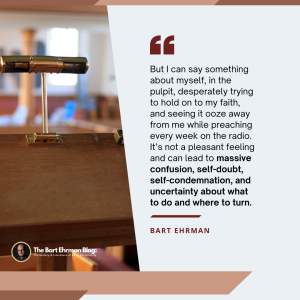
I’ve been there, on both sides of that equation. I won’t talk about the loss of faith on the part of pastors who were preaching in front of me every week. But I can say something about myself, in the pulpit, desperately trying to hold on to my faith, and seeing it ooze away from me while preaching every week on the radio. It’s not a pleasant feeling and can lead to massive confusion, self-doubt, self-condemnation, and uncertainty about what to do and where to turn.
Many of my classmates at Moody Bible Institute went off, directly from there, to be missionaries and pastors, and are still serving the church now over 40 years later. Our education there involved not only Bible and theology classes, but also courses on preaching, Christian education, evangelism, and so on.
I myself was not sure what I would do when I graduated. Missionary? (I considered it.) Pastor? (Maybe?). More education? (Yup, went that route)? In my final year at Moody, I became a youth pastor in a church in Oak Lawn IL and led Bible studies, prayer meetings, and trillions of social activities with high school and college kids and young adults. I did it for three years (while finishing my degree at Wheaton.) Loved it. But didn’t think I wanted that to be my life.
Then I went to seminary. I had decided at that point not to go into ministry, but to get credentialed to teach at the university level. My idea was to have a different kind of ministry, in a secular setting, as an evangelical spokesperson with academic credentials. I had known a lot of professors teaching among the evangelicals; I wanted to be an evangelical among the (secular) professors. A Christian mission to the secular academic world.
In the course of my seminary training I was not allowed to take only the topics I was really interested in – history of early Christianity, Old Testament, and New Testament. I had to take courses in preaching; pastoral counseling; church administration; Christian education, etc. I received the same training as everyone else, most of whom were training for lifelong ministry.
It was a Presbyterian seminary, so most of my friends from those days were heading to the Presbyterian ministry and are still there. I myself was active in an evangelical church in those days, running the adult education programs.
When I got into my Ph.D. program I continued on in the church. By that time we had moved to an American Baptist Church. It’s an interesting denomination – not as consistently conservative theologically or politically as the Southern Baptist church has now become. My church was certainly conservative in many ways, but it was in Princeton and there was a broad range of theological and political views there. I was at the time heading toward a more liberal view of things in every way, as I advanced in my education.
During the second year of my Ph.D. program, the pastor of the church left, and the governing board asked if I would serve as an interim pastor for a year. So I did. Preached most weeks. On the radio. Performed church duties and services (funerals were not high on my list of pleasurable pastimes….). Visited the sick and grieving. Organized and ran the whole thing……and was losing my faith. I don’t need to explain why here. Just one very quick anecdote. One Sunday I gave a sermon dealing with how a certain passage of the Bible tried to explain why there can be such intense suffering in a world created by a good God. Afterward, a parishioner came up to me, a lovely man with a gentle disposition, with tears in his eyes, and gave me a hug. He and his wife were stalwart members of the church. Their seventeen-year-old son had committed suicide the year before, and they didn’t know how to handle it, how to make sense of it, how to have faith in the light of it.
This kind soul simply appreciated someone actually talking about the hard problems in the church, even if there were no obvious answers.
You like this post? It's free! However, you'll need to be a blog member to read most articles here. Get access to Dr. Ehrman's library of 4,000+ articles plus five new articles per week. Membership starts at $2.99/mth and every cent goes to charity!
Unlock 4,000+ Articles Like This!

Pastors confront this kind of thing all the time. It really beggars belief what some pastors deal with, getting into the horrible lives that so many people have to deal with. And some of these pastors lose their faith. For a variety of reasons. It happens. All the time. These are humans.
But what do pastors do when they are losing their faith? How do they keep ministering to those in need? Keep preaching every week? Assuring mourners at funerals? Keep following the church rituals: baptism, communion, and so on?
In my case, it wasn’t so bad. After a year, the church found a pastor, and I left to go to another church, my slide continued, but I didn’t have to feel like a hypocrite standing in the pulpit preaching something I wasn’t as sure about anymore, let alone preaching something I didn’t believe and counseling people in a faith I wasn’t sure I held.
Others are not so lucky. It is very, very difficult to lose your faith emotionally and socially – what you have always believed is getting sucked away from you, and you have based your entire life on it. You may have a deeply religious spouse, kids, parents, and friends; everyone looks up to you for spiritual guidance and support; you are to be a model and the model is crumbling.
And one thing outsiders may not think about as much. If you leave the pulpit, you can’t just find another comparable job. You’ve never done or thought about another job and you aren’t trained for another job. You have a family that you are the sole or the main support for and your kids need a place to live, clothes, and food, and how are you, literally, going to survive if you lose your faith?
This is an Incredibly Tough Position to be in. It is a horrible situation to be in. Some simply gut it out and hold on to what little faith they have as best they can. Others feel forced to be a hypocrite for the good of everyone else, to continue to comfort and help those in need and doubt, to avoid destroying the emotions and lives of family and loved ones, and so on. Yet others realize they simply can’t live with themselves, and so they admit the problem, leave the church, and try to figure out a way to mend all their relationships and move on, somehow, but not always successfully. Some heartbreaking stories out there.
Most of you will not know, but there is an organization that came into existence eight years ago to deal with precisely this problem. It is called The Clergy Project. You can find its public page here: http://clergyproject.org/. There is also a nice Wikipedia page devoted to it and a Facebook page. It’s worth checking out. It is designed to help clergy and other religious professionals who are either still active or who have left the ministry and have lost their faith.
It’s an amazing project. To join, one does have to have been a religious professional (not just Christian, but in any religion) who now does not hold supernatural beliefs. Applicants are carefully vetted. (No trolls!!)
People in this situation can join *completely* anonymously. The group is massively protective of identities: no one needs to know who you actually are unless you are ready to come out. The group provides lots of vital services. There is an online support group with others in the same boat, counseling services, and career development opportunities for retooling. Pastors actually have a lot of skills, well-honed, that are useful in other careers, if they can figure out how to redirect them. There are monetary grants for career transition and so forth.
The group is justifiably pleased just now that they have now reached a milestone of 1000 members. It’s a great accomplishment, as the numbers continue to grow. Members come from a large range of Christian denominations and groups, but not only there: it also has Muslims, Jews, Hindus, Scientologists, and others!
This Blog is a Source of Support for a Cross Section of Religious and Nonreligious People. I know a lot of people on the blog have also lost their faith. Others have started to have some doubts. Yet others are completely committed to their faith, as much as others. We represent a broad swath of religious and non-religious communities. And hopefully being together in this format is helpful to people, no matter what their commitments and views. Whatever our views, it is important to be supportive of one another, and to realize there are others in our boat with us. The Clergy Project does this in a very focused way. We do it in a different way. The goal for both is to help people think through matters of importance to their personal, religious, spiritual, emotional, and intellectual lives, both to help them come to what they really think is the truth and to support them as they move forward in life thinking and believing as they do.
We have two goals at Ehrman Blog. One is to increase your knowledge of the New Testament and early Christianity. The other is to raise money for charity! In fact, in 2022, we raised over $360,000 for the charities below.
You must be logged in to post a comment.Over $2 Million Donated to Charity!





Share Bart’s Post on These Platforms
31 Comments
Leave A Comment
So much of this article resonates with me. Thank you, Bart, for sharing again. Two works come to mind:
Daniel Dennett, Caught in the Pulpit: Leaving Belief Behind – a series of confidential interviews with pastors et al. who have lost their faith along with analysis.
Miguel de Unamuno, San Manuel Bueno, Martir (translated as Saint Emmanuel the Good, Martyr) – a short story about a priest who has lost his faith but still continues to do his good work.
Hello, Ricardo, Anecdotally, we hear a variety of testimonies. Dr. Ehrman has 100% of my respect. I heard the testimony of a man who was instructed to leave the pulpit and pursue another vocation. I heard two separate testimonies of pastors who were instructed to leave the church (organized religion). Daniel Dennett has ZERO (0) respect from me after his book, Darwin’s Dangerous Ideas. A professor of Psychology teaching a Freshman-level elective in the Philosophy Dept about a biological concept to an eager audience of pliable impressible minds. His friend, Richard Dawkins, was baptizing “former” Christians into unbelief. Include the books of Josh McDowell, Lee Strobel, and C.S. Lewis in your review. In my opinion, the Apostle Paul’s message was intended to end organized religion – including Churchianity. The Finished Work of the Cross ends organized religion. No evangelism. No Plan of Salvation. As the retired Christian pastor said in his YouTube channel, “The Bible is an idol.” Dr. Ehrman and I have two different lists of pseudepigrahal forgeries in the New Testament letters.
Heard the new book announcement on MJ podcast today: Jesus and Capitalism! Can’t wait!!! Looking forward to the one on the canon, too.
Just finished Love Thy Stranger last week. (Wonderful, thank you for writing it!) In it you say Jesus’ teachings on money aren’t practical for modern day. In fact, they probably have never been practical. I want so badly to find closure to the variety of tensions between Jesus teachings and my life, but alas, if I had all the answers I would not continue seeking…
OK, true. You wouldn’t continue to seek. But on the upside, you’d be a billionaire. (speaking of money…)
Jesus was Jewish, ministered to Jews, upheld the law devoutly (Jewish), and was expecting an advent. He was talking to people in his day, his culture, his religion, and his sense of national (for lack of a better word) identity. He was not taking to all people for all time.
It’s ok to have tensions between Jesus’ teachings and your life.
Different subject: Anything to to blurb below?
University of Glasgow scholars have recovered 42 lost pages from Codex H, one of the most important early New Testament manuscripts.
The sixth-century copy of the Letters of St. Paul was taken apart at Greece’s Great Lavra Monastery in the 13th century, with its pages reused as binding material in other books.
Researchers used multispectral imaging to capture faint “ghost” text left as mirror impressions on facing pages, then confirmed the parchment’s age with radiocarbon dating.
The recovered pages include some of the earliest known chapter lists for Paul’s Letters. View the digital edition here.
Yes, very interesting and important especially for ongoing uses of the technology. Over the years Codex H has not received a huge amount of attention in compoarison with other NT manuscripts. There are about 12-13 that are older (some much older), and off hand I don’t recall any crucial variant readings that it provides a decisive witness for. But it is indeed one of the few majuscule manuscripts — i.e., written in majuscule — more like our capital letters– script instead of the later minuscule — which is more like our cursive, and on parchment instead of papyrus. And it will be ingteresting to see if these additional pages provide us with any textual variants that are unlike what we’ve known before. I really doubt it — except in cases of obvious scribal mistakes. Even so, having this additional evidence is quite a coup. If I learn anything more about it, I’ll post on it.
What I found interesting is that not long after I’d lost my faith and left all forms of ministry, someone still asked me my opinion on a theological matter, prefacing his question with, “I know you don’t believe any more, but what would you have said before you lost your faith?”
I don’t remember my answer, but were I faced with the same situation again, I’d probably say, “I’m probably not the person to ask!”
What a painful experience it must be. That is all I can say.
However, perhaps some of those are, in a way, simply treating it as part of their job and keep being pastors
So glad I never became paid clergy! I’ve been active in my Church as a quiet atheist agnostic for over 15 years! It’s surprisingly easy to do if you simply never bring it up. Many committed Christians probably expect most atheists to be obnoxious Hitchens/Dawkins types and have no idea that moral atheists exist. Or if they do know moral atheists, they assume that they’re hopelessly naive since (in their and once my view) morality can only come from God. But I feel like I have a good handle on the evolutionary basis for morality and compassion. And I still see religious belief and practice at its best as one means to live that evolved morality, which is why I don’t leave my Church community. I worship Risen Jesus, 2nd person of the Trinity, same as my fellow Christians. I just don’t find any of it historically plausible or a transcendent reality. It’s a myth, but still a powerful and beautiful myth. Someday humanity may get past religion, but not in my lifetime. And I’m fine with that. The human story began long before I showed up and will presumably continue long afterwards!
Two related topics.
First: Any thoughts as to why ‘most’ christian colleges don’t present outright the issues within the bible, archeology and church history? Most continue to either teach the pentatuch as real history and dismiss the non-canonical books as so weird they can’t be considered indicative of christian beliefs, when in fact they reflect the diversity of early christian beliefs.
Second: Similar to the BSA, I think mainstream church fellowship topics that are not devotional oriented, e.g. history, literature, archaeology, evolution, astrophysics, etc. would help to expose christians to biblical and faith fallacies. Seems an opportunity that could be used by pastors who have lost faith. Thoughts?
1. Because that’s what they really believe.
2. Yup. But the pastors who admit they have lost their faith are no longer leading Christian congregations.
The father of all faith-losing clergy has to be Jean Meslier (1664–1729), a French Catholic parish priest who served his church quietly and, to all appearances during his lifetime, faithfully. It was only after his death that his secret manuscript was discovered: possibly the first systematic argument for atheism. I just recently found out about Meslier, thanks to his being included in Peter Rollins’ excellent Lenten season online course, “Atheism for Lent.” Here’s a brief account of Meslier’s life, thought, and influence from Rollins’ website: https://peterrollins.com/afl/7/2020
Interesting. Thanks.
As a fellow MBI grad (75′) I have benefited from your transparency and your scholarship. Having been down the same rabbit hole and emerged thanks to C S Lewis, I do understand and accept where you are coming from. If evangelicals actually understood what Lewis was saying, he would be burned in effigy.
I have benefitted greatly from your scholarship in a way that allows me to truly understand first and second century Christianity by your separating the wheat from the chafe so to speak. Instead of imposing my 21st century understandings, not to mention my MBI understandings, on the 1st and 2nd centuries I now can truly understand what life was like as an early Christian.
As an aside, I am curious as to who your favorite professor was at MBI? Mine was Louis Goldberg, who actually managed to get me to think outside the box.
Ah. Mind was Marvin Mayer, who just passed away. Goldberg was unusually intellectual (for MBI). So was Stan Gundry, who unfortunately got removed from the faculty because of a book his wife wrote; he went on, though, to have a great career at Zondervan.
We overlapped for two years. Did we know each other?
I entered in summer of ’71. I married Kayleen Finck in 1973. She was the Salutorian of class of 73. Took a year off working on the paint crew and graduated in 75′. When I was single I was in 812A in Culbertson.
The yearbook did not include the married students in 75′ for some reason, but I am in the Arch as Bill Bobbitt in 72′ and 73′.
I had Mayer for systematic theology; and gave him a hard time about election and dispensationalism. He was happy to see me go. My close friend Bob Boyd really loved him too.
I had Stan Gundry for Bible Intro. Stan and I got together when he was at Zondervan and I was a visiting instructor at Calvin University in the business/econ department.
Odds are we crossed paths at MBI. Hope someday to met again IRL. You have my email address.
Stan Gundry had a huge impact on me, in a course where he had us read Kierkegaard, Philosophical Fragments. It was the beginning of my having a more open mind and thinking outside the fundamentalist box.
Years later I saw him at SBL; he wouldn’t have remembered teaching me, but I reminded him and told him that I owed my entire career path to him. He was aghast but I laughed and told him I was joking. But not entirely!
Curious in which of Lewis’ writings can what he was really saying be understood or derived?
Thanks.
My Jewish response: https://www.nytimes.com/2003/02/09/magazine/the-way-we-live-now-2-9-03-the-ethicist-the-faithless-faith-worker.html
THE WAY WE LIVE NOW: 2-9-03: THE ETHICIST; The Faithless Faith Worker
Feb. 9, 2003
THE WAY WE LIVE NOW: 2-9-03: THE ETHICIST
I am a member of the clergy (I will not identify the denomination), and I no longer believe in the tenets of my faith; indeed, I am an atheist. I am praised for my services, counseling, teaching, etc., and I receive glowing reports in staff reviews, but it is a futile, empty performance. On the one hand, my congregation is happy with me, but on the other, I feel like a fraud. Must I disclose my doubts to my congregation, knowing it would cost me my job? Anonymous
I’d suggest you check out the Clergy Project. There are a number of folk in your boat who can provide helpful advice.
I guess I need a better understanding of what it means to “lose one’s faith.” In my case, I certainly don’t believe many of the things I probably believed as a youngster or teen-ager. But I haven’t “lost my faith.” My faith has changed, yes, but I have new insights, new understandings, that make the faith journey more exciting and meaningful. Learning new things, for me, doesn’t cause a loss of “faith.” It expands it and makes it all the more meaningful. (And I am n ot worried about having all the “right” answers.) To use the perhaps trite expression, faith is a journey, not a destination.
Usually it is a shorthand (and therefore inadequate way) of saying that “I no longer believe in God.”
Thanks for your post. I’m on the same journey. I keep it to myself. There are too many family and friends that would be appalled and sad. I read a lot and learn a little more each day. It’s a long journey …
One other question which could be just semantics.
The title “…lost their faith…” implies a more passive process than I experienced.
So here is the question: Have you found that pastors you know who have ‘lost’ their faith would actually describe a more active or dynamic process or decision stance accepting empirical findings while rejecting non-empirical positions? Again, could just be semantics.
Yeah, it’s a problematic term, but widely used. It’s kinda like calling oneself an “agnostic” or an “atheist” — a negative term indicating what they are NOT, rather than a positive one indicating what they are (e.g., “humanist”).
Or, for Christians, “I no longer believe in the resurrection of Jesus” or “I no longer believe in Jesus’ salvific power.”
But There’s a big difference in the “faith” statement “I believe there is no God” and the likely more common statement “I no longer believe in a Christian teaching about God.”
I actually don’t hear the second much. But yes, they are significantly different. Those who say the first, of course, are happy as well to say the second, but not vice versa.
I think that definitions are important here. From my rabbinic perspective, it is “faith” that makes one a Christian. There are many many versions of this but one must believe in one to be within the boundary of the group we call “Christian.”
For Jews, there is no theological or dogmatic (or even suggested) belief that makes one Jewish. To be Jewish is to be a member, by birth or by choice, of a historic people–a people who’s primary purpose is not to discover proper belief, but, rather, to discover how God wants us to live.
A talmudic rabbi famously imagines God saying “If only my people would stop worrying about me and just follow my teachings.”
Yup! Most Christians have real trouble getting their minds around the idea of observant Jews who are are atheists.
“Are you curious about Christian Pastors who have lost their faith? ”
I saw a web site when living in Shanghai around a decade ago, most probably referred to by this site [or comments]
As I mentioned a few years ago here. China development was NOT as I learned it in the USA “God Bless America” I saw the superhuman work ethic of the employees & foresight & coordination of the government. As we see now with EVs, the fierce competition of the companies. [I learned it was best govt relations coordinator [guanxi].
ALL I can say is this last 5.5 years has been extremely difficult here.
1st Living in a far better place in an authoritarian police state & then “heaven” in a far more capitalist reality municipality than the SF Bay Area.
Thank You Dr Ehrman!!
But I can spew what to takes to be a Christian: be Humble, love your neighbor & Follow after GOD.
Lost USA decency!!