
Just how reliable is the Gospel of John? Is there *anything* in it that is historical?
A radical view of John was presented by John Shelby Spong in one of his last books (he published some nineteen or so over the course of his long career.) In my previous post I gave a brief biographical notice about John Shelby Spong, in commemoration of his death in 2021 — in case you don’t know who he was.
There aren’t too many Christian scholars who are more skeptical of its historical value than I am: but he is one! Here is how I discussed and engaged with the book when it came out. This will take two posts.
******************************
You like this post? It's free! However, you'll need to be a blog member to read most articles here. Get access to Dr. Ehrman's library of 4,000+ articles plus five new articles per week. Membership starts at $2.99/mth and every cent goes to charity!
Unlock 4,000+ Articles Like This!

John Shelby Spong, former Episcopal bishop of New Jersey and highly controversial author (because of his skeptical views about the New Testament and traditional Christian doctrine) has just published a new book on the Gospel of John, called The Fourth Gospel: Tales of a Jewish Mystic. He also wrote an interesting article on it that appeared in the Huffington Post yesterday.
In the article Spong summarizes the conclusions he advances in the book, based on an “intensive five-year long study.” He acknowledges that many of his findings are those that scholars have held for a long time. Spong himself is not trained as a biblical scholar but has made a very successful, and useful, career out of making scholarship known to a wider audience. So too, his goal in the book, in large measure, is to bring major scholarship to a general reader, a goal I obviously sympathize with deeply.
The following are the points that he stresses in his HuffPo article. I will comment on them from my perspective – with the caveat, once more, that I haven’t read what he adduces as evidence, only what he says in this article. I will respond to his views in two posts. Here are his first four major points.
1) There is no way that the Fourth Gospel was written by John Zebedee or by any of the disciples of Jesus.
I absolutely agree; this is a common view among scholars.
2) There is probably not a single word attributed to Jesus in this book that the Jesus of history actually spoke
Well, that’s a bit extreme. Jesus’ first words in the Gospel (1:38) are “what are you seeking” – and I bet Jesus said that at some point in his life. 🙂 In any event, Jesus surely said *some* of the things in the Gospel.
3) Not one of the signs (the Fourth Gospel’s word for miracles) recorded in this book was, in all probability, something that actually happened.
Again, I completely agree. The seven “signs” are not historical records. John explicitly doesn’t call them “miracles.” It is striking that in the Synoptics Jesus refuses to do “signs” (that is, to show who he really is). In the Gospel of John, that’s virtually *all* he does. Moreover, in the Synoptics he never teaches about himself. And in John, again, that’s virtually all he does. So unlike the Synoptics, Jesus in John teaches who he is (the one sent from heaven to provide eternal life) and does signs to prove that what he says about himself is true (so he says he is the bread of life, and then he feeds the multitudes with the loaves; he says he is the light of the world, and then he heals a man born blind; he says he is the resurrection and the life, and then he raises a man from the dead; and so on.
4) Many of the characters who appear in the pages of the Fourth Gospel are literary creations of its author and were never intended to be understood as real people, who actually lived in history.
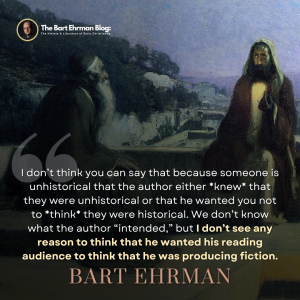
Now Spong is getting on tricky grounds. I don’t think you can say that because someone is unhistorical that the author either *knew* that they were unhistorical or that he wanted you not to *think* they were historical. We don’t know what the author “intended,” but I don’t see any reason to think that he wanted his reading audience to think that he was producing fiction. Moreover, the fact that Nicodemus in ch. 3, or the Samaritan Woman in ch. 4, do not appear in other Gospels (this is one of Spong’s points) does not mean that the author wanted you to assume they didn’t exist. For one thing, I don’t think he assumes that you’ve read the other Gospels – so he himself would not be assuming a point of comparison. For another thing, it’s not clear to me that these figures are inventions of the author of the Gospel; he may well have inherited these stories (and so, these narrative figures) from the traditions he had heard. If so, why wouldn’t he think they were historical? And even if he did make them up himself (how would one show that??), I don’t see any indications in the text to suggest that he wanted his readers to think that they were make-believe rather than figures that actually interacted with Jesus. In short, the fact (which I take to be a fact) that they were *not* historical figures who interacted with Jesus has no bearing, in my mind, on the question of what the author’s intentions were in narrating his stories.
As you can see, this will be a controversial book for lay people who have never been introduced to Johannine scholarship before, and will stir up some serious disagreements among scholars who have worked long in the field. We’ll see more of the latter in my next post.
We have two goals at Ehrman Blog. One is to increase your knowledge of the New Testament and early Christianity. The other is to raise money for charity! In fact, in 2022, we raised over $360,000 for the charities below.
You must be logged in to post a comment.Over $2 Million Donated to Charity!





Share Bart’s Post on These Platforms
35 Comments
Leave A Comment
In his book, Spong elaborates that Nicodemus is mentioned three times to represent a Pharisee and symbolize the people bound to the old thinking ‘in the dark’ of the synagogue [note: there is also potential well-known name familiarity with a Nicodemus ben Gurion of the 1st century] — those three times are John 3:2 (born again), John 7:50 (judgement/unbelief) and John 19:39 (burial prep) — so according to Spong and his theological perspective, John’s point was:
“Nicodemus was always close to the presence of light, but he could not enter it. He, and those whom he symbolized, simply could not get beyond the flesh that they knew, which always ends at the grave.”
This seems consistent with how John wove all his signs in his gospel. It would seem unusual for a Nicodemus to have historically been involved in all three stories (if the stories were at all historical) and not have had some role in an earlier gospel.
Thank you for this. I found your caution on Spong’s fourth point good. Even if a story in John is not historical, that still doesn’t tell us that John meant it as fiction. That is an important point.
(From something I wrote 20 years ago:) Suppose that one of General Eisenhower’s young aides during the D-Day invasion were to write a biography of Eisenhower today [i.e., 2006]. In his account, the now-elderly aide includes long quotations of things Eisenhower supposedly said more than 60 years ago. These quotations are markedly different from anything attributed to Ike in his other extant biographies; the now-elderly aide’s version doesn’t even mention these other accounts. The aide’s biography, by the way, repeatedly claims that he, the aide, was Ike’s favorite, and also gets in some jabs at Walter Bedell Smith, Ike’s chief of staff.
On these facts, it would be unreasonable for us to take the aide’s word for it concerning what Eisenhower supposedly said. So, too, would it be unreasonable for us to take John’s word for it concerning what Jesus supposedly said.
(From https://questioningchristian.org/2006/05/synoptic_christ.html)
Google AI’s answer to my question in your post on 06/07/26 is very interesting. It listed the lost documents theory proposed by Rudolf Bultmann in 1941 which included a Signs Gospel and then gave a breakdown of specific vocabulary puzzles including linguistic breaks between John’s writing style vs. sources. It listed the 1952 Liturgical/Festival Structure Theory of Aileen Guilding that John was written to mimic the Jewish three-year lectionary cycle used in first-century synagogues. Jesus explicitly travels to Jerusalem for each festival to declare that he is the literal replacement of that specific holiday (e.g., declaring “I am the Light of the World” during the illumination ritual of Tabernacles). Other theories were listed and it seems good cases can be made for each of them.
There was such great material from Google AI that anyone who wants to see it should go to Google.com, click on AI mode, and paste in my question from the comments section from your post on 06/07/26. Dr. Ehrman, I’d really like your thoughts on these various theories about John’s gospel. The more one looks into all this stuff, the more interesting it is.
I was heavily influenced by Bultmann’s views of sources, they they have come under scrutiny and attack. I don’t think Guilding has any ancient evidence to go on. We don’t have liturgical cycles discussed in Jewish sources of the period.
I have run across some of Spong’s virews before that I think many scholars would argue with. He has stated that Judas Iscariot was a completely fictitious character, and that the name “Judas” was used to promote an anti-Judaic agenda. He has also said that Jesus must certainly have been married as this was a requirement for the rabbinate. If I remember right, he has even weighed in favorably on the idea that Jesus was married to Mary Magdalene.
Spong was a very intelligent and well, educated man, but as you point out, not a specialist. I think his books are worth reading, and his views are worth hearing, but it’s also good to remember that he got some things wrong.
one of there more reputable writers in recent history from renaissance to 1900 wrote that only gospel writer of John wrote Judas Iscariot negatively
When I read the Gospel of John, I am struck less by whether it preserves historical fact—though it would be too strong to say it contains none at all, since it includes details that seem to reflect fairly specific knowledge of the context—than by how different it feels from the Synoptic Gospels. Its language of light and darkness, above and below, truth, knowledge, and the revealer who descends from the Father and returns to him can sound, at least at first, almost “Gnostic.”
At the same time, John strongly emphasizes the incarnation: “the Word became flesh.” This seems to stand against many later Gnostic or docetic tendencies. I understand that incarnation is not easily compatible with what we usually call “Gnostic” theology. Yet, since Gnostic movements were diverse, I wonder whether some religious or philosophical currents later associated with Gnostic thought helped create the conditions for such a distinctive Gospel to emerge.
How, then, should we understand John’s place in the second-century struggles over Christian identity? Was it read selectively by Gnostic interpreters, claimed by Pauline or proto-orthodox Christians, or written before those boundaries had fully hardened? I suspect the last option may be closest.
One of Elaine Pagels early books (maybe it was her dissertation?) was the Johannine Gospels in Gnostic Exegesis, where she discusses at length the Gnostic interpretatoin of John by our very first surviving commentator, Heracleon (a Gnostic, obviously). Heracleon’s chief proto-orthodox opponent was Origen, who went toe to toe with him in his later commentary on John. John was unusually maleable when it came to early Christian interpretatoin.
Thank you very much for recommending the book.
She is also one of the very few New Testament scholars whose works have been translated into Japanese—although only two of her books have been translated, far fewer than yours.
The book is quite expensive, but I hope to obtain a copy someday and read it. I believe I read somewhere that she also regards Paul as one of the sources of Gnosticism. I may be misunderstanding her argument, but I found that point very interesting.
The above makes me think about the relationship between historical inquiry and faith. In one sense, both begin with claims about past events, and both must deal with the fragmentary evidence that has survived into the present.
The difference, it seems to me, is that historians reason from surviving evidence in terms of probability, while believers may trust that other realities or events—now lost to us—would support their faith if only we had access to them. Yet both sides face the danger of arrogance. Historians may forget how limited the evidence really is, while believers may assume too easily that unseen or lost reality would necessarily support their faith.
This makes me wonder whether the conflict between history and faith is, at least in part, an epistemological problem. Historians may say, “We can judge only from the evidence we have,” while believers may say, “The surviving evidence is not the whole reality.”
The old story of blind people touching different parts of an elephant can serve as a metaphor for the limits of human knowledge. Perhaps both historians and believers touch only parts of the past. Both need epistemological humility. I realize that many may disagree with me.
Agree completely and I think Shinji provides worthwhile insight.
Bart has appropriately stated – in books and blog comments – that the gospels and other early writings are based on stories that have some basis in fact and were changed during retelling. One question is where and who perpetuated the stories. OK, these may be two questions.
I like the conclusion that these were ‘communities’ of believers in various locations who held certain beliefs, but not always the exact same beliefs. Similar to the Marcionites, Gnostics, Ebionites, etc. The community or communities that developed the gospel of John understood the mythology, miracles, sayings, etc. in terms that supported their beliefs, not as literal history.
The development of the belief that the gospels are literal history is an error of both ‘historical development’ and contemporary belief, which I appreciate this blog and the BSA providing counter evidence.
Thank you for your thoughtful response to my comments. I feel that Bart and the others who participate in this blog are helping me broaden and refine my understanding of Christianity. Until now, my views have been formed rather independently—and perhaps somewhat idiosyncratically—in a small country in Asia, almost like the Galápagos Islands. You guys’ perspectives help me see things in a more objective and universal way.
So much of scripture speaks in hyperbole, poetry, and metaphor. That doesn’t make it less meaningful — but it does make it unreliable as literal history. Even so, the Gospel of John remains a work of striking beauty—sacred poetry. Its authors place crafted theological reflections on the lips of Jesus, shaping a portrait that differs sharply from the Synoptics and often lacks grounding in Torah. That alone invites a more cautious reading.
What troubles me is how the Western church later treated John’s figurative language as if it were literal historical record. This became a convenient scaffolding for constructing a theological narrative — especially the political formation of the Trinity. As with many things, it’s the attempt to cover the interpretive leap that ends up doing the most damage.
Yet the teachings of Jesus themselves remain theologically rich and psychologically profound. Perhaps the way forward is not to defend the later layers of Pauline, Greek, and Roman influence, but to return to the essentials — the Torah-rooted wisdom, ethical clarity, and spiritual imagination that shaped Jesus’ original message.
I knew nothing about John Shelby Spong, but reading his article in the HuffPost, I agree with him 100%.
I wrote a comment with my opinion about John’s Gospel, in response to a series of post by Bart at the end of March 2020 that I never posted. Here it goes:
Whoever wrote John, wrote a romance about Jesus, the superman from outer space coming to Earth to save humanity, the Jews wanting to kill him, even his brothers wanting to get rid of him (John 7:3-5), but he always having the upper hand, even when he died, because HE RESURRECTED!!!
(continuing) John is different from the other Gospels. Its genre is of a novelist biography, a “vie romanceé” as the French say. It is very similar to other apocrypha of the 2nd century. It is full of details impossible to know unless he was a fly on the wall. For instance, the story of the blind man in John 9: making mud with saliva and put in his eyes, being called by the Pharisees, the Pharisees calling his parents, all the discussion, what this said, what the other said… very colorful story! Or with the Samaritan woman at the well (John 4). Great conversation! Who listened to it? His disciples had gone into the town to buy food (John 4:8). Details somehow amusing: When Jesus said, “I am he,” they drew back and fell to the ground (John 18:6), or: Both were running, but the other disciple outran Peter and reached the tomb first (John 20:4). These are not oral traditions transmitted by generations; they are embellishments of a novel writer.
“Just how reliable is the Gospel of John?”
While I’ve learned a lot from your writings about the relative date and purpose of the gospel attributed to John (thank you!), I’ve also heard from a Christian friend with strong family ties to Judaism that John in some ways is more authentic than the other gospels. One example relates to Mary Magdalene. In Mark’s gospel, we’re told that Mary and other women “had bought sweet spices that they might come and anoint him.” There’s just no way this can be correct since only men could ever see or touch a man’s dead body; for a woman to do so would be the height of immodesty. Women, of course, could anoint a woman’s body only. In the Gospel of John, however, Mary turns and runs to men the moment she discovers the stone has been rolled from the tomb’s entrance. We’re not told why she was there, but maybe it’s because she retained hope in Jesus’ predictions of being raised; it doesn’t appear she was there to anoint his body.
Do you have any thoughts on this?
We don’t know about burial rules (e.g., could women do it?) in Judaism in the first century. Your friend is basing his/her views on rabbinic sources from centuries later.
I was recently playing center-field in a senior baseball game, where there was a runner on first, and a ball was hit into the left center gap. I ran it down and thew to my shortstop(cut-off)who in turn fired home. The umpire called the runner safe, but I was sure the guy was out. I threw question at the ump’s call, “How could you call that guy safe when he was clearly out? The ball got there way before the runner!” What I was really saying was that a guy 300 feet from the play could see and know better what happened, than the guy five feet from the play.
New Testament criticism makes the same mistake in evaluating historical evidence(IMHO). People come along 1800-2000 years after the fact and claim to know more than those who gave us apostolic tradition via apostolic succession; who were millennia closer to what was recorded. The modern scholars reject all patristic literature that refutes their presuppositions, and invent arguments against scripture claiming things like “the gospels were anonymously written stories embellished by non-eyewitnesses.” Why should anyone believe the modern critics over the ancient witness? “The purest water is closest to the spring.”
Gino, great that you are still active, healthy and a skilled outfielder. However, your proximity comparison is flawed. Josephus wrote historical accounts of the Jews but many of his statements are not supported by other contemporaneous writers, which modern historians point out. This does not make modern historians wrong. Rather it means that Josephus had his own historical agenda. Another example: Archeological evidence supports clearly that ancient Jews, Canaanites, etc. worshiped Ashera, who was believed to be Yahweh’s consort; even while religious philosophers were writing not to worship her. Does not make modern archeologists wrong.
I encourage you to continue reading scholarship that can enlighten your understanding of the ancient world. Here is a reference for you: The Exposure of Infants Among Jews and Christians in Antiquity; Social World of Biblical Antiquity, Second Series 4, Series Editors: Keith W. Whitelam, James G. Crossley, 2009, Sheffield Phoenix Press.
I think you’ll be impressed both by the content and the sheer volume of valid historical sources used.
All the best.
Thanx for your response Steve. I’m familiar with some of the historical criticism with Josephus, Eusebius etc, but we’re talking about John’s gospel. Here’s my point:
In its infancy, the ancient churches were directed to only teach the doctrine handed down from the apostles (apostolic doctrine) and beware of the doctrine that does not come from them (1st Timothy 1:3,4, 4:6-16, 2nd Timothy 3:14, 4:2-4 etc.).
Irenaeus:Against Heresies, bk. III, 3:1-4 makes the point that at the beginning of the 3rd century, through the recorded succession of bishops, *apostolic doctrine and tradition* were clearly known.
“like a rich man depositing his money in a bank, the apostles lodged in the hands of the church all things pertaining to the truth.”(ibid bk. III, 4:1).
“From God through Christ to the apostles to the churches” (1st Clement 42:1-5, Irenaeus:AH, bk. III, 3:1).
Tertullian said *Our Rule* Is, “If a teaching can’t be traced to the apostles then it is “Ipso Facto False.”
Prescription Against Heretics: 21 (clearly the litmus test for apostolic doctrine and tradition).
My point is, the ancient historical church is a better witness to the truth than the modern critics, because it was contemporary, not millennium later.
CONTINUED:
According to Spong and Ehrman:
“There is no way that the Fourth Gospel was written by John Zebedee or by any of the disciples of Jesus.”(Spong)
“I absolutely agree; this is a common view among scholars.”(Ehrman)
However, history contradicts them. *ALL* Ante-Nicene literature *UNANIMOUSLY* claims that “The one whom Jesus loved, the one who leaned on his chest” was the Apostle John, and in this gospel account the author continually identifies himself as such. The Apostle John was an eyewitness of what he recorded….he says so a number of times in the document.
*ALL* Ante-Nicene literature *UNANIMOUSLY* claims that Mark’s gospel is the result of Mark taking dictation from Peter and we know Peter was an eyewitness(Acts 2:32, Acts 5:29-32 etc.).
Luke 1:2 claims that his gospel record comes from eyewitnesses.
These things are apostolic tradition held by the church from its infancy.
The modern critics fight against this, so again my point; those closest to the source had a better understanding of this than the ones who come along millennia later and see contradictions. Don’t throw the baby out with the bath water. Focus on the witness corroboration. Apparent contradictions don’t disqualify/invalidate the entire historical record.
Bart?
The author of the fourth Gospel never identifies himself as John and does not call himself the Beloved Disciple. He talks *about* that figure an in one point clearly differentiates himself from him (21:24: HE said something and WE believe him)
I think you overstate the case for Mark and Peter. Papias says it, Irenaeus trusts him, Tertullian picks it up, and then it just seemed right to everyone. The fact that 150 years after the book appeared Christians agree on the authorship has little bearing on whether they were historically correct or not. None of them engaged in a critical analysis of the question. They just heard something and assumed it was true. Probably the majority of people in this country have heard that “God helps those who help themselves” is in the Bible. That isn’t evidence that it is.
Addressing your 1st paragraph: Jesus celebrated Passover with the twelve apostles, Matthew 26:20, Mark 14:17. One of the twelve (probability science says probably John, if not John then who?) was leaning on the chest of Jesus; the one whom Jesus loved, John 13:23. This same person was at the trial of Jesus (John 18:14,15), at the crucifixion of Jesus (John 19:26,27), at the empty tomb (John 20:1-8), and communed with Jesus post-resurrection (John 20:24,25, Luke 24:33-36). In John 21:24, this person is one of the twelve (ten not counting Peter or Judas) even though speaking in the third person, and is the author of this gospel account and was an eyewitness (Acts 2:32). If not John, which of the ten is the most likely candidate then?
*ALL* patristic literature *UNANIMOUSLY* confirms that John the apostle; the one whom Jesus loved, who leaned on the chest of the Lord, is the author of the gospel account that bears his name (Irenaeus: Against Heresies, Bk. III, 1:1 etc.). There’s nothing in any historical literature to suggest otherwise.
This transmission of information is guaranteed by the process of apostolic succession and discipleship.
See my comments on your 2nd paragraph concerning the bishop/overseer/shepherd.
It’s amazing what a person would have to believe if the truth were guaranteed by apostolic succession….
In the 2nd sentence of your 2nd paragraph you make it sound like the tradition of Mark and the apostle John being authors of gospel accounts was invented by Papias. However, there is zero evidence to prove that. In fact, the work of Papias says he was “a disciple of the apostle, [John]the one who leaned on the bosom of Christ”(IX). I believe he was discipled through Polycarp, and He gives, “assurance to the truth of the things in which I was instructed.” He said he was more interested in what the apostles said(the living voice) than what they wrote in books(I).
“We shall add, as being *a matter of primary importance,* a tradition regarding Mark who wrote the Gospel, which Papias gives in the following words: ‘And the presbyter said this. Mark having become the interpreter of Peter, wrote down accurately whatsoever he remembered….took special care, not to omit anything he had heard, and *not to put anything fictitious* into the statements’”(VI).
This was communicated by the bishops of the churches. The bishop’s job was to refute heresy and insure correct apostolic doctrine and tradition(Galatians 1:6-9, Philippians 1:17, 2nd Timothy 2:16-18, 1st Clement, Ignatius, Irenaeus:Against Heresies, etc.etc.)
I didn’t say that I thought Papias himself was making it up. It’s more likely something he heard.
I think Bart responds much more eloquently to your author point than I could.
Consider this: I think that if Jesus’ words and deeds were recorded and transmitted accurately through apostolic authority, why did so much discrepancy exist that led to groups who considered themselves Christians? Ebionites, Marcionites, Gnostics, etc. By your logic these groups should have developed beliefs that were very uniform, not different. People like Irenaeus would not have needed to advocate destroying ‘heretical’ documents. I could pursue so many more valid tangents but space is limited and I’d be deviating too far from your main argument.
Bottom line, we are all humans riding the surface of this third rock from the sun. No reason we can’t get along, even if we disagree regarding some minor items. All the best.
Steve, first thing: I’ve greatly appreciated your insight and often excellent observations on your many posts over time. If the tenor of my words is ever rude or disrespectful I apologize, because that is never my intention.
My point about apostolic succession and the roll of the bishop is this, when I read Ignatius I see his emphasis on the bishop for the validity of baptism, the Eucharist, and teaching. These bishops were to teach no other doctrine (1st Timothy 1:3, Titus 1:7-11). When people taught heresy, such as Marcion, they were weeded out. This was done to protect apostolic doctrine and tradition. Ebionites and Gnostics weren’t orthodox Christians even though they may have tried to fly under a Christian banner.
I think Bart objected to my use of “guaranteed.” OK, I’ll withdraw it. Apostolic succession isn’t/wasn’t infallible, but was designed to abate falsehood. The heretics tried to discredit or rewrite apostolic doctrine and tradition. The job of the bishop(epi-skopeo); the one who *watches over* the flock, was to protect against pollution of their doctrine and tradition. That’s why we see so much refutation of heresy in the New Testament(Galatians 1:6-9) and Patristic literature. Can Bart elaborate on his post?
Yes, I’ve elaborated on it a good bit in my various discussoins (on the blog, in my books) of Eusebius’s model of heresy and orthodoxy in relation to Walter Bauers. Your view is the one that was almost universally held before the discoveries and scholarship of the late 19th and early 20th centuries (and since).
Dr. Ehrman, sorry if I don’t keep up with all the latest scholarly soap operas, but have you formed any degree of response to Dr. Lydia McGrew’s defense of John’s alleged reliability, “The Eye of the Beholder: The Gospel of John as Historical Reportage” (DeWard, 2021)? The fact that she refuses to debate anybody about it except the weak Mike Licona makes me suspicious. Plenty of people could have cleaned her clock six ways from Sunday on the subject of John’s historical reliability. And she certainly has most of the time each day 7 days per week for years on end to extensively blog and YouTube about various gossipy issues. But she can’t seem to find two hours worth of her time to be available in the next 6 months to debate you, or Carrier, or the scholars who praised Licona’s recent books.
She debated Mike Licona? Don’t they agree? If she does debate someone, it should be a NT scholar, not Carrier. THere are plenty that would be able to challenge her!
In 1993 a UNC graduate was playing in the NBA east finals. He and his Chicago teammates were reigning champions from the previous two years. During this playoff round against New York the media was looking to write a story.
They focused on apparent problems rather than the performance greatness of the individual. They made a case out of the evidence that MJ was gambling in Atlantic City till midnight the night before game three. They brought up previous gambling debts and circulated a story that MJ’s gambling was hurting his team. They also concluded that his father was murdered because of MJ’s gambling debts.
However, the truth is that MJ was instrumental in his team winning the six game series. He averaged 34 points,8 rebounds,7 assists,2 blocks, and 2 steals per game, and his father was murdered by two men who confessed to the crime. The media created a narrative to the story that just was not true, because they focused on what they perceived as problems, instead of correctly reading the evidence sitting in plain site. The modern critics do the same thing; focusing on discrepancies instead of historical corroboration(Matthew 23:13-15). We’re betting with our lives on this!
Gino, I’ve never considered your comments rude. We’re good.
Spong’s comments regarding the intentions of the writer of John remind me why I didn’t like his stuff back in the day (what bits I read or heard) or liberal Christianity in general. It seems like Spong and other liberals were treating first Century Gospel writers as sophisticated modern people like them who were misunderstood by ignorant fundamentalists then and now. No wonder the fundies won. Smug arrogance doesn’t win hearts and minds. I much prefer current approaches like yours and Paulogia: accept the early founders of Christianity as who they were in their time and place: not liars. Not modern sophisticates. Not insincere. Definitely not stupid. But very likely mistaken.