
I try not to re-publish a blog post from just 2-3 years ago, but in this case I’m making an exception. After posting my debate with Dan Wallace yesterday, I realized a lot of people who weren’t on the blog back when more information was released (and even a lot who were!) wouldn’t recall how the whole fiasco with the alleged first-century Mark played out. So here is a re-post that explains the discovery of the scandal, the fallout, and sundry related things. This’ll take two posts, both edited a bit.
******************************
There was a rather astonishing development in the story involving the so-called “First-Century Gospel of Mark” announced in my debate with Dan Wallace in 2012.
Until that point (and still now, as it turns out), our first fragmentary copy of Mark could be dated to around 200 CE. The earliest full copy of Mark comes to us from around 375 CE or so..
You like this post? It's free! However, you'll need to be a blog member to read most articles here. Get access to Dr. Ehrman's library of 4,000+ articles plus five new articles per week. Membership starts at $2.99/mth and every cent goes to charity!
Unlock 4,000+ Articles Like This!

Mark itself was written, probably, around 70 CE. So, well, that’s a long time between when the original was first published and when our first complete copy of it was made. Around 300 years. How many changes were made over the years? Were there lots? Were they massive? How could we ever know?
Well, what if we had a copy from, say, within 20-30 years of the original having been produced? Dan announced that we now had one. But he could not answer the obvious questions we all had about it (he had signed a non-disclosure agreement): how extensive it was (a tiny scrap or a full manuscript?), how it had been dated to the first century, by whom, with what corroboration, how different it was from other known copies, etc. etc.
OK, I’m not going to go into all the ins and outs here again. I posted a number of times on the issue: just use the search function on the blog and look for posts with the phrase “first-century Mark.” You’ll see.
In 2018 we had learned through the actual publication of the manuscript that in fact it is just a small fragment and it does not date to the first century, but to the second or third (i.e., about the same age as the much fuller fragmentary copy we have already had for a long time).
But, even more intriguing, it came out that the fragment had been illegally sold by someone who didn’t own it – on the grounds that it *was* to be dated extremely early — to the people who were funding, organizing, and operating the Museum of the Bible in Washington DC (“the people” are the Green family that own the Hobby Lobby and use the proceeds from that enterprise to fund their conservative Christian evangelical causes).
The person named as selling it was Dirk Obbink, from the University of Oxford, one of the world experts in analyzing and dating ancient manuscripts, who was the director of the extremely important and prestigious “Oxyrhynchus Papyri” collection, which publishes the authorized editions of ancient manuscripts that had been discovered, starting in the 19th century, in the ruins of the city of Oxyrhynchus, Egypt (most of the world’s ancient manuscripts come from Egypt, mainly because the climate allows them to survive), under the direction of the Egypt Exploration Society, a fantastic and very important organization that works to preserve and promote the cultural heritage of Egypt. You should know about this organization. Here’s the website: https://www.ees.ac.uk/
As the Director of the project, Obbink had been given temporary possession of manuscripts (of all kinds – whatever is found from this site in Egypt, from tax receipts to literary texts) so he could analyze and publish them in the series.
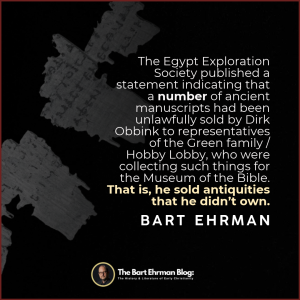
OK, now to the breaking news. Yesterday the Egypt Exploration Society published a statement indicating that a *number* of ancient manuscripts had been unlawfully sold by Obbink to representatives of the Green family / Hobby Lobby, who were collecting such things for the Museum of the Bible. That is, he sold antiquities that he didn’t own. And the Museum of the Bible people were hoodwinked. From not doing due diligence? I don’t know. Below I reproduce the statement published by the EES: https://www.ees.ac.uk/news/professor-obbink-and-missing-ees-papyri
I would like to point out that the two scholars mentioned in the first paragraph who through their diligence more or less drove the inquiry in the first place have both been members of the blog: Brent Nongbri, who has occasionally made guest posts for us (he’s the author of Before Religion: A History of a Modern Concept and God’s Library: The Archaeology of the Earliest Christian Manuscripts), and my old friend and colleague Michael Holmes who is the Director of Scholars Initiative at the Museum of the Bible.
I should clarify, Mike had ZERO to do with the purchase of the manuscripts; he works in a completely different branch of the museum, and joined it long after the purchases were made. But he has been persistent in trying to figure out what in the blazes actually happened, and making the information public.
Here is their statement. I’m afraid it was not good for Prof. Obbink.
****************
On 25 June 2019 the Egypt Exploration Society (EES) posted a statement on its website that it was working with the Museum of the Bible (MOTB) to clarify whether any texts from the EES Oxyrhynchus collection had been sold or offered for sale to Hobby Lobby or its agents, and if so, when and by whom. This was in response to the online publication by Dr Brent Nongbri, following its release by Professor Michael Holmes of the MOTB, of a redacted copy of a contract of 17 January 2013 between Professor Dirk Obbink and Hobby Lobby Stores for the sale of six items to Hobby Lobby, including four New Testament fragments probably of EES provenance. This statement reports our findings to date.
With the help of photographs provided by the MOTB, the EES has so far identified thirteen texts from its collection, twelve on papyrus and one on parchment, all with biblical or related content, which are currently held by the MOTB (see the attached list). These texts were taken without authorisation from the EES, and in most of the thirteen cases the catalogue card and photograph are also missing. Fortunately, the EES has back-up records which enable us to identify missing unpublished texts. For clarity, we note that the four texts specified in the handwritten list made public alongside the 2013 contract, which are probably the texts of that contract, remain in the EES collection, and two have been published as P.Oxy. LXXXIII 5345 and 5346.
The Board of Trustees of the MOTB has accepted the EES claim to ownership of the thirteen pieces identified to date, and is arranging to return them to the EES. The EES is grateful to the MOTB for its co-operation, and has agreed that the research on these texts by scholars under the auspices of the MOTB will receive appropriate recognition when the texts are published in the Oxyrhynchus Papyri series.
The MOTB has informed the EES that 11 of these pieces came into its care after being sold to Hobby Lobby Stores by Professor Obbink, most of them in two batches in 2010. In August 2016 the EES did not re-appoint Professor Obbink as a General Editor of the Oxyrhynchus Papyri primarily because of unsatisfactory discharge of his editorial duties, but also because of concerns, which he did not allay, about his alleged involvement in the marketing of ancient texts, especially the Sappho text. In June 2019 the EES banned him from any access to its collection pending his satisfactory clarification of the 2013 contract. Oxford University is now investigating, with EES help, the removal from University premises and alleged sale of EES texts.
The EES is also pursuing identification and recovery of other texts, or parts of texts, which have or may have been illicitly removed from its collection. Systematic checking of the EES collection will be a long process because of its size. Meanwhile, our primary aim remains the authoritative publication for public benefit of the texts of all types in our collection.
We cannot comment here on any broader legal issues arising from these findings, except to note that they are under consideration by all the institutions concerned.
EES papyri being returned by the MOTB (MOTB inventory number in square brackets)
-
- Genesis 5: P.Oxy. inv. 39 5B.119/C(4-7)b. [PAP.000121]
- Genesis 17: P.Oxy. inv. 20 3B.30/F(5-7)b. [PAP.000463]
- Exodus 20-21: P.Oxy. inv. 102/171(e). [PAP.000446]
- Exodus 30.18-19: P.Oxy. inv. 105/149(a). [PAP.000388]
- Deuteronomy: P.Oxy. inv. 93/Dec. 23/M.1. [PAP.000427]
- Psalms 9.23-26: P.Oxy. inv. 8 1B.188/D(1-3)a. [PAP.000122]
- Sayings of Jesus: P.Oxy. inv. 16 2B.48/C(a). [PAP.000377]
- Romans 3: <related to P.Oxy. inv. 101/72(a)>. [PAP.000467]
- Romans 9-10: P.Oxy. inv. 29 4B.46/G(4-6)a. [PAP.000425 one part]
- 1 Corinthians 7-10: P.Oxy. inv. 106/116(d) + 106/116(c). [PAP.000120 three small fragments]
- Quotation of Hebrews: P.Oxy. inv. 105/188(c). [PAP.000378]
- Scriptural homily: P.Oxy. inv. 3 1B.78/B(1-3)a. [PAP.000395]
- (parchment) Acts of Paul: P.Oxy. inv. 8 1B.192/G(2)b. [MS.000514]
We have two goals at Ehrman Blog. One is to increase your knowledge of the New Testament and early Christianity. The other is to raise money for charity! In fact, in 2022, we raised over $360,000 for the charities below.
Over $2 Million Donated to Charity!





Share Bart’s Post on These Platforms
Leave A Comment
You must be logged in to post a comment.