Sorting by

×

The Hobby Lobby, Biblical Manuscripts, and Academic Scandal

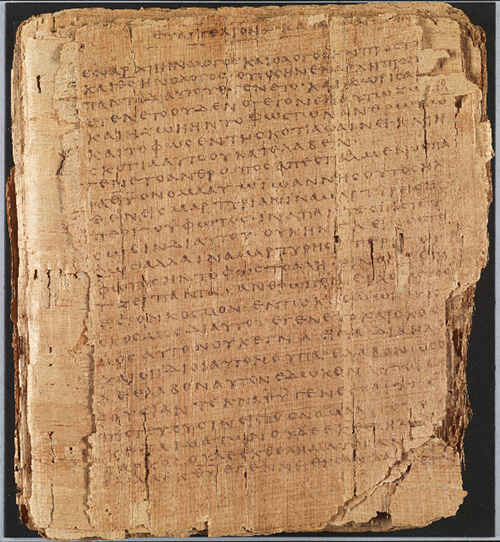
Yesterday I posted the most recent developments in the scandalous “first-century Mark” affair.   Readers of the blog who are not familiar with or invested much in the study of ancient manuscripts may have shrugged their shoulders and not seen what the big deal was.  I completely get that.   But anyone involved in New Testament textual criticism, the history of the Bible, and the ethics of modern biblical scholarship would have seen that this is a very, very big deal.  A  blockbuster development. For years now conservative evangelical scholars have been declaring that they have solid proof to support their views about the New Testament, against crazy liberal types (like me): we NOW have, they claimed, reliable *first* century evidence that the Gospels were both written earlier than the skeptics claim *and* that it was being reliably copied.  Their evidence?  A portion of the Gospel of Mark that had been dated by one of the world’s experts to the first century itself.  Amazing! And where was this manuscript of Mark?  No one would say.  How much [...]
2025-09-10T12:45:20-04:00June 25th, 2019|New Testament Manuscripts, Religion in the News|

Finally! Now We Know. The “First-Century Copy” of Mark

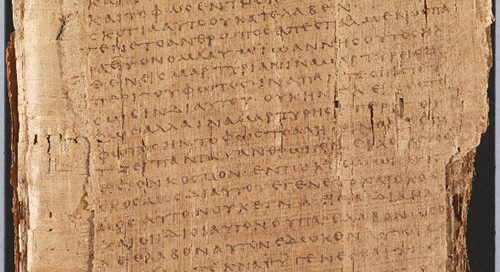
I have posted on and off over the past six or seven years about an allegedly first-century copy of the Gospel of Mark that some scholars claimed we had now in our possession.  This would be by far the earliest manuscript we have of any part of the New Testament, a matter of real importance and interest.  But it turns out NOT to be that, and it has involved a real academic farce. Those of you who have followed this charade know most of the important facts, but for those of you who don’t, and just to remind those of you who do, let me set them out, before explaining the new development: In 2012 I was holding a public debate on whether we can know what the authors of the New Testament “originally” wrote, given the fact that we don’t have their original writings but only later copies of them, all of them different in many, many small ways and sometimes in more important ways.  Virtually all of these copies are many centuries removed [...]

Why Christians Needed an Old Testament: Pagan Attacks on the Faith

In my discussion why Christians claimed the Jewish Bible for themselves (and argued it no longer belonged to Jews), I’ve been focusing strictly on the relationship of Jews and Christians, for obvious reasons.  But as it turns out, there is more to it than that.   Here is an issue that is hardly ever talked about in the scholarship on the rise of anti-Judaism in early Christianity, let alone among lay people wondering about why mainstream Christianity became opposed to Jews and the religion they practiced in antiquity (leading to the anti-Judaism and then the antisemitism of later times.)   This issue involves Christians’ relations not with Jews, but with pagans, and the rejection of the new Christian faith by the world at large. As is well known, apart from Jews and Christians, everyone in the Roman empire was pagan – that is, everyone followed one or more of the polytheistic religions of that world.  I do not need to detail the various kinds of pagan religion found throughout the Roman Empire.   But a couple of important [...]

The Jewish Bible in the Gentile Churches

I continue here with my thoughts about how Christians came to claim the Jewish Bible for themselves, and to argue that it no longer belonged to Jews.   I’ve already pointed out that the Jewish followers of Jesus (Many? Most? All?)  (I suspect the answer is “Most”), within a short time after his death (months?  a year?) began wonder why other Jews did not accept Jesus as the messiah.  After all, they themselves “knew” he had been raised from the dead.  It was a great miracle.  It proved Jesus was God’s “anointed” one.  Why wouldn’t others accept it? That was particularly perplexing and frustrating and eventually irritating and aggravating as they started finding indications in the Bible itself that this is what was supposed to happen to the messiah.  It’s all there, in the prophecies of Scripture.  Why don’t our fellow Jews – family members, friends, neighbors, fellow worshipers in the synagogue – why don’t they *see* it?   Are they blind?  Heard headed?  Rebellious against God? Eventually it came to be thought among many of these [...]

Feedback on the Blog?

I’m back from Greece and Turkey now, with two weeks with nothing to do but work like a  wild-person day and night on my book project on Christian tours of heaven and hell in relation to their Greek and Roman predecessors.   I’m madly into Virgil’s Aeneid just now.  Great stuff.  I’ll say more about it anon. But it seems like a good time for me to pause for a day and take assessment of developments on the blog and get your reactions.  I do this a couple of times a year, as old-timers will know.  My basic questions:  How is the blog going, from your point of view?  And is there anything we should change/do differently?  Any feedback at all is welcome – just let me hear it. The goal, of course, is to keep the customers satisfied and to draw more in.  I’d like to use the blog to disseminate scholarly knowledge of the New Testament and the early Christian movement more broadly, for three interrelated reasons.  First, of course, is that I think [...]

2025-09-10T12:45:19-04:00June 19th, 2019|Public Forum, Reflections and Ruminations|

Why Paul Did Not Write 2 Thessalonians: A Final Post

This will be my last post on the question of whether Paul wrote 2 Thessalonians.  If you’ve been following all this, you know that my view is that he did not.  My sense is that a lot of people have trouble accepting that view simply because it’s not what they’ve always heard and thought.  It’s hard to change your mind about something that just seems sensible and right, even if you haven’t really given it much thought or attention.  We’re *all* inclined to think what we’ve always thought. For most people, of course, the question doesn’t matter a twit.  Who CARES?   Well, some of us care.  And if you’re one who does, then I’d suggest being open to changing your mind if the evidence takes you in a different direction.  If you don’t want to change your mind, or are just on principle disinclined to do so, fair enough.  We all have to decide that to think and also what even not to bother thinking about. (But then why are you reading these posts?!?  J) [...]

2025-09-10T12:45:19-04:00June 18th, 2019|Forgery in Antiquity, Paul and His Letters|

Does Paul Think the End is Coming Soon? Does 2 Thessalonians?

I now come to the crux of the matter, the argument that for me seems the most convincing that Paul probably did not write 2 Thessalonians.  I already stated the argument in its simple form last week, here: https://ehrmanblog.org/did-paul-really-write-2-thessalonians/   Now I want to show how the argument gets grounded in a much deeper exploration of the text itself; in part this is to show that it’s not a particularly simple matter and in part it’s to illustrate, again, how scholars make argument like this to other scholars (as opposed to summarizing the results more broadly).  That may not be your cup of tea – but if so, then be assured, another pot is brewing. Once more, this comes from the blog (five years ago), and can be found with footnotes (if you’re a real glutton for punishment) in my monograph Forgery and Counterforgery.  I have translated most of the Greek here.   For further guidance, among the technical terms I use, “realized eschatology” refers to the idea that believers are *already* enjoying the full benefits of [...]

2025-09-10T12:45:19-04:00June 17th, 2019|Forgery in Antiquity, Paul and His Letters|

2 Thessalonians as a Forgery? Does the Author “Write” Like Paul?

I have made the following post available to all readers, whether they belong to the blog or not.  Rarely on the blog do I show how scholars make arguments to other experts in the field of biblical studies (as opposed to scholars who simply summarize the results for non-scholars); even more rarely do I make such posts available to anyone who wants to see.  But here is an example -- just in case you're interested and would like to know.   (You'll notice that once you get into the meat of the discussion, about half-way through, it's not the sort of thing that would occur to regular-ole readers of the Bible, even if they've been reading it their entire lives.)  This is a "re-post" of a post I made some five years ago. If you were a member of the blog, you could read five posts a week, nearly always written at a popular level for non-scholars, but always based on scholarship "behind the scenes" (like this).   So think about joining! ************************************************************* In my previous two [...]

2025-09-10T12:45:19-04:00June 16th, 2019|Forgery in Antiquity, Paul and His Letters|

Is 2 Thessalonians a Forgery Based on 1 Thessalonians?

In a previous post I began giving the scholarly version of why 2 Thessalonians is often considered to be non-Pauline – that is, to be forged in the name of Paul by someone wanting you to think he was Paul even though he was someone else.   That  discussion was taken from my book Forged, written for a broader audience   Now that I have given a (very) brief sketch of the history of the scholarship on this problem (the previous post) I can begin to discuss the actual evidence, taken from my deeper analysis in Forgery and Counterforgery. This is where the discussion gets down to business with more serious argumentation.  As you'll see, it's not that the ideas themselves are hopelessly complex (we're not talking astro-physics here....) but that to write at the scholarly level requires assuming lots of background not usually known to normal people, -- only to abnormal biblical scholars -- and, correspondingly that it requires the use of Greek. That's the only kind of approach that will convince.    (Not that scholars [...]

2025-09-10T12:45:19-04:00June 14th, 2019|Forgery in Antiquity, Paul and His Letters|

How “Jews” Became “Children of the Devil” in the New Testament

I have just started getting into the meat of the book proposal I have written for myself about The Battle for the Bible, on how it is that Christians claimed that the Hebrew Scriptures belonged to them rather than the Jews, and how this is what ultimately led to Christian opposition to Judaism and the Jews who practiced it.    As the argument unfolds, I hope it will make increasing sense!  Here’s the next bit, dealing with how the process began.   ************************************************ As we saw in the previous post, Church Fathers in effect were arguing on two fronts, with Jews who did not see the virtues of an interpretation of the Bible that pointed to Jesus as the messiah and “heretics” who either overvalued Scripture , thinking its laws were still in force, or rejected altogether, claiming it was not a revelation of the true God.   Jesus’ Followers and the Jewish Scriptures To understand these debates and their momentous historical consequences, we need to start at the beginning, with Jesus himself.   Even though critical [...]

Should the Old Testament Even Be in the Bible?

A week or so ago I started to describe how I’m thinking of one of my future books, that I’m tentatively calling The Battle for the Bible.  The book (if I write it) will be about how Christians got the Old Testament and saw the Old Testament as *their* book rather than the Jews', who had misinterpreted it and given up (without their knowledge) any claim to it.  My argument is that this dispute is what ultimately led to the history of anti-Judaism among Christians, which is eventually what led centuries later to anti-semitism. It will take a long time in the book to show how it worked – it’s a complicated issue.  In my first two posts I stated the thesis in its bald terms, and I received several negative comments about it by readers who thought it can’t be that simple.  And of course they are right.  It’s not.  But I haven’t started to explain how it all worked.  You have to see the whole system before you can tell whether it works [...]

When Were Matthew and Mark First Seen as Scripture: Guest Post on Papias by Stephen Carlson

Conservative Christian scholars often claim that the Gospels of Matthew and Mark were recognized as "Scripture" already by the early second century, and for evidence they appeal to the words spoken of that mysterious church father "Papias" (writing in 120 CE? 140 CE?).   But when Papias mentioned Matthew and Mark, was he speaking about the books that we now know about?  And if so did he see them as Scripture? Here is the final guest post by Stephen Carlson on Papias, based on research he has been doing for years for a book on this and related questions.  As you'll see, he reaches very different, and intriguing conclusions. - Stephen Carlson is the author of The Gospel Hoax and The Text of Galatians and Its History. ******************************************************************************   The Logia of Mark and Matthew In our last post, we considered Irenaeus’s extensive quotation of Papias for a millennial fertility tradition from the “elders” to the effect that Jesus promised that, in the resurrection, the renewed earth will be so fertile that each grape vine will [...]

2025-09-10T12:45:18-04:00June 10th, 2019|Canonical Gospels, Proto-Orthodox Writers|

2 Thessalonians: When Scholars Began To Doubt It Was Authentic

Since I am in Greece (starting out in Thessaloniki) I have begun reposting some blogs from five years ago connected with the Second Letter to the Thessalonians, which claims to be written by Paul but appears to have been written instead by someone else who wanted his readers to *think* he was Paul.  My last post gave the heart of the matter from my trade book for a general audience, Forged: Writing in the Name of God – Why The Bible’s Authors Are Not Who We Think They Are. In the next several posts I will show how I address the same question for scholars, in my scholarly monograph, Forgery and Counterforgery: The Use of Literary Deceit in Early Christian Polemics.   I thought this would be worth doing for two reasons.  First, I’d like you to know – if you’re interested – what the full reasoning behind the common critical view of 2 Thessalonians is, that is, what the really persuasive arguments are.   Some of these are long and complex and not easily simplified for [...]

2025-09-10T12:45:18-04:00June 9th, 2019|Forgery in Antiquity, Paul and His Letters|

Did Paul Really Write 2 Thessalonians?

I am out of the country must now, giving lectures for a tour of Greece and Turkey focused on “The Footsteps of Paul.”   For the past three days we’ve been in Thessaloniki, a terrific place; tomorrow we’re off to Samos, an island near the coast of Turkey, from which we’ll make expeditions to Ephesus and Patmos (not connected with Paul, but how can we pass it up?), etc.   Suffering for the cause. In my talk to the group today, I was explaining why scholars have such difficulties knowing what Paul actually said and did.  For one thing, the accounts in Acts (which give a kind of biography of Paul) may be roughly accurate in their broad picture, but there are reasons for thinking the details are problematic.  That’s important because Acts is our only ancient source that claims Paul was from Tarsus, was a Roman citizen, and had three major missionary journeys.  And some of the things it says about Paul are highly significant, if true – for example, that he never, personally, stopped keeping [...]

2025-09-10T12:45:02-04:00June 7th, 2019|Paul and His Letters|

Is There a “Best” Bible Translation Out There? A Blast from the Past

Here is one of the most frequently questions I have received over the years; I addressed it exactly seven years ago on the blog, as I have just discovered while rummaging through the archives.  And since it continually comes up, I thought it would be a good time to address it again.  Here's what I said then (and what I still think now!).   ******************************************************************************** QUESTION: Dr. Ehrman, most of your readers doe not know the ancient languages thatthe Bible was written in and therefore must rely on translations. Clearly no one translation is conclusive, but for clarity of reading and reliable research, can you recommend some translations to us? Conversely, do you have any that readers should avoid, because of clear bias or a little too loose?   RESPONSE: When I published Misquoting Jesus (2005) I received a lot of emails from a lot of people asking a lot of questions.  But the one question I got asked more than any other was this one (in various forms):  which translation of the Bible do I [...]

2025-09-10T12:45:02-04:00June 5th, 2019|Reader’s Questions, Reflections and Ruminations|

How Do We know When Manuscripts Were Written? Guest Post by Brent Nongbri

Here is the second post by Brent Nongbri on his recent book God's Library.    I mentioned in the first of his posts that the book is "ground-breaking."  In part that's because he challenges the widely accepted dates of a number of our earliest surviving manuscripts of the New Testament.   Here he talks about his further explorations of this problem.   The basic question: When scholars say "This manuscript dates from the fourth century" (or the second, etc.): how do they *know* that?  Or do they??  A lot of scholars will not be happy with Brent's conclusions!  But no one can simply write him off -- he gives some very convincing analyses.... - Brent Nongbri’s most popular books are Before Religion: A History of a Modern Concept and God's Library: The Archaeology of the Earliest Christian Manuscripts.   *********************************************************** In my last post (HERE), I talked a little bit about some of the interesting stories of discoveries of ancient Christian manuscripts I uncovered while researching my recent book, God’s Library. What I would like to do [...]

2025-09-10T12:45:01-04:00June 4th, 2019|New Testament Manuscripts, Public Forum|

Is the Old Testament a Christian Book?

Yesterday I started describing a trade book that I’m thinking about writing, tentatively called (in my head) “The Battle for the Bible.”    Here is the next part of my self-reflections: ******************************************** A major part of my book will deal with one of the great puzzles in the history of religion:  Why does the Christian Bible even have an Old Testament?   And how did the early Christians, most of them gentiles, manage – in their own minds -- to wrest it from the Jews by and for whom it was originally written?  If Christians chose not to keep the biblical laws and follow its customs, why did they retain the book? In my experience, many Christians still wonder about that.   I frequently hear Christians claim there are essential differences between the Old Testament and the New Testament and the religions based on them:  Jews have a religion of laws and judgment, but Christians have a gospel of grace and mercy; Jews think they have to earn their way into heaven on their own merits, but Christians [...]

Why Do Christians Have an Old Testament? Another Trade Book.

A month or so ago I posted a series of blogs about the next trade book I’m hoping to write, which I’m tentatively calling “Expecting Armageddon.”   As I explained then when I decide what I want to write next, I do a lot of preliminary research to get my ideas together and then write up a kind of overview statement about why I’m interested in the topic, what I imagine the book would cover, why I think it’s both interesting and important, and how I would probably structure it (at least how I’m imagining I would – the end product is never what I anticipate at the outset).  This kind of overview statement to myself ends up being the basis for what I send to my publisher as a Prospectus. The publisher takes the Prospectus, mulls it over, talks about it among themselves, and then decides whether they want to offer a contract on the book.  If not, I take it somewhere else.  If they do, then we enter into negotiations about the terms of [...]

The Blog Podcast: A Milestone!

As you may know, there is a weekly Podcast connected with the blog, called, cleverly enough, The Bart Ehrman Blog Podcast.  The idea was hatched two years ago by blog member John Mueller, who has put a tremendous amount of effort into the whole affair every week since, producing and managing the podcast all himself, simply out of the goodness of his heart.  The podcasts appear in a variety of venues, most anywhere you typically go for such things (e.g., Itunes, Stitcher, iHeartRadio, Spotify).  You can find it simply enough: just search for “Bart Ehrman” or look on the episode webpage:  http://ehrmanpodcast.libsyn.com/  John releases a new episode every Sunday and now, I am happy to say, we have reached a milestone.  Episode 100 is to be released this weekend. The goal of the podcast is to help raise blog awareness.  The theory was and is that this in turn would increase membership in the blog, which would then  raise more money for charity.  The best part of John’s offer to start the project is that [...]

2025-09-10T12:45:01-04:00May 31st, 2019|Public Forum|

God’s Library Part 1: Finding Ancient Christian Manuscripts in Egypt. Guest Post by Brent Nongbri

Here is a post by Brent Nongbri, from whom we have heard before on the blog.  His recent book on early Christian manuscripts, especially those of the New Testament, is ground-breaking and insightful.  He will give us a couple of posts devoted to it.  Here's the first. - Brent Nongbri’s most popular books are Before Religion: A History of a Modern Concept and God's Library: The Archaeology of the Earliest Christian Manuscripts.   *********************************************************** Bart suggested that a book I recently wrote might be of interest to readers of this blog, and he invited me to write a couple posts about it. The book is called God’s Library: The Archaeology of the Earliest Christian Manuscripts. It’s an introduction to early Christian manuscripts as archaeological artifacts. What exactly does that mean? Well, lots of excellent scholars have been studying our earliest Christian manuscripts for decades (in the case of some manuscripts, for centuries!), but they have mainly been interested in the texts that these manuscripts carry and not so much in the books themselves as physical [...]

2025-09-10T12:45:01-04:00May 28th, 2019|New Testament Manuscripts, Public Forum|
Go to Top