
I have now finished my summaries and discussions of each of the thirteen Pauline letters, “In a Nutshell.” In this long thread we have now covered 18 of the New Testament’s 27 books, which, by my math, means we are two-thirds of the way through this thread. Nine more gems to go.
I’d like to pause at this stage and provide a few other posts on Paul and his writings, specifically by talking a bit about Paul as found in early Christian writings outside the New Testament. I have a fuller discussion of the historical and legendary tales about Paul in my book Peter, Paul, and Mary Magdalene: The Followers of Jesus in History and Legend (Oxford University Press, 2006). This post and the next will contain excerpts discussing Paul and his female follower Thecla, one of the most famous early Christian women of all history (though widely forgotten today, she was virtually a household name throughout the Middle Ages.)
******************************
You like this post? It's free! However, you'll need to be a blog member to read most articles here. Get access to Dr. Ehrman's library of 4,000+ articles plus five new articles per week. Membership starts at $2.99/mth and every cent goes to charity!
Unlock 4,000+ Articles Like This!

The Acts of Paul and Thecla
One of the most popular legends about the apostle Paul in circulation from the late second century down through the Middle Ages involved his female convert, Thecla, and their interactions in the spreading of the gospel. The tale is usually called The Acts of Paul and Thecla, although some scholars have argued that since Paul is only peripheral to the main account, it should perhaps better be called simply The Acts of Thecla.
This was a controversial tale when first penned, for some Christians used it to provide apostolic support for the idea that women could exercise a prominent role in the church—for example, that they were allowed to baptize Christian initiates. So incensed over this issue was the church father Tertullian (ca. 200 CE)—one of the great Christian misogynists of antiquity—that he insisted the book had been forged by a presbyter of a church in Asia Minor, who had been caught red-handed in the act and severely punished for it. For Tertullian, women were to play no leadership role in the church, and Thecla’s example was simply an old wives’ tale that was to be given no credence.
Others clearly thought otherwise. Thecla became an enormously influential figure of Christian tradition for centuries, adored as a female saint of the highest standing. In some parts of the church, her following came to rival even that of the Blessed Virgin Mary herself.[1]
Her story in its oldest version is easily summarized.[2] Paul, on one of his missionary journeys, happens to arrive in the city of Iconium, where he is welcomed into the house of a Christian named Onesiphorus. There he spends his days preaching to all who will come to hear his message. Next door to Onesiphorus lives a young virgin named Thecla, with her mother Theoclia. They are an upper-class pagan family, and Thecla is engaged to be married to the leading citizen of the city, a man named Thamyris.
As it happens, the window of Thecla’s room overlooks the street next to Onesiphorus’s house, and she can hear Paul preach from there, although she can’t see him. She becomes enraptured by his words and, in fact, does not budge from her window seat for three days. Her mother is in some distress over this odd behavior and calls on Thamyris to come to rescue his future bride from the seductive proclamation of this stranger in town. Thamyris tries to woo her away from the window, but to no effect. Out of frustration, he goes out, tracks down Paul, and has him arrested for disturbing the peace.
Thecla’s allegiance has now been secured, however. She bribes her way into the prison to be with her beloved (in a Platonic sense) Paul. Thamyris and her family find her there, and they drag the two of them off to the tribunal for judgment. It is Thecla’s own mother who, out of frustration at the situation, calls out for her execution if she refuses to fulfill her commitment to marry Thamyris.
The governor has Paul flogged, who then disappears from the scene. Thecla, however, is sent off to be burned at the stake. But God works a great miracle, sending an enormous thunderstorm to douse the flames and set Thecla free.
The story gets a bit complicated at this point. Essentially, what happens is this: Thecla tracks down Paul, and they go together to Antioch, where Thecla is assaulted by another wealthy aristocrat, Alexander. Refusing his advances, she publicly humiliates him by pulling off his crown. This leads him to charge her before the local authorities, who decide to have her thrown to the wild beasts. Amid a number of subplots, the narrative shows Thecla in the arena, under attack by the animals. She, after all this time as a follower of Paul, has never yet received baptism. Seeing a vat of water nearby, she decides to baptize herself by throwing herself in. This creates great consternation among some of the audience—the women of the crowd are on her side in all this—because in the vat are a bunch of man-eating seals. But God performs another miracle, sending a lightning bolt down into the vat, killing the seals and allowing Thecla once again to escape.
Once more she tracks down Paul and informs him that she has now been baptized. She receives his blessing, as he tells her to go forth to “teach the word of God.” She does so and lives a long and happy life as a single and celibate proclaimer of the gospel.
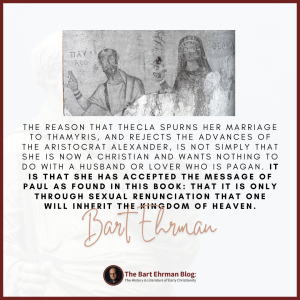
Remaining single and celibate is one of the keys to this fascinating narrative. For the theology represented here is not one you might expect, if all you knew were the seven undisputed letters that came from Paul’s own hand. The reason that Thecla spurns her marriage to Thamyris, and rejects the advances of the aristocrat Alexander, is not simply that she is now a Christian and wants nothing to do with a husband or lover who is pagan. It is that she has accepted the message of Paul as found in this book: that it is only through sexual renunciation that one will inherit the kingdom of heaven. It is this, rather than the proclamation of the atoning sacrifice of Christ, that lies at the heart of his proclamation.
This message is best seen at the outset of the narrative, where Paul preaches to those gathered in Onesiphorus’s house, while Thecla listens from the upstairs window next door:
Blessed are the pure in heart, for they will see God;
Blessed are those who have kept the flesh chaste, for they will become a temple of God;
Blessed are those who are self-controlled, for God will speak to them;
Blessed are those who have renounced this world, for they will be pleasing to God;
Blessed are those who have wives as if they did not have them, for they will be the heirs of God…
Blessed are those who have departed from the shell of this world because of the love of God, for they will judge angels and be blessed at the right hand of the Father…
Blessed are the bodies of the virgins, for these will be pleasing to God and will not lose the reward for their chastity; for the word of the Father will be an accomplished act of salvation for them on the day of his Son, and they will receive an eternal rest.
From these extracts, Paul’s message is clear. It is important to renounce this world and all the pleasures it holds. What matters before God is a chaste life of self-control. People are not to engage in the acts of sex, even if they are already married. For eternal life is the reward for chastity. This is the gospel that Thecla embraces. No wonder her fiancé is so disturbed.
[1]. See especially Stephen Davis, The Cult of Saint Thecla: A Tradition of Women=s Piety in Late Antiquity (New York: Oxford University Press, 2001).
[2]. For a recent translation, see The Acts of Thecla,@ in Bart D. Ehrman, ed., Lost Scriptures: Books that Did Not Make It into the New Testament. (New York: Oxford University Press, 2003), pp. 113-21.
We have two goals at Ehrman Blog. One is to increase your knowledge of the New Testament and early Christianity. The other is to raise money for charity! In fact, in 2022, we raised over $360,000 for the charities below.
You must be logged in to post a comment.Over $2 Million Donated to Charity!





Share Bart’s Post on These Platforms
19 Comments
Leave A Comment
Hi Bart, I wanted to ask you something since a while, unrelated to this post, but here I can ask you questions.
What do you think about the book “The greatest lie ever told”, by W H Uffington, whos is supposed to be a british scholar, who has hid his identity? Here is its description: “Jews, Christians and Muslims have been grossly mislead about their religions. All three were perverted from their shared origins, by politics, avarice and greed. The greatest of these perversions is Christianity. Academics knew the truth but dared not publish it. Church leaders knew the truth about Jesus but lied to hide it. They know that Christianity is one of many monotheistic religions based on an identical theme and they carried out a ruthless and bloodthirsty campaign which has failed to eradicate the truth. The Greatest Lie Ever Told takes the reader on a historical voyage, using wit and logic to reveal the evidence of research that no one wanted you to see. The author proves his allegations, presents truth not speculation and shows where the future path of the Church must lie. The Greatest Lie Ever Told isn’t some vague conjecture, it is a fact.”
I don’t know what he thinks the lie is, but it sounds like one of those many, many conspiracy theory books. I’ve never heard of him to my knowledge and can’t imagine he’s a scholar.
Thank you very much for your answer.
It’s been years that I read it, and perhaps 2/3, including the end. What I remembered is that he wrote that Judaism was somewhat a cover for an old Egyptian religion, some priests survived and hid it in these new texts, and that the History in the Old Testament was a lie. Most historians agree on this last part. Then, he extended to Christianism, I forgot exactly how.
He said he was a “professional historian, [his] specialism was War and Military Strategy. An independent expert is always a potential embarrassment to their colleagues.”
If one day, you are interested to dig into books that seem conspiracy theories, particularly that one, and to give feedbacks on their arguments, I would find it very interesting. It’s always better to have critics from historians, who have solid arguments to counteract. Thus, we have more clarity, and are more equipped, thanks to this confrontation of ideas from experts.
Hello Dr.Bart Erhman
Do you think jesus was accually sinless if no do you think it would have been included in the gospels.
For example there is a story where jesus lied then i think that story would have not been told.
Do you mean the historical Jesus? No, I think he was fully human.
Bart,
The ‘Pauline Beatitudes’ seem to be quite non-Pauline in style and an obvious rip-off from Matthew 5:3-12 used to make the story sound ‘orthodox’ at the start, which helps date the writing to a time long after Paul’s death. Were the Pauline Beatitudes found/used in any other early Christian writings?
Came here to ask this…
Hello Dr.Bart Erhman
Is there a concensus between secular historians that the ressurection of jesus very likely did not happen?
Now THIS is cinema! At the same time I just fell down a click hole for twenty minutes. At any rate, in competent hands her whole story would make one hell of a screenplay
I have wondered if the author of Thecla was working out a form of proto-Pelegianism — at least, to the extent of its extreme asceticism. (I suspect only a man could describe celibacy as “extreme asceticism,” but that appears to dove-tail with the spirit of the post.)
I have visited the Holy Well sacred to Thecla at Llandegla in North Wales.
I suspect that to many women a life of celibacy was preferable to the marriages their families arranged for them.
Thanks Dr Ehrman. This is fascinating. If the Pastoral epistles were a riposte to the Acts of Paul and Thecla, that could suggest that female ministry was an aspiration to be nipped in the bud, rather than a reality. I’m convinced that there were possibly many women leaders in the early Church (eg. the ‘deaconesses mentioned in Pliny the Younger’s letter). What are your views on this?
The Pastoral episltes were almost certainly written before the Acts of Thecla, I think, though the views embodied in Thecla may well have been floating around before that book was written. My sense is that Paul’s own views could be taken either to promote women in the church or to silence them, and over time, the silencing faction won out. But it’s clear that women were leaders in Paul’s churches — just in Romans 16 he mentions a deacon Priscilla, a number of women who run house churches, other missionaries, and Junia whom he labels as “foremost among the apostles.” Some later readers emphasized the importance of women ledership, most opposed it, based on passages such as 1 Cor. 11 on headcoverings.
Bart, how does Paul’s alleged teaching that Thecia took to heart and spread about staying celibate square with God’s word in Genesis 1:28 and 9:1,7? Seems to me that would be a question asked by anyone who heard her spread the word. Do you have any knowledge on that issue?
Christians who urged celibacy did not think that a commandment directed to specific people about having babies applied to everyone, and that being more highly focused on the heavenly realms required not being focused on earthly pleasures and experiences.
A happy memory from my trip to Syria in 2008 (when things were starting to get better, before they got worse) was a visit to Ma’loula. I sat in a cave drawing at the shrine of St Thecla, people came and prayed and left. A little girl came, and watched me drawing and asked if she draw too. . . instead of drawing she wrote “I love you” and asked my name. I wrote Lyn. She wrote Safa Hanin and drew a heart.
Ma’loula was still a Christian village. Aramaic is still spoken as well as Arabic, but not written. A nun in the nearby monastery, Mar Takla, recited the Lord’s prayer in Aramaic to us.
The town gets its name from the Aramaic word ma’la meaning entrance or gap. St Taqla was being chased by soldiers (presumably sent by a disappointed suitor). She came to a mountain and after a prayer the mountain split open and she escaped. The gap between mountains is still there so it didn’t close again to engulf the soldiers. Perhaps when the saw the earth move they were too timid to follow her.
A lovely story. Thanks. So sad, aggravating, and upsetting what has happened since…