
Search
Advanced search
Some Interesting Questions of the Week
I’ve started posting questions and responses from readers. Here’s another set of particularly good ones. QUESTION: I recently read your book Jesus Interrupted and have become interested in your work. In it you discussed the potential forgeries contained in the Pauline letters and New Testament but it didn’t seem to mention much about the Old Testament. I noticed you did say that the New Testament was your specialty but was wondering if there was any evidence you were aware of that the Old Testament contains similar situations and which books. RESPONSE: Yes, my book was just about the NT, not the entire Bible.
May 21, 2025
The Letter to the Colossians, in a Nutshell
We continue in this series that explains each book of the New Testament “in a nutshell” by turning to the letter to the Colossians. This is a book that claims to be written by Paul, but as we will see in the next post, there are very good reasons for thinking Paul himself did not write it, but that it was written in his name by a later follower claiming to be Paul. For now, we are interested in the letter itself, it’s major themes and emphases. I begin by trying to explain the book in 50 words. The letter to the Colossians, allegedly written by Paul from prison, praises the Christians in Colossae and warns them against false teachers who urge them to follow the Jewish law, live strictly ascetic lives, and worship angels; for this author, Christ alone represents the godhead and deserves to be worshiped. Here now is a fuller account of the main features of the book. ****************************** “Paul” is in prison for preaching the gospel (Col 4:3). While there, he […]
May 22, 2025
The Letter to the Colossians: Who, When, and Why?
Now that I have summarized the major themes and emphases of Colossians, I can talk about who wrote it, when, and why. The book, as we have seen, claims to be written by Paul. But there are good reasons for doubting it. In a number of ways, this letter does look very much like those that Paul himself wrote. The prescript written in the names of both Paul and Timothy, the basic layout of the letter, and the closing all sound like Paul; and a number of important Pauline themes are sounded throughout: the importance of suffering in this world, Jesus’ death as a reconciliation, and the participation of believers in Jesus’ death through baptism. On these grounds, one might think that Paul may well have written this letter.
May 24, 2025
Colossians: For Further Reading
Here is an annotated list of books on Colossians, most of them relevant to all the Deutero-Pauline epistles (that is, the letters that are assigned a “secondary” standing in the New Testament collection of Paul’s letters because scholars doubt they were actually composed by Paul himself) with a couple of commentaries specifically on Colossians. One benefit of serious commentaries is that they always begin by discussing major critical issues in understanding a book: authorship, date, historical context, major themes, disputed issues, and so on.
May 28, 2025
Did Paul Write That Letter? Getting Into the Weeds…
A few days ago I published a post trying to show why many critical scholars do not think Paul wrote the letter to the Colossians even though its author claims to be Paul. It’s pretty easy to put the matter in simple, easy-to-understand terms for non-experts: all you have to say is that the writing style, theology, and presupposed historical circumstances don’t match up with what we know about Paul otherwise. But, well, that’s really not very convincing. It’s just informative. So I provided a few of the details connected with writing style and theology, but tried to do it still in fairly simple terms. As I’ve done sometimes before, I thought it might be useful to (some of?) you to see how I would argue that for scholars without having to mince words, just so you can see how it might be done. To do it fully would take many pages, but here is the discussion I devote to the matter in my academic book Forgery and Counterforgery: The Use of Literary Deception in […]
May 25, 2025
The Book of Acts “At a Glance” and Controversial Questions
In addition to my nutshell summaries of each book of the New Testament, I have been providing a post that gives additional materials I present in my New Testament textbook. These are (a) rapid fire summaries of each book that I call “At a Glance” and (b) a set of study questions that challenge students to take a position on key aspects of the book, that I call “Take a Stand.” Here they are now for the book of Acts. I hope the summary “at a glance” makes sense, and that you can nail the questions. BOX 17.8 The Book of Acts The book of Acts is the second of a two-volume work by the author of Luke. Like the first volume, it is dedicated to an otherwise unknown “Theophilus.” These books have been traditionally ascribed to Luke, the traveling companion of Paul; there are, however, reasons to suspect this tradition. Like the Gospel of Luke, the book was probably written around 80–85 c.e. A thematic approach to the book reveals several prominent themes: The […]
May 27, 2025
Interesting Questions from Readers
Here are three interesting questions I’ve recently received, and my attempts to answer…. QUESTION: I’ve been wondering about the passage in Romans where Paul expresses his fear about returning to Jerusalem on account of opposition because he wanted to take the money that he raised there before leaving for Spain. I used to couple this account with Paul’s final leg of his third mission out of Corinth back to Jerusalem, and there he indeed faces opposition Acts chapter 20 and then finds himself in Rome, in prison Acts 28? The passages seem to fit well together, but how? History, hearsay, looking at the letter itself expanding the details? What do you think? RESPONSE: I think the big problem is the whether we can accept the book of Acts as providing a reliable account of Paul’s arrest and trials. I don’t think we can. So reconciling it or conflating it with Paul’s own account(s) just doesn’t work.
May 29, 2025
1 Thessalonians in a Nutshell
I now move on in my “New Testament in a Nutshell” series to the letter of 1 Thessalonians, which for-roughly-ever has been one of my favorite books of the New Testament. It is not one of the most widely read as a rule, but I think it is both unusually important and interesting. For one thing, it is the first letter of Paul that we have and, therefore, the very first piece of Christian writing of any kind that we have. That in itself makes it unusually significant in my view. THE earliest words from any Christian! Whoa. When I taught Greek at Princeton Theological Seminary (some millennia ago) this was the book we had beginning students first translate once they had all the important elements of Greek grammar down. It’s not excessively hard Greek, but it is challenging for first-timers, and it’s the kind of book that if you read carefully – as you have to do when you’re basically going one word at a time trying to figure out the Greek – you […]
May 31, 2025
1 Thessalonians and the Coming Rapture
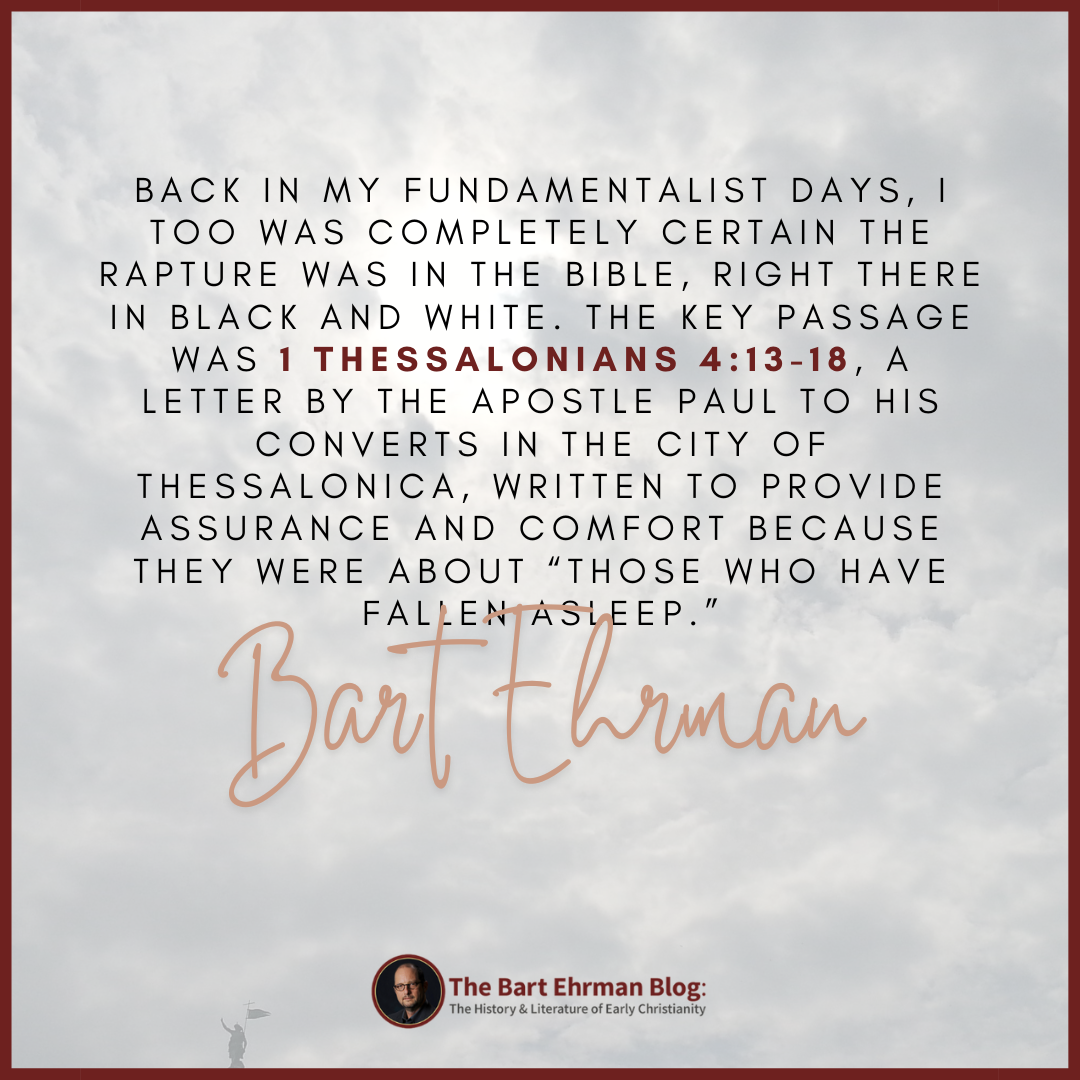
One of the most intriguing passages of 1 Thessalonians is also both the most widely referred to (these days) and the most universally misread. It is the passage that conservative Christians cite to support the idea of the coming “rapture,” when Jesus will allegedly arrive from heaven to take his followers out of the world before the appearance of the Anti-Christ and the horrendous period of disaster and “tribulation” that must take place for seven years before the Final Day of Judgement. The “rapture” is one of the firmest beliefs of conservative evangelicals. And it is not found in the Bible. Here is what I say about it, in relation to 1 Thessalonians 4:13-18 in particular, in my book Armageddon. ********************************* Here is an interesting factoid that, in my experience, almost no one knows: No one had even thought of the idea of a “rapture” until the 1830s. Of the many, many thousands of serious students of the Bible throughout Christian history, who pored over every word – from leading early Christian scholars such […]
June 4, 2025
1 Thessalonians. For Further Reading
Here is a list of readings on 1 Thessalonians, most of which are relevant to all the undisputed Pauline epistles, with a couple of commentaries specifically on this significant, short letter. One benefit of serious commentaries is that they always begin by discussing major critical issues in understanding a book: authorship, date, historical context, major themes, disputed issues, and so on. I devote a fuller discussion of 1 Thessalonians (an entire chapter) in my textbook, Bart Ehrman and Hugo Mendez, The New Testament: A Historical Introduction to the Early Christian Writings, 8th ed. (Oxford University Press, 2024), ch. 20. That’s a good place to start for a fuller exposition of what I have given here in my nutshell posts. If you have an earlier edition of the book, it will be pretty much the same, except for the expanded bibliography. ******************************
June 3, 2025
Interesting Questions from Readers (5/27/2025)
Here are some particularly sticky questions I’ve gotten recently, with expanded answers to share with all of you: QUESTION: Bart, what should we understand by “exousia” in I Cor 11.10? RESPONSE: Ah, right. A woman is to have an “authority” (exousia) on her head. It’s a confusing verse in a confusing passage. The verse: For this reason a woman ought to have authority over her head, because of the angels. It’s sometimes translated “veil” though it clearly does not mean veil, per se. But in the context Paul is talking about why women should wear head coverings in church and so in some sense apparently the veil is seen as an “exousia” or “authority.” His opening explanation is that since God is the “head” of Christ and Christ is the head of a man then the man is the head of a woman. Does “head” here not refer to the thing sitting on your shoulders but something like “chief authority” (as in “the head of the department”)?
June 5, 2025
1 Thessalonians: Who, When, and Why
Now that I have given an overview of the major themes and emphases of 1 Thessalonians, I can say a few more things about what we know about its authorship, when it was written, and why. The book, of course, is always called “Paul’s” first letter to the Thessalonians but as you’ll notice, the opening verse indicates that it comes from “Paul, Silvanus, and Timothy.” And throughout the letter the first-person plural pronoun predominates “WE give thanks” “WE know” “OUR visit” and so on. So, was this a letter written by committee? If so…how does that work exactly?
June 1, 2025
2 Thessalonians in a Nutshell
In this series of “nutshell” overviews of each of the books of the New Testament, we move now to one of the most intriguing instances of a book that claims to be written by Paul, but was apparently, instead, written by someone else who wanted his readers to think he was the apostle. 2 Thessalonians is an intriguing case because the book certainly sounds a lot like Paul’s other letters and does indeed appear to be a kind of follow-up letter to 1 Thessalonians. It also has numerous word-for-word similarities to 1 Thessalonians. It too, for example, is written by “Paul, Silvanus, and Timothy” (1:1) and is addressed “to the church of the Thessalonians in in God our Father and the Lord Jesus Christ” (2 Thessalonians 1:2) – both verses being virtually identically to 1 Thessalonians. Moreover, its contents are closely related to the other letter: both are concerned about the suffering the Thessalonian Christians are experiencing through persecution and especially about their misunderstanding about when Jesus is to return on the Day of Judgment. […]
June 7, 2025
2 Thessalonians: Who Wrote It, When, and Why?
In my previous post I explained the major theses and emphases of 2 Thessalonians, and pointed out that in many ways it is very similar in its concerns and themes to 1 Thesssalonians. But I also said that it is commonly considered by scholars to be “Deutero-Pauline,” that is, written by a later author only *claiming* to be Paul. How can we know? As I said there, the problem from a historian’s point of view is that someone who had decided to imitate Paul would no doubt try to sound like Paul. If both Paul and an imitator of Paul could sound like Paul, how could we possibly know whether we are dealing with the apostle himself or one of his later followers? Here’s how I deal with the matter in my textbook on the New Testament (Oxford University Press, ch. 23). ****************************** There is, in fact, a way to resolve this kind of historical whodunit, and it involves looking at the other side of the coin, that is, at the parts of 2 Thessalonians […]
June 8, 2025
2 Thessalonians: For Further Reading
Here is an annotated list of books on 2 Thessalonians, most of them relevant to all the Deutero-Pauline epistles (that is, the letters that are assigned a “secondary” standing in the New Testament collection of Paul’s letters because scholars doubt they were actually composed by Paul himself) with a couple of commentaries that deal with 2 Thessalonians. One benefit of serious commentaries is that they always begin by discussing major critical issues in understanding a book: authorship, date, historical context, major themes, disputed issues, and so on.
June 10, 2025
2 Thessalonians, The Modern State of Israel, World War III, and the Return of Jesus
An obscure verse in 2 Thessalonians may conceivably lead to World War III. OK, it sounds sensational and implausible, but hear me out. The following is taken from my book Armageddon (Simon & Schuster, 2023), edited for this occasion. ****************************** Evangelical Christians historically have believed that the Bible predicts the future, that many prophecies are being fulfilled in our day, and that they will continue to be fulfilled until the end comes when Jesus returns from heaven in judgment on the living and the dead. One thing that needs to happen is that the Temple in Jerusalem needs to be rebuilt. The end cannot come before then. And so they can appeal to the prophecy of Ezekiel: They shall live in the land that I gave to my servant Jacob, in which your ancestors lived; they and their children and their children’s children shall live there forever; and my servant David shall be their prince forever. I will make a covenant of peace with them; it shall be an everlasting covenant with them and I will bless […]
June 11, 2025
In the Weeds with the Author of 2 Thessalonians
I thought it migh be interesting for readers who like on occasion to get down into the weeds of scholarship to see a more detailed argument for how the *similarity* of 2 Thessalonians to 1 Thessalonians suggests not that Paul wrote both of them but that a later author (of 2 Thessalonians) was imitating Paul’s authentic letter (1 Thessalonians). Here’s how I express the case in my book Forgery and Counterforgery (Oxford University Press). [Don’t worry about the Greek: you can either just see the similar letters or look up the verses in your English translation]: 2 Thessalonians as a Forgery One reason the case for the inauthenticity of 2 Thessalonians has occasionally seemed wanting, even to some very fine scholars, is that critics have often resorted to a shotgun approach, citing every possible argument, good or bad, in support of their position. It is all too easy to dismiss bad arguments, leaving an appearance of evidence in balance, pro and con. And so, for example, the letter is often said to lack Paul’s customary […]
June 12, 2025
The Pastoral Epistle of 1 Timothy in a Nutshell
In this series providing summaries of each book of the New Testament “in a nutshell” I have dealt with three of the letters that claim to be written by Paul but probably were not: Colossians, Ephesians, and 2 Thessalonians. We now come to the three letters that are grouped together and called the “Pastoral Epistles,” 1 and 2 Timothy and Titus. For reasons we will see, there is a wide scholarly consensus that these books were not actually written by Paul. Before addressing the issue of authorship, I’d like to note the ostensible distinctive themes and emphases of these books, both as a group (since most scholars are reasonably certain that they all came from the same pen) and individually. The three letters are grouped together as Pastoral epistles because each claims to be written by Paul to a person he has appointed to lead one of his churches: Timothy, his young companion left to minister among the Christians in Ephesus, and Titus, his companion left on the island of Crete. Moreover, these epistles contain […]
June 14, 2025
The Pastoral Epistles of 2 Timothy and Titus in a Nutshell
I continue now with my nutshell overviews of the Pastorals by summarizing 2 Timothy and Titus. I begin with a 50-word overview of the book Timothy. 2 Timothy, a more intimate letter (allegedly) by Paul to Timothy, recounts their past relationship, expresses hope that his disciple will come to visit him in prison in Rome, and urges him to fulfil his duties as leader of the church by quashing false teaching and maintaining his upright character. Here is a longer sketch of the book from my New Testament Introduction.
June 15, 2025
Who Wrote the Pastoral Epistles? When? And Why?
Now that I have given an overview of each of the Pastoral epistles of 1 and 2 Timothy and Titus, I can turn to the key question of whether Paul actually wrote them, when they were written, and why. This will take several posts. I have taken the information with some revision by book, The New Testament: A Historical Introduction to the Early Christian Writings. To begin with, when discussing the question of the authorship of these letters, we should constantly remember that we are not asking whether Christians in the first or second century would have forged documents in Paul’s name. We know for a fact that some did: 2 Thessalonians alludes to a forged letter (2:2). Moreover, everyone agrees that some of the writings that survive in Paul’s name are Christian forgeries (e.g., the correspondence between “Paul” and the philosopher Seneca, and the apocalypse written by “Paul”). What we are asking, then, is whether any given document that claims to be written by Paul can sustain its claim. Most scholars are reasonably convinced […]
June 17, 2025