Sorting by

×

Why I Don’t Like Public Debates

Over the years I’ve done a lot of public debates, and deep down I suppose I think they can do some good.  Maybe not on a large scale, but at least for a few individuals in the audience who are open both to thinking about an important issue and to realizing that the view they’ve always held and simply assumed to be true may not be.  If there are 300 people there and five of them are like that, OK, that’s great.  Think Genesis 18:23-33. On the other hand, even though I get enthusiastic when I do debates, I really don’t enjoy them.  I’m not sure I’ve ever enjoyed one.  As some of you have heard me say, in virtually every debate I’m in, part way through I start writing notes to myself:  “WHY are you doing this??” I had a debate last week with my friend and conservative evangelical apologist Mike Licona on whether the apostolic “authorities” Matthew, Mark, Luke, and John actually wrote the Gospels named after them.  During the debate, [...]
2025-12-02T15:45:13-05:00November 30th, 2025|Public Forum|

A Gold Nugget Often Overlooked: The Book of Zechariah

Last week, for some reason I can’t remember (!) I decided to see what I had written about the book of Zechariah in my textbook, The Bible: A Historical and Literary Introduction (Oxford University Press).  As I read it, I thought — I bet most people on the blog haven’t actually read Zechariah (one of the Minor Prophets in the Old Testament — called “minor” not because they are unimportant but because they are shorter than the “major” ones — Isaiah, Jeremiah, Ezekiel…).  And I bet most people who have read it couldn’t summarize it to save the planet.  And hey, why should they?  (Summarize it; not save the planet…) So why not give a bit of info on it?  It’s a great little book.  Here’s what I say about it in my undergraduate textbook. ZECHARIAH Like other books of the Hebrew Bible (most famously Isaiah) the book of Zechariah does not appear to be the work of a single writer. Scholars have long considered Zechariah 1–8 to be by one author (called First Zechariah) and 9–14 by a different one, living later (Second Zechariah). First Zechariah [...]

2025-12-02T15:45:54-05:00November 29th, 2025|Public Forum|

Errors That Are Not Mistakes in the Bible

In a post a few days ago I pointed out that people often don’t clearly differentiate between the nuances of words that mean similar but not identical things, and that this leads to misunderstandings. I posed a challenge then for readers to differentiate between the words: Error Mistake Falsehood Deceit Lie Some of you took me up on the challenge.  I’m not able to comment on all the responses, but I will say: Well Done! The point of the exercise was to stress that if we don’t have a clear idea of the differences between these related terms, we both mis-communicate with others and mis-interpret what others are saying. That happens – in the two examples I gave – when someone says that if the disciples claimed they saw Jesus after the resurrection but did not then they were “lying,” and when someone claims that if a Gospel writer intentionally reports that Jesus said the opposite of what he actually did say, it is not an error (since he changed Jesus’ words on [...]

2025-11-26T15:24:48-05:00November 27th, 2025|Public Forum|

Some Good Questions On John and the Appearance of Jesus in the World

Here are some of the intriguing questions I've received recently: a number on how Jesus came into the world and the theology of the Gospel of John.   QUESTION: In your opinion, why did Paul say Jesus was “born of a woman” (Galatians 4:4)? To my memory it seems unique in the entire Bible, and unnecessary. Why would anyone talking about anyone feel the need to say that person was born of a woman? Should it not be a given? RESPONSE: Yup, in isolation it seems a very odd thing to say.  How ELSE would he have been born?  But it makes better sense in its literary context (Gal. 4:1-7).  Paul indicates that we ourselves were "children" enslaved to foreign powers; God sent his own son who was not just his son but the child of a woman, so that now with this child we could be adopted to be children of God and heirs of God.  Paul's playing with "son" / "child" language here.  Christ is God's son; a human's son; and [...]

2025-11-26T15:18:03-05:00November 26th, 2025|Reader’s Questions|

Lies, Contradictions, Mistakes, and the Meaning of Words. What Do You Think?

I occasionally get an email from someone who says that the disciples must have really seen Jesus raised from the dead because “they would not have lied about it.”  I’m always struck my how that seems to be the only option: Jesus was raised or the disciples “lied.” Relatedly (though not obviously so), my friend the evangelical apologist Mike Licona has claimed (in a public event we were both participating in) that when the author of Matthew changed a saying of Jesus from what he found in his source, Mark -- thereby making Jesus say just the opposite of what he said in Mark -- it was not an “error,” because Matthew did it on purpose and knew what he was doing. Mike’s logic was that Matthew was treating the account the way historians in antiquity often did, editing it for his own purposes in a way that created a discrepancy.  (FWIW: Mike thinks Mark accurately reports what Jesus actually said). [In case you’re interested in checking it out, it’s in the passage [...]

2025-11-26T15:11:40-05:00November 25th, 2025|Public Forum|

The Striking Prayers of the Didache

Among the most fascinating elements of the Didache are the prayers it records, one (the Lord’s Prayer) which it presents in a form more familiar to people today than the forms found in the New Testament (!), and others connected with the Eucharist – that is, the “Lord’s Supper” as celebrated in church.  These prayers are nothing like most churches say today. I start with the Lord’s Prayer. The Lord’s Prayer is not found in the Gospels of Mark or John, and Matthew and Luke word it differently.  Luke appears to represent the oldest surviving form of the prayer, possibly the form that was original to Q. Matthew’s Gospel expands this version by adding some additional petitions, as seen below. One of the many intriguing features of the Didache is that it also presents the Lord’s Prayer but in a slightly different form from what can be found in either of the canonical Gospels, and, as I said, the Didache’s version is closest to the form of the prayer familiar to most Christians [...]

2025-12-02T15:47:31-05:00November 23rd, 2025|Early Christian Writings (100-400 CE)|

Help Feed Families in Need (With a Particularly Enticing Incentive!): Ehrman Blog Annual Appeal

At the end of each year, the blog highlights one of the charities we support through our ongoing charitable work. This year, we’re rallying behind the Food Bank of Central and Eastern North Carolina—a phenomenal organization that distributes food to those in need throughout my part of the state. What they do is both astonishing and essential. They gather millions of pounds of food from farms, manufacturers, grocery stores, and individuals, then manage the enormous logistical task of getting it to where it’s needed most. The operation is mind-bogglingly complex—but the result is beautifully simple: they keep people from going hungry. You can read more about their work here. This year, I’ve set a goal to raise $20,000 by the end of the year.And to double the impact, I’ll personally match every dollar raised, up to $20,000—meaning together, we can send $40,000 to help feed families in need. A Special Thank-You Gift: The New Testament in a Nutshell To thank you for your generosity, anyone who donates $50 or more will receive an advance digital [...]

2025-11-18T15:56:24-05:00November 22nd, 2025|Public Forum|

Intriguing Instructions for How To Run the Church: More on the Didache

In my previous post I started to discuss one of the most important of the Apostolic Fathers, the Didache. I indicated there that it consists of three parts, the first of which is an ethical treatise on the "Two Ways" one can live. Now I continue with describing the even more unusual next two parts, a set of instructions about ritual activities and wandering apostles and prophets, and an apocalyptic prediction of what is yet to come..  This description is principally taken from my book The New Testament: A Historical Introduction to the Early Christian Writings.   ******************************   Like the “Teaching of the Two Ways,” the second portion of the Didache may be drawn from one or more earlier sources, or it may represent the anonymous author’s own composition. It is a kind of “church order” in which instructions are given for various kinds of church activities. For example, Christians are to perform their baptisms in cold running water (i.e., in an outdoor stream) whenever possible, although standing or warm water is [...]

2025-11-14T16:25:24-05:00November 20th, 2025|Early Christian Writings (100-400 CE)|

The Didache: An Important Early Christian Document in a Nutshell

The Didache (pronounced DID-ah-kay) is one of the most interesting and important documents to have survived from the earliest years of Christianity, written before even some of the books of the New Testament, apparently, and invaluable for understanding the development of Christian ethical views, the ways the early church was organized (with wandering teachers and prophets going from own to town), and he earliest Christian rituals (baptism and eucharist). Over the next two posts I’ll summarize the major themes and emphases of the book In a Nutshell.  I begin with a one-sentence, fifty-word summary. The Didache, probably completed around the year 100 CE, consists of three writings combined into one: (1) An ethical treatise on how Christians should behave, called “the Two Ways,” (2) Rules for handling itinerant church “authorities” and church rituals (baptism; eucharist), and (3) An apocalyptic discourse about the imminent end. The Didache of the Twelve Apostles (the Greek word didache literally means “the teaching”) was virtually unknown until 1873, when it was discovered in a monastery library in Constantinople. Since then [...]

2025-11-14T16:22:27-05:00November 19th, 2025|Early Christian Writings (100-400 CE)|

Are You Interested in a More Interactive Approach on the Blog? Reflections on the First Blog Stewards Seminar

I would like to describe for all of you the kind of webinar I did this past week for those blog members who have chosen to become Blog Stewards -- so you can see what you too could be involved with if you choose. For a long time I’ve wanted to try having a bona-fide seminar with a group of layfolk. Not a lecture, not a Q&A, but a discussion – something closer to what happens in a university classroom when everyone comes prepared and ready to wrestle with a text together. Our focus was the Prologue to the Gospel of John (John 1:1–18). Few passages in the New Testament have provoked more thought or more confusion than this one. What exactly does it mean to say “the Word was with God, and the Word was God”? How an entity be something and be with the same something? What does it mean for that Word to “become flesh”? Why is this high view of Jesus found here and nowhere else in the New Testament?  Is [...]

2025-11-20T22:36:47-05:00November 18th, 2025|Public Forum|

How Do You Date a Book Such as Barnabas?

In my posts on Barnabas I indicated that it was probably written sometime in the 130s CE; I often get asked how scholars come up with dates like that? The first thing to stress is that it's is very difficult to date ancient writings.  But scholars who have worked on such matters (for nearly 300 years now, in some instances) have marshaled pretty good evidence in case after case, although in many instances there continue to be substantial debates. There are several ways to establish parameters, which are fairly commonsensical. If a writing is quoted by an author whose dates are relatively certain (his dates too need to be established on independent grounds! But in lots of cases there is almost no doubt), then obviously the writing is earlier than that. So that’s a beginning. Second, if the writing itself quotes a dateable writing or author then it must be written later than that. And third, relatedly, if the writing refers to a dateable event, then it must be later. Much of the [...]

2025-11-13T23:20:53-05:00November 16th, 2025|Early Christian Writings (100-400 CE)|

Why Was the Letter of Barnabas Attributed to Barnabas (Part 2)

In my last post  in starting to explain why early Christians may have attributed the anonymous Letter to Barnabas to Barnabas, best known as a one of the closest companions of Paul.  That post was a set up to this; in it I explained some of the key things we know about the mid-second century philosopher/theologian-eventually-branded-arch-heretic Marcion. Here I explain the relevance of that. It is important to recall that the letter of Barnabas is stridently anti-Jewish, claiming that the Jews never were the people of God because they had broken the covenant as soon as God had given it to them on Mount Sinai (by worshipping the Golden Calf); they misunderstood the law, taking it literally, when it was meant figuratively. Even though Jews never realized it, the OT was not a Jewish book but a Christian book, that not only anticipated Christ but proclaimed the Christian message. The first explicit reference to this anonymous letter is in the writings of Clement of Alexandria, writing around 200, who quotes it and claims [...]

2025-11-20T23:02:14-05:00November 15th, 2025|Early Christian Writings (100-400 CE)|

November 2025 Gold Q&A Announcement

Hey Gold & Platinum Members, Our next Gold Q&A with Bart is coming up soon! Join us Sunday, November 30th at 5PM Eastern, just those of us stateside emerge from our annual ritual of gratitude and gluttony for another round of sharp questions and as always, Bart’s trademark wit. Got something you’ve been itching to ask?Send your question to [email protected], and don’t hold back! (Only emailed questions make it into the lineup.) A few quick notes: Keep it short and to-the-point. Bart loves a good challenge and diving deep, but with limited time to get through as many questions as possible, clarity wins the day. Can’t join live? No worries. I will email the full recording after the event. Question deadline: Wednesday, November 26th (end of day). Join us live on Zoom: https://us02web.zoom.us/j/86523158115?pwd=kOEL0WFrnXrpfeGG2N6chSbhYcMfbX.1Meeting ID: 865 2315 8115 Passcode: 518727 Bring your best questions...clever, tricky, or downright tough...and see what Bart has to say! Looking for past Gold Q&A Recordings? While we work on finding them a permanent home on the blog website, you can check out [...]

2025-11-19T10:37:47-05:00November 14th, 2025|Public Forum|

Why Would Anyone Claim Barnabas Wrote “The Epistle of Barnabas”?

In my previous posts I indicated that the “Letter of Barnabas” was not actually written by Barnabas (named as an apostle in Acts 10-15). In fact, it could not have been, since it is almost certainly to be dated to the 130s CE (for reasons I could explain if anyone really wants to know….). Barnabas, the companion of Paul, must have died no later than the 70s CE, more likely the 60s – some seventy years before this letter was written. So Barnabas couldn’t have written it. So why was the (rather long) letter of Barnabas – which in fact is anonymous – eventually attributed to Barnabas, the companion of Paul? I dealt with this question once (and only once in my entire life, I believe); it was something like thirteen years ago on the blog (!).  And here's what I said: ****************************** Even though much of what I write about on the blog is widely known among scholars (and even accepted, mirabile dictu!) , I occasionally do set forth views that are [...]

2025-11-26T14:53:09-05:00November 13th, 2025|Public Forum|

The Epistle of Barnabas in a Nutshell (Part 2)

Here I continue my discussion from the previous post of the major themes and emphases of one of the best know of the Apostolic Fathers, The Epistle of Barnabas, which embodies strong attack on Jews for misunderstanding their own religion and misinterpreting their own Scriptures. ****************************** According to this anonymous author, Jews are also wrong to take the dietary laws of the Old Testament literally. God did not mean that his people were not to eat pork or rabbit or hyena, all of which are proscribed in the Torah. The injunction not to eat pork means not to live like swine, who grunt loudly when hungry and keep silent when full. People are not to treat God in this way, coming to him with loud petitions when they are in need and ignoring him when they are not (10:3). Not to eat rabbit means not to live like those wild creatures, who with every passing year increase their sexual appetites and add an additional orifice to their body, allowing them to propagate at [...]

2025-11-13T09:59:09-05:00November 12th, 2025|Early Christian Writings (100-400 CE)|

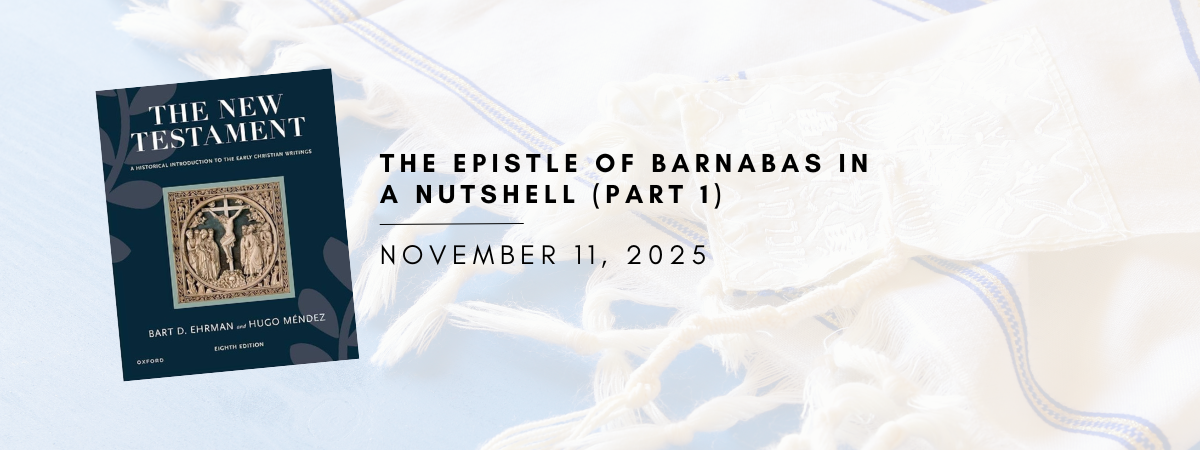
The Epistle of Barnabas in a Nutshell (Part 1)

The Epistle of Barnabas, another one of the "Apostolic Fathers," was a popular book in the early centuries of Christianity; one of our oldest manuscripts of the New Testament, Codex Sinaiticus (375 CE or so) includes it among the books of Scripture.  But I think we can be glad, on the whole, it was not included in the end.  It presents one of the strongest attacks against Jews and Judaism from the early second century.  It is nonetheless an intriguing work that continues to be studied rigorously by experts of early Christianity today. I begin explaining it by providing a fifty-word one-sentence summary: The Epistle of Barnabas argues that the Jewish people broke their covenant with God as soon as they received it and so have always misunderstood their own Scriptures and mis-practiced their religion; only followers of Jesus are God’s people, and the Old Testament is a Christian, not a Jewish, book. I can now begin to unpack the major themes and emphases of the book.   I am taking much of this from my [...]

2025-11-07T11:02:00-05:00November 11th, 2025|Early Christian Writings (100-400 CE)|

Christ-killers; the date of Luke; and the literacy of Matthew: Questions and Responses

Here are some of the really interesting questions I've received recently, and my responses. QUESTION: Bart, you have said:  “1 Thessalonians is a heartfelt connection from Paul to some of his converts where he tells them how well he thinks they are doing, urges them to keep on keeping on, reminds them to avoid sinful natures, and encourages to be patient now that some have fallen asleep, because the end is near.” It’s been a long time since I’ve read the book and I am struck with the passage  “…You suffered from your own people the same things those churches suffered from the Jews who killed the Lord Jesus…” “…the Jews who killed the Lord Jesus…”, in the earliest Christian document we have????? Dr. Ehrman, what are your thoughts on that? I didn’t remember Paul saying something so matter of fact blaming Jews for the death of Jesus.   RESPONSE: Yup, it's a tricky passage.  The important thing to notice is that Paul is talking about people in a region (around Thessalonica and [...]

2025-11-07T10:57:01-05:00November 9th, 2025|Reader’s Questions|

How the Heavenly Lights and the Resurrection of the Phoenix Reveal God’s Will

I’ve indicated that the book of 1 Clement is rather long and seems a bit rambling in places to many of its readers, when its only real goal is to tell some usurpers in the church of Corinth to give the reins of power back to the duly appointed church leaders. I read it differently.  I think that it makes rather marvelous connections between things that one would normally think of as unrelated in an extended effort to show the wayward upstarts in Corinth that they have taken over the church illicitly. Who woulda thought that the sun, moon, and stars, the seasons ,the boundaries of the sea, and the winds reveal that God wants the original leaders given their authority back? Or that the Myth of the Phoenix (first discussed in the western tradition six centuries earlier by Herodotus) would have any relevance? This author thinks so! Here are two passages that make the point.  The first (ch. 20) expounds on the regularity of nature as established by God, in order to [...]

2025-11-07T10:46:03-05:00November 8th, 2025|Early Christian Writings (100-400 CE)|

June 2026 Cruise Details – Norway & Svalbard

I earlier mentioned that in June I'm doing a cruise with Thalassa Journeys that will go up the coast of Norway to Svalbard (think: Polar Bears!).  This is going to be a terrific adventure; gorgeous landscapes, picturesque villages; intriguing wildlife; and scintillating fellow-travelers all on a fantastic ship that I've been on and can certainly vouch for.  I'll be giving lectures on "Who Chose the Gospels," based on research I'm currently doing for my next book.  Come along and you'll be the first to hear!  (When I'm not lecturing, I'll be hanging out with my fellow travelers, sharing ideas and thinking deep thoughts!) Below is the brochure.  (You can scroll through it with the sidebar on the right.)  There is limited space available so you if you're inclined -- go for it. To that end, Thalassa Journeys has provided an EARLY BIRD  SPECIAL.  Anyone who signs up by December 15, 2025 will receive a $300 discount on the trip.  AND for everyone who takes advantage of the Early Bird pricing, I will provide a free webinar, early [...]

2025-11-07T10:48:09-05:00November 7th, 2025|Public Forum|

Was 1 Clement Written BEFORE Some of the New Testament?

This will be my final post on the book of 1 Clement.  Now that I’ve summarized what the book is about and said something about its author, I can turn to the question of when it was written.  The time of its writing is an important question, for a reason you might not suspect. It is almost always said – I myself regularly say this, as a kind of simple “short hand,” knowing that it’s probably not literally true -- that the books of the New Testament are the “earliest” Christian writings we have.  In fact, if, as is often thought, Revelation was written around 95 CE, and 2 Peter around 120 and Acts possibly (?) around them as well, then a couple of other Christian books may have ante-dated them, including 1 Clement and the Didache, two of the apostolic fathers.  The letters of Ignatius of Antioch were almost certainly written around 110 CE. So, the big question here is: when did this anonymous author from Rome write the book of 1 Clement?   This [...]

2025-11-03T11:52:10-05:00November 6th, 2025|Early Christian Writings (100-400 CE)|
Go to Top