
If the Gospels are not historical, why should they matter??
Here is my anniversary post from April 2015; in it I expostulate on the importance of the Gospels even if they are not historically accurate, and challenge the idea that history is all that matters. (It’s longer than my typical post.) It is taken from the ending of my book Jesus Before the Gospels (HarperOne) based on feedback / pushback I was getting from some readers, and explains why “memory” is just as important (more?) as history.
******************************
Like most authors, I get a lot of email from people who have read my books. I find one of the comments I repeatedly receive somewhat puzzling and even disheartening. To explain it, I need to provide a bit of background.
When I discuss historical understandings of the New Testament and of the historical Jesus, I frequently refer to the problems of our sources. The Gospels were written decades after Jesus’ death by people who were not eyewitnesses and had probably never laid eyes on an eyewitness. They are filled with discrepancies and contradictions. They represent different perspectives on what Jesus said and did. For that reason, to know what actually happened in the life of Jesus we have to apply rigorous historical criteria to these sources to establish what he really said and did.
I present these views because at heart I am a historian, interested in seeing what we can know about the past. I have presented some such views here, in this book. But my focus in the book has been on memory, including, of course, “distorted” memories of Jesus’ life, but also memories that I think are closely related to history, for example, some of the “gist” memories found throughout the Gospels. Memory is not only faulty: at times, probably most of the time, it’s pretty good. So too with the memories of Jesus. We can know a good deal about Jesus’ historical life based on what our sources say.
You like this post? It's free! However, you'll need to be a blog member to read most articles here. Get access to Dr. Ehrman's library of 4,000+ articles plus five new articles per week. Membership starts at $2.99/mth and every cent goes to charity!
Unlock 4,000+ Articles Like This!

Moreover, I have tried to emphasize that the study of memory is not at all limited to what comes to be distorted over time. It is possible to engage in memory-history (what Jan Assmann calls mnemohistory) to see how recollections of Jesus can help us understand the people who were remembering him in one way or the other, why Mark, or John, or Thomas recalled Jesus the way he did.
The comment that I sometimes get from readers that I find puzzling or disheartening is when they tell me that if there is something in the Gospels that is not historical, then it cannot be true, and if it is not true, then it is not worth reading. My sense is that many readers will find it puzzling or even disheartening that I find this view puzzling and disheartening. But I do.
It is true that doing the work of the historian requires one to be extremely critical about the sources of information that are available about the past. Some readers seem to think that this is only what atheistic, hard-headed, liberal historians with anti-supernaturalist biases who are out to destroy religion do. But in fact, it is what all historians do. The reason some readers find this approach to the Gospels objectionable is that they simply aren’t accustomed to dealing with the Bible as history.
But even though I do deal with the Bible as a historian, I do not personally think that is the only way to deal with the Bible, and I find it disheartening when readers think that once the Gospels are shown to have discrepancies, implausibilities, and historical mistakes that we should just get rid of them and move on to other things.
I find that disheartening because the Gospels are so much more than historical sources. They are memories of early Christians about the one they considered to be the most important person ever to walk the planet. Yes, these memories are all distorted, when seen from the perspective of historical reality. But that doesn’t rob them of their value. It simply makes them memories. All memories are distorted.
And yes, the New Testament memories are all different from one another in one way or the other. But that doesn’t mean that we should then throw them all away because they are not trustworthy. Everyone’s memories – even of the same event – will be different from everyone else’s. That’s just how memories work.
And yes, again, these memories have all been shaped by the lives, histories, and concerns of the people who recorded them, so that the “present” of these authors affected what they remembered about the past and how they remembered it. But that doesn’t mean that we should just go on to read other books instead. All memories of the past are chosen and shaped by the present.
At the end of the day, I find it very puzzling that so many people think that history is the only thing that matters. For them, if something didn’t happen, it isn’t true. Really? Do we actually live our lives that way? How can we? Do we really spend our lives finding meaning only in the brute facts of what happened before, and in nothing else?
Think about the things that matter to us: our families, friends, work, hobbies, religion, philosophy, country, novels, poetry, music, good food, and good drink. Do we really think that the brute facts about the past are the only things that matter?
To pick one just one of these examples: is literature unimportant because it does not deal with the brute facts of history? Is Dickens’s great novel David Copperfield of no value because its main character didn’t actually live? Well, that’s different you say, because it’s fiction. Yes indeed, it’s fiction. And fiction can be life-transforming because it is full of meaning — even though it never happened. Or consider further: can historical discoveries undermine the power of great literature? Does the earth-shattering force of King Lear evaporate if it can be historically proved that someone other than Shakespeare wrote it? Does Dover Beach really fail to grip us with its powerful pathos if we learn that these were not actually the author’s thoughts the last time he was looking out over the English Channel?
Literature speaks to us quite apart from the facts of history. So does music. So does sculpture. So do all the arts. The Gospels are not simply historical records about the past. They are works of art.
They are also written forms of memory. The truth is that most of us cherish our memories – memories of our childhood, of our parents, of our friends, of our romantic relationships, of our accomplishments, of our travels, of our millions of experiences. Other memories, of course, are terribly painful – memories of pain, of suffering, of misunderstandings, of failed relationships, of financial strain, of violence, of lost loved ones, of millions of other experiences.
When we reflect on our past lives, when we remember all that has happened to us, all the people we have known, all the things we have seen, all the places we have visited, all the things we have experienced, we do not decide, before pondering the memory, to fact-check our recall to make sure that we have the brute facts in place. Our lives are not spent establishing the past as it really happened. They are spent calling it back to mind.
When we do so our memories may be frail, and faulty, and even false. But they are how we remember. And that is how we live our lives, with these memories. If someone tells us that something happened to us differently from how we remember, we may change how we think about it. But that’s not usually what happens. More often we’ll simply say that we don’t remember it that way. And we stick to our memories. If we do shift what we think about our remembered past, we don’t jettison our memories, but we transform them.
We live not only with our own memories, but also with the memories of others. We share our lives. Others share their lives with us. The only way to share a life with someone outside of that non-existent nano-second of the present is to share a life of memory. Our presents are affected by these pasts – both ours and those of others. Just as these pasts are molded by our presents. And our reflections about the future are molded by both. Living life is never a matter of isolation – from either our past or the pasts of others. The living and sharing of memories is what makes up our lives.
The Gospels are shared memories of the past. Yes, they can be scrutinized by historians who want to get a better sense of what actually happened in the life of Jesus. That’s what I do for a living. But if they were only that, they would be dry, banal, and frankly rather uninteresting to anyone except those with rather peculiar antiquarian interests. The Gospels are more than historical sources. They are deeply rooted and profound memories of a man whose memories ended up transforming the entire world.
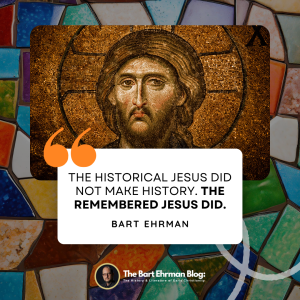
It is easy to make the argument that the historical Jesus did not transform the world. He does not transform the world today. You may wonder how that could possibly be, if Christianity became the religion of the West. Look at it this way. There are two billion people today who are committed to the memory of Jesus. How many of those two billion have what I, as a historian, would consider to be a historically accurate recollection of the basics of Jesus’ real life and ministry? Some thousands? It’s a tiny fraction. The historical Jesus did not make history. The remembered Jesus did.
For me as a historian it goes without saying that we should pay close attention to what can be learned about the historical Jesus. But we should not neglect the remembered Jesus.
Does it matter if Jesus really delivered the Sermon on the Mount the way it is described in Matthew 5-7? It matters to me historically. But if Jesus didn’t deliver the sermon, would it be any less powerful? Not in the least. It is, and in my view deserves to be, one of the greatest accounts of ethical teaching in the history of the planet.
Does it matter if Jesus really healed the sick, cast out demons, and raised the dead? Does it matter if he himself was raised from the dead? But if these stories are not historically accurate, does that rob them of their literary power? Not in my books. They are terrifically moving accounts. Understanding what they are trying to say means understanding some of the most uplifting and influential literature that the planet has ever seen.
Does it matter if Jesus considered himself to be God on earth? As a historian, it matters to me a great deal. But if he did not – and I think he did not – the fact that he was remembered that way by later followers is terrifically important. Without that memory of Jesus, the faith founded on him would never have taken off, the Roman Empire would not have abandoned paganism, and history as we know it would never have transpired.[1] History was changed not because of the brute facts of history, but because of memory.
Memory can certainly be studied to see where it is accurate and where it is frail, or distorted, or even false. It should be studied that way. It needs to be studied that way. I spend most of my life studying it that way. But it should also be studied in a way that appreciates its inherent significance and its power. Memory is what gives meaning to our lives – and not only to our own personal lives, but to the lives of eeryone who has ever lived on this planet. Without it we couldn’t exist as social groups or function as individuals. Memory obviously deserves to be studied in its own right, not only to see what it preserves accurately about the past, but also to see what it can say about those who have it and share it.
Christian memory is particularly and uniquely important. Christian memory transformed our world. Christian memory brought about a revolution in the history of Western Civilization. Christian memory continues to influence billions of lives in our world today. Ultimately, of course, Christian memory goes back to the earliest memories of Jesus. These too need to be studied, both for what they can tell us about the historical person who stands behind the memory, but also about those who came in his wake, who remembered him and passed along their memories to those of us living today.
We have two goals at Ehrman Blog. One is to increase your knowledge of the New Testament and early Christianity. The other is to raise money for charity! In fact, in 2022, we raised over $360,000 for the charities below.
You must be logged in to post a comment.Over $2 Million Donated to Charity!





Share Bart’s Post on These Platforms
25 Comments
Leave A Comment
My favorite post is your discussion of how the birth of Jesus story differs in Matthew versus Luke. I think this appeared in a news magazine as well.
Among your comments, this one impressed me the most. I am a rather conservative Christian, so I do not necessarily agree with all of your conclusions. Nevertheless, I believe that many of the “facts” you explain are correct as historical observations.
How we deal with memory may be, in some sense, an epistemological question. I think the epistemology of historians and that of believers are not necessarily the same. Whether the words recorded in the Gospels were actually spoken by Jesus in exactly that form may remain uncertain. Yet I personally find myself trusting passages such as John 14:26.
This does not mean that faith causes me to stop thinking. Rational understanding and faith seem to coexist in my mind. I can recognize tensions among the Gospel accounts while still trying to understand them as part of a meaningful whole.
From a historical perspective, this may simply mean that I am choosing to believe. Yet when I feel compassion for those who suffer, it does not seem to me that such impulses can be explained by DNA alone.
These are only my personal reflections, and no reply is necessary.
Shinji: I used to also believe love and compassion could not be explained by DNA. And then I learned about the evolutionary power of cooperation down to the cellular level (even below that: each of our cells lives in symbiosis with mitochondria which once had an independent ancestor). This understanding changed my whole outlook so that now I can be an atheist and still believe in cooperation, love, and empathy.
Thank you for sharing your experience
Dear Professor Ehrman,
Thank you very much for your thoughtful answer to my question during the April 6 Gold Members Q&A about Jesus’ cry of dereliction. Your explanation of how Mark uses the tearing of the temple curtain to signal atonement was especially illuminating.
I have been working on a new theory of atonement that builds on the idea that the Synoptic Gospels present Jesus as the earthly manifestation of God’s eternal moral laws. In my view, the crucifixion symbolizes not only the suffering of Jesus but also the “crucifixion” or yielding of the eternal divine laws themselves. This theory aligns with your explanation of the passage in Mark.
The full argument is too long to present in a Q&A submission. I would be grateful to hear your opinion of it. Would it be possible to send it to you by email or in another format? If so, please let me know the best way to do so. My email address is: [email protected].
Thank you for your time, your scholarship, and your generosity in engaging with readers.
With appreciation,
Henrik Kochan (Israel)
Sounds interesting. I”m afraid that because of all my other commitments, I’m not able to read and comment on emails I receive. (As you probably noticed, I have a hard time even commenting on blog comments I receive; but not for want of trying!). But if you sant to give bits and pieces here on occasoin, I’d be happy to respond.
What I’d say about how you’re expressing your views here briefly is that they sound like a very interesting theological perspective, rather than a historical assessment of whta the authors were themselves saying. That’s not a criticism but an observation.
Dear Professor Ehrman,
I also have a brief follow up question from the Q&A. When discussing Jesus’ forty days in the wilderness, you noted the parallel with Israel’s forty years in the desert. Do you think the Gospel writers may also have had Moses’ forty days on Mount Sinai in mind? And more broadly, since the number forty appears so frequently in the Hebrew Bible—the flood, the wilderness, Moses on Sinai—I have wondered whether it might sometimes function as an idiomatic way of saying “a long time,” rather than a literal numerical value. I would be interested to hear your thoughts on whether this possibility has any support in biblical scholarship.
Thank you again.
With appreciation,
Henrik Kochan (Israel)
Yup, I definitely think Matthew in particular has Moses in mind (Dale Allison has an entire book on how Matthew uses Moses stories/motifs to shape his understanding of Jesus), and yes, “40” often is simply a way of saying “a long time,” but usually in a way that the reader is supposed to think “a significant long time planned by God.”
Bart,
In reference to Jesus, you asked the question “Does it matter if he himself was raised from the dead?”
In Christianity, the answer to that question makes an astronomical difference. Christianity is built on the premise that Jesus was raised from the dead. In 1 Corinthians 15:1-5, it is stated that the gospel is the death, burial, and resurrection of Jesus. Later in the chapter, we find the following verse:
1 Corinthians 15:14 – And if Christ be not risen, then is our preaching vain, and your faith is also vain.
I get the point you were trying to make, but I think this is one question that matters tremendously. My question is this: Eleven years after this post, do you still feel the answer to this question doesn’t matter?
I certainly agree, 100%, that it matters to most Christians theologically if Jesus was raised from the dead or not, for just the reasons you cite. Traditionally, without the resurrection there would be no salvation.
My question isn’t exactly that. It is instead whether the stories of the resurrectoin COULD be significant even for those who don’t believed in actually happened, literally. I think the answer to that is “yes” as well, for reasons I explained in my recent Easter Message that you can find on my youtube page.
I agree with Bart here. I am no longer a believing Christian, nor a believer in any other religion. I am an atheist, since in my view the evidence overwhelmingly weighs against the proposition that there is any self-aware, omniscient, omnipotent creator of the universe.
BUT, nevertheless, I find the Gospel stories powerfully moving, all the way from the homeless baby sleeping in a manger, to the anguish in Gethsemane, to the cry of despair “Why have you forsaken me?” on the cross, through to the Resurrection. I do not believe that the Resurrection actually happened. But that in no way diminishes its power as a *story.* I respond to it with the same kind of emotional intensity and, indeed, the same yearning that it *were* true (even though I know that it isn’t) as I respond, for example, to Tolkien’s description of Frodo’s embarking from the Grey Havens. I wish the Grey Havens existed, and that I too could sail out of the confines of this world. I wish that the Resurrection were true, and that eternal life existed. In both cases, my certainty that these stories are not factually true in no way diminishes the stories’ emotional power.
“Christianity is built on the premise that Jesus was raised from the dead.” Institutional Christianity, yes, but one can be a follower of Christ’s teachings w/out believing in his resurrection.
“The historical Jesus did not make history. The remembered Jesus did.” Bart Ehrman
Hi bart I have a question!
My question: I’ve been listening to scholar Dan McCellans arguments that John did not consider Jesus to be the incarnate god of the hebrew bible, god HIMSELF as chrsitians do (Like 2/3rds of the trinity) but rather a divine god-like or proto-god being intermediary imbued with the image OF god with the authority of god but not the god made flesh. His arguments make a LOT of sense to me especially with john 14:20 and 17:21 which seems to indicate john believed whatever relationship jesus had with god it would be extended to his disciples. Surely they weren’t ALSO going to be the literal god of the hebrews? What am i missing here? There’s other verses too but It’s sort of one of those things once I see it, I can’t unsee it.
Do you believe that John believed jesus was the actual god of the hebrew bible unified in substance a la the trinity? Is there a consensus of biblical scholars just what john believed jesus was? I can’t see him being portrayed as the hebrew god in the synoptics at all but I have to squint now to see it in john.
John definitely did not think that Jesus was Yahweh, the God of the Jews. Otherwise he would pray to him! John did think that Jesus was a divine being who pre-existed his appearance on earth.
I understand your post and I think the memory of this man is so important for shaping much of how we got here but I guess as a person who never believed, it just never had much impact on me. Take the sermon on the mount. To me it was never particularly moving, more amusing as it’s a mix of what seems like pretty basic good advice, such as mercy and not judging others, some very terrible advice about not caring where your food and clothes will come from, and absurdities about thought crimes being equal to actions that cause harm.
For me as a nonbeliever, i look at the destruction wrought in christs name and can see the logic of how it was all justifiable to believers. I’m horrified by the mountain of corpses left in it’s wake. I can see that the arc of justice and equality and human dignity has mostly occurred because we pushed the bible farther and farther away from us and affirming jesus is on it’s own affirming the bible.
I’m willing to accept maybe I’m naive and the common sense good advice is only common sense because of jesus’s words in the gospel
While I agree that just because the gospels may be (largely) non-historical doesn’t mean they aren’t valuable, I would argue that the standard of “only history matters” was self-imposed by Christians themselves (1 Corin 15:12-18). This standard can quickly polarise the perspectives of either side, trapping people into a dichotomy of historical-useful/ahistorical-useless.
Comedian Dave Chappelle has a bit explaining why Donald Trump resonated with blue-collar Americans. Chappelle portrays Trump as someone who, though not blue-collar, steps “from behind the curtain” to reveal how things really work.
He frames the bit around the Clinton-Trump debate, using real references/quotes. At one point, he jokes that Trump “pulled out his Illuminati membership card and snorted a line of cocaine off the podium.” Obviously, that didn’t happen. The real debate is still available to watch. But Chappelle isn’t deceiving/misremembering.. he assumes the audience understands the exaggeration.
A future historian might wonder whether it occurred. If they determine it didn’t, it would be a mistake to dismiss the bit as false/unreliable. It conveys something real/historical: how Trump’s movement felt to certain people.. something a transcript alone can’t capture.
Similarly, when Peter heals Dorcas/Tabitha, the story doesn’t have to be strictly literal to carry historical meaning. It reflects how early Christians understood the continuity between Jesus/apostles.
That insight matters more than the tired debate between literalism/dismissal. Historically, the early apostles did carry forward the mission Jesus began. That reality can remain true even if the story of Dorcas functions as a symbolic expression of that continuity.
My current self loves this post! My 20 something self of ancient times is still yelling “No, the Gospels still aren’t the same as Lord of the Rings! If the Gospels aren’t history what hope does any of us have? Life is just Nietzsche level nihilism! Might as well just end it all or live a hedonistic life!” That very visceral reaction kept me in the believing Christian camp for many decades before I finally moved beyond it!
“The historical Jesus did not make history. The remembered Jesus did.”
While I agree with that statement, it is a tough sell to many Christians.
Memories set into a hardened artistic mode over the years became extremely strong visual and emotional markers of a later ‘history’ and these visual markers often block out any attempts to even consider less dramatic memories that may have been in place before those icons appeared. Who would dare claim that Jesus did anything less than the most miraculous presentation of a potentially apostolic memory?
The counter to why they matter are:
We live in an EMPIRICAL world rather than a MYTHIC world in which the supernature, miracles, magic, etc. were accepted.
Unfortunately, some people consider religious, mythic, magic, etc. statements to be superior to empirical facts. Of course god created the universe, animals, plants, people, etc. in seven days because the bible states this; even though empirical science contradicts this.
In an empirical world medicine, manufacturing, archaeology, chemistry, etc. are conducted based on empirical science, not based on religion, magic or supernature. The same people who want to set social policy based on religion would not want their doctors to simply ‘lay hands’ on them to treat illnesses.
I agree. But we still read Tolkien and find it meaningful.
Your comments about historical facts and memory are profound! 🙂
You said it beautifully, Bart. All of it. I’ve been wanting to read “Jesus Before the Gospels,” because I do want to learn more about oral traditions and memory, and I know you will do a great job helping me understand the essentials. Earlier this week I was thinking about this very same topic as it relates to ancient Hebrews. Still today, Passover is celebrated among observing Jews, and that tradition goes all the way back to the story of God bringing their people out of Egypt, which I think must have happened in some way, even though there is no historical or archaeological evidence that it happened at the scale the Bible presents. The collective memory of the ancient Hebrews, and of the first century Christians was galvanizing. It gave them a sense of cultural identity and belonging. Whether or not it all happened historically, or exactly as described, I think the idea that these culturally defining stories are wholesale fabrications is implausible. There is some truth in there. And yes, their meaning is deeply inspiring and moving . Brute facts are about how the world turns. Meaningful stories are about why we should care.
” “The historical Jesus did not make history. The remembered Jesus did.” While I agree with that statement, it is a tough sell to many Christians.”
Most Christians don’t know their religion or the bible, an anthology. They follow what their preacher spouts.
Until the last decade I believed that Scripture was God breathed. But St
Paul was addressing the Hebrew Bible, not the NT