Sorting by

×

About BDEhrman

Ehrman is the James A. Gray Distinguished Professor of Religious Studies at the University of North Carolina at Chapel Hill, where he has served as the director of graduate studies and chair of the Department of Religious Studies.

Live Gold Q&A! Monday March 13.

Dear Gold Members, I will be   my Gold Q&A tomorrow evening, March 13, 7:30 pm -- and anyone who wants to watch is welcome to come!  I've got a great set of questions to deal with and am looking forward to it.  No charge for admission, just show up.  We'll meet and greet, I'll do my thing, and then we can chat for a few minutes after. Here's the link: Topic: Gold Q&A https://unc.zoom.us/j/92207490998?pwd=MXRhQW9GTlRaMmE1WXdvRHVEVlNRQT09 Meeting ID: 922 0749 0998 Passcode: 339508 One tap mobile +16469313860,,92207490998# US +19294362866,,92207490998# US (New York) Dial by your location +1 646 931 3860 US +1 929 436 2866 US (New York) +1 301 715 8592 US (Washington DC) +1 305 224 1968 US +1 309 205 3325 US +1 312 626 6799 US (Chicago) +1 386 347 5053 US +1 507 473 4847 US +1 564 217 2000 US +1 669 444 9171 US +1 669 900 6833 US (San Jose) +1 689 278 1000 US +1 719 359 4580 US +1 253 205 0468 US +1 253 215 8782 [...]
2025-09-10T13:01:52-04:00March 12th, 2023|Public Forum|

What Do the Apostles’ Deaths Prove? Guest Post by Kyle Smith.

This is the final guest post by Kyle Smith, based on his recently published book about martyrs and the cult of the saints in Christianity. There is a special bonus for this post! A significant discount offer to buy the book. Go for it! And whether or not you do buy the book, feel free to ask him questions or make comments on this post, on a widely misunderstood but important topic. Kyle is the author or coauthor of five books about Christian saints and martyrs, including Cult of the Dead: A Brief History of Christianity (University of California Press, 2022). As a special bonus for readers of the blog, you can buy Cult of the Dead today at 40% off the cover price! Click here to order directly from the University of California Press, then select “UC Press” under the “Buying Options” drop down menu and enter coupon code CULT40 at checkout. Offer valid until March 31, 2023. ****************************** The Christian passion for martyrdom began with the cross, but it is often forgotten that this [...]

2025-09-10T13:01:36-04:00March 12th, 2023|Public Forum|

Is the God of Job Worthy of Worship?

Is there any way to consider the God portrayed in Job as a morally upright being who deserves complete devotion?  Read the account yourself.  I have summarized the "folktale" of Job (found in Job 1-2, 42) in my previous post.  This is a tale that portrays God, Job, and the reason for human suffering very differently from the (different) composition of Job 3-42, a set of dialogues between Job and his friends and eventually God that I will discuss in my next posts.  For now I'm interested in the reasons God crushes the righteous Job with suffering in the tale. The overarching view of suffering from the story is clear: sometimes suffering comes to the innocent in order to see whether their pious devotion to God is genuine and disinterested.  Are people faithful only when things are going well, or are they faithful no matter what the circumstances?  Obviously for this author, no matter how bad things get, God still deserves worship and praise. But serious questions can be raised about this perspective, questions raised [...]

2025-09-10T13:01:36-04:00March 11th, 2023|Hebrew Bible/Old Testament|

The Story of the Righteous Job and His Righteous God

In my previous post I explained how the book of Job comprises both a folk-tale written in prose about a righteous man named Job (chs. 1-2; 42) and a set of dialogues written in poetry between Job, his so-called friends, and eventually God (chs. 3-42).   These are two different compositions with two different authors living at two different times with two different understandings of why Job and people like him suffer. To unpack these understandings, I begin with the folktale as discussed in my book God's Problem (HarperOne, 2008). ****************************** The Folktale: The Suffering of Job as a Test of Faith The action of the prose folktale alternates between scenes on earth and in heaven.  It begins by indicating that Job lived in the land of Uz; usually this is located in Edom, to the southeast of Israel.  Job, in other words, is not an Israelite.  As a book of “wisdom,” this account is not concerned with specifically Israelite traditions: it is concerned with understanding the world in ways that should make sense to everyone living [...]

2025-09-10T13:01:36-04:00March 9th, 2023|Hebrew Bible/Old Testament|

Suffering in the Two Books of Job. Two Books?

  After I finished my short thread of posts about the problem of suffering a couple of weeks ago, I realized that it might be helpful for me to discuss one or two of the books of the Bible that deal with the issue head-on -- in part because many people don't read these books much, even if they know about them, and in part because many people who *do* read them don't know how expert interpreters have explained them. For no book is this more true that that gem in the Hebrew Bible, the book of Job.  Or rather those two books, the two books of Job. To talk about Job and what it is really about will require several posts.  This is the first, an introduction to the single most important issue connected with the book that most people have never heard and that completely affects how the book is to be interpreted. This is how I discuss it in my book God's Problem: How the Bible Fails to Answer Our Most Important Question [...]

2025-09-10T13:01:36-04:00March 8th, 2023|Hebrew Bible/Old Testament|

Platinum Webinar! Forgiveness vs. Atonement

Dear Platinum members, It is time (finally!) for our quarterly Platinum webinar, for you Plats only.  We have scheduled it for Wednesday March 15, 7:30 pm EST.  I have decided to delve into a topic that you (or at least I) almost NEVER hear about: the difference between forgiveness and atonement.  This difference plays a significant role in early Christianity, even though, so far as I know, no early Christian talks about it or even seems to recognize it.  And it marks a very big difference between the teachings of Jesus and the preaching of his followers after his death.  It matters a lot for understanding how "salvation" works AND for understanding interpersonal relations. All this will be part of the next book I'm working on, and I've never made a presentation on it!  I'd like to try my ideas out on you.  Wanna come?  Come! Here's the Zoom link.  I'm looking forward to it! https://unc.zoom.us/j/99912549124?pwd=NnNsSDRGbVlBWDA4MFFNUXJBS0taZz09 Bart

2025-09-10T13:01:51-04:00March 7th, 2023|Public Forum|

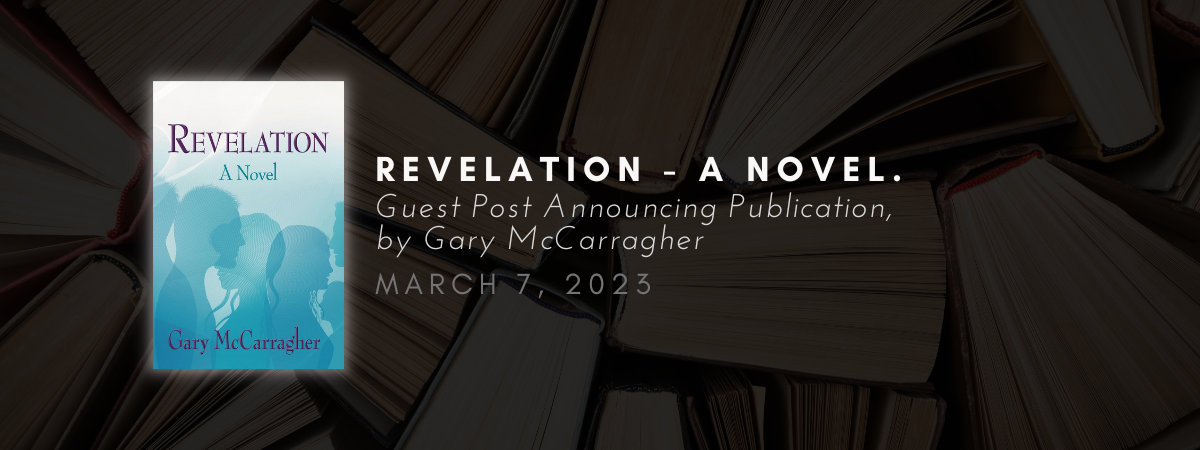
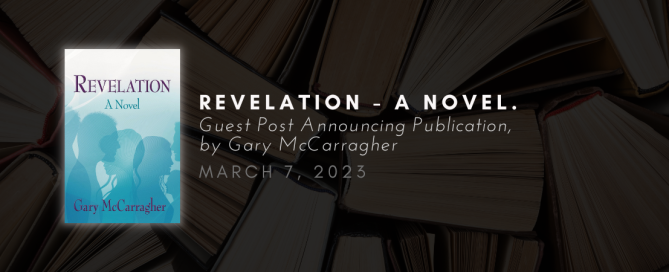
Revelation — A Novel. Guest Post Announcing Publication, by Gary McCarragher

Just now published, here is a novel about a New Testament scholar named Bart, at a major university in the South, who comes from a fundamentalist background and continues running up against it.  But this Bart's story ain't mine.  As a novel, this is a fictional narrative, which does, however, deal with issues that I and many of you have confronted and dealt with at length: how to come to grips with a historical understanding of the New Testament when coming from an evangelical world, a world still inhabited by those we love. Gary McCarragher is a blog member, a physician, and award-winning author.  He contacted me a couple of years ago to see if I'd be willing to consult with him on his novel.  As some of you know, I run a writing consultation service off my website (unconnected with the blog)  for authors of fiction and nonfiction, screenwriters, and playwrights.  Gary and I had a number of sessions about his work, and it has resulted now in this novel, Revelation .  I found [...]

2025-09-10T13:01:36-04:00March 7th, 2023|Book Discussions, Public Forum|

March Gold Q&A: Submit your questions!

Dear Goldies, Our monthly Gold Q&A is coming upon us.  DEADLINE for your question(s):  this coming Friday, March 10, midnight your time.    Interested in anything I can deal with?   Now's your chance: Ask away! I'm more likely to answer questions that are relatively short and to the point than those that go on for a long paragraph.  So be concise. I'll answer as the spirit leads. To enter your question on to the list: send it to Diane at [email protected] My plan is to record the session sometime over the few days after that.  I will probably send out a note indicating when that'll be a day or so ahead of time in case any of you want to listen in live. So, let me hear what you're curious about and I'll do my best to respond! BDE  

2025-09-10T13:01:51-04:00March 7th, 2023|Public Forum|

The Voice at Jesus’ Baptism–An Intriguing Version in the Gospel of the Ebionites

Last week in my class on "Jesus in Scholarship and Film" we were discussing the intriguing little fact that when Jesus is baptized, the voice of God that comes from heaven to call him his Son says different things in each of the three Synoptic Gospels (there is no voice in the Gospel of John).  How does one explain that?  It made me think of the Gospel of the Ebionites, and I started wondering if I ever talked about it on the blog. It turns out the answer is yes.  Here is a post devoted to it, from years ago -- which begins with a general discussion of it along with two other "Jewish-Christian Gospels," and ends with a description of its rather clever way of reconciling the three accounts of the voice from heaven. ****************************** Yesterday in my graduate seminar we spent three hours analyzing the three so-called “Jewish-Christian Gospels.” These are very tricky texts to deal with. We don’t have any manuscripts of them – even small fragments. They come to us, instead, [...]

2025-09-10T13:01:35-04:00March 5th, 2023|Public Forum|

Is the Gospel of Mark in Papias Our Gospel of Mark?

Can we trust a source such as Papias on the question of whether our Gospel of Matthew was written by the disciple Matthew and that our Gospel of Mark was written by Mark, the companion of the disciple Peter? It is interesting that Papias tells a story that is recorded in our Matthew but tells it so completely differently that it appears he doesn’t know Matthew’s version.  And so when he says Matthew wrote Matthew, is he referring to *our* Matthew, or to some other book?  (Recall, the Gospel he refers to is a collection of Jesus’ sayings in Hebrew; the Gospel of Matthew that *we* have is a narrative, not a collection of sayings, and was written in Greek.)  If he *is* referring to our Matthew, why doesn’t he see it as an authoritative account? Here's the conflicting story.  It involves the death of Judas.  And it’s quite a story!  Here is my translation of it from my edition, The Apostolic Fathers (Loeb Classical Library, vol. 1; 2004). But Judas went about in this [...]

Who Wrote the Gospels? Our Earliest (Apparent) Reference

I have begun to discuss the evidence provided by the early church father Papias that Mark was actually written by Mark.  He appears to be the first source to say so.  Does he?  And if so, is he right? Here’s how I begin to discuss these matters in my book Jesus Before the Gospels (edited a bit here). ****************************** Papias is often taken as evidence that at least two of the Gospels, Matthew and Mark, were called by those names already several decades after they were in circulation. Papias was a Christian author who is normally thought to have been writing around 120 or 130 CE.  His major work was a five-volume discussion of the teachings of Jesus, called Exposition of the Sayings of the Lord. [1] It is much to be regretted that we no longer have this book.   We don’t know exactly why later scribes chose not to copy it, but it is commonly thought that the book was either uninspiring, naïve, or theologically questionable.  Later church fathers who talk about Papias and [...]

Did Mark Write Mark? What the Apostolic Fathers Say

Did Mark write Mark?   A couple of weeks ago I did an eight-lecture course on the Gospel of Mark for my separate (unrelated to the blog) venture, a series of courses on “How Historians Read the Bible” (the courses are available on my website: www.bartehrman.com).  It was a blast.  One of the things I loved about doing it was that I was able to read and reread scholarship on Mark and I learned some things I had long wondered about, and re-learned other things that I used to know. One of the things I had to think seriously about for the first time in some years was the question of why church fathers in the second century (but when?) began claiming that our second Gospel was written by John Mark, allegedly a secretary for the apostle Peter.  That took me straight back to the question of the reliability of an early Christian writer named Papias (writing around 120 or 130 CE?). Papias gets used all the time as proof that Mark wrote Mark.  Conservative Christian [...]

The End of the World Means the End of Sex. Guest Post by Daniel Kohanski

Here now is the third post by Platinum blog member Daniel Kohanski, based on his recently published book A God of our Invention.   This one should grab your attention!   **************************** From its beginnings, Christianity has had theological difficulties with human sexuality. In this edited excerpt from my latest book, A God of Our Invention: How Religion Shaped the Western World, I lay out what I believe are some of the reasons for this. --------------------------------------------------------------- The first Christian commentator that we have record of, the Apostle Paul, was also the first to recommend that Christians avoid sexual activity and stay celibate. “To the unmarried and the widows I say that it is well for them to remain unmarried as I am” (1 Cor. 7:8). Still, he did accept that not all were capable of it. He advised the Corinthians that if a man “thinks that he is not behaving properly toward his fiancée, if his passions are strong, and so it has to be, let him marry as he wishes; it is no sin” (1 [...]

Do We Suffer Because We Have “Free Will”?

In my previous posts I discussed a class I once taught at Rutgers University on how the various biblical authors deal with the problem of suffering – the problem of how there can be such horrible suffering in a world that is said to be controlled by an all-loving and all-powerful God (who therefore wants the best for people and is able to provide it).  Many of my students, as I pointed out, think that there’s an easy answer:  we suffer because of “free will.”  If we weren’t free to love and hate, to do good and do harm, we would just be robots or computers, not humans.  If God wanted to create humans, as opposed to machines, necessarily we have to be free to hurt others.  And many people do so, often in horrendous ways. Does that solve the problem?  Naturally we dealt with that issue in my class.  Here is how I discussed those conversations in my book on suffering, God’s Problem: How The Bible Fails to Answer our Most Important Question – [...]

2025-09-10T13:01:35-04:00February 26th, 2023|Public Forum|

Why Would Evolving Beliefs about Sin Lead to the Idea of an Afterlife? Guest Post by Daniel Kohanski

Last Week I published the first of three guest posts by blog member Daniel Kohanski, based on a book that he recently published that will be of interest to many blog readers.  Here now is the second post. ******************************             Apocryphile Press has just published my latest book, A God of Our Invention: How Religion Shaped the Western World (https://apocryphilepress.com/book/a-god-of-our-invention-how-religion-shaped-the-western-world/). The book first examines how the western world’s idea of God developed, from the Israelite worship of many gods, Yahweh included, through the first centuries of Christianity. It then looks at how that idea of God has impacted the way we deal with sex, war, and death, and how the belief that Jesus is coming back has interfered with our ability to handle crises. Here is an edited excerpt from the first part of the book, exploring how the Jews first came to believe in judgment after death. (I’ve relied on some of Bart’s books, and other scholars, for some of this material, but omitted the references for space reasons.) --------------------------------------------------------------- In the days of [...]

2025-09-10T13:01:20-04:00February 25th, 2023|Afterlife, Hebrew Bible/Old Testament|

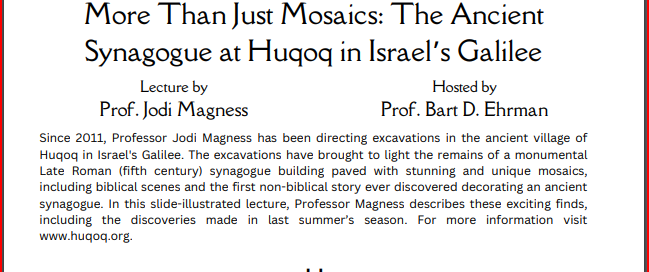
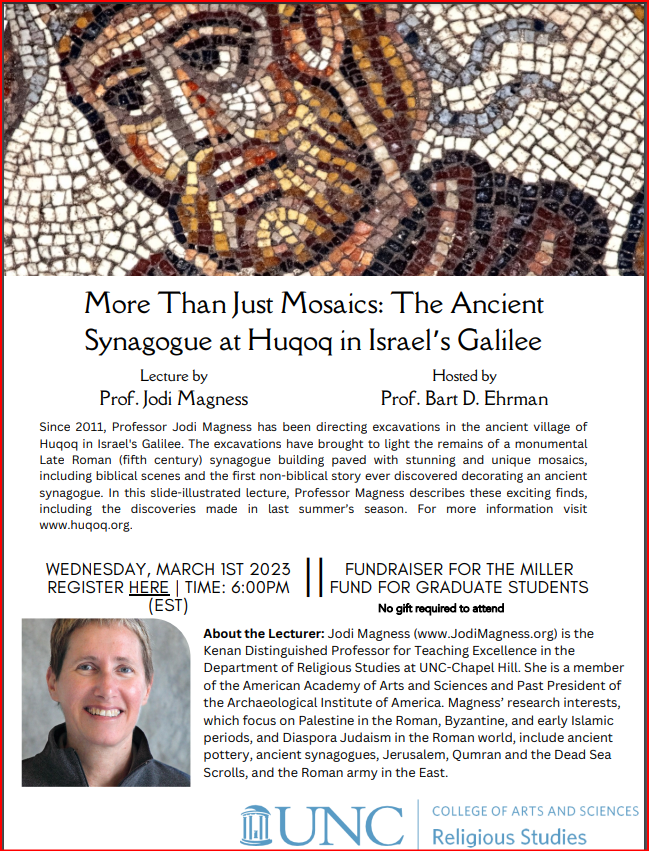
Exciting Lecture: Archaeological Finds (Artwork!) in an Ancient Galilean Synagogue

Now *this* will be a great event. My UNC colleague Jodi Magness is one of the premier archaeologists of ancient Israel in the world.  She started her career on a dig at Masada (the Roman army camps!) and for the past twelve years has run a dig in a village in Galilee called Huqoq.  Her findings have been extraordinary, far beyond what anyone could hope for.  Her team uncovered a (fifth-century) synagogue and discovered amazing mosaics unlike anything known before -- pictorial art, depicting humans (possibly Alexander the Great) and biblical scenes (Samson!).  Pictorial art in a *synagogue*?!?  What??  If you read National Geographic, you'll know about these discoveries: her dig is featured in the magazine nearly every year. This coming Wednesday, March 1, 6:00 pm Jodi will be giving an online lecture with slides about their most recent finds.  I'll be hosting the event.  It will not be recorded.  There is no charge, though it is a fund-raiser for my department to help provide research funds for our graduate students (donations are voluntary). Below [...]

2025-09-10T13:01:36-04:00February 24th, 2023|Early Judaism, Public Forum|

Seeing the Problem of Suffering as a PROBLEM

In my previous post I began to talk about how thinkers in the Jewish and Christian traditions have wrestled with the problem of suffering.  I indicated that the technical term for this “problem” is “theodicy,” and it is often said to involve the status of three assertions which all are typically thought to be true by those in these two religions, but if true appear to contradict one another.  The assertions are these: God is all-powerful. God is all-loving. There is suffering. How can all three be true at once?  If God is all powerful, then he is able to do whatever he wants (and can therefore remove suffering).  If he is all loving, then he obviously wants the best for people (and therefore does not want them to suffer).  And yet people suffer.  How can that be explained?   As I pointed out some thinkers have tried to deny one or the other of the assertions: either God is not actually all powerful, or he is not all loving, or there is no suffering. But [...]

2025-09-10T13:01:35-04:00February 23rd, 2023|Public Forum|

Is Suffering a “Problem” for Believers?

This past week I had a long talk with one of my bright undergraduates, a first-year student who had been raised in a Christian context but had come to have serious doubts driven in large part by the difficulty she had understanding how there could be suffering in a world controlled by an all-knowing and all-powerful God.  I naturally resonated with the question, since this is why I myself left the Christian faith. I get asked about that transition a lot, and it’s been five or six years since I’ve discussed it at any length on the blog.  So I thought I might return to it.  The one and only time I”ve talked about it at length is in my book God’s Problem: How the Bible Fails to Answer our Most Important Question – Why We Suffer (Oxford University Press, 2008).  Here is how I discuss it there, slightly edited.  (This will take several posts) ******************************* I think I know when suffering started to become a “problem” for me.  It was while I was still [...]

2025-09-10T13:01:35-04:00February 22nd, 2023|Bart’s Biography, Reflections and Ruminations|

Wait, Was Jesus Married? Guest Post by Kyle Smith

This is now the second guest post by Kyle Smith, scholar of early Christianity, on a hot topic related to his recently published book.   Kyle is Associate Professor and Director of the History of Religions Program at the University of Toronto. An award-winning teacher, he is the author or coauthor of five books about Christian saints and martyrs, including Cult of the Dead: A Brief History of Christianity (University of California Press, 2022). You can find him on Twitter, Instagram, TikTok, and the Peloton @kylesmithTO. ******************************  Few characterizations of Jesus’s life have spurred as much intrigue (and outrage) as the idea that he might’ve been married. In 2012, before it was discredited as a forgery, a scrap of papyrus inscribed with a few lines of Coptic set off a media furor when reports emerged that it quoted Jesus as saying, “My wife …” Conveniently, the rest was cut off. Despite the abiding popularity of books like The Da Vinci Code, which might lead one to think otherwise, there is no scholarly debate over whether Jesus [...]

How Does Something “Mean”

One morning recently, at the crack of dawn, I was walking my dog when I saw my neighbor Sally walk across the street and pick up the newspaper from my neighbor Jane’s driveway, and head back to her house.  I thought WHOA!  Sally is stealing Jane’s paper! I bet her own paper didn’t get delivered this morning!  Interesting and a bit amusing. But Sally she stopped in her own driveway and picked up her (identical) paper, and I suddenly realized, OH!  Jane must be gone for a few days and Sally is picking up her paper so it won’t be obvious she’s away.  Sally wasn’t doing something slightly nasty but something very neighborly. And it made me think how the *context* of an action is completely determinative of its meaning.  The very same action, in a different context, means something different and can have, in fact, precisely the opposite moral worth. Naturally, I started thinking about other actions along these lines.  ‘Cause that’s the kind of thing I do when I walk my dog. What [...]

2025-09-10T13:01:20-04:00February 19th, 2023|Public Forum|
Go to Top