Sorting by

×

About BDEhrman

Ehrman is the James A. Gray Distinguished Professor of Religious Studies at the University of North Carolina at Chapel Hill, where he has served as the director of graduate studies and chair of the Department of Religious Studies.

Jesus’ Death in Mark and Luke: Why Don’t They Agree?

In my previous post I tried to show how Mark and Luke portray Jesus very differently in his final moments before his death: in Mark he is deeply disturbed and seemingly in doubt, in Luke he is calm, confident, and in control.  But why would they each chose to portray Jesus in the way they do?   It is easier to show *that* they differ than to explain why.  Still, there are some good, plausible views of the matter.  I’ll start with Mark. In Mark Jesus appears to be in shock, is silent the entire time, seems not to understand why this is happening to him, up to the end, when he cries out asking God why he has forsaken him.  And then he dies, never having received an answer.  What is most striking is that even though Mark’s Jesus may not know why, when it comes to the time, he has to suffer like this, the reader ... The rest of this post is for the lucky few, the blog members.  Actually, they're not lucky [...]
2025-09-10T12:50:45-04:00September 10th, 2020|Canonical Gospels|

All Day Seminar (Online) for the Smithsonian: This Saturday!

Looking for some fun, excitement, and a change of pace this weekend?  On Saturday I will be doing an all-day seminar for the Smithsonian Associates, four lectures (two in the morning, two in the afternoon), each with Q&A to follow, on Heaven and Hell, based, of course, on the book.  Interested in joining in?  Ticket information, and so on, can be found here: https://smithsonianassociates.org/ticketing/tickets/heaven-and-hell-perspectives-on-afterlife The structure of the lectures will be different from the book.  Here is the line-up of the lectures. 9:30­–10:45 a.m.  Death After Death The earliest records of the afterlife in ancient Near Eastern, Israelite, and Greek cultures portrayed it as no life at all: death leads to only a dreary, uninteresting, eternally empty existence in which there is no joy, no pleasure, and no hope, as portrayed in the Epic of Gilgamesh, the Hebrew Bible, and writings of Homer. 11 a.m.–12:15 p.m.  Justice in the World Beyond Both Greek and Israelite cultures eventually developed the concept that this life cannot really be the end of the story and that the misery [...]

2025-09-10T12:50:45-04:00September 9th, 2020|Afterlife, Public Forum|

The Calm and Collected Jesus

I was just browsing through old posts and came across this one that appeared eight years ago tomorrow – a circumstance I thought was remarkable, since the very topic I cover in it is what I’ll be talking  about with my undergraduate class tomorrow, in my course on Jesus in Scholarship and Film.  At this stage of the semester we are learning about the various Gospels, and one of the BIG points I'm trying to make in the class -- one that is extremely hard for anyone raised with a traditional view of the Bible to get their mind around -- is that each of the Gospels has its *own* story to tell about Jesus:  the portrayal of Matthew is not the same as that in John; that Mark's is not Luke's; that none of them is like the Gospel of Peter; or of Thomas; or of Mary; etc....  Each is different – sometimes in contradictory ways and more often in emphasis (which is just as important).  And you can't just assume they all are [...]

2025-09-10T12:50:45-04:00September 7th, 2020|Canonical Gospels, Historical Jesus|

The Earliest Infancy Gospel: Some of the Critical Problems

In my previous post I gave some of the early chapters from the Infancy Gospel of Thomas.  It seems like a pretty straightforward and entertaining set of early legends about the boy Jesus.  But it turns out the scholarship on the text is complicated.  Here is how I describe some of it in the edition I co-authored with my colleague Zlatko Pleše, The Other Gospels.  I have omitted here some of the more technical discussion (mainly about manuscripts in other ancient languages, that are so different from one another that we are not sure even what the Gospel was originally called); but this should give you a taste of some of the key issues scholars wrestle with. ******************************************** The so-called Infancy Gospel of Thomas presents some of the most intractable textual and historical problems of the entire corpus of early Christian literature.  On the most basic level, we do not know the scope and contents of the original version of the book, if we can even speak about an “original.”  This Gospel, in its various [...]

2025-09-10T12:50:45-04:00September 6th, 2020|Christian Apocrypha|

Jesus as a Boy? The Infancy Gospel of Thomas

This coming week in my graduate seminar we will be discussing the Infancy Gospel of Thomas.  Do you know it?  Fantastic book! I often get asked which non-canonical book would I include in the New Testament if I were given the choice.  I sometimes mischievously answer, The Infancy Gospel of Thomas. “Mischievously” is an appropriate term.  This is a set of legendary stories about Jesus as a child, starting when he was five and going up to twelve, ending with the story found (only) in Luke’s Gospel about Jesus as a twelve-year old in the Temple discussing the Law with Jewish teachers (the unknown author of Infancy Thomas got the story from Luke).  Many of the stories do seem to portray him in a mischievous light, especially to modern readers.  Is this Jesus the Super Brat?  Many readers (especially the first time through) think so.  Others argue there are more serious things going on. There were probably a number of reasons for someone to write this book.  In part, of course, it was to satisfy [...]

2025-09-10T12:50:26-04:00September 4th, 2020|Christian Apocrypha|

How I Do My Research

I often get asked how I go about doing my research for a book I'm writing, especially the scholarly ones.  One question people ask on occasion: do I take notes on what I read?  If so, how?  I dealt with the question on this date six years ago, in answer to a specific question.  I still follow the same system today.  Here is the question and my response! QUESTION: You’ve told us about reading book after book after book before you even begin writing a book. I’d appreciate your sharing a little info on how you take notes during all of this reading.  And how do you decide what to make notes on and what not to put into notes?   RESPONSE: Right – this is a very big issue for scholars in the Humanities, since what we do, for the most part, is read books and write books.  So knowing how to read books is very important.  In particular it is important because there are so *many* books to read (not to mention articles [...]

2025-09-10T12:50:26-04:00September 3rd, 2020|Bart’s Biography, Reader’s Questions|

Two More Answers from My Pop Quiz

I continue here with some comments about my pop quiz (see: https://ehrmanblog.org/my-faux-pop-quiz-this-semester/ and https://ehrmanblog.org/does-basic-information-about-the-nt-matter-my-pop-quiz/ ), and some of the reasons I ask the questions – that is, what I try to teach from the answers (so that the quiz is not designed to see how much the students know already).  Here are two more of the questions:   In what century were they (the books of the NT) written? Answer:  First century CE.  I use this question to explain the modern usage, among historians (and others!) of BCE and CE.  Of course all of us (well, all of us my age) grew up with the dating system BC and AD.  Most people don’t actually know what those abbreviations mean.  Nearly everyone gets “BC”: Before Christ.  But I remember – or maybe I misremember – being taught when I was young that A.D. stood for “After Death.”  Well that ain’t right.  And a second’s reflection shows why.  It would mean there would be no dates for the years between Jesus’ birth and his death!  A.D. therefore [...]

2025-09-10T12:50:26-04:00September 2nd, 2020|Canonical Gospels, Teaching Christianity|

More Member Publications!

A while back I asked blog members to forward to me information about publications they have ... published.  Twice I've given a half dozen, and here are some more: a couple of articles and a couple of books.  They all look fascinating to me, and two of them are by research scholars / professors of the New Testament that I know.  Maybe one of the others is as well, that I don't know!  In any case, read through their self-descriptions, and if you're so moved, check out the publications themselves! ************************************************************************* Steve  Very Short Article Another side of New Testament Jesus wintertao Twitter.com/wintertao New Testament Jesus did and said many wonderful things. We are taught them as kids and everyone knows them. But on close objective reading the NT also contains another side of Jesus. I’ve worked on this off and on for over 10 years and have posted it many different places including a much earlier revision here on the blog in the members message board where I received valuable feedback. It’s been critiqued [...]

2025-09-10T12:50:26-04:00August 31st, 2020|Public Forum|

Does Basic Information about the NT *Matter*? My Pop Quiz

Last week I posted the pop quiz that I gave my first-year seminar, “Jesus in Scholarship and Film,” on the opening day of the term.  There are several reasons I give a quiz, even before the students have read, heard lectures, or discussed anything about the New Testament.  For one thing, it’s a fun activity and we can have some laughs – it’s not graded and we go over the answers after they take it.  For another thing, it’s important for me to know how much they know about the New Testament and early Christianity before we start the course.  It’s also important for them to know how much they know – especially the students who were raised in church and assume they already know a lot.  Some of them do; but not most.  And sometimes they are chagrined when they find out.  (If I had a nickel for every time a student has said to me, “Why haven’t I heard this before?" I could buy a condo on the Champs-Élysées.) Even more important, in [...]

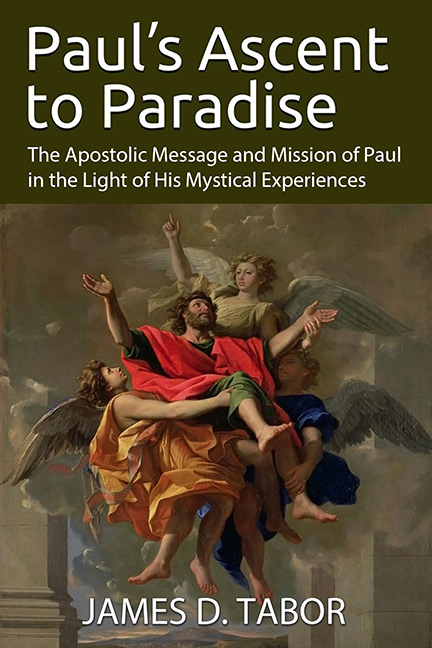
Paul’s Ascent to Paradise. Guest Post by James Tabor

A couple of weeks ago I learned that James Tabor had republished his book Paul’s Ascent to Heaven, his first scholarly monograph, which, alas, had gone out of print.  But it’s back in!  I wrote him to ask if he’d be willing to write a couple of guest posts about it, and here is the first.  This one explains how and where the book originated (published 1986); his next post will discuss how his mind has changed on some issues in the intervening years. Many of you know James from his other writings.  He publishes for both scholarly and popular audiences.  James has long been a professor of Religious Studies at UNC Charlotte.  Here is his story of how his book first came to be.  He will be happy to respond to comments and questions. James Tabor’s most popular books are Paul and Jesus and The Jesus Discovery: The New Archaeological Find that Reveals the Birth of Christianity, among others.    ************************************************************ James D. Tabor, Dept. of Religious Studies, UNC Charlotte Paul’s Ascent to Paradise [...]

What Is the Unforgivable Sin? Readers’ Mailbag.

Important question this week! QUESTION: I wondered if you have written a blog which talks specifically about the 'unpardonable sin'. RESPONSE: Well, it’s been a while.  But I get asked this question a good bit, and almost always it is a fearful request – by someone who is afraid they’ve committed it.  So it’s worth addressing the issue again.   I think the NT is pretty clear on the matter, even though few people actually look carefully at what it says about it. In a famous passage in Matthew, Jesus talks about the “unforgiveable sin”:  “Therefore I tell you every sin and blasphemy will be forgiven people, but the blasphemy of the Holy Spirit will not be forgiven; and whoever speaks a word against the Son of man, it will be forgiven; but whoever speaks against the Holy Spirit it will not be forgiven, either in this age or the ages to come.” (Matthew 12: 31-32). As you might imagine, over the Christian centuries there have been numerous interpretations of what that *one* sin was, especially [...]

2025-09-10T12:50:26-04:00August 27th, 2020|Afterlife, Canonical Gospels, Historical Jesus|

My Faux Pop Quiz this Semester

Here’s a question from one of my recent posts on teaching this term, and what I did on the first day of class. QUESTIONS Now that Aug 11 is safely past, is there any chance that we here on the blog might be able to see the “Faux Pop Quiz”? RESPONSES               The question is about the pop quiz I gave on my first day of class in my First Year Seminar (i.e, the small seminar for first year students – their first semester in college!) on “Jesus in Scholarship and Film.”  Different instructors do different things on the first day of class.  We are required to give out a syllabus that describes the course objectives, requirements, textbooks, grading policies, and sundry other things (I posted mine last week on the blog).  Some instructors do that and then that’s all for the first class.  I do more.  I don’t believe in throwing away any class time for the entire semester, so I always take up the whole period.  Hey, they’re payin’ for this class.  (Well, [...]

2025-09-10T12:50:26-04:00August 26th, 2020|Historical Jesus, Teaching Christianity|

My Early Christian Apocrypha Seminar

I am teaching a PhD seminar this semester on the early Christian apocrypha; it's a little hard to define what those are, though hundreds of people have tried!.  The way I define them are as non-canonical books that are similar in genre and contents to those that did make it into the canon.  Or something like that.  They comprise Gospels, Acts, Epistles, and Apocalypses, they can be "orthodox" or "non-orthodox" (= " heretical"); most of them claim to be written by apostles (but not all); the ones I'm most interested in date from the second to the fifth centuries. It's a fairly but not crazily heavy-hitting class.   It meets once a week for three hours.  Here, for your amusement and reading pleasure (especially if you do the assignments!) is the syllabus: To see what follows, you will need to belong to the blog.  Not a member yet?  Now's the best time ever to join.  Why?  Because you can't join in the past.     Reli 801: Early Christian Apocrypha Instructor: Bart D. Ehrman Fall 2020 [...]

At Last. Jesus and the Son of Man.

Two weeks ago I started addressing a question I got asked on the blog.  At first I was just going to reply to the question as a comment; as my response started getting a bit long I decided I better devote an entire post to it.  When I started working on a post on in, I decided it needed to be a thread.  As I pointed out, that was two weeks ago.  And I still haven’t answered the question. I’ll answer it here rather briefly, based on the information I’ve given.  The answer should make sense on its own terms, but if you want to see the reasoning behind it, read the posts over the past couple of weeks that have been about “the Son of Man.”     QUESTION: In Mark 8:27-28 Jesus asks his disciples “Who do people say that I am?” and they reply that different people think he is “John the Baptist, Elijah, or one of the prophets”  Jesus then follows up with the key question: “But who do you say that [...]

2025-09-10T12:50:25-04:00August 23rd, 2020|Canonical Gospels, Historical Jesus, Reader’s Questions|

Smith-Pettit Lecture – The History of Heaven and Hell

Here is a webinar that I did on July 29th, 2020, as the Smith-Pettit lecture for the Sunstone Digital Symposium sponsored by Sunstone Education Foundation.  It was on the "History of Heaven and Hell."  It was an unusual event for me: Sunstone is an independent organization located in Salt Lake City, Utah.  Sunstone does not have any official ties to The Church of Jesus Christ of Latter-day Saints but it does serve mainly them, bringing together traditional and non-traditional Latter-day Saints, promoting an atmosphere that seeks to value faith, intellectual, and experiential integrity. Moderating the event was Karin Franklin Peter, president of the Fifth Quorum of Seventy, who serves on the Council of Presidents of Seventy with the Community of Christ.  This is a branch of "Mormons" that split from the LDS over polygamy in the 19th century.  She received a bachelor of science in psychology and a master of arts in Christian ministry from Community of Christ Seminary at Graceland University, Independence, Missouri. I was introduced by Lindsay Hansen Park, an American Mormon feminist [...]

2025-09-10T12:50:24-04:00August 21st, 2020|Afterlife, Book Discussions, Public Forum, Video Media|

The Flukes of Life and My Teaching Career

I've been concerned for the past months (among many other things, of course) about PhD's trying to get teaching positions in colleges and universities. Even when there is not an economy-busting pandemic, it's hard. Very hard. Many years ago when I was on the market, I had an awful time trying to find a job . Oddly enough, I see now, I posted on this very topic, on this very date during the first year of the blog (2012). Here's what I said then. *********************************************************************** My students are alternatively comforted and chagrined to learn how hard it was for me to get a teaching position. It makes them feel good that they are not alone, but bad that they too might have a hard time – even harder. I was on the job market while I was writing my dissertation.. And even though there were job openings, I couldn’t get an interview to save my soul. Part of the problem was that my PhD was from a theological seminary, and a lot of the jobs [...]

2025-09-10T12:50:25-04:00August 20th, 2020|Bart’s Biography, Reflections and Ruminations|

“The Case for Christ”? The New Testament Review Podcast

The case for Christ.  Here now is the second guest post by Duke Ph.D. students Ian Mills and Laura Robinson, dealing with their podcast  New Testament Review.   In this one, they describe one of their more unusual podcasts.  As you'll see, they deal with extremely interesting material for anyone interested in real scholarship on early Christianity-- as opposed to the (often very popular) books by people who don't know or understand scholarship but try to denigrate it in order to "prove" their own sectarian views.   Blog Post #2 New Testament Review on Lee Strobel’s The Case for Christ As outlined in our last post, the New Testament Review podcast is dedicated to summarizing influential pieces of New Testament scholarship and their reception in the field. Every work we cover has transformed how later scholarship treats a specific topic or text. Every work, that is, except one. On April 1st, 2019, we released an episode with the title, “Lee Strobel, The Case for Christ.” Lee Strobel is a former journalist turned evangelical Christian apologist. His [...]

2025-09-10T12:50:25-04:00August 19th, 2020|History of Biblical Scholarship, Public Forum|

How Jesus’ Apocalyptic Teachings Were Changed (even in the NT)

I have been arguing that Jesus talked about a figure he called the Son of Man, a cosmic judge of the earth who was soon to arrive from heaven to judge all people, to destroy the opponents of God (both human and non-human) and to reward his (human) followers with a utopian kingdom here on earth.  This was not a weird, unusual, or psychotic message: in basic terms it was a rather common view among Jews in Jesus day, a view that scholars have called "apocalyptic." The word comes from the Greek term "apocalypsis," which means a "revealing" or an "unveiling."  Jewish apocalypticism was widespread in Jesus' day: it was a view held by the Pharisees, the Essenes (including the authors and users of the Dead Sea Scrolls), authors of books such as 1 Enoch, 4 Ezra, and 2 Baruch, various "prophets" we know about (named and unnamed), John the Baptist, and many, many others.  These Jews believed the world was controlled for now by forces of evil, but God was soon to re-assert his [...]

2025-09-10T12:50:25-04:00August 17th, 2020|Canonical Gospels, Historical Jesus|

Jesus in Scholarship and Film

University classes started this past week, and as so many have said, this will be a school year like no other.  I will be teaching both of my classes remotely, a PhD seminar on Early Christian Apocrypha, which I will be discussing in a later post, and my undergraduate course, Jesus in Scholarship and Film.  I've taught this latter course on and off for years now, and it is absolutely one of my favorites. The basic idea behind it is to see how Jesus is portrayed in different ways in different venues: ancient Gospels (the four canonical Gospels and seven from outside the New Testament), modern scholarship on the historical Jesus (i.e., attempts to see what he really said and did), and film, from the earliest silents up to recently. One of the goals is to learn how each book/film portrays Jesus differently.  There is not "one" Jesus out there that everyone agrees on. Teaching remotely is a huge challenge.  But I have a terrific group of students.  It is a First Year Seminar; these [...]

2025-09-10T12:50:25-04:00August 16th, 2020|Public Forum, Teaching Christianity|

A Podcast of Interest to You! Guest post by Ian Mills and Laura Robinson

If you are interested in learning more about scholarship on the New Testament, but at a lay person's level, this is the post for you!  It is about a podcast that might be (probably is) right up your alley, set up and run by two graduate students from Duke University who have worked with me over the past few years. One of the real pleasures of teaching graduate students in New Testament/early Christianity at UNC is that Duke is just ten miles away, with its own graduate program.  The New Testament program at Duke program in New Testament has a different focus from ours here at at UNC.  To put it in the most simple terms, at UNC we have a more historically-focused approach and at Duke they have a more interpretation-focused approach.   Of course, you can't do one without the other.  But I tend to teach historical topics to our students, with interpretation of texts as part of what we do; many of their classes are more focused on interpretation with history as the [...]

2025-09-10T12:50:25-04:00August 14th, 2020|History of Biblical Scholarship, Public Forum|
Go to Top