Sorting by

×

Could Paul’s Letter to the Philippians be TWO Letters?

In my previous post I answered, in short order, a series of questions that a reader had about the “original” text of Paul’s letter to the Philippians.  I will now take several posts in order to address some of the questions at greater length.  Here was the first one:   QUESTION:  Would you agree that the letter written to the Philippians was an original writing of Paul? The short answer is Yes – it is one of the undisputed Pauline letters.  The longer answer is, well, complicated.  Scholars have long adduced reasons for thinking that this letter of Paul was originally *two* letters (or parts of two letters) that were later spliced together into the one letter we have today.  I explain the reasons for thinking so in my textbook, The New Testament: A Historical Introduction to the Early Christian Writings.  Here is what I say there.  (If you want to follow the argument particularly well, I’d recommend reading the short letter of Philippians, and then reading what follows by looking up the passages referred [...]

2025-09-10T12:51:24-04:00November 29th, 2020|Paul and His Letters|

Do We Have Paul’s Original Letter to the Philippians?

A few days ago I answered a question about whether someone in the very earliest church who was reading one of the Christian writings to his congregation in the church -- say, one of the Gospels or one of Paul's letters -- might have *changed* it in places orally so that the people who were listening to him (most of whom wouldn't be able to read themselves) might have heard something other than what was written.  Great question. In this and the following posts I want to deal with an equally vexed question.  Stick with that same situation.  That writing the person is reading (unless he is living in the same town as the author and this is just a little while later) is presumably a copy of  the original writing, or, more likely, even if it's just a few years after the original, a copy of a copy.   What are the chances that that copy was different in places from the original, and if it was, do we now, today, actually have the original. [...]

Women Apostles in Early Christianity

In my previous post, I discussed the Gospel of Mary and its portrayal as Mary Magdalene as the one to whom Jesus had revealed the secrets of salvation (as part of a gnostic myth) - -much to the consternation of the male disciples, especially Peter and his brother Andrew.  Hey, how could he consider a *woman* more important than us men???  It’s an attitude that appears to have run through the family. It is striking that there was a much wider tradition in early Christianity that said that Mary Magdalene was the *first* apostle, the one who made the other apostles.  Now THAT is a view you don’t hear every day. To explain it I first have to say something about women apostles more broadly in early Christianity, another topic most people don’t think or know much about.  Here is how I explain it in my book Peter, Paul, and Mary Magdalene. ****************************** The term “apostle” comes from a Greek word that means something like “one who has been sent.”  It can refer to anyone [...]

Hard Evidence that the Book of Acts was Written by an Eyewitness?

Here is an interesting question I received about a Christian apologist’s argument that the book of Acts must be written by an eyewitness, a view that I think is completely wrong.  It’s one of those arguments that has no bearing on anything when you actually think about it, but until someone points out the flaw, it’s hard to see it -- or I assume so since so many people get taken in by this sort of thing. It comes in a book called I Don’t Have Enough Faith to be an Atheist, a title which, I have to say, is a clear indication of how well informed the book will be.  But that would be an entire post of its own.  Here I’ll focus on the question raised: QUESTION: One thing about the reliability of the book of Acts I’m constantly encountering when researching popular apologetics is Frank Turek’s argument in his book I Don’t Have Enough Faith To Be An Atheist.  In it he quotes a Colin Hemer, who apparently chronicled the last 16 [...]

2025-09-10T12:51:02-04:00October 4th, 2020|Acts of the Apostles, Paul and His Letters, Public Forum|

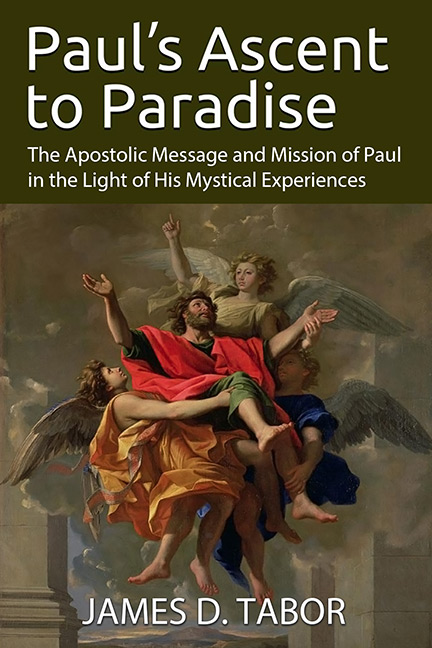
Paul’s Ascent to Paradise. Guest Post by James Tabor

A couple of weeks ago I learned that James Tabor had republished his book Paul’s Ascent to Heaven, his first scholarly monograph, which, alas, had gone out of print.  But it’s back in!  I wrote him to ask if he’d be willing to write a couple of guest posts about it, and here is the first.  This one explains how and where the book originated (published 1986); his next post will discuss how his mind has changed on some issues in the intervening years. Many of you know James from his other writings.  He publishes for both scholarly and popular audiences.  James has long been a professor of Religious Studies at UNC Charlotte.  Here is his story of how his book first came to be.  He will be happy to respond to comments and questions. James Tabor’s most popular books are Paul and Jesus and The Jesus Discovery: The New Archaeological Find that Reveals the Birth of Christianity, among others.    ************************************************************ James D. Tabor, Dept. of Religious Studies, UNC Charlotte Paul’s Ascent to Paradise [...]

Will “All Israel” Be Saved? Really? Guest Post by Jason Staples

Here now is the third and final post by Jason Staples connected with his dissertation and now to be published book on what Paul meant that “All Israel will be saved.”  It’s a big issue.  Isn’t Paul the apostles of the “gentiles”?  Doesn’t he attack Jews and Judaism?  Doesn’t he think God rejected them because they rejected him?   What could Paul mean by this? Jason argues that Paul does not mean what scholars have long argued and regular ole lay folk have thought he meant (there are lots of opinions!).  As you’ll see, it’s a major issue with lots of ins and outs, but a huge payoff. Jason will again be happy to respond to questions and comments. - Jason A. Staples is the author of The Idea of Israel in Second Temple Judaism: A New Theory of People, Exile, and Israelite Identity.   ***********************************************     Post 3: Did Jesus Fail to Restore Israel? Paul’s Solution to the Problem   The two previous posts have discussed why scholars have found Paul’s statements about Israel’s [...]

When Paul Says “Israel” Does He Mean “The Jews”? Guest Post by Jason Staples

Last week I posted the first of three interesting discussions by my erstwhile student Jason Staples, PhD in New Testament, currently teaching at North Carolina State University.  Here is the second post, with an even more challenging thesis that runs counter to what scholars have long said, but for which he makes a compelling case.  His fuller discussion will be found in the book he has coming out from Cambridge Press at the end of the year.   Jason will be happy to address your comments and questions. - Jason A. Staples is the author of The Idea of Israel in Second Temple Judaism: A New Theory of People, Exile, and Israelite Identity.   ***************************************   Post 2: Why Does Paul Switch from Talking about ‘Jews’ to ‘Israel’? My last post looked at how Paul’s statements about Israel’s ultimate salvation in Romans 11 seem to contradict what he says elsewhere about the equality between Jews and gentiles (non-Jews) and surveyed several ways scholars have tried to reconcile that tension. But that post concluded by calling [...]

Did Paul Really Think “All Israel Will Be Saved”? Guest Post by Jason Staples

One of the most thorough dissertations I’ve directed in recent years was by Jason Staples, called “Reconstituting Israel: Restoration Eschatology in Early Judaism and Paul’s Gentile Mission.”  It might be difficult for a lay person to figure out what it’s about from the title, but it was on a really significant topic that I think most any reader of the New Testament would see is important.  It involves the Apostle Paul’s views of Jews, Judaism, and the nation of Israel.   The goal of the dissertation was to explain what Paul meant when he said that in the end, “All Israel will be saved” (Romans 11).  Huh?  What’s that mean exactly?   There are lots of options that have been proposed over the years, and none of them “obviously right.”   The question drove Jason to an even more basic question, which almost no one has thought to ask, let alone provide a comprehensive answer to: what does Paul mean by “Israel”?   Jason defended his dissertation at the end of 2016.   It was large!  The first [...]

Do Matthew and Paul Agree on the Matter Most Important to them Both?

I was going through posts from many years ago and came across this one, on an issue I've always thought was unusually interesting: if the writer of the Gospel of Matthew (whoever that was) and the apostle Paul had been locked in a room and not allowed to emerge until they had hammered out a consensus statement on how one attains eternal life, would they still be in there, possibly with their skeletons locked in a mutual death grip?  I didn't put it that way when I posted this so long ago, but I was younger and milder then I suppose. Here's how I expressed it then.  What do you think? ***************************************************************** One of my major goals as a professor of New Testament is to get my students to understand that the NT is not a single entity with a solid and consistent message.  There are numerous authors who were writing at different times, in different parts of the world, to different audiences, and with different – sometimes strikingly different – understandings about important issues.  [...]

2025-09-10T12:49:48-04:00July 3rd, 2020|Canonical Gospels, Early Judaism, Paul and His Letters|

Did Paul Know that Judas Betrayed Jesus? Readers’ Mailbag!

QUESTION: Do you think that Paul, without naming him, is referring to Judas in 1 Corinthians 11:23-24? (The verse in the NRSV: “For I received from the Lord what I also delivered to you, that the Lord Jesus on the night when he was betrayed took bread, and when he had given thanks, he broke it and said, ‘This is my body which is for you.  Do this in remembrance of me.”)   RESPONSE: Ah, it’s a great question. Paul never explicitly mentions Judas Iscariot or indicates that Jesus was betrayed by one of his own disciples. But couldn’t this verse contain a reference to Judas? It refers to the night on which Jesus was betrayed! One reason the question matters is that Paul says almost *NOTHING* about the events of Jesus’ lifetime. That seems weird to people, but just read all of his letters. Paul never mentions Jesus healing anyone, casting out a demon, doing any other miracle, arguing with Pharisees or other leaders, teaching the multitudes, even speaking a parable, being baptized, being [...]

2025-09-10T12:49:09-04:00May 15th, 2020|Historical Jesus, Paul and His Letters|

Christians Against Christians: Already In the New Testament

I've long been intrigued by the fact -- I think it's a fact -- that the people we get in the BIGGEST fights with are those closest to us: spouses, siblings, parents, good friends.  Sometimes we fight with others, of course.  But it's those closest to us that really seem to annoy us.  Which of us has not had situations get completely out of hand? That has made some people wonder about the New Testament.  For example, Jesus' main opponents during his ministry are with the Pharisees.  Is that because he was particularly close with them in some way? Five years ago today (I checked) I posted on an interesting parallel situation from the life of Paul.  As you know, Paul can be a bit, uh, vitriolic at times.  And never more than in the letter to the Galatians, written to a group of churches with which he was really peeved.  This is one fierce letter (many people don't see that because they simply aren't expecting it; the fierceness is even more pronounced when you [...]

2025-09-10T12:48:36-04:00March 24th, 2020|Paul and His Letters|

Did Paul Really Have *That* Exalted a View of Jesus?

With this post I plan to end the rather long-running thread that began with a basic question several blog members asked me.   Some weeks ago I was posting on the unusually important “Christ Poem” of Philippians 2:6-11, where Paul appears to be quoting a poem about Christ, composed earlier and probably by someone other than himself, in which Christ is said to have been a pre-existent divine being who gave up his divine status to become a human and suffer and die, who was then, as a result, exalted up to heaven and made the one to whom all the universe would eventually bow down and worship. The claims of that poem might seem rather unremarkable to anyone not familiar with the history of early Christianity.  Hey, isn’t that just what Christians say about Jesus? But for those who do know how ideas of Christ evolved over time, in the early decades and centuries of the Christian religion, it is an absolutely extraordinary poem.  Already BEFORE the vast bulk of the NT was written there [...]

2025-09-10T12:48:36-04:00March 23rd, 2020|New Testament Manuscripts, Paul and His Letters|

Paul the Misogynist? The Alternative Perspective

Based on what I said in previous posts, from Paul's own (authentic) letters, his attitude toward women in the church may seem inconsistent, or at least ambivalent.  Women could participate in his churches as ministers, prophets, and even apostles.  But they were to maintain their social status as women and not appear to be like men.  This apparent ambivalence led to a very interesting historical result.  When the dispute over the role of women in the church later came to a head, both sides could appeal to the apostle's authority in support of their views. On one side were those who urged a complete equality between men and women in the churches.  Some such believers told tales of Paul's own female companions, women like Thecla, who renounced marriage and sexual activities, led ascetic lives, and to taught male believers in church.  On the other side were those who urged women to be in complete submission to men.  Believers like this could combat the tales of Thecla and other women leaders by portraying Paul as an [...]

2025-09-10T12:48:35-04:00March 18th, 2020|Paul and His Letters, Women in Early Christianity|

Paul the Feminist? The Thecla Legends

I’m in the middle of talking about whether Paul wrote the verses now found in 1 Cor. 14:34-35, or if they were a later interpolation into his letters (that is, an insertion that ended up in every single one of our manuscripts)  It's an important issue.  This is the passage where Paul sternly tells women that they are NOT to speak in church.   They can't only not be *leaders*.  They can't *talk*. Wow.  OK, then.  Did Paul really write that?  I'm going to be arguing he did not, that it's an interpolation (I'm doing this in part in order to show how one can show that a passage is not "original" even if the manuscripts all agree.  It doesn't happen much.  But *sometimes*). But to make sense of it, I have to talk about the two views about Paul and women that emerged after he was dead, one that portrayed him as very much on the side of women, a kind of early Christian proto-feminist, and the other that saw him as a complete misogynist, [...]

2025-09-10T12:48:35-04:00March 17th, 2020|Paul and His Letters, Women in Early Christianity|

Paul and the Status of Women

In this thread I've been talking about how scholars decide if a passage that is found in *some* New Testament manuscripts but missing from *others* was actually written by the author or not (such as the account of Jesus' "sweating blood" in Luke 22:43-44:  was it really an original part of the Gospel or was it something a scribe added?)   It is a complicated process of decision, involving examining the surviving manuscripts (i.e. "external" evidence), figuring out if the passage fits well with the author's writing style and perspective otherwise, and seeing if there is anything in the passage that would make a scribe want either to insert it or take it out ("internal" evidence).  Each of these arguments can get very tricky, once you get down into the weeds. But the thread began with the question of how do we know if a passage that is in *all* of the manuscripts is possibly something that was not originally there.  The question started with the "Christ poem" of Phil 2:8-9, where Paul talks about Christ [...]

Maybe the Passage wasn’t “Original”!!

How do we know if a passage in the New Testament was “originally” in the New Testament?   Scholars are widely agreed, for example (there is not a whole lot of serious debate about the matter) that the appearances of Jesus after his resurrection at the end of  Mark’s Gospel (the last twelve verses of Mark 16) were not originally there.  The Gospel ends with the announcement that he has been raised and will meet his disciples in Galilee (so that, contrary to what a lot of people say – there definitely *is* a resurrection in Mark); but no one sees him.   That makes Mark very different from the other Gospels. So too the famous story of the woman taken in adultery in John 7:53-8:11 – arguably the most famous story from the life of Jesus in the entire New Testament, but almost certainly not originally there.  It was added later. So how ‘bout *other* passages?  How can we know? I’m addressing this question because ... At the end of this post I explain why it [...]

2025-09-10T12:48:19-04:00March 3rd, 2020|New Testament Manuscripts, Paul and His Letters|

Paul’s Incredibly High Christology

I have been trying to explain the unusually important statement about Christ in Paul's "Christ Poem" in Phil. 2:6-10.   It's an extremely high Christology.   Christ is a divine being before coming into the world; and at his exaltation he was made *equal* with God.   Wow.  Just 20 years earlier Jesus was a virtually unknown peasant with a few followers in a remote part of rural Galilee.   Now he's equal to the Lord God Almighty??   How did *that* happen??? That, of course, is the topic of my book How Jesus Became God.  I try to explain how it happened.  In the book I talk about other passages in Paul that have similarly remarkable things to say about Christ.  Here is how i discuss it there.  (I do refer back to some of my earlier discussions in the book here -- e.g., about how some Jews thought of another power being on God's level; I can post some of those too if anyone is interested.) *********************************************************************** Other Passages in Paul The incarnational Christology that lies behind the [...]

2025-09-10T12:48:19-04:00March 2nd, 2020|Early Christian Doctrine, Paul and His Letters|

A Fuller Exposition of the Christ Poem in Philippians

I’ve been talking about the Christ poem in Philippians 2:6-10, and given some keys to it’s interpretation.  If you are new to the discussion, here is the poem itself, about “Jesus Christ…. Who, although he was in the form of God Did not regard being equal with God Something to be grasped after. But he emptied himself Taking on the form of a slave, And coming in the likeness of humans. And being found in appearance as a human He humbled himself Becoming obedient unto death – even death on a cross. Therefore God highly exalted him And bestowed on him the name That is above every name. That at the name of Jesus Every knee should bow Of those in heaven, and on earth, and under the earth. And every tongue confess That Jesus Christ is Lord To the glory of God the Father.   I’ve said some things about it’s interpretation, but here I want to give a fuller explication of its meaning.  I’ve drawn this from my book How Jesus Became God [...]

2026-04-24T10:38:49-04:00February 28th, 2020|Early Christian Doctrine, Paul and His Letters|

Did Paul Think Jesus Was a New Adam, Not a Divine Being?

In my last post I started talking about Paul’s “understanding of Christ” – that is, his Christology.  It will take several posts to fill out the picture, and in this one I need to return to the Christ Poem that I talked about last week, expanding my discussion of it from what I said then.   Just so you don’t have to flip back through to find the former post, here is what the poem says, set in poetic lines.   It comes from Phil 2:5-7. It is introduced by Paul’s exhortation to his readers to “Have this mind in yourselves which was also in Christ Jesus”:  And then he says   Who, although he was in the form of God Did not regard being equal with God Something to be grasped after. But he emptied himself Taking on the form of a slave, And coming in the likeness of humans. And being found in appearance as a human He humbled himself Becoming obedient unto death – even death on a cross. Therefore God highly exalted him [...]

2025-09-10T12:48:19-04:00February 25th, 2020|Early Christian Doctrine, Paul and His Letters|

Was Christ an Angel, According to Paul?

I have received a number of comments and questions on last week’s about Paul’s understanding of who Christ was, based especially on the key passage called the “Christ Poem” in Philippians 2:6-11.  An intriguing passage!  But very puzzling in light of what Paul says elsewhere about Christ, as readers have pointed out, and asked about.   So I thought I should return to the matter and lay out how I understand Paul’s “Christology” – his “understanding of Christ.”    I talked about it at length in my book How Jesus Became God, and have dealt with it on the blog on occasion.  But here I want to address it head on.   To make sense of my comments it is important to remember two sets of terms that scholars have long used for early understandings of Christ.   A “low Christology is one that understands Christ primarily as a HUMAN who somehow and in some way became divine. A “high” Christology is one that understands him primarily as GOD in some sense from before his birth. [...]

2025-09-10T12:48:19-04:00February 24th, 2020|Early Christian Doctrine, Paul and His Letters|
Go to Top