Sorting by

×

My Least Favorite Passage of the Pastorals: Those Silent and Submissive Women….

I'd like to conclude this thread on the Pastoral epistles by discussing at greater length the one passage that I think has done more damage than nearly any other.  It involves women in the church.  The story of women in the entire Bible is long and complex, but it starts in the beginning (Genesis 1-2) and continues all the way through.  The traditional Christian views ultimately derive from the New Testament. In an earlier set of posts I explained why women were actually prominent, important, and authoritative leaders of the Christian church in its earliest days – they were unusually present and active in the Jesus movement while he was living, as well as in the earliest churches we know about, those connected with Paul (who has received a rather unfair rap as one of the world’s great misogynists). But it was not long before men took over the movement and suppressed women’s voices and roles.  We are obviously  still living with that today, in a world where the largest Christian body, the Catholic Church, still [...]
2025-09-10T13:12:33-04:00June 22nd, 2025|Paul and His Letters, Women in Early Christianity|

The Pastoral Epistles. For Further Reading

Here is an annotated list of books on the Pastoral Epistles of 1 and 2 Timothy and Titus, most of them relevant to all the Deutero-Pauline epistles with a couple of commentaries that deal with 2 Thessalonians.  One benefit of serious commentaries is that they always begin by discussing major critical issues in understanding a book: authorship, date, historical context, major themes, disputed issues, and so on. ****************************** Beker, J. Christiaan. The Heirs of Paul: Paul’s Legacy in the New Testament and in the Church Today. Philadelphia, PA: Fortress, 1991. A clear assessment of the theology of the Deutero-Pauline, especially in light of the views embodied in the undisputed Paulines. Ehrman, Bart D. Forged: Writing in the Name of God—Why the Biblical Authors Are Not Who We Think They Are. San Francisco: Harper One, 2010. An account of the phenomenon of literary forgery (pseudepigraphy) throughout the early Christian tradition that asks how and why a Christian author would try to deceive his readers about his own identity, written for a popular audience; it it I deal [...]

2025-09-10T13:12:33-04:00June 21st, 2025|Paul and His Letters|

More Evidence That the Pastoral Epistles Were Written After the Days of Paul

I now conclude this short thread and who wrote the Pastoral epistles, when, and why by picking up on my previous argument: that aspects of these letters reveal a church situation after Paul’s day when proto-orthodox Christians were appealing to the authorities of the clergy, the creed, and the canon of Scripture to support their views, in contrast to those of “false teachers. The Creed Proto-orthodox Christians of the second and third centuries felt a need to develop a set of doctrines that were to be subscribed to by all true believers. As was the case with the proto-orthodox clergy, the proto-orthodox creed was acclaimed as a creation of the apostles themselves: hence the name of the most famous of these statements of faith, devised in the fourth century and known today as the Apostles’ Creed. The proto-orthodox creeds affirmed beliefs that were denied by other groups who claimed to be Christian, and they repudiated beliefs that these other groups affirmed. For example, Gnostic Christians claimed that there were many gods, not just one; and [...]

2025-09-10T13:12:19-04:00June 19th, 2025|Forgery in Antiquity, Paul and His Letters|

The Later (post-Pauline) Context of the Pastoral Epistles

In my previous post I showed why the vocabulary of the Pastoral epistles and the kinds of problems they address suggest that they were written after Paul’s time, by a follower who was using his name.  As I indicated there, of particular importance for establishing they do not come directly from Paul is the way in which “false teachings” are attacked in the Pastorals, for the author’s basic orientation appears to be very much like what we find developing in second-century proto-orthodox circles. In some ways, to understand this different orientation we have to think about how it is that one kind of Christianity came to be dominant within the rising religion.  Christianity of the second and third centuries (long after Paul) was widely diversified, with all sorts of teachers teaching all sorts of things (with numerous questions unresolved:  how many gods are there? Was Christ human? Divine? Both somehow?  How?  What books are Scriptural authority?  How should the church be organized? Etc. etc.).  But out of that wild diversity one Christian movement of the [...]

2025-09-10T13:12:19-04:00June 18th, 2025|Forgery in Antiquity, Paul and His Letters|

Who Wrote the Pastoral Epistles? When? And Why?

Now that I have given an overview of each of the Pastoral epistles of 1 and 2 Timothy and Titus, I can turn to the key question of whether Paul actually wrote them, when they were written, and why.  This will take several posts. I have taken the information with some revision by book, The New Testament: A Historical Introduction to the Early Christian Writings.  To begin with, when discussing the question of the authorship of these letters, we should constantly remember that we are not asking whether Christians in the first or second century would have forged documents in Paul’s name. We know for a fact that some did: 2 Thessalonians alludes to a forged letter (2:2). Moreover, everyone agrees that some of the writings that survive in Paul’s name are Christian forgeries (e.g., the correspondence between “Paul” and the philosopher Seneca, and the apocalypse written by “Paul”). What we are asking, then, is whether any given document that claims to be written by Paul can sustain its claim. Most scholars are reasonably convinced [...]

2025-09-10T13:12:18-04:00June 17th, 2025|Paul and His Letters|

The Pastoral Epistles of 2 Timothy and Titus in a Nutshell

I continue now with my nutshell overviews of the Pastorals by summarizing 2 Timothy and Titus.  I begin with a 50-word overview of the book Timothy. 2 Timothy, a more intimate letter (allegedly) by Paul to Timothy, recounts their past relationship, expresses hope that his disciple will come to visit him in prison in Rome, and urges him to fulfil his duties as leader of the church by quashing false teaching and maintaining his upright character. Here is a longer sketch of the book from my New Testament Introduction. 2 Timothy The second Pastoral epistle presupposes a somewhat different situation from th efirst. It too is written by “Paul” to Timothy (2 Tim 1:1). Now, however, “Paul” is in prison in Rome (2 Tim 1:16–17; his location in 1 Timothy was not specified), and he is clearly expecting to be put to death soon (4:6–8) after a second judicial proceeding (the first one evidently did not go well; 4:17). He writes to Timothy not only to encourage him to continue his pastoral ministry [...]

2025-09-10T13:12:18-04:00June 15th, 2025|Paul and His Letters|

The Pastoral Epistle of 1 Timothy in a Nutshell

In this series providing summaries of each book of the New Testament “in a nutshell” I have dealt with three of the letters that claim to be written by Paul but probably were not: Colossians, Ephesians, and 2 Thessalonians.  We now come to the three letters that are grouped together and called the “Pastoral Epistles,” 1 and 2 Timothy and Titus. For reasons we will see, there is a wide scholarly consensus that these books were not actually written by Paul.  Before addressing the issue of authorship, I’d like to note the ostensible distinctive themes and emphases of these books, both as a group (since most scholars are reasonably certain that they all came from the same pen) and individually. The three letters are grouped together as Pastoral epistles because each claims to be written by Paul to a person he has appointed to lead one of his churches: Timothy, his young companion left to minister among the Christians in Ephesus, and Titus, his companion left on the island of Crete. Moreover, these epistles contain [...]

2025-09-10T13:12:18-04:00June 14th, 2025|Paul and His Letters|

In the Weeds with the Author of 2 Thessalonians

I thought it migh be interesting for readers who like on occasion to get down into the weeds of scholarship to see a more detailed argument for how the *similarity* of 2 Thessalonians to 1 Thessalonians suggests not that Paul wrote both of them but that a later author (of 2 Thessalonians) was imitating Paul's authentic letter (1 Thessalonians).  Here's how I express the case in my book Forgery and Counterforgery (Oxford University Press).  [Don't worry about the Greek: you can either just see the similar letters or look up the verses in your English translation]:   2 Thessalonians as a Forgery One reason the case for the inauthenticity of 2 Thessalonians has occasionally seemed wanting, even to some very fine scholars, is that critics have often resorted to a shotgun approach, citing every possible argument, good or bad, in support of their position.   It is all too easy to dismiss bad arguments, leaving an appearance of evidence in balance, pro and con.  And so, for example, the letter is often said to lack Paul’s customary [...]

2025-09-10T13:12:18-04:00June 12th, 2025|Paul and His Letters|

2 Thessalonians, The Modern State of Israel, World War III, and the Return of Jesus

An obscure verse in 2 Thessalonians may conceivably lead to World War III.  OK, it sounds sensational and implausible, but hear me out. The following is taken from my book Armageddon (Simon & Schuster, 2023), edited for this occasion. ****************************** Evangelical Christians historically have believed that the Bible predicts the future, that many prophecies are being fulfilled in our day, and that they will continue to be fulfilled until the end comes when Jesus returns from heaven in judgment on the living and the dead. One thing that needs to happen is that the Temple in Jerusalem needs to be rebuilt.  The end cannot come before then.  And so they can appeal to the prophecy of Ezekiel: They shall live in the land that I gave to my servant Jacob, in which your ancestors lived; they and their children and their children’s children shall live there forever; and my servant David shall be their prince forever.  I will make a covenant of peace with them; it shall be an everlasting covenant with them and I will bless [...]

2025-09-10T13:12:17-04:00June 11th, 2025|Paul and His Letters|

2 Thessalonians: For Further Reading

Here is an annotated list of books on 2 Thessalonians, most of them relevant to all the Deutero-Pauline epistles (that is, the letters that are assigned a “secondary” standing in the New Testament collection of Paul’s letters because scholars doubt they were actually composed by Paul himself) with a couple of commentaries that deal with 2 Thessalonians.  One benefit of serious commentaries is that they always begin by discussing major critical issues in understanding a book: authorship, date, historical context, major themes, disputed issues, and so on. ****************************** Beker, J. Christiaan. The Heirs of Paul: Paul’s Legacy in the New Testament and in the Church Today. Philadelphia, PA: Fortress, 1991. A clear assessment of the theology of the Deutero-Pauline, especially in light of the views embodied in the undisputed Paulines. Ehrman, Bart D. Forged: Writing in the Name of God—Why the Biblical Authors Are Not Who We Think They Are. San Francisco: Harper One, 2010. An account of the phenomenon of literary forgery (pseudepigraphy) throughout the early Christian tradition that asks how and why a [...]

2025-09-10T13:12:17-04:00June 10th, 2025|Public Forum|

Time to Vote: Help Choose the Next Platinum Post!

Dear Platinum Members, Let’s call this a humble moment of accountability: we’ve fallen behind on something important. As many of you know, one of the special privileges of Platinum membership is the opportunity to submit guest posts to the blog — and then, every four submissions, we open it up for a Platinum vote. The post that gets the most votes is published to the entire blog for all members to enjoy and comment on. In theory, this happens every time we get four new Platinum posts. In reality... we now have a backlog of over a dozen. That means we’re multiple rounds behind on voting. But never fear — we’re setting things right starting now. Over the coming weeks, we’ll be rolling out a new vote every couple of weeks until we’re all caught up. After that, we’ll return to our regular rhythm. Today, we begin with the first group of four. These posts were published in chronological order, and we’re asking you to choose one to be featured on the main blog. Please [...]

2025-09-10T13:12:18-04:00June 9th, 2025|Public Forum|

2 Thessalonians: Who Wrote It, When, and Why?

In my previous post I explained the major theses and emphases of 2 Thessalonians, and pointed out that in many ways it is very similar in its concerns and themes to 1 Thesssalonians.  But I also said that it is commonly considered by scholars to be "Deutero-Pauline," that is, written by a later author only *claiming* to be Paul.  How can we know?  As I said there, the problem from a historian’s point of view is that someone who had decided to imitate Paul would no doubt try to sound like Paul. If both Paul and an imitator of Paul could sound like Paul, how could we possibly know whether we are dealing with the apostle himself or one of his later followers? Here's how I deal with the matter in my textbook on the New Testament (Oxford University Press, ch. 23). ****************************** There is, in fact, a way to resolve this kind of historical whodunit, and it involves looking at the other side of the coin, that is, at the parts of 2 Thessalonians [...]

2025-09-10T13:12:17-04:00June 8th, 2025|Forgery in Antiquity, Paul and His Letters|

2 Thessalonians in a Nutshell

In this series of “nutshell” overviews of each of the books of the New Testament, we move now to one of the most intriguing instances of a book that claims to be written by Paul, but was apparently, instead, written by someone else who wanted his readers to think he was the apostle. 2 Thessalonians is an intriguing case because the book certainly sounds a lot like Paul’s other letters and does indeed appear to be a kind of follow-up letter to 1 Thessalonians.  It also has numerous word-for-word similarities to 1 Thessalonians.  It too, for example, is written by “Paul, Silvanus, and Timothy” (1:1)  and is addressed “to the church of the Thessalonians in in God our Father and the Lord Jesus Christ" (2 Thessalonians 1:2) – both verses being virtually identically to 1 Thessalonians. Moreover, its contents are closely related to the other letter: both are concerned about the suffering the Thessalonian Christians are experiencing through persecution and especially about their misunderstanding about when Jesus is to return on the Day of Judgment.  [...]

2025-09-10T13:12:17-04:00June 7th, 2025|Paul and His Letters|

Interesting Questions from Readers (5/27/2025)

Here are some particularly sticky questions I've gotten recently, with expanded answers to share with all of you:   QUESTION: Bart, what should we understand by “exousia” in I Cor 11.10?   RESPONSE: Ah, right. A woman is to have an "authority" (exousia) on her head. It’s a confusing verse in a confusing passage.  The verse: For this reason a woman ought to have authority over her head, because of the angels.  It's sometimes translated "veil" though it clearly does not mean veil, per se. But in the context Paul is talking about why women should wear head coverings in church and so in some sense apparently the veil is seen as an “exousia” or “authority.”  His opening explanation is that since God is the “head” of Christ and Christ is the head of a man then the man is the head of a woman.  Does “head” here not refer to the thing sitting on your shoulders but something like “chief authority” (as in “the head of the department”)? Exousia itself means [...]

2025-09-10T13:12:16-04:00June 5th, 2025|Reader’s Questions|

1 Thessalonians and the Coming Rapture

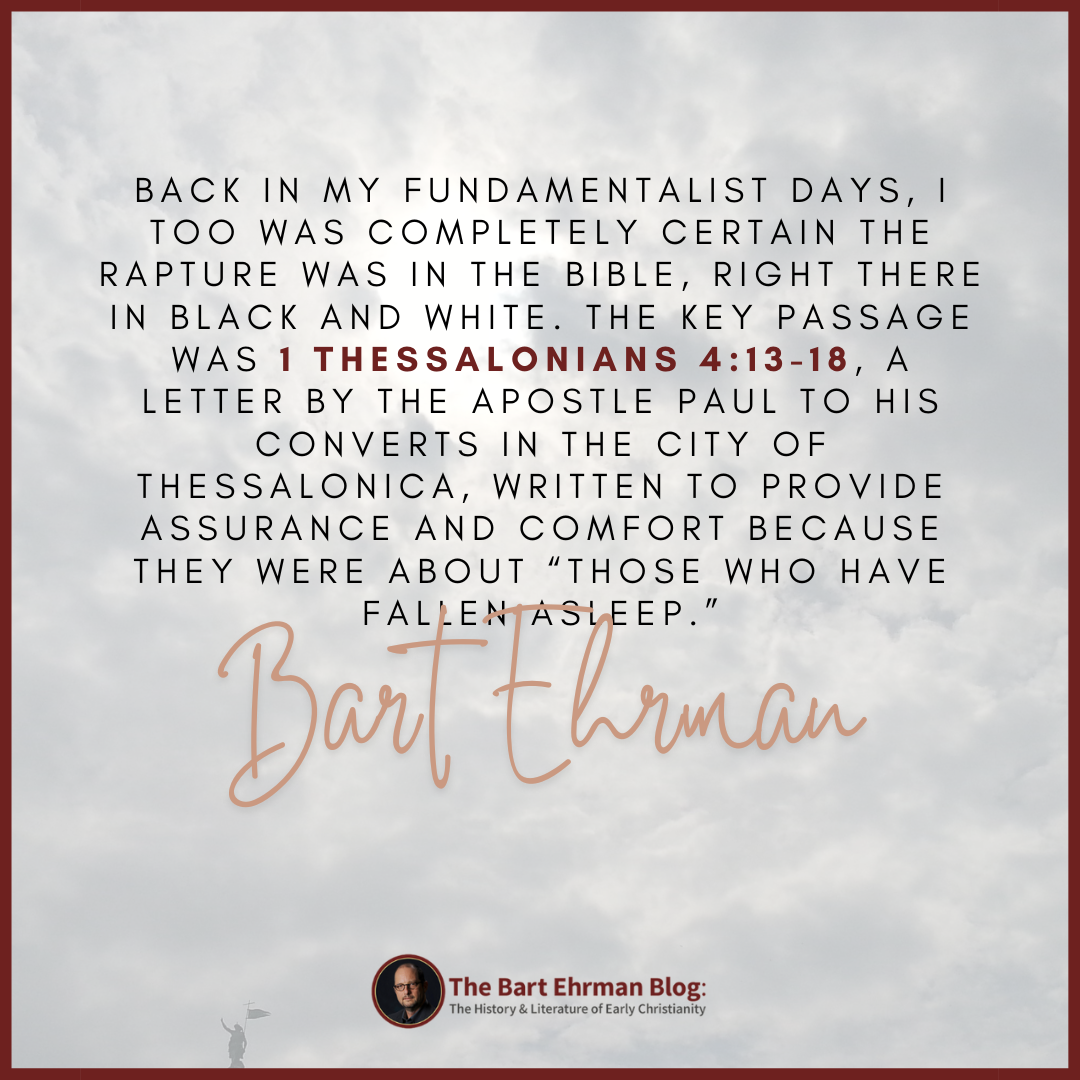
One of the most intriguing passages of 1 Thessalonians is also  both the most widely referred to (these days) and the most universally misread.  It is the passage that conservative Christians cite to support the idea of the coming “rapture,” when Jesus will allegedly arrive from heaven to take his followers out of the world before the appearance of the Anti-Christ and the horrendous period of disaster and “tribulation” that must take place for seven years before the Final Day of Judgement. The “rapture” is one of the firmest beliefs of conservative evangelicals.  And it is not found in the Bible. Here is what I say about it, in relation to 1 Thessalonians 4:13-18 in particular, in my book Armageddon. *********************************   Here is an interesting factoid that, in my experience, almost no one knows:  No one had even thought of the idea of a “rapture” until the 1830s.   Of the many, many thousands of serious students of the Bible throughout Christian history, who pored over every word – from leading early Christian [...]

2025-09-10T13:12:16-04:00June 4th, 2025|Paul and His Letters|

1 Thessalonians. For Further Reading

Here is a list of readings on 1 Thessalonians, most of which are relevant to all the undisputed Pauline epistles, with a couple of commentaries specifically on this significant, short letter.  One benefit of serious commentaries is that they always begin by discussing major critical issues in understanding a book: authorship, date, historical context, major themes, disputed issues, and so on. I devote a fuller discussion of 1 Thessalonians (an entire chapter) in my textbook, Bart Ehrman and Hugo Mendez, The New Testament: A Historical Introduction to the Early Christian Writings, 8th ed. (Oxford University Press, 2024), ch. 20.  That’s a good place to start for a fuller exposition of what I have given here in my nutshell posts.  If you have an earlier edition of the book, it will be pretty much the same, except for the expanded bibliography.    ****************************** Aune, David. The New Testament in Its Literary Environment. Philadelphia: Westminster, 1987. Includes a superb discussion of the practices of letter writing in Greco-Roman antiquity as the social context for Paul’s epistles. [...]

2025-09-10T13:12:16-04:00June 3rd, 2025|Paul and His Letters|

1 Thessalonians: Who, When, and Why

Now that I have given an overview of the major themes and emphases of 1 Thessalonians, I can say a few more things about what we know about its authorship, when it was written, and why. The book, of course, is always called “Paul’s” first letter to the Thessalonians but as you’ll notice, the opening verse indicates that it comes from “Paul, Silvanus, and Timothy.”  And throughout the letter the first-person plural pronoun predominates “WE give thanks” “WE know” “OUR visit” and so on. So, was this a letter written by committee?  If so…how does that work exactly? Aspects of the letter make it pretty clear that the three named authors did not take turns writing (Silvanus writing one passage, Timothy another, Paul yet another) but that it comes from one hand, and the hand was Paul’s.   Timothy in particular does not appear to be involved in the writing of the letter, since in chapter 3 the author(s) indicate that when they were in Athens they were distressed not knowing what was [...]

2025-09-10T13:12:17-04:00June 1st, 2025|Paul and His Letters|

1 Thessalonians in a Nutshell

I now move on in my “New Testament in a Nutshell” series to the letter of 1 Thessalonians, which for-roughly-ever has been one of my favorite books of the New Testament.  It is not one of the most widely read as a rule, but I think it is both unusually important and interesting.  For one thing, it is the first letter of Paul that we have and, therefore, the very first piece of Christian writing of any kind that we have.  That in itself makes it unusually significant in my view.  THE earliest words from any Christian!  Whoa. When I taught Greek at Princeton Theological Seminary (some millennia ago) this was the book we had beginning students first translate once they had all the important elements of Greek grammar down.  It’s not excessively hard Greek, but it is challenging for first-timers, and it’s the kind of book that if you read carefully – as you have to do when you’re basically going one word at a time trying to figure out the Greek – you [...]

2025-09-10T13:12:02-04:00May 31st, 2025|Paul and His Letters, Public Forum|

June 2025 Gold Q&A

Hello Gold & Platinum Members, It’s that time again—Bart’s monthly Q&A is just around the corner! Have a burning question about the history of early Christianity? Curious about a blog post or topic we’ve covered recently? This is your chance to ask Bart directly. He’ll respond to as many member-submitted questions as possible during a one-hour, Gold & Platinum members-only recorded session. The next Q&A will be recorded live on Sunday, June 22 at 1pm ET. Can’t make it? No problem. A full recording will land in your inbox shortly afterward. To submit a question, just email Jen at [email protected] by the end of the day Thursday, June 19—no matter where in the world you are. We can’t wait to hear what you’re wondering about! Zoom Meeting Link: https://us02web.zoom.us/j/89470277770?pwd=9mrbO1OeGBlKaT6mCb0muBU45mnZD0.1 Meeting ID: 894 7027 7770 Passcode: 540933

2025-09-10T13:12:17-04:00May 30th, 2025|Public Forum|

Interesting Questions from Readers

Here are three interesting questions I've recently received, and my attempts to answer....   QUESTION: I’ve been wondering about the passage in Romans where Paul expresses his fear about returning to Jerusalem on account of opposition because he wanted to take the money that he raised there before leaving for Spain. I used to couple this account with Paul’s final leg of his third mission out of Corinth back to Jerusalem, and there he indeed faces opposition Acts chapter 20 and then finds himself in Rome, in prison Acts 28? The passages seem to fit well together, but how? History, hearsay, looking at the letter itself expanding the details? What do you think? RESPONSE: I think the big problem is the whether we can accept the book of Acts as providing a reliable account of Paul's arrest and trials.  I don’t think we can.  So reconciling it or conflating it with Paul’s own account(s) just doesn’t work. In Acts, the arrest itself is meant to show that Paul has never done anything contrary [...]

2025-09-10T13:12:01-04:00May 29th, 2025|Reader’s Questions|
Go to Top