Sorting by

×

A Very Odd Saying of Jesus

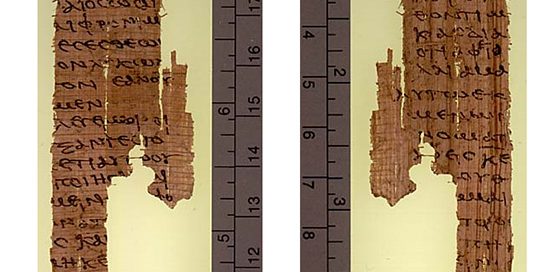
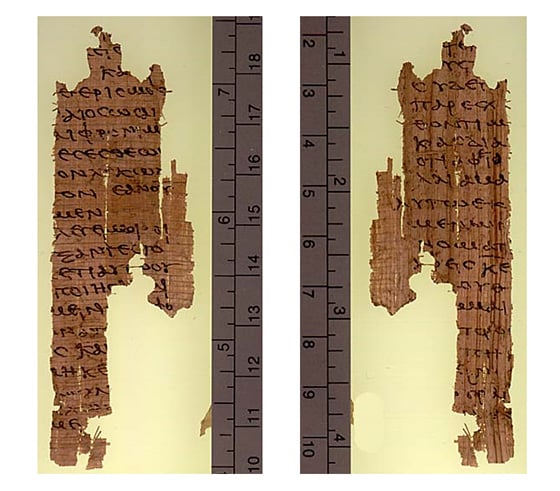
Now *here* is a recorded saying of Jesus I bet you haven't heard before.  Unless you've been reading the blog for years.  It's one of my favorites from outside the NT and it has an odd connection to a question I raised yesterday about the Gospel of Peter.  As I pointed out then, the "Gospel of Peter" that we have today, which was discovered in 1886, is, unfortunately, only a portion – the only surviving portion – of what was once a complete Gospel.  But was it a complete Gospel? Or was it a passion Gospel (like the later Gospel of Nicodemus) that gave an account only of the trial, death, and resurrection of Jesus?  That has long been debated. The weird saying of Jesus I'm talking about is NOT found in that fragment of the Gospel of Peter, but it may help decide whether Peter was a complete Gospel or not. In recent years a German scholar named Dieter Luhrmann has argued that other portions of the Gospel of Peter have shown up, in [...]
2025-09-10T12:50:46-04:00September 24th, 2020|Christian Apocrypha, Historical Jesus|

And Now: The Gospel of Peter!

Each week just now I'm talking about one of the apocryphal texts that I have assigned to my graduate seminar this semester on early Christian apocrypha.  This week we took on one of my all-time favorites, the Gospel of Peter.  I've mentioned it on the blog before, but it's been a while.  I've been writing about it in the book I'm working on, and I'm particularly struck by how enigmatic and fascinating it is. Unfortunately, we have only a fragment of the book, which begins smack dab in the middle of an episode and ends, literally, in the middle of a sentence.  To show why that in itself so tantalizing, let me first say a bit about what the Gospel is (at least that part of it we still have!). The Gospel of Peter comes from one of the most remarkable archaeological discoveries of Christian texts in the nineteenth century.  In the winter season of 1886-87, a French archaeological team headed by M. Grébant was digging in Akhmîm in Upper Egypt, in a portion of [...]

2025-09-10T12:50:46-04:00September 23rd, 2020|Christian Apocrypha|

Jesus’ Twin Brother? Really? Readers’ Mailbag

Here is a question I get with some fair regularity, and which I have addressed several times on the blog in the past.  Since I made a few posts on the Coptic Gospel of Thomas last week, I've received it again several times -- including this succinct way of asking. QUESTION: I’m perplexed by how Jesus could have had a twin brother. Jesus was miraculously conceived of the holy spirit so how did a twin get into Mary’s womb at the same time? RESPONSE: Here is what I've said before about the matter which, for what it's worth, is one of the most intriguing in early Christian traditions, from where I sit: ************************************************* I have mentioned in passing that there were some early Christians who thought that one of Jesus’ brothers, Jude (or Judas: both are translations of the same Greek word), was actually a twin.  Not just of anyone, but of Jesus himself.  Some readers have expressed surprise in the most succinct way possible, by asking: “Huh??” I talk about the matter in a [...]

2025-09-10T12:50:46-04:00September 21st, 2020|Christian Apocrypha, Historical Jesus|

Inclusive Language in Bible Translation?

One more issue connected with Bible translations: what does one do with shifts in usage in the English language toward inclusive language.  It's a hot topic, and somehow I suspect one that a lot of people on the blog have strong views of.  I certainly have them.  I talked about it once on the blog, in connection with my work with the NRSV Translation Committee. ******************************************** One of the most difficult issues that the New Revised Standard Version translation committee had to address involved the use of inclusive language.  Part of the problem was that this issue was not a generally recognized issue (by the wider reading public) when the translators began their work, but was very much an issue when they were already finished with a large chunk of it.  The translators were mainly senior scholars who had acquired their linguistic skills before virtually anyone in the academy knew (or at least said) that there even was a problem with inclusivity, and so they themselves were learning how to communicate in the new idiom.  [...]

Translating the Bible (and other ancient texts)

For a very long time I've been interested in the question of how to translate ancient texts, such as the Greek New Testament, into modern languages. Early in my scholarly career my interest was piqued by the work I did as a graduate student working as a research grunt for the translation committee for the New Revised Standard Version. My Doktorvater, Bruce Metzger, was the chair of the committee and he asked me, during my graduate studies, to be one of the scribes for the Old Testament subcommittee. In that capacity I recorded all the votes that were taken by the translators for revisions of the text of the Revised Standard Version, in whichever subsection of the committee I was assigned to. Normally the subsection would have, maybe, five scholars on it. They would debate how to modify the text of the RSV, verse by verse, word by word; they would then take a vote by show of hands; and I would record their decision. This was an eye-opening experience for me. Bible translation (or [...]

2025-09-10T12:50:46-04:00September 18th, 2020|Reflections and Ruminations|

The Secret Message of the Gospel of Thomas

This will be my last post for now on the Coptic Gospel of Thomas.  Here I try to unpack its overarching meaning.  It delivers a surprising method, quite different from that found in the Gospels of the New Testament.  Its author, of course, thought he was delivering the ultimate truth.  It's interesting to think about what would have happened if people found him more convincing than the authors of Matthew, Mark, Luke, and John. Again, this is taken from my textbook on the NT.   ************************************************************************************** The Overarching Message of the Book.      The meanings of many of Thomas's sayings are in no way obvious. If they were, they would not be called secret! Even though the book contains nothing like the Sethian or Valentian myths, some of the sayings do seem to reflect roughly analogous understandings of the world and the human’s place in it (see earlier posts on Gnosticism). Within the hearer is an element of the divine—a soul—that had a heavenly origin (it originated “in the place where the light came into being”). [...]

2025-09-10T12:50:46-04:00September 17th, 2020|Christian Apocrypha|

The Gospel of Thomas: Some Basic Information

In my previous post I cited the first eighteen sayings of the Gospel of Thomas.  There are 114 altogether, but those first ones give the sense of the whole.  I'll spend a couple of posts explaining a bit further what this Gospel is all about, first with a basic overview of its most important aspects.  This is taken from my textbook on the New Testament: ***************************************************************************** The Gospel of Thomas The Gospel of Thomas is without question the most significant book discovered in the Nag Hammadi library. Unlike the Gospel of Peter, discovered sixty years earlier, this book is completely preserved. It has no narrative at all, no stories about anything that Jesus did, no references to his death and resurrection. The Gospel of Thomas is a collection of 114 sayings of Jesus. The Sayings of the Collection. The sayings are not arranged in any recognizable order. Nor are they set within any context, except in a few instances in which Jesus is said to reply to a direct question of his disciples. Most of [...]

2025-09-10T12:50:46-04:00September 16th, 2020|Christian Apocrypha|

Our Most Important Gospel from Outside the NT: The Gospel of Thomas

This week in my graduate seminar we will be discussing the Coptic Gospel of Thomas, not to be confused with the Infancy Gospel of Thomas that I mentioned in a post last week, with which this one has no relation, apart from the fact that both claim to be written by Thomas, a.k.a. Didymus Judas Thomas, i.e., Jesus’ brother Jude. By far this Gospel of Thomas is the best known, most read, and most significant Gospel from outside the New Testament.  It was accidentally discovered in 1945 near Nag Hammadi Egypt as one of the 52 documents contained in a set of twelve books, with part of a thirteenth, now widely known as the Nag Hammadi Library.  Most of these documents are Gnostic. Like all the others, this one is written in Coptic and is a Coptic translation of a Greek original.  The book that contains it was produce in the mid-fourth century CE.  But the Gospel itself was originally composed in the early second century CE.  It is hard to say when after this [...]

2025-09-10T12:50:46-04:00September 14th, 2020|Christian Apocrypha, Early Christian Writings (100-400 CE)|

Gospel Questions and Problems

Here I return to the quiz I gave my undergraduate class the first day of the term; I have been explaining why I ask the questions I do and what I would like my students to learn from them.  Here now are three more of the questions Name three Gospels from outside the New Testament Some students may know something like the Gospel of Thomas, but, well, not many even know this one.  In the course we spend most of our time, of course, talking about Matthew, Mark, Luke, and John.  But we also look at some of the amazing non-canonical Gospels: The Gospel of Peter. This is a fragmentary alternative account of Jesus’ trial, death, and resurrection, with unusually interesting features, including an actual description of the resurrection.  People are surprised to hear this, but the New Testament Gospels do *not* describe the resurrection.  They indicate that Jesus was buried, and then they jump to the third day when his tomb is discovered empty.  The event itself is not narrated.  But it is in [...]

2025-09-10T12:50:46-04:00September 13th, 2020|Canonical Gospels, Public Forum|

An Unusual Podcast Interview with a Muslim about How I Debate. Check This One Out!

Very rarely do I myself find an interview that I've done very interesting -- usually because they are often on the same topics, over and over again.  And I almost *never* listen to one afterward.  This one is an exception.  Everyone has her or his preferences, but I really like this one. It is also one of the weirdest interviews I've ever done.  This guy contacted me out of the blue about a new podcast he was doing.  He lived in Chicago.  I was going to be in Chicago to give a talk at a conservative evangelical "apologetics" conference; the three other speakers were all hard-core evangelicals who believed the Bible is "inerrant," and I was speaker number 4.  That in itself was going to be a scream (it was; I had a great time).  But this guy wanted to interview me.  He was going to the conference.  And he was a Muslim. I'm thinkin': Really?!?  He asks for an interview a couple of times; I tell him I'm not sure the organizers are going [...]

2025-09-10T12:50:45-04:00September 11th, 2020|Bart's Debates, Public Forum, Video Media|

Jesus’ Death in Mark and Luke: Why Don’t They Agree?

In my previous post I tried to show how Mark and Luke portray Jesus very differently in his final moments before his death: in Mark he is deeply disturbed and seemingly in doubt, in Luke he is calm, confident, and in control.  But why would they each chose to portray Jesus in the way they do?   It is easier to show *that* they differ than to explain why.  Still, there are some good, plausible views of the matter.  I’ll start with Mark. In Mark Jesus appears to be in shock, is silent the entire time, seems not to understand why this is happening to him, up to the end, when he cries out asking God why he has forsaken him.  And then he dies, never having received an answer.  What is most striking is that even though Mark’s Jesus may not know why, when it comes to the time, he has to suffer like this, the reader ... The rest of this post is for the lucky few, the blog members.  Actually, they're not lucky [...]

2025-09-10T12:50:45-04:00September 10th, 2020|Canonical Gospels|

All Day Seminar (Online) for the Smithsonian: This Saturday!

Looking for some fun, excitement, and a change of pace this weekend?  On Saturday I will be doing an all-day seminar for the Smithsonian Associates, four lectures (two in the morning, two in the afternoon), each with Q&A to follow, on Heaven and Hell, based, of course, on the book.  Interested in joining in?  Ticket information, and so on, can be found here: https://smithsonianassociates.org/ticketing/tickets/heaven-and-hell-perspectives-on-afterlife The structure of the lectures will be different from the book.  Here is the line-up of the lectures. 9:30­–10:45 a.m.  Death After Death The earliest records of the afterlife in ancient Near Eastern, Israelite, and Greek cultures portrayed it as no life at all: death leads to only a dreary, uninteresting, eternally empty existence in which there is no joy, no pleasure, and no hope, as portrayed in the Epic of Gilgamesh, the Hebrew Bible, and writings of Homer. 11 a.m.–12:15 p.m.  Justice in the World Beyond Both Greek and Israelite cultures eventually developed the concept that this life cannot really be the end of the story and that the misery [...]

2025-09-10T12:50:45-04:00September 9th, 2020|Afterlife, Public Forum|

The Calm and Collected Jesus

I was just browsing through old posts and came across this one that appeared eight years ago tomorrow – a circumstance I thought was remarkable, since the very topic I cover in it is what I’ll be talking  about with my undergraduate class tomorrow, in my course on Jesus in Scholarship and Film.  At this stage of the semester we are learning about the various Gospels, and one of the BIG points I'm trying to make in the class -- one that is extremely hard for anyone raised with a traditional view of the Bible to get their mind around -- is that each of the Gospels has its *own* story to tell about Jesus:  the portrayal of Matthew is not the same as that in John; that Mark's is not Luke's; that none of them is like the Gospel of Peter; or of Thomas; or of Mary; etc....  Each is different – sometimes in contradictory ways and more often in emphasis (which is just as important).  And you can't just assume they all are [...]

2025-09-10T12:50:45-04:00September 7th, 2020|Canonical Gospels, Historical Jesus|

The Earliest Infancy Gospel: Some of the Critical Problems

In my previous post I gave some of the early chapters from the Infancy Gospel of Thomas.  It seems like a pretty straightforward and entertaining set of early legends about the boy Jesus.  But it turns out the scholarship on the text is complicated.  Here is how I describe some of it in the edition I co-authored with my colleague Zlatko Pleše, The Other Gospels.  I have omitted here some of the more technical discussion (mainly about manuscripts in other ancient languages, that are so different from one another that we are not sure even what the Gospel was originally called); but this should give you a taste of some of the key issues scholars wrestle with. ******************************************** The so-called Infancy Gospel of Thomas presents some of the most intractable textual and historical problems of the entire corpus of early Christian literature.  On the most basic level, we do not know the scope and contents of the original version of the book, if we can even speak about an “original.”  This Gospel, in its various [...]

2025-09-10T12:50:45-04:00September 6th, 2020|Christian Apocrypha|

Jesus as a Boy? The Infancy Gospel of Thomas

This coming week in my graduate seminar we will be discussing the Infancy Gospel of Thomas.  Do you know it?  Fantastic book! I often get asked which non-canonical book would I include in the New Testament if I were given the choice.  I sometimes mischievously answer, The Infancy Gospel of Thomas. “Mischievously” is an appropriate term.  This is a set of legendary stories about Jesus as a child, starting when he was five and going up to twelve, ending with the story found (only) in Luke’s Gospel about Jesus as a twelve-year old in the Temple discussing the Law with Jewish teachers (the unknown author of Infancy Thomas got the story from Luke).  Many of the stories do seem to portray him in a mischievous light, especially to modern readers.  Is this Jesus the Super Brat?  Many readers (especially the first time through) think so.  Others argue there are more serious things going on. There were probably a number of reasons for someone to write this book.  In part, of course, it was to satisfy [...]

2025-09-10T12:50:26-04:00September 4th, 2020|Christian Apocrypha|

How I Do My Research

I often get asked how I go about doing my research for a book I'm writing, especially the scholarly ones.  One question people ask on occasion: do I take notes on what I read?  If so, how?  I dealt with the question on this date six years ago, in answer to a specific question.  I still follow the same system today.  Here is the question and my response! QUESTION: You’ve told us about reading book after book after book before you even begin writing a book. I’d appreciate your sharing a little info on how you take notes during all of this reading.  And how do you decide what to make notes on and what not to put into notes?   RESPONSE: Right – this is a very big issue for scholars in the Humanities, since what we do, for the most part, is read books and write books.  So knowing how to read books is very important.  In particular it is important because there are so *many* books to read (not to mention articles [...]

2025-09-10T12:50:26-04:00September 3rd, 2020|Bart’s Biography, Reader’s Questions|

Two More Answers from My Pop Quiz

I continue here with some comments about my pop quiz (see: https://ehrmanblog.org/my-faux-pop-quiz-this-semester/ and https://ehrmanblog.org/does-basic-information-about-the-nt-matter-my-pop-quiz/ ), and some of the reasons I ask the questions – that is, what I try to teach from the answers (so that the quiz is not designed to see how much the students know already).  Here are two more of the questions:   In what century were they (the books of the NT) written? Answer:  First century CE.  I use this question to explain the modern usage, among historians (and others!) of BCE and CE.  Of course all of us (well, all of us my age) grew up with the dating system BC and AD.  Most people don’t actually know what those abbreviations mean.  Nearly everyone gets “BC”: Before Christ.  But I remember – or maybe I misremember – being taught when I was young that A.D. stood for “After Death.”  Well that ain’t right.  And a second’s reflection shows why.  It would mean there would be no dates for the years between Jesus’ birth and his death!  A.D. therefore [...]

2025-09-10T12:50:26-04:00September 2nd, 2020|Canonical Gospels, Teaching Christianity|

More Member Publications!

A while back I asked blog members to forward to me information about publications they have ... published.  Twice I've given a half dozen, and here are some more: a couple of articles and a couple of books.  They all look fascinating to me, and two of them are by research scholars / professors of the New Testament that I know.  Maybe one of the others is as well, that I don't know!  In any case, read through their self-descriptions, and if you're so moved, check out the publications themselves! ************************************************************************* Steve  Very Short Article Another side of New Testament Jesus wintertao Twitter.com/wintertao New Testament Jesus did and said many wonderful things. We are taught them as kids and everyone knows them. But on close objective reading the NT also contains another side of Jesus. I’ve worked on this off and on for over 10 years and have posted it many different places including a much earlier revision here on the blog in the members message board where I received valuable feedback. It’s been critiqued [...]

2025-09-10T12:50:26-04:00August 31st, 2020|Public Forum|

Does Basic Information about the NT *Matter*? My Pop Quiz

Last week I posted the pop quiz that I gave my first-year seminar, “Jesus in Scholarship and Film,” on the opening day of the term.  There are several reasons I give a quiz, even before the students have read, heard lectures, or discussed anything about the New Testament.  For one thing, it’s a fun activity and we can have some laughs – it’s not graded and we go over the answers after they take it.  For another thing, it’s important for me to know how much they know about the New Testament and early Christianity before we start the course.  It’s also important for them to know how much they know – especially the students who were raised in church and assume they already know a lot.  Some of them do; but not most.  And sometimes they are chagrined when they find out.  (If I had a nickel for every time a student has said to me, “Why haven’t I heard this before?" I could buy a condo on the Champs-Élysées.) Even more important, in [...]

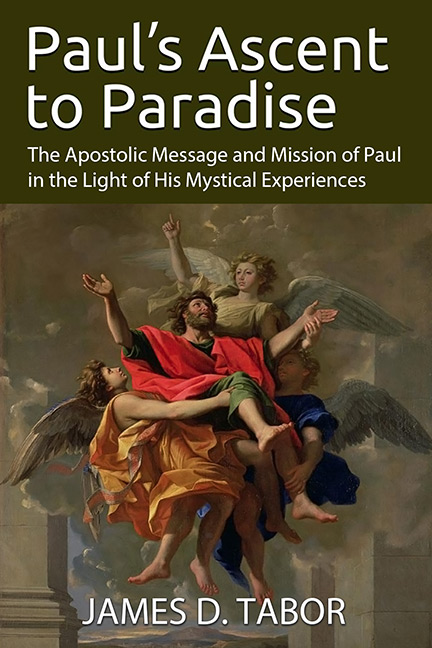
Paul’s Ascent to Paradise. Guest Post by James Tabor

A couple of weeks ago I learned that James Tabor had republished his book Paul’s Ascent to Heaven, his first scholarly monograph, which, alas, had gone out of print.  But it’s back in!  I wrote him to ask if he’d be willing to write a couple of guest posts about it, and here is the first.  This one explains how and where the book originated (published 1986); his next post will discuss how his mind has changed on some issues in the intervening years. Many of you know James from his other writings.  He publishes for both scholarly and popular audiences.  James has long been a professor of Religious Studies at UNC Charlotte.  Here is his story of how his book first came to be.  He will be happy to respond to comments and questions. James Tabor’s most popular books are Paul and Jesus and The Jesus Discovery: The New Archaeological Find that Reveals the Birth of Christianity, among others.    ************************************************************ James D. Tabor, Dept. of Religious Studies, UNC Charlotte Paul’s Ascent to Paradise [...]

Go to Top