
Search
Advanced search
Christ as an Angel in Paul
This will be my final set of comments on the evaluation of How Jesus Became God by Larry Hurtado, on his blog. His review consisted of a set of positive comments, of things that he appreciated (for which I’m grateful); several misreadings of my positions, in which Larry indicates that my book was asserting a view that, in fact, it was not (he corrected those after our back and forth in a subsequent post); one assertion that I was motivated by an anti-Christian agenda and wanted to convince readers that Jesus’ followers had hallucinations (I dealt with that assertion yesterday; I do not think that it is a generous reading of my discussion – especially since I explicitly stated on repeated occasions that I was *not* arguing for a non-Christian or anti-Christian view); and, well, this one point that I’ll discuss here, on which we have a genuine disagreement. The point has to do with whether the apostle Paul understood Christ, in his pre-existent state, to have been an angelic being. Larry devotes two paragraphs […]
Tags: Christology, Larry hurtado, Paul
June 7, 2014
The Myth of the First Christmas
Over the years I’ve been asked to write short articles on the meaning of Christmas for various news magazines. Looking back at some of these articles makes me realize how many different views of the season seem to be competing with each other inside my head. Or maybe I’ve just been in different moods! I thought I would reproduce a couple of these articles on the blog. The following is one I wrote a few years ago for the British journal The New Statesman. I called it “The Myth of the First Christmas.” (Apologies to those with better memories than mine: I just checked after posting this article and see that I did so earlier — three years ago! But no matter, I didn’t remember what was in it, and so probably you won’t either!) ****************************************************************** Once more the season is come upon us. At its heart stands a tale of two-thousand year vintage, the Christmas story. Or perhaps we should say the Christmas myth. When Post-Enlightenment scholars turned their critical tools on the tales […]
Tags: anti-judaism, Christmas
December 23, 2015
The Divine Realm in Antiquity
I have started a thread on my current interest, the relationship of the imperial cult (the Roman worship of the emperors) to the rise of Christology (the understandings of Christ). Both Caesars (especially deceased ones, but in some parts of the empire, also the living one) and Christ (by most of his followers, now that he too was deceased) were thought of and called “Savior,” “Lord,” “Son of God,” and even “God.” Most people would know that was true of Christ. But why was it true of the Roman emperor? Why would you worship your political leader? Does this mean we’re going to have to call either Hillary or Donald “Lord” or “God”? It seems unlikely. So why did ancient people in the Roman Empire do it? That’s what I want to explore over a few posts. To get there, I need to provide a refresher course (or, for those who don’t know this, simply a course!) on how ancient people imagined the divine realm in relation to the human realm. I have taken this […]
Tags: Greek religion, imperial cult, Roman religion
September 16, 2016
Jesus’ Crucifixion as King of the Jews
One of the main reasons I think Jesus called himself the future messiah is that this best explains the best attested event of his entire life: his crucifixion by the Romans. There are a few things we can say with virtual certainty about Jesus. For example: he was a Jewish preacher from rural Galilee who made a fateful trip to Jerusalem and was crucified by the Roman governor Pontius Pilate. There are, of course, lots of other things that we can say, without quite so much certainty (see my book Jesus: Apocalyptic Prophet of the New Millennium). But that much is certain. So why did the Romans crucify him? Romans had to have a reason to crucify a person. There had to be a criminal charge. There could be lots of charges – runaway slaves, brigands, insurrectionists, all could be crucified. So why was Jesus crucified? The Gospels tell us, and in this particular case, there are very good reasons for thinking what they say is right. Jesus was crucified for calling himself King of […]
Tags: historical jesus, king of the jews, messiah
November 21, 2016
The Apostolic Fathers: Serendipity Strikes
In my previous post I blasted from the past about my translation of the Apostolic Fathers for the Loeb Classsical Library. That was actually the first of a few posts on the topic, and since I referred to the next ones, I thought I should give them — at least the one that followed. Here it is. As I point out, in a way it’s about how, in a concrete way, life is a series of chances….. ************************************************************** It seems that much that has happened in my professional life has been because of serendipity. Back when I was a believer, we called it Providence. (!) It’s how I got my first job at Rutgers in 1984; how I got my current position at UNC in 1988; how I got asked to write something other than a technical study involving the Greek manuscript tradition of the New Testament – a textbook for undergraduates (in the early 1990s), and thus, in a sense, started my publishing career; how I had my first bestselling book (Misquoting Jesus) become […]
Tags: apostolic fathers, Loeb Classical Library
October 30, 2017
Free Memberships for those Who Need Them!
Thanks to the incredible generosity of members of the blog, I am happy to announce that there are a limited number of free one-year memberships available. These have been donated for a single purpose: to allow those who cannot afford the annual membership fee to participate on the blog for a year. I will assign these memberships strictly on the honor system: if you truly cannot afford the membership fee, but very much want to have full access to the blog, then please contact me. Do NOT reply here, on the blog, as a comment. Send me a separate email, privately, at [email protected]. In your email, let me know your situation (why you would like to take advantage of this offer) and provide me with the following information: 1) Your first and last name. 2) Your preferred personal email. 3) Your preferred user name (no spaces). 4) Your preferred password (should be 8 or more characters, no spaces). The donors will remain anonymous, but here let me publicly extend my heartfelt thanks for […]
December 6, 2017
On Being Controversial
I woke up this morning thinking I’d like to start finishing out this little mini-thread on Misquoting Jesus by talking about how I never thought of anything in the book being particularly controversial, even though it struck a lot of people that way. I was going to call the post “On Being Controversial.” And then I thought Wait a minute: That sounds familiar! And I checked it out, and I wrote almost exactly that post some three years ago. So, rather than reinventing the wheel, I give it here. After this, in my next post, I’ll explain how one claim that I do make about the manuscripts among the New Testament *is* controversial — not one I make (to a general audience) in Misquoting Jesus but one I make in scholarly contexts, one that really irritates some (a lot) of my colleagues. ******************************************************************* In this post I am going to take a bit of time out to do some self-reflection. An issue I’ve been puzzling over for some time is the fact that people keep […]
Tags: controversy
February 4, 2018
Futuristic Interpretations of the Book of Revelation
Now that my book The Triumph of Christianity has come out, I’m thinking about my future books. The one I’m working on now is The Invention of the Afterlife, where I explore the origins of the idea that when you die, your soul goes to heaven or hell (it’s not in the Old Testament and it’s not what Jesus taught — so where did it come from??). But I always like to think two or three books in the future, and so I’m contemplating what I might do after this. One idea is to deal with the belief that the world is soon to come to an end, a book that would, among other things, take on the book of Revelation. I’ve dealt with the issue before, of course, but not broadly. One of the things I’m interested in is how people interpret Revelation as referring to things about to happen in our own future. Here’s something I say about the topic in my textbook on the Bible. *************************************************************** One of the most popular ways […]
Tags: Revelation
March 1, 2018
A Privileged View of Suffering
I haven’t posted on this topic for a while, and looking through old posts from five years ago, I came across this one. I’ve edited it a bit from the first time, but my sentiments are pretty much the same now that I’m older and not much wiser….. ************************************************************************** Sometimes people get upset because I deal with the problem of suffering even though I don’t seem to be experiencing any severe pain and misery myself. Here is an example of the kind of comment I occasionally receive, this from someone commenting to me on Facebook a couple of days ago: “Dude, in a world of suffering, you claim doubts in deity because you live the privileged life of a UNC professor. If you lived in a 40-year-old trailer in Tarboro, I’d take you more seriously. And you even charge people to read your self-indulgent crap. Just for the record, I’m a non-theist. But I’m not a hypocrite.” I take comments like this very seriously. Even though I recognize that it is, well, a bit […]
March 12, 2018
Free Memberships for Those Who Need Them!
Thanks to the incredible generosity of members of the blog, I am happy to announce that again this year there are a limited number of free one-year memberships available. These have been donated for a single purpose: to allow those who cannot afford the annual membership fee to participate on the blog for a year. I will assign these memberships strictly on the honor system: if you truly cannot afford the membership fee, but very much want to have full access to the blog, then please contact me. Do NOT reply here, on the blog, as a comment. Send me a separate email, privately, at [email protected]. In your email, let me know your situation (why you would like to take advantage of this offer) and provide me with the following information: 1) Your first and last name. 2) Your preferred personal email. 3) Your preferred user name (no spaces). 4) Your preferred password (should be 8 or more characters, no spaces). The donors will remain anonymous, but here let me publicly extend my heartfelt thanks […]
December 11, 2018
Contradictions in the Gospels – Rev Matthew Firth’s Response
Thank-you very much, Bart, for your opening gambit. It has given me a most enjoyable afternoon of delving deeply into the Gospel texts, and I really appreciate the written format of this debate, which allows space for considered reflection, study and learning, rather than the rhetorical tennis of some other formats of debate which, while they produce spectacle, rarely achieve deep insight either for the proponents or the onlookers. I will now take the cases in the order in which you proposed them. You must be a registered and paid member to read the following text…
April 17, 2019
Why Are the Gospels Anonymous?
Looking through some old posts, I ran across this one (that I’d forgotten about) that answers a question I get at least a couple of times a year. Why didn’t the authors of the Gospels name themselves? (They have long been called Matthew, Mark, Luke, and John, of course, but you’ll notice that the authors themselves never indicate who they are; the first record we have of anyone actually quoting these books *and* calling them Matthew, Mark, Luke, and John is in Irenaeus, Against the Heresies, written about 185 CE — that is, about a century after the Gospels themselves were written and placed in circulation. Anyway, here is the post, giving a reader’s question and my attempt at an answer. *************************************************************************************** Among the interesting questions I’ve received recently is the following. It’s on something other than How Jesus Became God! Rather than type out a completely new answer, I’ve resorted to the discussion I set out in my book Forged, cited here, as relevant, in full. QUESTION: I still can’t quite grasp […]
April 19, 2019
Contradictions in the Gospels – Rev Matthew Firth’s Second Response
Thanks very much, Bart, for these interesting responses. I will get straight into explaining why I still don’t think you have shown that the examples you have offered are genuine contradictions. In the case of Luke 24 you say that the grammar of the Greek indicates that ‘Luke is extremely careful to date the entire sequence of chapter 24, at the beginning of each major paragraph. It all happens on the day of the resurrection.’ But we know from Acts, Luke’s sequel, that Luke certainly does not think that all of Luke 24 happened on the day of the resurrection. He says in Acts 1:3 and the following verses that after Jesus’ suffering and resurrection, Jesus appeared to the apostles over a forty-day period, and after that he was taken up. This means that Luke is well aware that Luke 24:50-53 did not happen on the day of the resurrection, despite your assertion that the grammar makes it clear that all of the events of Luke 24 did happen on the day of the resurrection. […]
April 28, 2019
Contradictions in the Gospels – Rev Matthew Firth’s Final Response
Thanks for such an interesting debate, Bart. Here goes with my final response: In my view, a genuine contradiction between two texts occurs when those texts carry mutually exclusive accounts, i.e. accounts where, if one account is correct, the other cannot be. In the examples you have cited, you have failed to show that the so-called contradictory accounts are genuinely mutually exclusive. You have therefore failed to provide any examples of genuine contradictions. Sure, the examples you’ve cited are, on the face of it, contradictions, but only if one doesn’t go beyond the surface and if one is insistent on applying contemporary values to the practice of ancient authors. It seems to me that the so-called contradictions you’ve cited are akin to saying that the following two accounts are contradictory: 1. Yesterday, Alice enjoyed a meal with Bob in New York. 2. Yesterday, Alice spent the day with Bob in London. But these accounts are not contradictory. They do not present mutually exclusive events, and their failure to each give an exhaustive account of the […]
May 12, 2019
God’s Library Part 1: Finding Ancient Christian Manuscripts in Egypt. Guest Post by Brent Nongbri
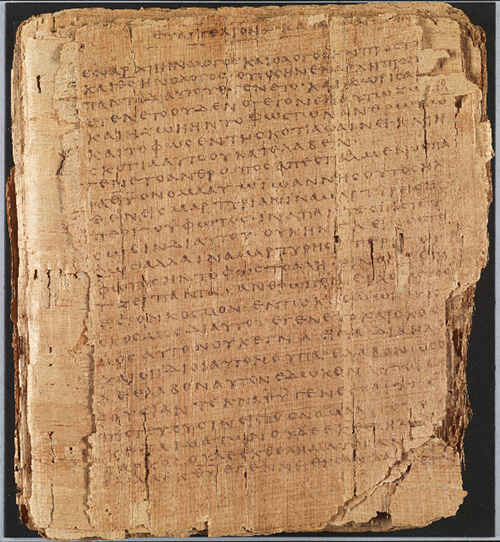
Here is a post by Brent Nongbri, from whom we have heard before on the blog. His recent book on early Christian manuscripts, especially those of the New Testament, is ground-breaking and insightful. He will give us a couple of posts devoted to it. Here’s the first. – Brent Nongbri’s most popular books are Before Religion: A History of a Modern Concept and God’s Library: The Archaeology of the Earliest Christian Manuscripts. *********************************************************** Bart suggested that a book I recently wrote might be of interest to readers of this blog, and he invited me to write a couple posts about it. The book is called God’s Library: The Archaeology of the Earliest Christian Manuscripts. It’s an introduction to early Christian manuscripts as archaeological artifacts. What exactly does that mean? Well, lots of excellent scholars have been studying our earliest Christian manuscripts for decades (in the case of some manuscripts, for centuries!), but they have mainly been interested in the texts that these manuscripts carry and not so much in the books themselves as physical […]

May 28, 2019
How Do We know When Manuscripts Were Written? Guest Post by Brent Nongbri
Here is the second post by Brent Nongbri on his recent book God’s Library. I mentioned in the first of his posts that the book is “ground-breaking.” In part that’s because he challenges the widely accepted dates of a number of our earliest surviving manuscripts of the New Testament. Here he talks about his further explorations of this problem. The basic question: When scholars say “This manuscript dates from the fourth century” (or the second, etc.): how do they *know* that? Or do they?? A lot of scholars will not be happy with Brent’s conclusions! But no one can simply write him off — he gives some very convincing analyses…. – Brent Nongbri’s most popular books are Before Religion: A History of a Modern Concept and God’s Library: The Archaeology of the Earliest Christian Manuscripts. *********************************************************** In my last post (HERE), I talked a little bit about some of the interesting stories of discoveries of ancient Christian manuscripts I uncovered while researching my recent book, God’s Library. What I would like to do […]
June 4, 2019
Do You Need a Free Membership?
Thanks to the incredible ongoing generosity of members of the blog! I am happy to announce that there are a limited number of free one-year memberships available. These have been donated for a single purpose: to allow those who cannot afford the annual membership fee to participate on the blog for a year. I will assign these memberships strictly on the honor system: if you truly cannot afford the membership fee, but very much want to have full access to the blog, then please contact me. Do NOT reply here, on the blog, as a comment. Please send me a separate email, privately, at [email protected]. In your email, let me know your situation (why you would like to take advantage of this offer) and provide me with the following information: Your first and last name. Your preferred personal email. Your preferred user name (no spaces). Your preferred password (should be 8 or more characters, no spaces). Country located The donors will remain anonymous, but here let me publicly extend my heartfelt thanks for such kind […]
June 30, 2019
Do You Need a Free Membership?
Thanks to the incredible ongoing generosity of members of the blog, I am happy to announce that there are still some free one-year memberships available. These have been donated for a single purpose: to allow those who cannot afford the annual membership fee to participate on the blog for a year. I will assign these memberships strictly on the honor system: if you truly cannot afford the membership fee, but very much want to have full access to the blog, then please contact me. Do NOT reply here, on the blog, as a comment. Send me a separate email, privately, at [email protected]. In your email, let me know your situation (why you would like to take advantage of this offer) and provide me with the following information: 1) Your first and last name. 2) Your preferred personal email. 3) Your preferred user name (no spaces). 4) Your preferred password (should be 8 or more characters, no spaces). The donors will remain anonymous, but here let me publicly extend my heartfelt thanks for such […]
August 16, 2019
666: The Number of the Beast
Yesterday’s post was meant as background to this brief discussion about the meaning of the “number of the beast” in the book of Revelation. Remember: I’m talking about “gematria” as a way of interpreting words by understanding their letters as numbers. Yesterday I tried to explain the symbolism of the beast in Rev. 17. To make best sense of what I have to say now, it would probably help to see that post. But it’s not required reading and will not be on the Final Exam. Four chapters earlier are given a description of another beast, one which in fact bears a remarkable resemblance to the one that shows up in ch. 17. According to chap. 13, this other beast arises from the sea and has ten horns and many heads. One of its heads receives a mortal wound that is then healed. The entire world follows this beast, which is empowered by the dragon (i.e., the Devil, 12:9). The beast makes war on the saints and conquers them (13:7). It has power over all […]
November 12, 2020
Fifty Ways to Forge a Gospel
You may already know New Testament scholar and blog member James McGrath. James is the Clarence L. Goodwin Chair in New Testament Language and Literature at Butler University, with many academic interests similar to mine. Six years ago we were both at a conference at York University (Toronto) that was dealing with ancient Christian apocrypha. I gave a talk on pseudepigraphy in the antiquity, in which I argued that it was not an acceptable practice to write a text claiming to be a famous person (when you were someone else). In the modern world we call that a “forgery”; I argued that in the ancient world they also used negative terms for it and consistently disparaged the practice (contrary to what you often hear). After my talk, James happened to be sitting across from me, and he suggested that one could write a (Paul Simon imitation) song “Fifty Ways to Forge a Gospel.” I laughed and didn’t think he was serious. He was. And he did. And now he’s not […]
April 14, 2021