
Search
Advanced search
A Really Scathing Review of My Book on Suffering
I’ve devoted my past couple of posts to a review of one of my books that the reviewer (really) didn’t like, and doing so reminded me of the most scathing review that, to my knowledge, I ever received, that at the time (sixteen years ago) I thought was outrageous, and now find rather humorous…. I’m a believer in letting the “other side” have its say, so I thought I’d post it here. The book under review was God’s Problem: How the Bible Fails to Explain our Most important Question – Why We Suffer. (As is usual, I didn’t give the book its title; usually publishers do that). It was reviewed in the Christian Century (Dec. 30, 2008) (View PDF (christiancentury.org), by Will Willimon, a well-known preacher and a former Bishop of the United Methodist Church and Professor at Duke Divinity School. No need for me to comment on it. Read it for yourself: ****************************** Bart Ehrman has written another book that is probably destined to be a best seller. God’s Problem is a lively, though […]
March 31, 2024
ANOTHER March Platinum Webinar! Did Jesus Really Mean It?
You are unauthorized to view this page. Username Password Remember Me Forgot Password
Tags: Platinum
March 19, 2024
Among Paul’s Enemies….
In my previous post I indicated that among the lost writings of early Christianity, one batch that I would especially like to see discovered would be those produced by Paul’s enemies among the Christians. I don’t know how many of his opponents were writing-literate, but possibly some of them were, and their own attacks on him and defenses of their own positions would be fascinating and eye-opening. Among these, I would especially love to see what his opponents in Galatia had to say for themselves. My hunch is that they were every bit as aggressive and confident in their views as Paul was in his. I’ve always found the letter to the Galatians to be one of the most forceful, intriguing, and difficult letters of Paul. I’ve studied it for over forty years, and there are still verses that I don’t understand. My view is that most scholars don’t understand them either — even the scholars who think they do! It is a packed and theologically dense letter in places. But the basic point is […]
March 27, 2024
Reminder! Platinum Webinar This Evening (Tuesday, March 26)! Did Jesus Really Mean It?
You are unauthorized to view this page. Username Password Remember Me Forgot Password
Tags: Platinum
March 26, 2024
Public Lecture at Wake Forest University: April 2
In case any of you is around Winston Salem NC next Tuesday, April 2 — I’ll be giving a public lecture at Wake Forest. This’ll be the first event I’ve done like this since before Covid! I’ll be talking about the real-life effects of the Christian view that the End is Near, based on my book Armageddon. The event is free, and you can find out more about it and register here: https://www.eventbrite.com/e/free-public-lecture-bart-ehrman-armageddon-in-america-visions-of-the-end-tickets-777270646427
March 27, 2024
Was Jesus Opposed to Women and Childbirth? The Lost Gospel of the Egyptians
Now here are some conversations between Jesus and one of his women followers I bet you’ve never seen before! When Salome asked, “How long will death prevail?” the Lord replied “For as long as you women bear children.” But he did not say this because life is evil or the creation wicked; instead he was teaching the natural succession of things; for everything degenerates after coming into being. (Clement of Alexandria, Miscellanies, 3, 45, 3) Why do those who adhere more to everything other than the true gospel rule not cite the following words spoken to Salome? For when she said, “Then I have done well not to bear children” (supposing that it was not necessary to give birth), the Lord responded, “Eat every herb, but not the one that is bitter.” (Clement of Alexandria, Miscellanies, 3, 66, 1-2) And when the Savior said to Salome, “Death will last as long as women give birth,” he was not denigrating birth — since it is, after all, necessary for the salvation of those who believe. (Clement […]
- Christian Apocrypha
- Early Christian Writings (100-400 CE)
- Sex and Sexuality in the Bible
- Women in Early Christianity
April 2, 2024
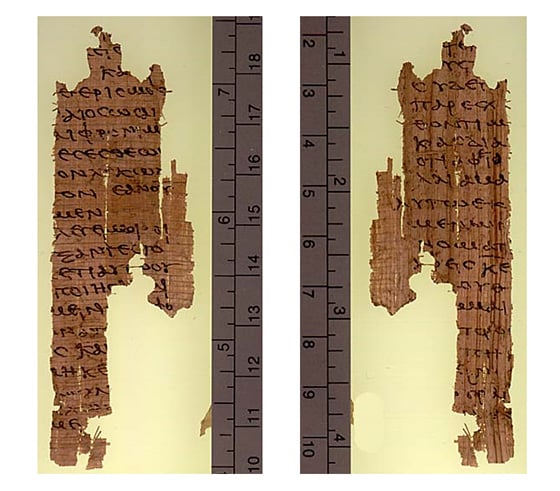
Is That a Portion of a Famous Lost Gospel?
Here is an intriguing and mysterious fragment of an ancient Gospel (that is to say: the manuscript of this book was entirely lost, EXCEPT for this little bit that just happened to turn up). I’ll bet my bottom dollar (but none of my other dollars) that you will think it is a fragment of one of the Gospels of the New Testament. WRONG! It is a clever combination of various Gospel accounts into one narrative, a “Gospel Harmony.” Scholars have long debated: is it a portion of the most famous ancient Gospel Harmony of them all, the massive work known as the Diatessaron (I’ll explain below), which we are desperate to get our hands on but probably never will? (It has been completely lost; no manuscripts survive). Here’s the tiny fragment of the something we have,
April 3, 2024
My Favorite Fragment of a Lost Gospel. Is It the Gospel of Peter??
One of the most captivating tiny fragments of a lost Gospel discovered in modern times came from a trash heap excavated from the ancient city of Oxyrhynchus, Egypt, one of many thousands of manuscript fragments found there, some of them Christian but most of them non-Christian (most of which were non-literary texts, that is, personal letters, land deeds, divorce certificates, bills of sale, etc.). Did this fragment come from Gospel of Peter? I’ve taken two posts to explain what the Gospel of Peter is, in order to set up this particular post. If you haven’t read the earlier posts, that’s fine. You’ll still get this one. If you have read them, even finer! As I pointed out in the earlier , the “Gospel of Peter” that we have today, which was discovered in 1886, is, unfortunately, only a portion – the only surviving portion – of what was once a complete Gospel. But was it a complete Gospel? Or was it a passion Gospel (like the later Gospel of Nicodemus) that gave an account only […]
April 7, 2024
An Unusually Large “Fragment” of a Lost Gospel: The Gospel of Peter
I’ve been doing a thread on Lost Gospels as these are represented by fragments of manuscripts that have been discovered and by quotations in the writings of church fathers. I was getting ready to post my favorite one today and then I wondered: Have I talked about that one before on the blog? Turns out, yes! Some years ago. It is a fragment that MAY be a lost portion of the also otherwise also lost Gospel of Peter. The Gospel of Peter is not *completely* lost: we have a chunk of it. But how large a chunk, we can’t really say. I’ve talked about it on the blog several times, but have decided that I need to say something about it again, to make sense of the fragment that will be coming in a later post. And to talk about the Gospel of Peter itself will require a couple of posts. So here’s the first.
April 4, 2024
What We Knew about the Gospel of Peter Before We Had the Gospel of Peter
This is the second of my two posts on the Gospel of Peter. When the fragment that we now have was discovered by archaeologists in a cemetery in Egypt in 1886, it was almost immediately recognized as the Gospel of Peter, not because it had a title on it, but because it fit so well a description of the Gospel in the writings of Eusebius, the early church historian. In two places in his ten-volume history of Christianity (from Jesus to his own day around 300 CE) Eusebius mnentions the book twice as one of the writings not accepted by the church as Scripture (Church History, 3. 3. 2; 3. 25. 6). And on one other occasion, Eusebius discusses the book at some length, in order to show why it had been excluded from consideration from the canon.
April 6, 2024
Is the Message of Paul in Acts the Same as the Message of Paul According to Paul?
In September I’m going to be hosting an online conference of Bible scholars discussing their work for laypeople at a level that most anyone will be able to follow easily. This will be the second of our conferences, “New Insights into the New Testament” (if you don’t know about the first one from this past year, focused on the Gospels, you can learn about it here: New Insights into the New Testament Conference). The topic will be The Life, Letters, and Legends of Paul, and we’ll have 8 or 10 scholars making presentations with Q&A for each. We’ll be announcing the course later (date, etc.), but just now as I’ve started thinking about it, I’ve been reflecting on some of the issues involved with trying to figure out what Paul actually preached. In addition to his hints and statements in his surviving letters, we have actual speeches allegedly delivered by him in the book of Acts in the NT. But do these accurately reflect what he really said? I’ve addressed the question on and off […]
April 9, 2024
Is the Paul of Acts at Odds with the Paul of His Own Letters?
Here I continue my few remarks on the differences between Paul’s proclamation as recorded in the speeches he gives in the book of Acts and the views he sets forth in his own letters. Again, this is taken from my book Peter, Paul, and Mary Magdalene (Oxford, 2006). ****************************** Further contrasts between what Paul says about his proclamation and what Acts says about it can be seen in
April 10, 2024
Ever Hear of an Agraphon? An “Unwritten” Saying of Jesus?
To my surprise, I’ve never talked about the “agrapha” of Jesus before on the blog. It’s about time I did! This is an intriguing topic connected with the teachings of Jesus known to almost precisely No One!! (I’d bet a case of fine French wine that your pastor — if you’ve ever had one, in any kind of church whatsoever — wouldn’t be able to tell you what it’s all about! Welcome to the world of the insiders. Here is what I say about the agrapha (plural of agraphon) in the book I published with my colleague Zlatko Pleše, The Other Gospels (Oxford, 2014). ****************************** The term “agrapha” has traditionally been applied to a group of “unrecorded” sayings allegedly delivered by the historical Jesus. The term is not altogether apt, since technically speaking these sayings have indeed been recorded–otherwise we would have no access to them. And so the term is more normally taken to mean sayings of Jesus that are not found in the canonical Gospels. Even this definition is problematic however, since it privileges […]
April 11, 2024
Other “Unknown” Sayings of Jesus
Here are now some more “agrapha” (sayings of Jesus not found in any of the surviving Gospels; I say more about “agrapha” in the previous post). These ones are found in writings of church fathers, who appear to have had access to Gospels unavailable to us, or at least to have heard non-canonical sayings of Jesus in some other way. (You will be able to find info on each church father/writing mentioned pretty easily online)
April 13, 2024
What Is Sheol in the Hebrew Bible?
I was recently asked what the Old Testament teaches about “hell” and whether that’s what “Sheol” refers to. If not (or if so), what it the view of the afterlife in the Hebrew Bible? This is a topic I dealt with in my book Heaven and Hell (Simon & Schuster, 2020) and I posted on it some years ago on the blog. This is what I said. ****************************** When trying to figure out where the Christian ideas of heaven and hell came from, an obvious place to start is with the Hebrew Bible. Jesus himself held to the authority of the Hebrew Scriptures. To be sure, there was not a completely fixed canon in his day, which all Jews everywhere agreed to. But virtually all Jews we know of ascribed to the high authority (and Mosaic authorship) of the Torah (Genesis, Exodus, Leviticus, Numbers, and Deuteronomy); and most Jews – including Jesus – also considered the prophets authoritative; Jesus also
April 14, 2024
What About People Who Come Back From the Dead in the Hebrew Bible?
In thinking about Sheol and death in the Hebrew Bible, it is worth reflecting on passages where the dead come back to life or are contacted by the living. This does not happen much at all – a couple of instances of resuscitation and one of necromancy. Probably the most famous resuscitation – the bringing back to life of a dead person – involves the prophet Elijah in 1 Kings 17:17-24. Elijah has been helping an unnamed widow from the town of Zarephath, miraculously providing her and her son with food during a divinely-mandated drought/famine (which the prophet brought to teach the wicked King Ahab a lesson). But the boy dies. The widow is understandably distraught – the prophet was supposed to be helping her and now her son has died. Some help. Elijah takes the boy, though,
April 17, 2024
What’s It Like in Sheol?
In the previous post I began discussing the intriguing story of 1 Samuel 28, where the king of Israel, Saul, illicitly consults a medium in an attempt to communicate with his now-dead advisor and predecessor, the prophet Samuel. This is the only case of necromancy in the entire Bible. In this post I want to consider what the author of the passage seems to think about those who go to Sheol after death. I have taken much of what follows from my book Heaven and Hell: A History of the Afterlife (Simon and Schuster, 2020). ****************************** In the account, King Saul learns of a medium in the town of Endor, near the front lines of the approaching battle. He goes to her and, for rather obvious reasons, does so in disguise: it would not help matters if she were to realize the illicit request for contact with the dead is coming from the sovereign ruler who made it illegal in the first place.
April 18, 2024
More on Sheol: Was it an Actual Place?
The Jewish scriptures contain a variety of different views about what happens to a person at death. Most commonly, a person who dies is simply said to have gone to “death” – a term used some thousand times in the Bible. Better known, but far less frequent, a person’s ultimate destination is sometimes called “Sheol,” a term whose meaning and etymology are debated. It occurs over sixty times in the Hebrew Bible, and there is unanimity among critical scholars that in no case does Sheol mean “hell,” in the sense people mean today. There is no place of eternal punishment in any passage of the entire Old Testament. In fact – as comes as a surprise to many people – nowhere in the entire Hebrew Bible is there any discussion at all of heaven and hell as places of rewards and punishments for those who have died. Probably most people who read the Bible think of Sheol as a Jewish kind of Hades, a shadowy place where everyone goes and all are treated the same, […]
April 16, 2024
The Bible and the Quran: Their Historical Problems. A New Course!!
Most Muslims argue that the Quran is absolutely perfect in every way: it represents God’s words, accurately recorded, with no contradictions, and no textual changes by scribes. Most fundamentalist Christians argue the same thing about the New Testament. Is either one true? I’m pleased to announce that I will be hosting a special event on May 4-5, an eight-lecture course on “The Bible and the Quran: Assessing their Historical Problems.” I will be giving half the lectures discussing textual, literary, and historical problems connected with the New Testament, and an expert on Islam, Javad Hashmi, will be dealing with the SAME problems with the Quran. Now THIS is something you’ve never heard before. It is not connected directly with the blog (except to the extent that I’m involved with both and that blog people will certainly be interested in it!). I myself am planning on learning a ton. Here is some information on it: ******************************* Overview This course will consist of eight 45-50 minute lectures, alternating between Christianity and Islam, exploring the Bible and the […]
April 20, 2024
Major Ways to Compare and Contrast the Quran With the New Testament
In my previous post I announced the new course I’ll be doing on May 4 and 5, with scholar of Islam, Javad Hashmi, in which we both apply rigorous historical methods to analyzing the NT (me) and the Quran (Javad). To register for the course, go to https://ehrman.thrivecart.com/bibleandquran. For a $5 blog member discount, simply enter the code Blog5. Here now are the topics and specific lectures we’ll be doing. We shot for the really important and interesting issues; I’m really looking forward to what Javad has to say about them with respect to the Quran. I’m sure it won’t be what I’ve normally heard! After each of us lectures on a topic, we’ll discuss the issues between ourselves. And at the end of each day (two topics/day) we’ll open it up for audience Q&A. Topic A – Getting Back to the Originals: Knowing What the Authors Actually Wrote Lecture 1:- The New Testament: Do We Have the Original Text? The New Testament is often called “the best preserved writing of the ancient […]
April 21, 2024