
Search
Advanced search
Why Would Anyone Claim Barnabas Wrote “The Epistle of Barnabas”?
In my previous posts I indicated that the “Letter of Barnabas” was not actually written by Barnabas (named as an apostle in Acts 10-15). In fact, it could not have been, since it is almost certainly to be dated to the 130s CE (for reasons I could explain if anyone really wants to know….). Barnabas, the companion of Paul, must have died no later than the 70s CE, more likely the 60s – some seventy years before this letter was written. So Barnabas couldn’t have written it. So why was the (rather long) letter of Barnabas – which in fact is anonymous – eventually attributed to Barnabas, the companion of Paul? I dealt with this question once (and only once in my entire life, I believe); it was something like thirteen years ago on the blog (!). And here’s what I said:
November 13, 2025
Why Was the Letter of Barnabas Attributed to Barnabas (Part 2)
In my last post in starting to explain why early Christians may have attributed the anonymous Letter to Barnabas to Barnabas, best known as a one of the closest companions of Paul. That post was a set up to this; in it I explained some of the key things we know about the mid-second century philosopher/theologian-eventually-branded-arch-heretic Marcion. Here I explain the relevance of that. It is important to recall that the letter of Barnabas is stridently anti-Jewish, claiming that the Jews never were the people of God because they had broken the covenant as soon as God had given it to them on Mount Sinai (by worshipping the Golden Calf); they misunderstood the law, taking it literally, when it was meant figuratively. Even though Jews never realized it, the OT was not a Jewish book but a Christian book, that not only anticipated Christ but proclaimed the Christian message.
November 15, 2025
How Do You Date a Book Such as Barnabas?
In my posts on Barnabas I indicated that it was probably written sometime in the 130s CE; I often get asked how scholars come up with dates like that? The first thing to stress is that it’s is very difficult to date ancient writings. But scholars who have worked on such matters (for nearly 300 years now, in some instances) have marshaled pretty good evidence in case after case, although in many instances there continue to be substantial debates. There are several ways to establish parameters, which are fairly commonsensical. If a writing is quoted by an author whose dates are relatively certain (his dates too need to be established on independent grounds! But in lots of cases there is almost no doubt), then obviously the writing is earlier than that. So that’s a beginning. Second,
November 16, 2025
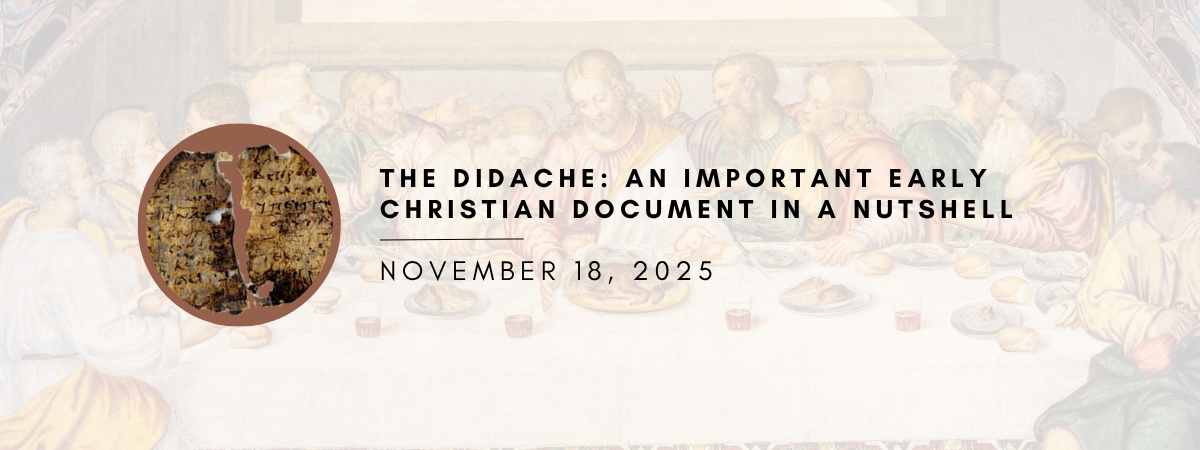
The Didache: An Important Early Christian Document in a Nutshell
The Didache (pronounced DID-ah-kay) is one of the most interesting and important documents to have survived from the earliest years of Christianity, written before even some of the books of the New Testament, apparently, and invaluable for understanding the development of Christian ethical views, the ways the early church was organized (with wandering teachers and prophets going from own to town), and he earliest Christian rituals (baptism and eucharist). Over the next two posts I’ll summarize the major themes and emphases of the book In a Nutshell. I begin with a one-sentence, fifty-word summary. The Didache, probably completed around the year 100 CE, consists of three writings combined into one: (1) An ethical treatise on how Christians should behave, called “the Two Ways,” (2) Rules for handling itinerant church “authorities” and church rituals (baptism; eucharist), and (3) An apocalyptic discourse about the imminent end. The Didache of the Twelve Apostles (the Greek word didache literally means “the teaching”) was virtually unknown until 1873, when it was discovered in a monastery library in Constantinople. Since then […]
November 19, 2025
Intriguing Instructions for How To Run the Church: More on the Didache
In my previous post I started to discuss one of the most important of the Apostolic Fathers, the Didache. I indicated there that it consists of three parts, the first of which is an ethical treatise on the “Two Ways” one can live. Now I continue with describing the even more unusual next two parts, a set of instructions about ritual activities and wandering apostles and prophets, and an apocalyptic prediction of what is yet to come.. This description is principally taken from my book The New Testament: A Historical Introduction to the Early Christian Writings. ****************************** Like the “Teaching of the Two Ways,” the second portion of the Didache may be drawn from one or more earlier sources, or it may represent the anonymous author’s own composition. It is a kind of “church order” in which instructions are given for various kinds of church activities. For example,
November 20, 2025
The Striking Prayers of the Didache
Among the most fascinating elements of the Didache are the prayers it records, one (the Lord’s Prayer) which it presents in a form more familiar to people today than the forms found in the New Testament (!), and others connected with the Eucharist – that is, the “Lord’s Supper” as celebrated in church. These prayers are nothing like most churches say today. I start with the Lord’s Prayer. The Lord’s Prayer is not found
November 23, 2025
Lies, Contradictions, Mistakes, and the Meaning of Words. What Do You Think?
I occasionally get an email from someone who says that the disciples must have really seen Jesus raised from the dead because “they would not have lied about it.” I’m always struck my how that seems to be the only option: Jesus was raised or the disciples “lied.” Relatedly (though not obviously so), my friend the evangelical apologist Mike Licona has claimed (in a public event we were both participating in) that when the author of Matthew changed a saying of Jesus from what he found in his source, Mark — thereby making Jesus say just the opposite of what he said in Mark — it was not an “error,” because Matthew did it on purpose and knew what he was doing. Mike’s logic was that Matthew was treating the account the way historians in antiquity often did, editing it for his own purposes in a way that created a discrepancy. (FWIW: Mike thinks Mark accurately reports what Jesus actually said). [In case you’re interested in checking it out, it’s in the passage where Jesus […]
November 25, 2025
Errors That Are Not Mistakes in the Bible
In a post a few days ago I pointed out that people often don’t clearly differentiate between the nuances of words that mean similar but not identical things, and that this leads to misunderstandings. I posed a challenge then for readers to differentiate between the words:
November 27, 2025
Some Good Questions On John and the Appearance of Jesus in the World
Here are some of the intriguing questions I’ve received recently: a number on how Jesus came into the world and the theology of the Gospel of John. QUESTION: In your opinion, why did Paul say Jesus was “born of a woman” (Galatians 4:4)? To my memory it seems unique in the entire Bible, and unnecessary. Why would anyone talking about anyone feel the need to say that person was born of a woman? Should it not be a given? RESPONSE: Yup, in isolation it seems a very odd thing to say. How
November 26, 2025
Letters by A Christian About to Be Martyred: Ignatius of Antioch in a Nutshell
The letters of Ignatius of Antioch are among the most fascinating earliest Christian writings from outside the New Testament. I’ve long been fascinated by them and would like to introduce you to them in a series of three posts in this thread presenting the “Apostolic Fathers” in a nutshell. The “Apostolic Fathers,” as I have indicated before, are a group of ten or eleven (depending how you count) books/authors who have long been understood to stand in the “orthodox” Christian camp before the major theological views later considered orthodox had become the overwhelmingly dominant form of Christian belief and practice some time in the third century or so – and so we call these write “proto-orthodox”; they were collected into a group of writings only in the modern period, and called “apostolic fathers” because they were each believed to have been acquainted with the apostles of Jesus themselves. In almost all instances, as it turns out, that turns out to be wrong, but we still give them this name. They are (for the most part) […]
December 3, 2025
A Glimpse of Proto-orthodox Views in the Letters of Ignatius
Yesterday I introduced the letters of Ignatius of Antioch (from around 110 CE), a bishop of the largest church in Syria (and one of the largest in the world at the time), written while en route to his martyrdom in Rome, to several of the churches that he had met with during his journey. The letters are addressed to churches in Asia Minor, in Ephesus, Magnesia, Tralles, Philadelphia, and Smyrna, along with a letter to the bishop of Smyrna, Polycarp (who also wrote a letter included among the Apostolic Fathers), and a letter to Rome — seven surviving letters altogether. That has long struck me as interesting: we have seven authentic letters of Paul; seven letters dictated by Christ to churches of Asia Minor in the book of Revelation (including two of the churches addressed by Ignatius); and there are seven letters of Ignatius. Seven is the perfect number. How odd. I’ve tried to figure out a rhyme or reason for it, but don’t think there is one. We just *happen* to have seven authentic […]
December 4, 2025
Ignatius: Eager to be Eaten by the Wild Beasts
In some respects, the most interesting of Ignatius’s writings is the letter to the Romans, where he deals explicitly with his upcoming martyrdom. We might expect that Ignatius would want to find some way to avoid having to pay the ultimate price for his faith, if he could do so without compromising his convictions. Ignatius, however, goes to his death eagerly, longingly. He writes to the Romans to urge them not to interfere, for he believes that only by suffering a glorious and bloody martyrdom will he become a true disciple of Christ, only by imitating Christ’s own Passion will he be able to “get to God.” Most of the surviving Christian writings from antiquity take a positive view of Christian martyrdom, urging Christians
December 6, 2025
Some Key Passages from the Gospels: Questions from Readers
I’ve received some terrific questions about the Gospels recently; here is a good sample and my responses. QUESTION: I have a question on the Gospel of John. This gospel describes Jesus as a pre-existing divine being (the Word) who became flesh. But it does not mention any virgin birth of a divinely sired baby. Without the virgin birth, how did John imagine the incarnation to have happened? Did Jesus simply materialize in the world as a baby? Or as a full-grown man? What can we know about this? RESPONSE: Ah, good question. Actually John’s view of incarnation is at odds with the idea of Virgin Birth, even though Christians have long conflated the two by saying the line in the Creed: “He became incarnate through the Virgin Mary.” When you read the Virgin Birth narratives of Luke, it indicates that Jesus became the son of God at and because of his conception: “The Holy Spirit will come upon you SO THAT the one born of you will be called holy, the Son of God.” […]

December 9, 2025
A Heart-Rending Story and Stunning Condemnation: The Prophet Hosea
Most of the so-called “minor prophets” (called that because their books are shorter than those of Isaiah, Jeremiah, and Ezekiel) are both terrific and terrifically under-read. So I think maybe I should post a bit on each of them (there are twelve). (I started last week with Zechariah) One of my favorites is Hosea, which tells a heart-wrenching story and delivers an unusually powerful message. The following is an edited version of my discussion in my book The Bible: A Historical and Literary Introduction (Oxford University Press).
December 7, 2025
If It Is All Matter, Why Should It Matter?
On Saturday I was sitting in a comfortable chair in front of a large window with a nice cup of coffee watching the sun slowly rise. I was in a contemplative mood, not dwelling on the quotidian duties bound to occupy me in the hours ahead, but thinking about some of the Big Issues in life, or at least in my life. I had two thoughts that I’d like to pass along. At the time I wondered if they were possibly, but not necessarily, standing at odds with each other. If so, so be it!
December 10, 2025
My Birdbrain View of Agnosticism
Yesterday I shared one of the thoughts that crept into and dominated my mind for a few minutes while watching a glorious sunrise from the comforts of a nice chair in front of a big window while drinking a cup of coffee. Here now is my second. We have some bird feeders out on the deck and I was watching not only the dawning of the day but also the birds coming out to break their fast. Chickadees, Titmice, and Juncos for the most part. They love the seed. And it occurred to me: these birds have no idea of my existence. If I moved toward them they would instinctively fly away, so they do recognize the reality of threat. But do they understand that I’m a human, that I have a mind with thoughts and organs and limbs that make me function, that I have the abilities to analyze and reason, that I have a career and possessions, that I think about lots of issues both academic and quotidian. Do they have any conception […]
December 11, 2025
What Are the Dead Sea Scrolls? The Basics
I gave a lecture the other day in which I mentioned the Dead Sea Scrolls. This morning, when looking back over the blog, I realized I haven’t really said much about them for … years! So, here are some of the basics you can pull out when things get dull at your next cocktail party. Even though just about every thinking human being in our context has heard of the Dead Sea Scrolls, most have no clue what the scrolls are, what they contain, and how they were found. It’s no surprise they’ve at least heard of them. The Dead Sea Scrolls are by virtual consensus the most significant manuscript discovery of the twentieth century, of major importance for understanding Judaism at the time of Jesus and, in some respects, the teachings of Jesus himself. Here is what I say about the scrolls in my New Testament textbook (Oxford University Press: The New Testament: A Historical and Literary Introduction). I begin by talking about the Jewish group widely thought to have been responsible for producing, using, […]
December 13, 2025
Why Do the Dead Sea Scrolls Matter for Understanding Jesus?
Many people assume that somehow or other the Dead Sea Scrolls matter for understanding better who Jesus was and what he preached. But how? In this post I’ll give a fairly succinct answer to the question. I should begin by stressing that the Scrolls are *mainly* important for understanding early Judaism, and only secondarily for understanding early Christianity. Even so, they are highly important for Christianity as well, though not in ways you might suspect (especially if you acquire all your historical knowledge from random searches on the Internet!). If I were to do the one-sentence version of why they matter for understanding Christianity, the shortest iteration I can come up with is that: “The Dead Sea Scrolls are texts written and/or copied by Jews living at about that same time and about the same place as Jesus, and so inform us about the milieu out of which his ministry, and the earliest Christian church, emerged.” The first thing to stress is that
December 14, 2025
Was Jesus a Member of the Dead Sea Scroll Community (the Essenes)?
In my previous post I talked about the significance of the Dead Sea Scrolls for understanding Jesus and the milieu out of which earliest Christianity grew. My basic point is that if Jesus was a Jew, then to understand him, you have to understand Jews in his world. And the Dead Sea Scrolls provide us valuable information to that end. I am not saying that the Dead Sea Scrolls are representative of what all or even most Jews thought at the time. They clearly are not. If the “Essene hypothesis” is right (that is, that the Scrolls were produced by members of a Jewish sect known as the Essenes) – and it is the view held by the vast majority of the experts (I am *not* an expert on the Scrolls) – then the Scrolls were produced by a Jewish sect that had very distinctive views of its own that were not, in many respects, shared by outsiders. In particular, this was a group of Jews who insisted that the coming apocalyptic judgment, soon to […]

December 16, 2025
A Bizarre Scandal Involving the Dead Sea Scrolls
Years ago I published a blog post about a scandal involving the Dead sea scrolls. I had forgotten all about it, but ran across it today and thought it would be an interesting re-post. It involved a court case and jail time! Here’s what I said: ****************************** A few years ago I was asked to give a speech at a museum in Raleigh NC in connection with an exhibit of the Dead Sea Scrolls that had been long in the works and had finally become a reality. I will be the first to admit, I’m not the first person you should think of to give a lecture on the Dead Sea Scrolls. It’s not my field of scholarship. But the lecture was to be one of a series of lectures, and the other lecturers actually were experts, including my colleague Jodi Magness, a world-class archaeologist who happens to teach in my department (well, she doesn’t “happen” to teach there; we hired her when I was chair of the department) and who has written the best […]
December 17, 2025