
Search
Advanced search
On the Cutting Room Floor: Part 3
This first paragraph is repeated from yesterday’s post: I have now finished with my final edits for my book How Jesus Became God. In the process of doing these final edits, I have cut out large sections of my Preface and the Introductions of four of my chapters and replaced them with other, hopefully better, sections. But I really like the old ones as well. So, since they won’t appear in print, I decided to post them here as a record of what almost was. The all involve anecdotes about my past. In most instances (the Introductions to the four chapters), these were narratives related to my “deconversion” from Christianity. My editor and I agreed that the reading public has heard enough about all that, and there’s only so much more that could still be interesting to them. And so I have replaced those anecdotes with other things. But I will present them here, anyway, for your reading pleasure or displeasure. The following is drawn from my old chapter 7. ***************************************************************************** I first began to […]
Tags: deconversion, How Jesus Became God
June 20, 2013
On the Cutting Room Floor: Part 4
This first paragraph is repeated from yesterday’s post: I have now finished with my final edits for my book How Jesus Became God. In the process of doing these final edits, I have cut out large sections of my Preface and the Introductions of four of my chapters and replaced them with other, hopefully better, sections. But I really like the old ones as well. So, since they won’t appear in print, I decided to post them here as a record of what almost was. The all involve anecdotes about my past. In most instances (the Introductions to the four chapters), these were narratives related to my “deconversion” from Christianity. My editor and I agreed that the reading public has heard enough about all that, and there’s only so much more that could still be interesting to them. And so I have replaced those anecdotes with other things. But I will present them here, anyway, for your reading pleasure or displeasure. The following is drawn from my old chapter 8. ***************************************************************************** It is always interesting […]
Tags: deconversion, How Jesus Became God
June 21, 2013
On the Cutting Room Floor: Part 5 and Final!
This first paragraph is repeated from my earlier posts: I have now finished with my final edits for my book How Jesus Became God. In the process of doing these final edits, I have cut out large sections of my Preface and the Introductions of four of my chapters and replaced them with other, hopefully better, sections. But I really like the old ones as well. So, since they won’t appear in print, I decided to post them here as a record of what almost was. The all involve anecdotes about my past. In most instances (the Introductions to the four chapters), these were narratives related to my “deconversion” from Christianity. My editor and I agreed that the reading public has heard enough about all that, and there’s only so much more that could still be interesting to them. And so I have replaced those anecdotes with other things. But I will present them here, anyway, for your reading pleasure or displeasure. The following is drawn from my old chapter 9. This will be the […]
Tags: How Jesus Became God
June 22, 2013
The Identity of “Matthew”
In a previous post I dealt very briefly with the question of whether the author of the Gospel of Matthew was Jewish. I want to say a few more things about the issue, although I’m not planning on providing anything like an exhaustive treatment. It’s a complicated issue. At the end of the day, my view is that we simply don’t know. In this post I want to say something about what we know about the identity of the author more generally. We call this author “Matthew” because that is the name traditionally associated with the Gospel. The Gospel is called “According to Matthew” in all of the surviving manuscripts that have a title (i.e., all the manuscripts that still have their first page.) It is never called anything else – although the *form* of the ascription to Matthew differs in different manuscripts: e.g., is it entitled “According to Matthew” or “The Gospel according to Matthew” or “The Holy Gospel according to Matthew,” or something else? But in all the ascriptions, the person named is […]
Tags: authorship, Gospel of Matthew, matthew
June 23, 2013
When Was Matthew Called Matthew?
For years I agreed with those scholars who claim that we have very early “evidence” that the Gospel of Matthew was actually written by Matthew, the tax-collector who was a disciple of Jesus. I no longer think so. Let me give some of the relevant information. The anonymity of this author – as is true for the other three NT Gospels as well, was respected by Christians for decades. When the Gospels of the New Testament are alluded to and quoted by authors of the early second century, they are never entitled, never named. Even Justin Martyr, writing around 150-60 CE, quotes verses from the Gospels, but does not indicate what the Gospels were named. For Justin, these books are simply known, collectively, as the “Memoirs of the Apostles.” It was about a century after the Gospels had been originally put in circulation that this book was called Matthew, and the others were called Mark, Luke, and John. This comes, for the first time, in the writings of the church father and heresy-hunter Irenaeus, around […]
- Canonical Gospels
- History of Christianity (100-300CE)
- New Testament Manuscripts
- Proto-Orthodox Writers
- Reader’s Questions
Tags: authorship, Gospel of Matthew
June 24, 2013
Was the Author of Matthew Matthew?
In my previous post I showed that the claim that Matthew, the tax-collector, was the author of the Gospel of Matthew (as we continue to call it) cannot be traced earlier than about 180 CE. It is not found in Justin, who lived in Rome in 150 CE and who quotes the Gospel – along with Mark and Luke – without indicating who wrote them. And the evidence of Papias (120-140 CE) is more than just ambiguous: he actually does not appear to be referring to *our* Gospel of Matthew when he says that the disciple Matthew collected the sayings of Jesus in the Hebrew language. In this post I want to give two reasons for thinking that the Gospel was not in fact written by Jesus’ disciple Matthew (and at every point it needs to be remembered that the Gospel does not *claim* to be written by Matthew; quite the contrary, not only is it anonymous: it speaks of Matthew as one of the characters in the story in the third person). FIRST point. […]
Tags: authorship, Gospel of Matthew
June 25, 2013
The Jewish Emphases of Matthew
In evaluating whether Matthew was himself Jewish or not – the theme of my current thread — it is important to get a sense of his distinctive emphases in his portrayal of Jesus. Here there can be little doubt. The focus of attention in Matthew’s Gospel is on to the nature of Jesus’ relationship to Judaism. You see this off the bat in chapter 1. Whereas Mark’s Gospel begins with Jesus as an adult being baptized by John the Baptist, Matthew’s begins with a clear resonance of Jewish Scripture – with a genealogy of Jewish and Israelite ancestors. And before he begins the genealogy, Matthew tells us that it will be one that traces the line of Jesus back to David and Abraham (“The Book of the genealogy of Jesus Christ, the son of David, the son of Abraham”). And why does he highlight these two names in particular? Because David was the greatest king of Israel, whose descendant was to be the “messiah” (as Jesus is called here: Jesus “Christ”), and Abraham was “the […]
Tags: authorship, early Judaism, matthew
June 26, 2013
The Jewish Emphases of Matthew: Part 2
In continuation of the question of the relationship of the Gospel of Matthew – both the Gospel itself and its anonymous author – to Judaism, I lift from something I wrote somewhere else at some point a while back: ********************************************************************************************************** Contrary to what many Christians have thought throughout the ages, for Matthew following Jesus does *not* mean abandoning Judaism and joining a new religion that is opposed to it. It is worth observing that even some Christians in Matthew’s own day appear to have thought that this is what Jesus had in mind, that is, that he sought to overturn the law of Moses in his preaching about the way of God. For Matthew, however, nothing could be further from the truth. The keynote of the sermon is struck soon after the Beatitudes in the striking statement, found only in this Gospel: Do not think that I have come to abolish the law or the prophets; I have come not to abolish but to fulfill. For truly I tell you, until heaven and earth pass […]
Tags: early Judaism, matthew
June 27, 2013
My New Course for The Teaching Company (The Great Courses)
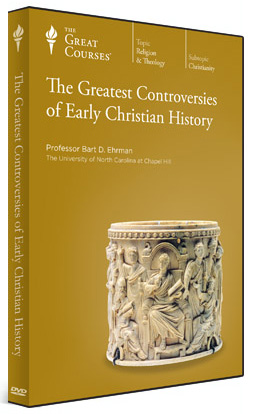
New Teaching Company Course! A temporary “time-out” from my posting on the Jewishness of Matthew’s Gospel. I received the good news that my new course with the Teaching Company (now called the Great Courses) has become available today. I am, needless to say, very pleased. Those of you who have been reading every post for the past few months will remember me talking about the course. It is called “The Greatest Controversies in Early Christianity.” As with all the courses I’ve done, this one was 24 lectures in length, each lecture 30 minutes in length. As I indicated before, these are the topics it covers: Was Jesus Born in Bethlehem? Was Jesus’ Mother a Virgin? Did Jesus have a twin brother, Thomas? Is Jesus in the Dead Sea Scrolls? Did Jesus Preach that the World Would End in his own day? Was Mary Magdalene Jesus’ Closest Disciple? Was Jesus Married? What Did Judas Betray? Did the Jews kill Jesus? Was Pontius Pilate a Secret Christian? Why Did Jesus’ Early Followers Claim that He Was Raised from […]
Tags: Great Courses, teaching company, The Greatest Controversies in Early Christianity
June 28, 2013
The Jewish Emphases of Matthew’s Gospel: Part 3
In the current thread I have been posting about the Jewish emphases of Matthew’s Gospel, all in an attempt to move to an answer to the question of whether, in my opinion Matthew was himself Jewish. When I get done with these posts, I’ll explain what my opinion is and why I have it; I can tell by some of the responses so far to these posts that some people are in for a surprise…. In previous posts we saw that Jesus, in Matthew, insists that his followers keep the Jewish law – even better than the scribes and the Pharisees. But for Matthew, What is the real purpose of the law? We get a hint of Matthew’s answer already in the Sermon on the Mount, in Jesus’ famous expression of the Golden Rule. We know of other ancient teachers who formulated similar guidelines of behavior usually in its negative form — that you should not do to another what you do not want them to do to you – as far afield as Confucius […]
Tags: early Judaism, matthew
June 30, 2013
The Jewish Emphases of Matthew: Part 4
In previous posts I’ve talked about Matthew radicalizing the law – so that his followers were to adhere to it even more closely than the scribes and Pharisees. Most Christians today think the Jewish law is irrelevant (except maybe for the Ten Commandments) (well, nine of them anyway: most Christians don’t keep the Sabbath.) (For years, as a boy, raised in the Christian church, I thought “Sabbath” meant “Sunday.” I assume that’s typical. But even so, we had no qualms about doing just about anything we pleased even on Sunday….). But when Jesus speaks about the laws that his followers are to keep, they are always the ethical laws such as not murdering and not committing adultery,which presumably would have applied not just to Jews but also to gentiles. What about the laws of Scripture, though, that were widely recognized as making Jews a separate people from the non-Jews, for example, the laws that required Jews to circumcise their baby boys, and to keep the Sabbath day holy, and to observe certain dietary restrictions? We […]
Tags: early Judaism, matthew
July 1, 2013
The Jewish Emphases of Matthew: Part 5
In the last post I tried to show that Matthew’s Jesus (remember: I’m not talking about the historical Jesus here; I’ve been referring to Jesus as he is presented in Matthew – a very different thing!) does indeed seem to think that his readers should follow not just the ethical aspects of the Jewish law, but the cultic aspects as well – keeping Sabbath, tithing, and so on. At the same time, it appears that Jesus in Matthew thinks that his opponents are wrong in placing the highest priority on keeping these cultic requirements, rather than on emphasizing the commandment to love that lies at its core. This becomes especially clear in two stories that Matthew took over from Mark, but modified. The first is Mark’s account of the call of Levi the tax collector (Mark 2:13-17; in Matthew’s account, it is the call of Matthew!). When the Pharisees see Jesus eating in Levi’s home with “tax collectors and sinners,” they disparage him for mixing with such tainted company. Evidently their own emphasis on ritual […]
Tags: early Judaism, matthew
July 2, 2013
Was Matthew’s Community Gentile or Jewish?
Given the importance of following the law for Matthew (especially as seen in 5:17-20 and in the Antithises), if we had no indication that Christianity spread among non-Jews soon after Jesus’ death, we might simply assume that Matthew’s community was comprised of Jews who continued to adhere to the law even if they disagreed with the Pharisees over how best to do so. But Gentiles *were* joining the Christian church well before Matthew wrote his Gospel; indeed, at this time there were probably more Gentiles who claimed to be followers of Jesus than Jews. Does Matthew think that these Gentiles Christians are to keep kosher, to observe the sabbath, and, if male, to be circumcised? It is an intriguing question because, as we will see in a later post, the apostle Paul was adamant that they should *not*. It is unfortunate for us that Matthew does not address this issue directly. In this Gospel Jesus does give numerous indications that Gentiles will become his followers and inherit the kingdom of heaven; but nowhere does he […]
Tags: early Judaism, matthew
July 3, 2013
So … Was Matthew a Jew?
I am near the end of this thread on the Jewishness of Matthew’s Gospel. I have several more posts to go, so I’m not completely at the finish line; but it’s within sight. (I should stress that I am not intending to give an exhaustive analysis of the problem and all the relevant issues. That would take a very long book. In fact, scholars have indeed written significant books on the topic. One of my graduate students, Judy Siker, wrote her dissertation on one aspect of the issue. She’s also the author of Who is Jesus? What a Difference a Lens Makes. I hope to close out the thread with posts on three related topics: this post and the next on whether Matthew was himself Jewish; the one after on whether Matthew – whether Jewish or not – was anti-Jewish (I hope to do that in just one post, but it may take more); and finally one on whether Matthew and the apostle Paul would have or could have seen eye-to-eye on the relationship of […]
Tags: early Judaism, matthew
July 4, 2013
Gentile Judaizers
I ended my last post with a question: Suppose Matthew really did think a person had to be a Jew in order to be a follower of Jesus. Would that indicate that he himself was born and raised a Jew? In this case I think there is a clear and certain answer. But it may not be the answer you’d expect. I think the answer is certainly No. The reason is that we know of other Christians in the early church who insisted that to be a follower of Jesus, one had to adopt the ways of Judaism. And these other Christians were themselves born and raised pagan. The clearest instance involves Paul’s opponents in Galatia. Paul’s letter to the Galatians is one of the most dense and difficult writings of the New Testament. There are verses and even passages that are, in my opinion, virtually impenetrable, statements that Paul makes that I still have difficulty figuring out after years of thinking and reading about it. But the basic situation that prompted the letter, in […]
Tags: Galatians, Judaizers, Paul
July 5, 2013
Teeth Will Be Provided
Teeth will be provided seems like a strange title right? Well, we will get to that soon. I have had a long thread of fairly heavy-hitting posts for over a week now, dealing with whether Matthew and his audience, were Jewish. I still have a few things to say about related issues (such as whether, at the end of the day, Matthew and the apostle Paul would have been able to see eye-to-eye, and whether rather than being Jewish Matthew should be considered *anti*-Jewish). But I think it’s time for a break from the hard-hitting discussions for something a bit different and humorous. And so I have an anecdote to tell about a passage that I quoted in one of my earlier posts from Matthew, where Jesus says: “Truly I tell you, in no one in Israel have I found such faith. I tell you, many will come from east and west and will eat with Abraham, Isaac, and Jacob in the kingdom of heaven, while the heirs of the kingdom will be thrown into […]
Tags: Coleman Norton
April 11, 2022
Would Matthew and Paul Have Seen Eye-to-Eye
One of my major goals as a professor of New Testament is to get my students to understand that the NT is not a single entity with a solid and consistent message. There are numerous authors who were writing at different times, in different parts of the world, to different audiences, and with different – sometimes strikingly different – understandings about important issues. In fact, about key issues, such as who Jesus was and what his role was in salvation. One of the assignments that I used to give was to have students compare Matthew’s view of salvation with that found in Paul. Specifically, what is the role of doing what the Law demands and of doing good deeds? If someone abides by the law and does good deeds for others – will that bring about salvation? The way I get them to think about those questions is by looking at two passages, one in Matthew and the other in Paul. The first is Matthew’s version of the “rich young ruler” (he’s actually not a […]
July 7, 2013
Early Christianity in Egypt
About two months ago, in May, I was feeling pretty burned out; I had just finished my manuscript on How Jesus Became God and my brain was reasonably fried. At that point, I had trouble imagining being able to come up with posts for the blog for a while, and so I asked if anyone had any questions they would like to have answered. And so once again I have learned my lesson: Be careful what you ask for! Since then I’ve been answering the questions I received (the long series of posts on Matthew were ultimately from one of the questions). I’m, maybe, half way through the list. And questions keep coming in. So I think what I’m going to TRY to do now is simply answer the remaining ones, one question at a time, one per post (unless I get carried away again, as I did with the Matthew question). Feel free to keep asking questions if there are any that are burning on your brain; but realize that it may take a […]
- Heresy and Orthodoxy
- History of Christianity (100-300CE)
- Proto-Orthodox Writers
- Reader’s Questions
- Spread of Christianity
Tags: Egypt, Eusebius, heresy, orthodoxy
July 9, 2013
Paul’s Chronology
QUESTION: Could you give some of the clues scholars have regarding the dating of Paul’s letters? RESPONSE: This seems like it ought to be an easy question to answer, a real softball. But it’s not; it’s a tough one, a hard curve. Different scholars have different likes and dislikes within their own fields. Most New Testament scholars, for example, do not enjoy doing textual criticism – the reconstruction of the oldest attainable form of the text based on our surviving manuscripts. In fact, most are not trained in it and want nothing to do with it. When I started in my career, on the other hand, that was the one thing I was completely passionate about. Different strokes for different folks. There are some scholars who want nothing to do with the Synoptic Problem, and others who have worked on it for thirty years. And there are scholars who simply cannot get interested in establishing a chronology of Paul’s life and letters, and others who want to do almost nothing else. I’m afraid when […]
Tags: Paul
July 10, 2013
Jesus and Sacrifices
QUESTION: Would it be accurate to say that after Jesus’ death the first-century Christians turned him into an enduring symbol of the very sacrificial system that he himself rejected in life? By ‘sacrificial system’ I’m referring both to the ancient lamb/goat-based traditions surrounding Yom Kippur, as well as to the later lamb sacrifices conducted by the Jerusalem temple priests during Jesus’ day, etc. And, by the word ‘rejected,’ I’m wondering if Jesus having upset the moneychanger’s tables at the temple was his way of disparaging the very notion of paying money to buy a lamb for a priest to sacrifice in order to atone for one’s sins. RESPONSE: This is an interesting question, with several intriguing aspects: 1) Did Jesus reject the Jewish sacrificial system? 2) Did his followers borrow their imagery for the salvific character of his death from the Jewish sacrificial system? 3) If so, were they not embracing precisely what he abandoned? I think the easiest question to answer is #2: Yes, I think the early followers of Jesus did see […]
Tags: sacrifice, the historical Jesus
July 11, 2013