
Search
Advanced search
Who Can Still Be A Christian?
QUESTION: If historical Jesus scholars believes that Jesus’ main message was the imminent apocalypse, and that didn’t happen, how can anyone who believe that remain a Christian, given that Jesus was wrong on the main focus of his life? RESPONSE: This is a great question, and one I get asked a lot. Let me say at the outset that I think it is exactly right in its evaluation of who Jesus was. As I’ve explained in a lot of places, for over the past century – since Albert Schweitzer’s classic, The Quest of the Historical Jesus (1906), the majority of NT scholars in Europe and the United States have been convinced that Jesus was indeed an apocalyptic preacher, like others of his day. Apocalypticism appears to have been widespread throughout Palestinian Judaism at the time. In rough form (with lots of variations) it was held by the Pharisees (who believed in the “resurrection” at the end of the age, an apocalyptic idea; they therefore probably held to other apocalyptic notions), by the Essenes who produced […]
Tags: apocalypticism, historical jesus
November 10, 2013
Multiple Attestation for Jesus
I had an interesting email from a reader the other day, in which he pointed out that the “multiple attestation” for the existence of Jesus is virtually matched by the “multiple attestation” for the resurrection of Jesus. At first I thought his point was the Christian apologetic one, that therefore since the resurrection is just as well (not quite, but still pretty well) attested as the very existence of Jesus, doesn’t that show that Jesus was probably raised from the dead? When I responded to that question, it turned out that he was actually saying the opposite: since we (meaning he and I) don’t believe that Jesus was raised from the dead, but *that’s* well attested, doesn’t that call into question the very existence of Jesus, which has comparable attestation. Multiple attestation can’t “show” it, in this view. As I think about it now, my response to *both* points (the Christian apologetic and the non-christian mythicist) is probably the same, that when dealing with the two phenomena – 1. the existence of Jesus and 2. […]
Tags: historical criticism, historical jesus, multiple attestation
November 12, 2013
History is Not the Past
Yesterday I started to answer a question from a reader who pointed out that just as the existence of Jesus is multiply attested, so too is Jesus’ resurrection. And so if *one* is established as historical, doesn’t the other one *also* have to be seen as historical? And if one is considered non-historical, doesn’t that show that the other is probably also non-historical? These are great questions, but I think the answer to both of them is “no.” Yesterday I showed why multiple attestation strongly supports the existence of Jesus. Some readers objected to that, but I should reiterate – this is simply a common sense principle that all of us use every day to decide if something happened (say, what happened at lunch yesterday). Today I want to show why multiple attestation can *not* be used to support the resurrection of Jesus. I begin by pointing out something that hasn’t occurred to a lot of people, but is nonetheless a fundamental point. History is not the past. This may come as a surprise, but […]
Tags: historical criticism, historical jesus
November 13, 2013
Historians and the Problem of Miracle
Yesterday I started to talk about why historians cannot demonstrate that a miracle such as the resurrection happened because doing so requires a set of presuppositions that are not generally shared by historians doing their work. Over the years I’ve thought a lot about this question, and have tried to explain on several occasions why a “miracle” can never be shown, on historical grounds, to have happened — even if it did. Here is a slightly different way of approaching the matter, as I expressed it in an earlier publication on the historical Jesus: ******************************************************** People today typically think of miracles as supernatural violations of natural law, divine interventions into the natural course of events. I should emphasize that this popular understanding does not fit particularly well into modern scientific understandings of “nature,” in that scientists today are less confident in the entire category of natural “law” than they were, say, in the nineteenth century. For this reason, it is probably better not to speak of supernatural violations of “laws,” but to think of miracles […]
Tags: historical criticism, historical jesus
November 15, 2013
Why Historians Can Talk “About” the Resurrection
In this final post (for now) on the historian and miracles, I want to emphasize one point that I raise of my own volition, and answer one question that has been asked by a reader. First, a point to emphasize (I borrow this from my forthcoming book on How Jesus Became God), on whether my stand on miracles just means that I’m a crazy secularist…. The reason that historians cannot prove or disprove whether God has performed a miracle in the past – such as by raising Jesus from the dead – is not because historians are required to be secular humanists with an anti-supernaturalist bias. I want to stress this point because conservative Christian apologists, in order to score debating points, often claim that this is the case. In their view, if historians did not have anti-supernaturalist biases or assumptions, they would be able to affirm the historical “evidence” that Jesus was raised from the dead. I should point out that these Christian apologists almost never consider the “evidence” for other miracles from the […]
Problem on the Site
My assistant and computer guru Steve Ray noticed yesterday (Saturday, November 16) that comments were not getting posted on the site. There was a technical malfunction, unrelated to him, me, or the CIA (the real one or the secondary one in D.C., so far as I know….). This is the note he posted on my facebook page. Please … take note! Greetings Blog Members. Technical Notice. There was a database corruption on the blog server today due to JetPack, one that did not allow comments to record. If you left a comment between 6am to 6pm EST, please consider submitting it again. If any member notes that their account is not working properly (cannot access membership content), please email your password to [email protected] and it will be manually reset. Sorry for any inconvenience. S. E. Ray, Bart’s Assistant. Additionally, the inbound links still result in membership access issues, even after logging in. Developers are looking into this and will not get back to us until Monday, 11/18/2013. However, if you login directly at https://ehrmanblog.org/login/ member posts are […]
November 17, 2013
Jesus and Brian!!!
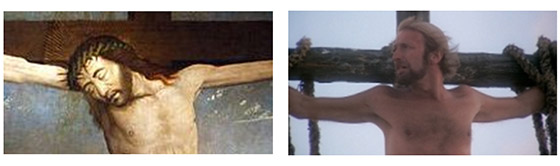
I am pleased to be able to announce that a conference will be held this summer that looks to be outrageously fun and interesting. It will be at King’s College, London. And it will be on the Life of Brian and the Historical Jesus. I have been asked to give one of the papers, and how could I refuse! I’m going to have to cut short a family vacation in France, but there’s no way I’m missing this. Here’s the publicity for it. Jesus and Brian Or: What have the Pythons done for Us? A Biblical Studies Conference King’s College London, The Strand, London WC1 Safra Lecture Theatre Friday June 20th to Sunday June 22nd, 2014 Monty Python’s Life of Brian provoked a furious response in some quarters when it first appeared in 1979, even leading to cries of ‘blasphemy’. However, many students and teachers of biblical literature were quietly, and often loudly, both amused and intrigued. Life of Brian in fact contains numerous references to what was then the cutting edge of biblical scholarship […]
Tags: historical jesus, Life of Brian
November 20, 2013
Errant Texts and Historians
QUESTION: In your debates with James White and Dan Wallace, you argued that we cannot know what the original autographs of the NT said because we don’t have the originals. In your debate with James White, you even commented that the 2nd or 3rd copier of the text of Mark could have radically altered the text so that the way it came down to us is radically different than the autographs. You’ve argued that this is the case even for classical writings or any textual document from antiquity. Now, if you believe we cannot know what the originals said because we don’t have the autographs, then how could you know that Paul met with James and Cephas, and use that as an argument proving that we know Jesus existed? Is it not possible (according to your view) that Galatians has been radically altered? In other words, it seems that you either have to sacrifice your skepticism regarding textual criticism or sacrifice your certainty for the historicity of Jesus. RESPONSE: This is a great question! So, […]
Amusing Fund Raising and the Blog
As many of you know, the charity that this blog supports more than any other is the Urban Ministries of Durham, which deals with issues of hunger and homelessness in my city of Durham – or rather, deals with people who are experiencing problems of hunger and homelessness. Urban Ministries (which, despite its name, is not a religious organization) does amazing work. And one of the most amazing things about it is that it does not simply put a band-aid on the problem, e.g., with its soup kitchen and overnight housing. They do have both, of course! But more than that, it works hard at ending homelessness for people, by getting them into permanent housing and employment to pay for it. It is a model organization that I am very proud to be associated with. They have just started an incredibly innovative fund-raising effort that is rather amusing and potentially ground-breaking. Here is the website: https://www.namesforchange.org/Intro Check it out, and tell me what you think. And feel free to name the toilet paper after […]
November 21, 2013
My SBL Conference
There are two happy events affecting my life today. The first is that I just now have received an author’s copy of my new book, co-edited with my colleague, Zlatko Plese, The Other Gospels: Accounts of Jesus from Outside the New Testament (Oxford University Press). As I’ve earlier indicated, this book is an English-only edition of our Apocryphal Gospels: Texts and Translations, which included the original Greek, Latin, and Coptic along with the English translations. For this new lay-reader edition, we have simplified the introductions, making them more accessible to the non-scholar, and gotten rid of the ancient languages. The other happy event is that I am off, now, to my annual meeting of the Society of Biblical Literature meeting. This is the professional meeting for all scholars and professors of Biblical literature. It is a highlight of my year. Papers are read by scholars on topics of everything you can imagine by scholars who are presenting the results of their research to other scholars. Papers are short – usually 20-25 minutes in length – […]
Tags: Gospel of Peter, SBL
November 22, 2013
The Gospel of Peter in a Papyrus Fragment?
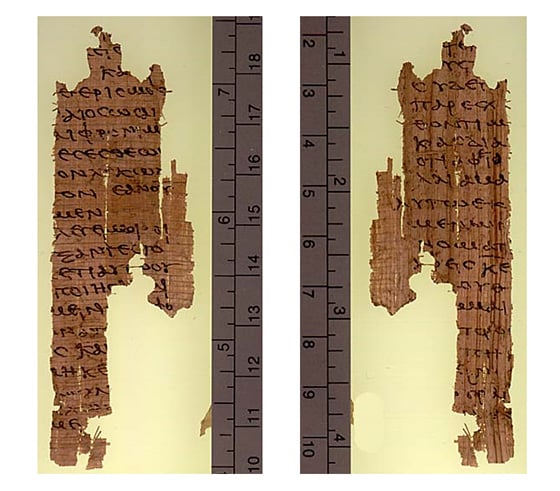
Yesterday I gave a lecture at the Biblical Archeology Society FEST here in Baltimore. Even though I’m (obviously) not an archaeologist, a lot of my work is connected with archaeology, especially the discovery of ancient manuscripts. In 1886 archaeologists digging in Akhmim Egypt were working through a cemetery and uncovered a tomb, from about the 8th century, they thought, that had, along with a skeleton, a 66 page parchment book. The book was written in Greek, and had four texts in it (all incomplete), including, on the first ten pages, a copy of what was identified as the Gospel of Peter. If you’ve ever read the surviving Gospel of Peter, this is the text (or the translation of it!) that you have read. I can blog more about it at some point later. For now: this is an alternative account of the trial, death, and resurrection of Jesus, which is most famous for the resurrection scene, in which the narrator describes what actually happened when Jesus came out of the grave. It’s spectacular. Jesus is […]
Tags: 2 Clement, Dieter Luhrmann, Gospel of Peter, Papyrus Oxyrhynchus 4009
November 23, 2013
SBL and ALL those Books
I had a good and interesting first day at the Society of Biblical Literature annual meeting here in Baltimore. This society comprises professors and other scholars of biblical literature mainly from the U.S., but with some attendees from overseas as well. It meets along with the American Academy of Religion, which is the professional society for all professors of religion who are not teachers of biblical studies (so experts in Christianity outside the NT, Judaism, Hinduism, Buddhism, anthropologists of religion, historians of religion, and so on and on). All together it is a very large group. I don’t have the exact numbers, but I think maybe there are 10,000 or 11,000 people here for the meeting. That’s a lot of experts on religion in one place! One of the most important aspects of the conference for me is the book display. Dozens of publishers of books in every field and aspect of religion are here – from major well known pubishers such as Oxford University Press and Princeton University Press to religious publishing houses such […]
Tags: SBL
November 24, 2013
Papers at the SBL
As is typical, I spent most of my four days at the Society of Biblical Literature meeting seeing old friends in the field and former students who now have teaching careers of their own. I did make some time to go to a few papers on the final day (yesterday). Some were very stimulating, interesting, and learned, others were … not. Just to give you a sense of the sorts of things that get done in this setting, I’ll give (very) brief summaries of a couple of the papers I heard.. The sessions I went to were on New Testament Textual Criticism (this is the group that discusses the manuscripts that preserve the NT) and Social Memory and the Historical Jesus (roughly speaking, this group considers issues raised for establishing what Jesus really said and did based on advances in the study of “memory” by psychologists and historians today). The textual criticism section was long my “home” in the SBL; I was the chair of the section for six years and on the steering committee […]
Tags: SBL, textual criticism
November 26, 2013
Is History Possible?
One other section that I attended at the Society of Biblical Literature meeting in Baltimore was devoted to the field of social memory and the historical Jesus. This was a very interesting panel, of four papers, devoted to what we can say about the recollections of Jesus found in the Gospels, based on what psychologists now tell us about memory, and what historians familiar with this psychological work are saying about how the past can be remembered. I found one paper in particular to be especially interesting, because the author, a very smart scholar named Zeba Crook, used developments in the psychology of memory to argue that we can NOT know anything about the historical Jesus. Crook’s paper (I’m reconstructing this from my mind, based on what I heard two days ago; I may get some of this wrong. But if Crook’s point is correct, then I can’t reconstruct the event at all, as you’ll see!) was based on the phenomenon of memory distortion. Psychologists have determined several things about memory and how it gets […]
Tags: historical jesus, memory
November 27, 2013
Paul and the Resurrection of a Spiritual Body
QUESTION: You may have gone over this before, but do you think the earliest Christians, Peter, Paul, and Mary etc. believed in the physical bodily resurrection of Jesus, or do you think they believed his “spirit” was raised from the dead? From Paul’s writing it’s hard for me to judge. I ask this because it seems easier for me to attribute the resurrection belief to “hallucinations” if they were only experiencing visions of Jesus’ spirit. Even group “hallucinations” of Jesus’ spirit seems plausible, maybe during a group’s ecstatic experience or something. On the other hand I think there’s difficulty with the idea that several people hallucinated an experiences with a seemingly physical Jesus. RESPONSE: This is a great question. My view is that different early Christians had different views. Paul’s view for me is the most interesting. In a forthcoming book I’ve mapped out my understanding of that. Here’s what I say there: ****************************************************************************** It is striking, and frequently overlooked by casual observers of the early Christian tradition, that even though it was a universal […]
Tags: Paul, resurrected body, resurrection, spiritual body
November 29, 2013
A Gnostic View of Jesus’ Resurrection
The Gnostic view of Jesus’ resurrection. Yesterday, in response to a question, I discussed Paul’s view of the resurrection of Jesus. In response to several questions I was asked, let me say emphatically that YES, in my view Paul believed that Jesus’ corpse itself was transformed into a spiritual body. If asked, he would have said that the grave was empty. That’s how I read 1 Corinthians 15. The body that comes out of the tomb is the same body that went into the tomb, but it is a transformed (not a different) body, made immortal. (And let me stress – again in response to a couple of questions I’ve asked: this is not *my* view of what happened to Jesus’ body. I’m just explaining what *Paul’s* view was). Paul’s view was not the only one found among the early Christians. I explain that view further in this excerpt from my forthcoming book How Jesus Became God: The Raising of the Spirit – the Gnostic View of Jesus’ Resurrection Some ancient Christians – taking a […]
Tags: gnosticism, nag hammadi, resurrected body, resurrection
November 30, 2013
A Third View of Jesus’ Body at the Resurrection
This will be my final post on the early Christian understandings of the nature of Jesus’ resurrected body. I have tried to show that Paul believed that Jesus’ actual body came out of the tomb, but as a spiritual, immortal body – completely transformed; other Christians, including groups of Gnostics, maintained that Jesus’ spirit lived on even though his body decomposed and ceased to exist (like all other bodies) In this final post I deal with another extreme in the opposite direction, one found already in the New Testament, possibly in order to oppose the idea that Jesus was raised only in spirit but not in body. Again, this is an extract from my forthcoming book How Jesus Became God. ************************************************************************************ The Raising of the Mortal Body We don’t know how early such full-blown Gnostic views came to expression in the Christian movement; they were certainly in place by the middle of the second century, and possibly earlier. But there were tendencies toward such views already in the New Testament period. If my reconstruction of […]
Tags: resurrected body, resurrection
December 1, 2013
The Giving Season
The season of giving has come upon us! I have to admit, even though I am not a Christian, I absolutely love the Christmas season. I know there are a lot of things wrong with Christianity, just as there are with every religion. The harm, the evil, done in the name of Christ is enough to make my skin crawl. But at the same time, there is a lot of good, and I see no reason to deny it. At its very best, Christianity is all about giving: God giving his son, his son giving himself, his followers giving themselves to one another, and even to strangers in need — giving of themselves and their worldly goods for the sake of others. This is the part of Christianity – which I consider to be true Christianity at its heart – that I completely resonate with and cherish, even though I no longer consider myself to be among the faithful….. The Christmas season is a giving season. I completely detest the crass materialism. But the […]
Tags: Christmas
December 4, 2013
Jesus the Magician
Some of you will be familiar with the work of Morton Smith, especially on the “Secret Gospel of Mark.” I may have posted a few bits on it at some point. Smith was a brilliant scholar, always the smartest guy in the room. And he knew it. He had a rapier wit and was not afraid to use it. He regularly bloodied people – even internationally famous scholars – who disagreed with him. I met him only a couple of times, when I was a lowly graduate student and he was a mighty professor at Columbia. He really was the real deal. Unbelievably learned and uncanilly knowledgeable about all things antiquity. One of his “popular” books was Jesus the Magician. A great book, even if you disagree with it. A new edition is coming out (it was published in 1978 – 35 years ago now!). And the publisher has asked me to write a brief Introduction to it. I was honored and flattered. Here is a draft of what I have in mind for it: […]
Tags: Jesus the Magician, magic, Morton Smith, Secret Gospel of Mark
December 5, 2013
Jesus: L’enfant terrible?
I just (now) flew into Washington D.C., to give four lectures tomorrow (count them, four) on “The Other Gospels” at the Smithsonian. Each lecture is about an hour, followed by 15 minutes of Q & A. It’ll be a grueling day. I do these Smithsonian things once or twice a year on average. They’re great – 160 adults who have paid good money and devoted an entire day to hearing lectures on a topic important to them. It’s a terrific audience, wide-ranging, highly intelligent, educated, and curious — real a shift from teaching 19-year old college kids. I enjoy both kinds of audience very much – but (some) more things can be assumed in this setting and, well, the humor has to change. 🙂 I normally do these Smithsonian talks when a new book has come out, and so this is to be about the new edition of The Other Gospels that just appeared. I’ve decided that my lectures will be on four different Gospels/types of Gospels, and maybe I’ll blog a bit about them. […]
Tags: Early Christian Apocryphal, Infancy Gospel of Thomas
December 6, 2013