
Search
Advanced search
My Jesus Class and … Destroying Christianity?
My first-year seminar on “Jesus in Scholarship and Film” is going extremely well. Last week I gave the students an exercise comparable to one I mentioned earlier on the infancy narratives of the Gospels; this one was on the passion narratives. They were to read each of the Gospels accounts of Jesus’ trial, death, and resurrection carefully, several times (Matthew 27-28; Mark 15-16; Luke 23-24; John 18-20). Then they were to choose two of the four, and compare them very carefully, noting all the similarities, all the differences, and any apparent discrepancies that they thought in fact could not be reconciled. As a side note: probably three or four times a week I get an angry note from someone who has read one of my books or heard me give a lecture or listened/watched one of my Great Courses courses, who is upset because I am “trying to destroy Christianity.” I’m always completely baffled by this comment. (I got it yesterday from a retired Episcopalian priest; I would think an Episcopalian cleric would be the […]
Tags: biblical discrepancies
October 16, 2013
Jesus’ Passion in the Movies
So, once my students have done a comparative study of the accounts of Jesus’ trial, death, and resurrection in the four Gospels, we then watch several clips of movies to see what directors do about the problems. How does a director handle the fact that each Gospel tells its own story, that the stories are different in many ways, and that in some instances there are discrepancies between the accounts (as laid out in yesterday’s post)? The short answer is that sometimes directors follow one account instead of the others; and sometimes they create their *own* account out of the four by smashing them together (overlooking their differences) as if they are all saying the same thing. For this exercise I do *not* have my students watch Mel Gibson’s Passion of the Christ, for two reasons: (1) I am showing them only clips of Jesus movies – those portions that present the Passion narratives – whereas Gibson’s movie is *entirely* about the passion; and I have only an hour to show what I do show, […]
Tags: Ben Hur, Jesus and film
October 17, 2013
The Gospel according to Mel
I mentioned in my post yesterday that I do not much like Mel Gibson’s “The Passion of the Christ.” Now that I think about it, I don’t think I know a single scholar of the historical Jesus, or of the New Testament, or – well of any academic topic taught at universities whom I’ve ever spoken with – who liked the movie. Most of the objections raised to it have involved its portrayals of Jews and its apparent embrace of the kinds of anti-Semitism that is all too easy to overlook, and therefore re-embrace without thinking. I am completely sympathetic with these objections. But here I’ll talk about other issues. I find the movie problematic (also) because Gibson maintained *both* that he stayed faithful to the accounts of the Gospels *and* that he showed events “as they really were.” Neither is true. First, as to being faithful to the Gospel accounts. The one thing that struck every single person who saw the movie and that kept most everyone else away from seeing it was the […]
Tags: Mel Gibson, Passion of the Christ
October 18, 2013
When Time Stood Still
Tomorrow in my graduate seminar on the early Christian apocrypha we finish translating the Proto-Gospel of James (aka: the Protevangelium Jacobi). We have done about five or six chapters a week for each of the past few weeks; next week we begin to translate the Infancy Gospel of Thomas, another really great text. In an earlier post I mentioned one of the most significant passages of the Proto-Gospel, where the midwife Salome doubts that a virgin had given birth (note: she does not doubt whether a virgin could have *conceived* [although no doubt she *would* have doubted it!]; what she doubts is that a woman could give *birth* and still have her hymen intact. That, obviously, would be impossible), and gives Mary a postpartum examination only to find that in fact she really is still a virgin (i.e., “intact”). Immediately before that amazing scene is another that I find at least as entrancing. In it, Joseph himself describes – in the first person – what happened when the Son of God came into the world. […]
Tags: Proto-gospel of James
October 21, 2013
Jesus’ Brothers?!? And the Proto-Gospel of James
One more post on the Proto-Gospel of James. As it turns out, this Gospel was very popular in Eastern, Greek-speaking Christianity throughout the Ages, down to modern times; and a version of it was produced – with serious additions and changes – in Latin, that was even more influential in Western Christianity (a book now known as the Gospel of Pseudo-Matthew). In some times and places, these books were the main source of “information” that people had for knowing about Jesus’ birth and family – more so than the NT Gospels. The idea that Joseph was an old man and Mary was a young girl? Comes from the Proto-Gospel (not the NT!). The view that Jesus was born in a cave? Proto-Gospel. The notion that at the nativity there was an ox and a donkey? Pseudo-Matthew. And there were lots of other stories familiar to Christians in the Middle Ages not so familiar to people today, all from these books – for example, a spectacular account (in Pseudo-Matthew) of Jesus as an infant, en […]
- Canonical Gospels
- Christian Apocrypha
- Historical Jesus
- Reflections and Ruminations
- Teaching Christianity
Tags: Jesus' family, Proto-gospel of James
October 23, 2013
Brothers of Jesus and the Mythicists
QUESTION: Since you’ve brought up the subject of Jesus’ family perhaps it won’t be too far off the subject to ask this question. Mythicists are forced by their arguments to deal with Paul’s encounter with Peter and James in Galatians 1:18–20. They claim that when Paul refers to James as “The Lord’s brother” he does not mean that James is Jesus’ biological brother (which of course would mean that Jesus actually lived) but that he was using the word “brother” in the sense that all the disciples were “brothers” i.e., metaphorically. What about this? Is the word translated as “brother” in English that ambiguous in the original Greek? Can it be other than a biological relationship? Elsewhere I believe Paul uses the word “brothers” to describe fellow believers. Does he use the same Greek word? Thanks for the clarification. RESPONSE: Great question! I’ve dealt with the issue in my book Did Jesus Exist. I think this is one of the real deal-breakers for the mythicist position – that Paul was personally acquainted with Jesus’ own […]
Tags: James, Jesus' family, mythicism
Jesus’ Brother and the Mythicists (Part 2)
In my previous post I pointed out that mythicists have a real problem on their hands when it comes to insisting that Jesus didn’t exist (well, they actually have a *boatload* of problems; but this is one of them): Paul actually knew, personally, Jesus’ own brother, James. It’s hard to say that Jesus never lived if he in fact had a brother…. It doesn’t solve the problem to say that this was in fact Jesus’ cousin, since, well, he would still then be the cousin of (the real) Jesus (!) (plus the word Paul uses is “brother” not “cousin”) and it doesn’t work to say that he is Jesus’ brother meaning he is a member of the Christian church (since Paul differentiates him from himself and Peter by calling him the “brother” – and both Peter and Paul were also members of the church!). Mythicists have tried other approaches, including the one I discussed yesterday, of trying to claim that there was a group of fervent missionaries in Jerusalem called “the brothers of the Lord,” […]
- Bart's Critics
- Book Discussions
- Christian Apocrypha
- Historical Jesus
- Mythicism
- Paul and His Letters
- Reader’s Questions
Tags: Jesus' family, mythicism, Robert Price
October 24, 2013
Upcoming Lectures at the Smithsonian
Now that the government is back in business, the Smithsonian Associates has resumed its work; they sponsor lectures and lecture series in Washington D.C., every week, all the time, and I usually do a day long series of lectures for them once or twice a year, based on a book I have coming out. I’m scheduled for the Spring 2014 in conjunction with my book How Jesus Became God. But I’ll also be doing one this December for the English-only version of the apocryphal Gospels that is to be published by then (edited from the original-language + English version that came out last year; this new one, like the old one, was written, edited, and translated with my colleague at UNC, Zlatko Plese). This first event is scheduled for Saturday Dec. 7; there will be four lectures, two in the morning and two in the afternoon. It’s a killer of a day (for me at least). But anyone in the area should consider attending. You can get further information at their website: http://smithsonianassociates.org/ticketing/index.aspx The following […]
Tags: Apocryphal Gospels, Smithsonian
October 25, 2013
Why Are There Contradictions in the New Testament?
QUESTION: If I had collected a lot of stories about a person and put them together into a “biography” I would at least make sure that all the stories were at least somewhat consistent. I don’t understand why the writers of the gospels didn’t make sure their final product made sense – they certainly didn’t seem to have any problems changing things to suit them in many cases. Did they just write down everything they heard without any regard to whether one story or dialog totally contradicted another in the same story? Did they not even care? RESPONSE: This is a great question, and I wish there were a simple (let alone great) answer to it. Let me make a few observations more or less off the cuff, without presuming to make anything like an authoritative pronouncement on the matter…. First, the question refers to internal discrepancies *within* a single author, not to discrepancies between authors. One of the most interesting features of the canonical Gospels’ accounts of Jesus is, of course, that they are […]
Tags: biblical discrepancies
October 27, 2013
A Rather Serious Mistake
In my previous post I started answering the question of why there may be contradictions/discrepancies/differences within the works of a single author. Weren’t they careful? Didn’t they see the problem? I mentioned that sometimes it may be that with someone like Paul, since his letters spanned over a decade, maybe he changed his mind about some things. I certainly don’t think all the same things I did ten years ago; and if you contrast what I thought when I was 19 and when I was 29, it was an *extreme* shift. The example I used was Paul’s sense in his early letters that he would be alive when Jesus returned; but in his later letters he seems to have thought that he might well die first. In that context I mentioned the famous passage in Paul, a favorite in funeral and memorial services, 2 Cor. 5:1: “For we know that if the earthly tent we live in is destroyed, we have a building from God, a house not made with hands, eternal in the heavens.” […]
October 29, 2013
Was Paul Contemplating Suicide?
I will get back to contradictions in my next post. For now, something else has come up. In my two previous posts I’ve mentioned Phil. 1:21, where Paul says, “To live is Christ, to die is gain.” I’ve been asked by several blog-readers about this, and it occurs to me that it might be useful to sketch out one set of reflections on the verse, as I lay it out in one of my side-comments in my textbook on the New Testament. Here is what I say there: ******************************************************************************************************************* In an intriguing book that discusses suicide and martyrdom in the ancient world (A Noble Death: Suicide and Martyrdom among Christians and Jews in Antiquity. HarperSanFrancisco, 1992) Arthur Droge and James Tabor argue that the modern notion that suicide is a “sin” stems not from the Bible but from the fifth-century Saint Augustine. Prior to Augustine, suicide per se was not condemned by pagans, Jews, and Christians. On the contrary, in certain circumstances it was even advocated as the right and noble thing to do. Indeed, […]
Tags: Paul, Philippians, suicide
October 30, 2013
Discrepancies *Inside* the Fourth Gospel
OK, back to contradictions. This thread (such as it is – so far there’s been no thread) began with a reader’s question of how there could be contradictions in the work of a single author? Was he just inattentive? Didn’t he care? Was he sloppy? In the previous post I pointed out that with someone like Paul, it was possible that he changed his mind about some things over the decade covered by his letters. But how about internal contradictions within a book? There are lots of these two? How can they be explained? In some instances they can be explained by the fact that an author has taken a variety of different sources and incorporated them into his writing. On occasion, these sources have discrepancies (sometimes very slight) between them, and the author for some reason or another did not choose to smooth them out. Or he didn’t notice them! (More on that in my next post.) A terrific set of examples comes from the Gospel of John. Most people reading John don’t see […]
Tags: biblical discrepancies, Gospel of John, literary seams
October 31, 2013
Video: Misquoting Jesus
I have decided to add a new feature to my blog. There have been a number of video’s recorded of my lectures and interviews, and I thought it might be interesting to post these on occasion here on the blog combined with my added comments. My most successful popular book so far has been Misquoting Jesus. After it was out for a while and finally “took off,” I got asked to give a bunch of lectures on the topic. In fact, I still *do* give lectures on the topic. Well, usually, it’s the same lecture! So I won’t be posting every one of them — one is enough. This is one of the earlier ones I did, at Stanford University on April 25, 2007. This was part of Stanford’s Heyns Lecture Series. The lecture was given at Cubberley Auditorium, Stanford University Campus. The lecture was called “Misquoting Jesus: Scribes Who Altered Scripture and Readers Who May Never Know.” The original flyer announcing the event is here in PDF format. One of […]
Tags: Heyns Lecture Series, Misquoting Jesus
November 3, 2013
Writers Who Contradict Themselves
In response to the question of why the authors of the New Testament sometimes contradict themselves, I’ve so far discussed two phenomena: (1) sometimes (as with Paul) an author changes his mind about something over time, and (2) sometimes an author (as with John) incorporates a number of earlier sources in his or her writing when these sources are sometimes at odds with one another, thereby creating discrepancies, or “literary seams” as I called them in my previous post. Now I deal with a third and final thing (there may be more explanations, but these are the ones I’ve thought most about). In my view, authors – not just NT authors, but authors in general (and whatever we can say about the writers of the NT, at least we can say they were authors!) – often simply are careless and don’t notice mistakes. This is not only true of authors, it’s true of readers. Very often, when I point out internal discrepancies, for example, in the Gospel of John or in the Book of Acts, […]
Tags: biblical discrepancies
November 1, 2013
Is The NT Portrayal of Jesus Accurate? Debate With Craig Evans
This video is of a debate that I participated in nearly two years ago in Nova Scotia with Dr. Craig Evans, a very well-known and widely published scholar of the New Testament who is also a conservative evangelical Christian (not “ultra-conservative,” and nowhere near a fundamentalist – but still conservative). He is the author of Jesus and His World: The Archaeological Evidence and Fabricating Jesus: How Modern Scholars Distort the Gospels. This was the first of two debates that took place, in two different locations,on subsequent evenings. The topic of the debate was: “Does the New Testament Present a Reliable Portrait of the Historical Jesus.” As you might imagine, Craig Evans argues that Yes, it does. I argue that No, it does not. Both of us, naturally enough, focus our attention on the four Gospels of the New Testament. We each gave an opening speech of 30 minutes; and then we had a chance for a rebuttal, followed by some Q & A. I have to say, this was one of the favorite debates that I […]
Tags: Craig Evans, historical jesus
November 17, 2013
Video: Forgery in the New Testament
On Monday, March 21, 2011, I gave a lecture at the San Francisco Commonwealth Club of California, underwritten by The Bernard Osher Foundation. The moderator was Alan Jones, Dean Emeritus, Grace Cathedral. Below is a link to the lecture. I gave the lecture soon after my book Forged: Writing in the Name of God. Why the Bible’s Authors Are Not Who We Think They Are appeared. In that book I try to present, to a lay audience, the evidence that scholars have found compelling that not only are some books *outside* the New Testament written (falsely) in the names of the apostles (for example, the Gospel of Peter, the Gospel of Thomas, the Apocalypse of Paul, and so on: these were not really written by Peter, Thomas, or Paul, as everyone agrees) but also books written *inside* the New Testament. This does not apply to “anonymous” books, where an author does not provide his name (e.g., Matthew, Mark, Luke, and John — the authors themselves do not say who they are, it was only later […]
Tags: Commonwealth Club, Forgery and Counterforgery
November 8, 2013
Fortune Telling with Manuscripts
An interesting new manuscript of the Gospel of John has just been identified. I’ll give some information on it in the next post, but to make sense of it I need to provide some background. This is pretty esoteric stuff (i.e., hardly anyone but hard-core experts knows about it), but it’s pretty interesting. In 1988 my mentor, Bruce Metzger, published an article called “Greek Manuscripts of John’s Gospel With ‘Hermeneia.’ ” In this article he identified five Greek manuscripts of the Gospel of John with an unusual feature. These papyrus manuscripts date from the third (or possibly fourth) to the seventh centuries. The unusual feature in them is that on the bottom of one or more pages (fourteen instances altogether among the five manuscripts) after the portion of the text of John’s Gospel , they have written the Greek word “hermeneia,” which is then followed by some kind of phrase or other. These phrases are such things as “If you believe it will be a joy to you” or “it is a good deliverance” or […]
Tags: Bruce Metzger, fortune telling, hermeneia manuscripts
November 5, 2013
New Hermeneia Manuscript
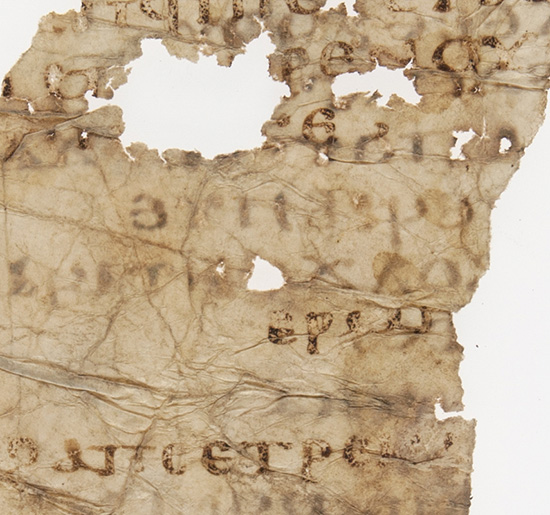
Yesterday I provided background for my post of today by talking about the five hermeneia manuscripts of the Gospel of John that were discussed by Bruce Metzger in a publication in 1988. The reason that is now timely is that a new manuscript has just recently been identified with the same phenomenon. This time it is a Coptic manuscript that survives only in a fragment, of John chapter 3. The person who has identified it is Brice Jones, a PhD candidate in New Testament at Concordia University in Montreal. Brice is developing an expertise in textual criticism and the study of manuscripts, and this is a terrific discovery. Below is the notice that he sent around a few weeks ago reporting his find (in his own words, of course). FOR THE REST OF THIS POST, log in as a Member. Click here for membership options. If you don’t belong yet, JOIN NOW!!!
Tags: Brice Jones, hermeneia manuscripts
November 6, 2013
Carrier, Bayes Theorem, and Jesus’ Existence
As most of you know, I’m pretty much staying out of the mythicist debates. That is for several reasons. One is that the mythicist position is not seen as intellectually credible in my field (I’m using euphemisms here; you should see what most of my friends *actually* say about it….) – no one that I know personally (I know a *lot* of scholars of New Testament, early Christianity, and so on) takes it at *all* seriously as a viable historical perspective (this includes not just Christians but also Jews, agnostics, atheists – you name it), and my colleagues sometimes tell me that I’m simply providing the mythicists with precisely the credibility they’re looking for even by engaging them. It’s a good point, and I take it seriously. In that connection I should say that I can understand how someone who hasn’t spent years being trained in the history of early Christianity might have difficulty distinguishing between serious scholarship that is accepted by experts as being plausible (even when judged wrong) and the writings of others […]
Tags: Bayes Theorem, mythicism, Mythicists, Richard Carrier
November 7, 2013
Video: Ehrman & Evans 2012 Debate – Part 2
A couple of weeks ago I posted a debate that I had with Craig Evans, an evangelical Christian New Testament scholar. That debate was held at Saint Mary’s University in Nova Scotia. The next night we had a second debate — on the same topic (!) but in a different location, at Acadia University, where Craig currently teaches in the Acadia Divinity College. The topic, again, was “Does the New Testament Present a Historically Reliable Portrait of Jesus.” I was hesitant to post this debate on the blog, since it’s on the same topic as the other one. But I watched it and saw that I actually make my case differently this time, as does he. So, what the heck — you can start watching it and if it sounds like old hat, you can stop! But in a way it’s interesting how we changed our presentations, in no small measure because we had heard the night before what they other guy was going to argue…. Please adjust gear icon for 720p High-Definition: See first video […]
Tags: Craig Evans, debate, historical jesus
December 5, 2013