
Search
Advanced search
My Life! An Interview with Frank Statio on “The State of Things”
On March 5 I had a radio interview at the local NPR station with Frank Stasio, host of “The State of Things.” Most of the interview had to do with my religious journey from Christian fundamentalist to atheist; by the end we got to the ostensible reason for my being there, my then new book “The Triumph of Christianity: How A Forbidden Religion Swept the World.” Frank is one of the very best interviewers anywhere, extremely good, as you’ll hear. He really knows how to get to the heart of an issue and to keep it interesting. Enjoy! Please adjust gear icon for 720p High-Definition:
May 13, 2018
Why Would It Matter If There Were a First-Century Copy of Mark?
After making my post yesterday about the bogus apologetic claims being made about the existence of a copy of Mark from the first century, I remembered I had posted on the matter some years ago on the blog. I looked it up, and found a set of reflections on a closely related topic: what difference *would* a first century copy of Mark make, if it doesn’t make the difference these breathless apologists are making? Here is what I said at the time, at the beginning of 2015 (I’ve edited the post slightly here for its new context). ******************************************************************************************* I personally think that there are no shenanigans going on when Dan Wallace and Craig Evans tell us that a fragment of the Gospel of Mark has been found and that it can, with reasonable certainty, be dated to the late first century. I’m not saying that I know they are right. Far from it. In fact, one of the most disconcerting things about this claim is that they are not making the papyrus available so real […]
May 9, 2018
A Different First-Century Mark? An Interesting Piece of Sleuth Work
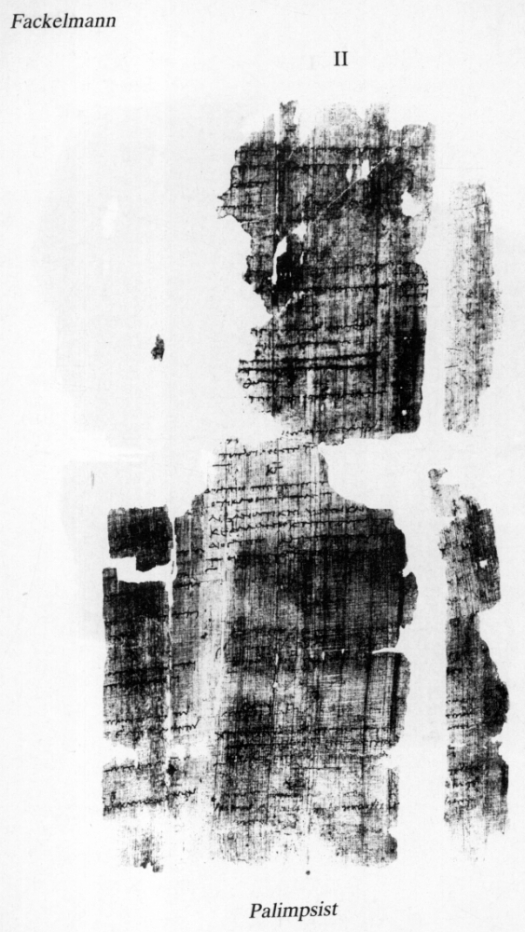
One of the many pleasures of doing this blog is that there are some highly trained scholars who are members who interact with the posts on occasion. One of them is Brent Nongbri, whom I first knew when he was a graduate student at Yale (PhD 2008) and who for several years was an Honorary Research Fellow at Macquarie University in Sydney, Australia. One of his fields of expertise is papyrology, the study of ancient papyrus manuscripts. He’s also the author of Before Religion: A History of a Modern Concept and God’s Library: The Archaeology of the Earliest Christian Manuscripts, among others. Brent was interested in my posts on the alleged first-century copy of the Gospel of Mark, and contacted me to let me know about an article he wrote on a related matter — yet *another* manuscript fragment allegedly connected with Mark and also allegedly from the first century, one that almost none of the rest of us scholars have heard about. He had himself posted about it, and he has given me permission […]
May 10, 2018
Does Paul Condemn Slavery? The Case of Philemon and Onesimus.
I received an interesting question this week about Paul’s letter to Philemon. And hey, how often do you get a question about Philemon?!? This is the shortest of Paul’s letter (it’s a one-pager) where he is writing to his convert Philemon, a rich slave owner, asking him to receive back into his good graces his run-away slave Onesimus. So what was *that* all about? Here is the question and my response. QUESTION: A question on an atheist discussion group, “Why did Paul send Onesimus back?” got me thinking. From your writing about Greco Roman notions of dominance as status, it seems that the simple manumission of a slave was not a de facto improvement in status, because a man with no wealth, power, or influence was about as low on the ladder as one can be, save for a similarly situated woman. A trusted slave of a wealthy, powerful individual would have more status than a “free” Onesimus. Would it be unreasonable to suggest that Paul was hoping for an improved station in life […]
May 11, 2018
Technology Challenge at the Beach
Dear Blog Members, Many apologies for taking a few days off from posting on the blog. It’s not been intentional! I’ve been at the beach for a few days (poor soul….) and the Internet is down. I can get email, but no access to the web. So even though I’ve been writing posts, I can’t get them up to the blog. I hope to have the problem resolved soon — hopefully today! – Bart
Tags: Beach Vacation
May 15, 2018
How I Write a Trade Book for a General Audience
I am at a good place in my progress toward writing my book on the afterlife, and thought I could devote a few posts to explaining the whole process. This is in response to questions I sometimes get from blog members who would like to know what steps I actually take in going from the idea of a book to the final product. First off: how do I decide what books to write? Different scholars have different ways of making this kind of (very big) decision. In my case it is a little complicated by the fact that I write three kinds of books. I write scholarly books for academic colleagues in my fields of research; I write textbooks for college students; and I write trade books for general audiences. The process is slightly different for each one, so for my purposes here I’ll stick to how I go about writing trade books. Depending on how you count, this will be my fifteenth trade book. My first was Jesus: Apocalyptic Prophet of the New Millennium, […]
May 16, 2018
Back in Business!
Many apologies to all for the hiatus on the blog. I wish I had a sob-story to tell to justify it (well, not really), but as I indicated yesterday, it was rather a bit of good fortune with a downside. Every year for nineteen years now my wife Sarah and I have come to the beach with our friend Dale Martin, the New Testament scholar who introduced us just six years before that (he taught at the time at Duke; he moved on to Yale; he just retired this past year). We are very boring at the beach. We rent the same house (right on the beach; we often see dolphins from the deck). We all bring our books and work all day (I get up at 6:30 and have at it!), then take a five mile walk on the beach; come home to do drinks and dinner; go to bed, and repeat every day for two weeks. For us it’s fantastic. We all get tons done. No distractions. No departmental or student obligations or […]
How a Book Gets Written
Once I decide what I want to write the next book on, the fun begins. Or rather, the work begins. I’m not sure I’d classify any part of the whole process as “fun.” There are certainly enjoyable elements, but I think what drives me is wanting to have the very best end product possible. Having *done* a book is fun; doing the book is less fun. If I had to label it as anything I guess I’d say it’s intense. The work goes through a number of distinct stages, each of them challenging in different ways and requiring different skills. I think that’s why it’s so hard to write a good book and why so few authors are able to pull it off. There are various skill-sets required, not one. And if you’re deficient in any of them, the book simply isn’t going to be very good. Even before you start you have to decide what is the heart and soul of what you want to accomplish in your book. That involves knowing what your […]
May 17, 2018
The Tricks of Writing for a General Audience
Yesterday I mentioned how hard it is for academics to learn how to write for a general audience. In graduate school we are trained to write for fellow scholars – learning the jargon and mastering the background knowledge that everyone in the field shares. That’s because scholarly writing is a kind of short hand for insiders. If you had to explain every term, every concept, every assumption then what you could say in an article for insiders would literally require a book. And so you learn which assumptions, perspectives, ideas, terms, and knowledge are widely shared by those for whom you are writing. Some of us are fortunate enough to teach in PhD programs, and we can see how a student starts to acquire this kind of information and insight into what can and needs to be assumed by their scholarly audience, and what cannot. It is very, very easy to read a piece by someone and know whether they are an “insider” or not. In fact, it is very easy to read an article […]
May 18, 2018
Do We Know Why Jesus Went to Jerusalem?
Browsing through my blog posts I came across this one from exactly six years ago today. Amazingly, I still agree with it! It deals with an unusually important question, one that, in a sense, involves a decision that changed the entire history of our world. QUESTION Just what did the historical Jesus think he was doing that last week in Jerusalem? It looks to me like he was working as hard as he could to get himself killed. If that’s what he was doing, then why was he doing it? RESPONSE Interesting question! There have been scholars, of course, who have argued that this is precisely what Jesus was doing, that he went to Jerusalem in order to be crucified. It is interesting that those who take that view cover as wide a range of ideology and theology as you could possibly imagine. Conservative Christian thinkers (from protestant fundamentalists to Roman Catholic theologians to … well, take your pick) have long thought that the point of the Jerusalem trip was in fact the […]
May 19, 2018
Why Are The Gospels Called Matthew, Mark, Luke, and John?
Matthew.Mark. Luke.John. I recently received an important and puzzling question about the names attached to our four Gospels. All four books were written and circulated anonymously, and only later did Christian leaders maintain that they were Matthew, Mark, Luke, and John. Why these names? Here’s the question: QUESTION: I understand why the names John and Matthew ended up being part of the tradition concerning authorship for gospels, but why a tradition for Mark and Luke? Today, they seem like unlikely characters for a tradition since they were not eyewitnesses. In the 2nd century did John, Mark (companion of Peter), and Luke (companion of Paul) hold more significance to the early church? RESPONSE: Even though the question is only about Mark and Luke, I think I should provide some context by discussing Matthew and John as well. I devoted some thought to the question for my book Jesus Before the Gospels. Here’s what I say about it all there. Why Were the Names Matthew, Mark, Luke and John Chosen? They are the names of two of […]
April 29, 2022
Why Would an Ancient Author Write a Book Anonymously?
In response to yesterday’s post, I received a seemingly simple question that is both intriguing and complex. I will devote two posts to giving an answer QUESTION: Why were the gospels written anonymously? Was this the usual practice with this type of account in those times? RESPONSE: It’s a bit surprising that more attention hasn’t been paid to this question by scholars, who, as a rule, are *far* more interested in proving that Matthew, Mark, Luke, and John were written by the people named in their (current) titles than in exploring the issue of why the authors never named themselves. In this post I’ll deal with the phenomenon of anonymous writings *generally* in the ancient world; in the following post I’ll elaborate a suggestion I make here, but do not develop at any length, about the Gospels in particular. The following has been drawn from my discussion in my scholarly book Forgery and Counterforgery. But apart ********************************************************************************************** There are far fewer anonymous writings from antiquity – and from Christian antiquity – than of […]
May 22, 2018
Why Didn’t the Gospel Writers Tell Us Who They Were?
Yesterday I dealt with the issue of anonymous writings in antiquity, what we know about them in general. Today I deal directly with the question about why the Gospels of the New Testament were all written anonymously, with the authors giving us no indication of who they were. I have a theory about that, a theory that I’ve never heard or seen before. Here is how I lay it out in my trade book Forged. ***************************************************************** It is always interesting to ask why an author chose to remain anonymous, never more so than with the Gospels of the New Testament. In some instances an ancient author did not need to name himself because his readers knew perfectly well who he was and did not need to be told. That is almost certainly the case with the letters of 1, 2, and 3 John. These are private letters sent from someone who calls himself “the elder” to a church in another location. It is safe to assume that the recipients of the letters knew who he […]
May 23, 2018
We Do *NOT* Have a First-Century Copy of the Gospel of Mark
As most of us have suspected for years now, there is in fact no first-century copy of the Gospel of Mark. If fortune smiles upon us, maybe one will eventually be discovered. But it hasn’t been yet. Dan Wallace, our lone public source for the existence of such a thing (announced with some flair at a public debate I had with him in 2012) has finally provided the necessary information: his claim that such a copy existed was based on bad information. He lays it all out here. https://danielbwallace.com/2018/05/23/first-century-mark-fragment-update/ . I’ve copied the post here, below. He is gracious to apologize to me, and I understand about non-disclosure agreements. But at the same time, I have lots of questions about the entire affair. You may have some too. If so, let me know. I’ll answer the ones I can and ask the ones I can’t. Daniel Wallace’s most popular books are Revisiting the Corruption of the New Testament and Reinventing Jesus. Here is Dan’s Post: ************************************************************************************************** First-Century Mark Fragment Update ON 23 MAY 2018 BY DANIEL B. WALLACEIN CONTEMPORARY […]
May 24, 2018
Doing Research for a Trade Book
Before getting side-tracked on other things, I had started to say that I was at a good place on my book on The Invention of the Afterlife and to lay out how I actually write a book like this. I explained how I choose what book to write next, and I talked about how writing a trade book is very different from writing an academic one. I’d like to pick up there since I am at the end of a major phase in my preparation for the book, and would like to explain how I typically proceed. Once you know what book you want to write next, what do you do next? How do you proceed? Of course any trade book that I decide to write is on a topic that I’ve thought about for many years – almost always for thirty or forty years, on and off. Most of the time my trade books are on topics that I’ve taught about in undergraduate and graduate courses since the 1980s. So I already have done […]
May 25, 2018
Did Jesus Do “Signs” To Prove Who He Was? A Blast from the Past
Rummaging through old blog posts, I came across this one from a few years ago. It is on a topic that I continue to be fascinated by, the significant differences between the Gospel of John and the “Synoptic” Gospels of Matthew, Mark, and Luke. These three have numerous differences among themselves, of course. But the differences of the three over against John are really quite striking. Here is one key instance of that, on a major issue connected with the life of Jesus. Did he try to prove that he was the messiah, or not? ********************************************************************************* For many decades now there have been scholars who have been convinced that the Gospel of John is based, in large part, on written, but no-longer surviving, sources. It is much debated whether John relied on the Synoptic Gospels for any of its stories, or whether in fact its author had ever read (or even heard of) Matthew, Mark, and Luke. There are very few verbatim overlaps between John and the others, and outside of the Passion narrative there […]
May 27, 2018
What the New Fragment of Mark’s Gospel Looks like (the so-called First-Century Mark)
Like many of you I have many questions about the bizarre way the discussion of the so-called “First-Century Gospel of Mark” unfolded. I was intimately connected with the first announcement of the discovery, which was made precisely in order to trump me in a public debate. As it turns out the announcement was based on false information acquired through hearsay. But that’s the past, and Dan Wallace has apologized, so that is that. There are still questions about how the affair unfolded, but I’m not going to go into that here. What there is now no longer any doubt about is the manuscript fragment that is involved. It is not from the first century but from the late second or early third. That’s not nearly as impressive but it is still mighty impressive. Until now we had only one manuscript of Mark that dated that early. Now we have two. The other one is P45 (P means “Papyrus” manuscript and 45 means it is the 45th papyrus ms. discovered and published) which is highly fragmentary, […]
May 28, 2018
Non-Disclosure Agreements
Several people have made comments or raised questions about Non-disclosure Agreements with respect to Dan Wallace and the so-called (but no longer) First Century Mark. For many years Dan refused to explain what he was talking about when he mentioned in the public debate with me in February 2012 a new discovery of a Gospel of Mark that dated to the first century. In a later post I may say something about why I was immediately skeptical about it (he apparently is going on record now for saying that my reaction of disbelief was inappropriate; I don’t think he liked my humor at the time. But, well, I was incredulous). But here let me say something about NDA’s. I myself signed a NDA once connected with the discovery of an ancient Christian manuscript, so I have some limited experience with the matter – although my direct knowledge comes from just this one instance. Otherwise what I know has been picked up just by paying attention. My case involved the newly discovered Gospel of Judas. I […]
May 30, 2018
Did the Gospels Originally Have Titles?
I have received a number of questions from readers about my blog post that tried to explain why the Gospel writers wrote their books anonymously; some of the questions have concerned the titles of the Gospels: if they books were not *written* by named authors (Matthew, Mark, Luke, and John) why do the titles *indicate* they were, and could the titles be original to the books? My view is that the books did not originally have titles, but – for reasons I explained in a different post (https://ehrmanblog.org/why-are-the-gospels-called-matthew-mark-luke-and-john/) – were given titles naming their authors years after they had been circulating anonymously. I explain why I think that the Gospels were originally without titles in a couple of my books; here are a couple of extracts (slightly edited) taken from Jesus Interrupted and Forged that marshal some of the arguments that are often adduced. There is some overlap between the two sets of comments, but together they pretty much make the point. ************************************************************* In our surviving manuscripts of the Gospels they are always […]
May 31, 2018
Past and Present: One of My Debates with Dinesh D’Souza
As you all know, Dinesh D’Souza is in the national news again; he’s one controversial fellow! As you may not know/remember, I had three public debates with Dinesh some years ago, not on campaign finance laws but on the problem of suffering, an issue he was long interested in as a committed evangelical Christian who believed he had (has) a reasonable answer or set of answers to the question of why there is so much pain and misery in the world if God is in charge of it. I was digging around and I found the following post from four years ago, giving one of our debates. Here is my intro to it and the debate itself. (WHEN I talk about him “being in the news” — this, again, is from four years ago) – Dinesh D’Souza is the author of What’s So Great About Christianity, and What’s So Great About God, among others. ********************************************************************************************* A prominent figure in the news lately has been Dinesh D’Souza. Dinesh is best known as a hyper-conservative […]
June 2, 2018