Sorting by

×

An Even More Unusual Story of What Happens to the Rich…

In my last post I began to discuss Jesus’ parable of the Rich Man and Lazarus from Luke 16) and I mentioned there is a very similar tale in ancient Egyptian lore, about a man named Setne and his adult son Si-Osire. In the story the two of them are looking out the window of their house and see the coffin of a rich man being carried out to the cemetery with great honors.  They then see the corpse of a poor beggar carried out on a mat, with no one attending his funeral.   Setne says to his son: “By Ptah, the great god, how much happier is the rich man who is honored with the sound of wailing than the poor man who is carried to the cemetery.”  Si-Osire surprises his father by telling him that the poor man will be much better off in the afterlife than the rich one.  He surprises him even more by proving it. He takes Setne down to the underworld, where they see how the unrighteous are punished, [...]

2025-09-10T12:58:20-04:00June 7th, 2022|Afterlife, Greco-Roman Religions and Culture|

A Lively Interview on my New Book “Journeys”

I've done a number of interviews over the years for my trade books (for general audiences), but almost NEVER for one of my academic books.  But here is one, on my recent book Journeys to Heaven and Hell: Tours of the Afterlife in the Early Christian Tradition.   The book is geared to academics (as you'd see from the very opening), but some is accessible to general readers (including the bits on wealth I've been summarizing here). This interview is *completely* accessible, and it's done by a very good interviewer, Mitch Jeserich for the podcast Letters and Politics.  He knows a lot about the history of early Christianity and the broader ancient world, and he asks well-targeted questions.  Some interviews are a bit of a pain; this one was all pleasure.  See what you think.  

2025-09-10T12:58:07-04:00May 29th, 2022|Afterlife, Book Discussions|

Did Early Christians Believe in Reincarnation?

In my previous post I talked about how Origen's view that souls existed before being born as humans related to his view that in the end, all things -- including the most wicked beings in the universe -- will convert and return to God: salvation for all!   Also connected to this idea was Origen's notion that after death people would be reborn to, in a sense, "give it another go."  Origen is our most famous Christian proponent of the idea of reincarnation. Reincarnations - Before Origen The idea of reincarnation had been floated for centuries before Origen.   In ancient Greece, the great philosopher Pythagoras was widely believed to have been the first to perpetrate, or at least popularize the idea.  Later it was allegedly held by such figures as Parmenides and Empedocles, the latter of whom had allegedly said “Before now I was a boy, and a maid, a bush and a bird, and a dumb fish leaping out of the sea.” So too we find it in the Roman tradition, as when Virgil’s Aeneas [...]

2025-09-10T12:43:27-04:00April 8th, 2022|Afterlife|

Heaven and Hell at the Popular Level

I often get asked about the difference between my trade books for general audiences and my academic monographs for scholars.  Three times in my career I have written on the same topic for a popular and a scholarly audience.   The first was one on the manuscripts of the NT.  The popular book was Misquoting Jesus:  The Story behind Who Changed the Bible and Why; the academic one was The Orthodox Corruption of Scripture: The Effect of Early Christological Controversies on the Text of the New Testament.    Just from the title it should not be too hard to tell which one is trying to cater to a wider audience and which one is directed to fellow academic nerds. So too with the next set, dealing with the issue of pseudonymity in the New Testament and other early Christian Writings.  The popular account:  Forged: Writing in the Name of God -- Why the Bible's Authors are Not Who We Think They Are; the academic one:  Forgery and Counter-forgery: The Use of Literary Deceit in the Early Christian [...]

2025-09-10T12:57:06-04:00February 20th, 2022|Afterlife, Book Discussions|

Why Cynics Thought Being Poor Was Ironically Better

Isn’t it better to have no possessions at all than to have millions of them and then lose them?  According to ancient Cynic philosophy: Absolutely Yes! I’ve been discussing how this view comes to be embodied in Lucian’ of Samosata’s humorous dialogue Downward Journey, about a rich tyrant who abused his power and wealth and then ended up completely miserable in the afterlife.  I begin here with the paragraph that ended the last post, to provide a bit of context for the humorous passage that follows.  (All this is taken from my book Journeys to Heaven and Hell, with Yale University Press, due out in April) ****************************** The dialogue shifts then to another of the deceased, an impoverished cobbler, Micyllus.  He too is upset, but not for being removed from the world of the living but for being delayed from crossing the Styx.  He cannot get to the underworld fast enough, and is perturbed that Charon’s boat has filled up without him and he has to wait on shore.  Clotho is surprised that Micyllus does [...]

A Humorous Take on Wealth From a Great Satire of Antiquity

In my previous post I discussed the radical views of Cynic philosophy – to be happy you must give up everything that can be lost, including all your possessions and your attachments to them.  That was a set-up for what I really wanted to discuss, a “Journey to the Afterlife” (technical term: Katabasis) found in the writings of Lucian of Samosata, one of the great writers of Satire in the Roman world, writing in the second century CE. Here I introduce Lucian and begin to talk about his very funny dialogue, The Downward Journey.  (Again, this is taken from a draft of my book Journeys to Heaven and Hell, to come out from Yale University Press in April) ****************************** Born in Samosata on the Euphrates, outside the centers of intellectual power and not known for its cultural icons, Lucian originally would have spoken Aramaic but he came to be trained in Greek rhetoric.  He eventually abandoned law for a literary career. Some eighty of his prose pieces survive, many of them attacks on charlatans and [...]

Should You Give Up All Your Possessions to Be Happy? The Ancient Cynic View

In my forthcoming book Journeys to Heaven and Hell (Yale University Press; due out in April) I will be devoting a chapter to discussing how tours of the afterlife functioned sometimes in order to promote certain ethical views.  If you know what life after death is really like, it can be incentive for how you live now. One of the sections of this chapter deals with ancient “Cynic” philosophy – a radical stand on the importance of giving up everything, all one’s possessions, in order to attain to true happiness.  That is not easy to do, as Jesus’ followers discovered later, even though they stood in an entirely different ideological tradition (apocalyptic Judaism). The Cynic view is embodied in a very humorous fictional “Journey” to Hades by one of my favorite writers from antiquity, Lucian of Samosata.  Here is how I will be describing Cynicism in my book – to be followed in the next two posts with a discussion of Lucian’s account. ****************************** It is not a simple task to summarize ancient Cynicism: the [...]

God’s Mercy and Justice: The Opening of a Chapter in Journeys to Heaven and Hell

Do the early Christians think God is more just and determined to punish or more merciful and determined to forgive? I deal with the matter in one of the chapters in my next scholarly book,  Journeys to Heaven and Hell: Tours of the Afterlife in the Early Christian Tradition, coming out in April with Yale University Press.  The book has been done for months now, and I am right now reading through the final page proofs sent to me by the press – making final corrections of typos before it heads into production.  (It’s a very long process: usually a book doesn’t get published for about a year after the author has finished writing it and sent it to the publisher.  This always reminds me of the famous poem of John Donne, “Hymn to God the Father,” with its celebrated refrain (about God forgiving sin):  “When thou has done, thou hast not done, for I have more.”). The book is written for scholars, but with a few helps non-scholars will be able to get the [...]

2025-09-10T12:55:53-04:00November 10th, 2021|Afterlife, Book Discussions, Christian Apocrypha|

What Do YOU Think? The Experience of Death.

A month ago I decided to add a new feature to the blog, a periodic post that asks you to share your personal view about something, your honest opinion based on serious expertise or complete non-expertise. These posts are (and will be) called “What Do You Think?”  I will NOT be responding to your replies/comments.  I’ll simply be posting them so you can express yourself and have others can see your views.  (As always, I will not be allowing comments that are rude to others or irrelevant to the question – for example, castigations of particular politicians that many but not all of us may despise, on one side of the political chasm facing us or the other. Or that try to proselytize others to your religious beliefs). Others of course can comment on your comment as they choose — and I hope they do.  I’ll be listening in, for my own fun, education, and edification! The topics are meant to involve the BIG QUESTIONS.  This one is related to the previous one but is [...]

2025-09-10T12:55:23-04:00October 5th, 2021|Afterlife, Public Forum|

Jesus and the Coming Destruction: Who, Why, and How?

In my book on Revelation, one of my goals (once I start to write it) will be to contrast its view of judgment with that of Jesus himself.  I think the differences are stark and telling.  BUT, that is not because I think Jesus imagined that God was simply a God of love who would forgive everyone in the end.  I wish he did think that, but alas.  He was a Jewish apocalypticist who firmly believed the judgment of God was coming on the earth.  So did the prophet John, seventy years later, writing the Apocalypse. But for me the important issue is the object and reason for destruction.  Here they differ significantly, in ways that make me think John the prophet is not preaching the gospel of Jesus. Nowhere, in my view, can Jesus' understanding of the coming judgment be seen more clearly than in the Parable of the Sheep and the Goats (Matthew 25:31-46).  I have talked about this passage several times on the blog before.  In order to explain the contrast with [...]

2025-09-10T12:55:08-04:00September 14th, 2021|Afterlife, Historical Jesus|

On the Flipside: The Glorious Salvation of Saints in the Teachings of Jesus

In my previous two posts I’ve talked about Jesus’ view of the coming destruction of sinners.  My goal is to compare and contrast his views with those of the book of Revelation.  For both Jesus and the prophet John (author of Revelation) the future will not only bring very nasty destruction for some people on earth, but also an amazing salvation for others. Here is how I talk about the future rewards of the righteous in my book Heaven and Hell (Simon & Schuster, 2020).   ****************************** It is easier to document Jesus’ words about the dreaded fate of sinners in Gehenna than about the blessings of the saved in the Kingdom of God.   Even so, we have seen one teaching that is repeated in the Gospels:  the coming Kingdom will entail a fantastic banquet where the redeemed eat and drink at leisure with the greats of Jewish past, the Patriarchs.  This is a paradisal image of great joy. Another key passage involves Jesus’ discussion of what life will be like once the resurrection has [...]

2025-09-10T12:55:08-04:00September 12th, 2021|Afterlife, Historical Jesus|

The Horrible Fate of Sinners: Jesus’ Teaching on Gehenna

I continue now with my reflections on Jesus’ view of the coming destruction and the very bad fate coming to those who are not rightly aligned from God.  In this post I deal specifically with his teaching on Gehenna, and the devastation that will happen there.  Spoiler alert: it is not the place you want to go, but Jesus is not talking about “hell.” If you want to read more about this, join the blog!  You will get access to five posts a week dealing with just about everything connected to New Testament and Early Christianity.  There are various tiers of membership, and whatever you pay goes straight to charities helping those in need.      Click here for membership options   I have taken this discussion from my book “Heaven and Hell” ****************************** It is highly unfortunate that sometimes English translations of the New Testament render the Greek word “Gehenna” as “hell.”  That conjures up precisely the wrong image for Bible readers today, making them think Jesus is referring to the underworld of [...]

2025-09-10T12:55:08-04:00September 11th, 2021|Afterlife, Historical Jesus|

What We Know Today About Religions and the Afterlife (in the US): Platinum Guest Post by Sharon Friedman

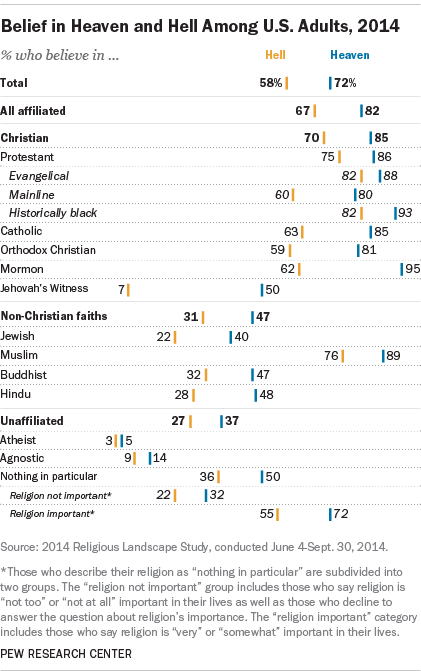
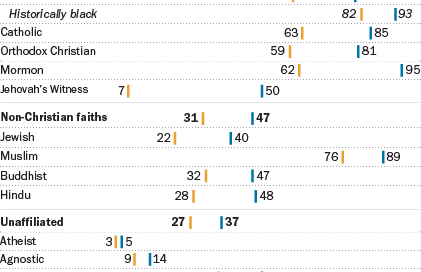
I am pleased to be able to publish this Guest Post by one of our Platinum members Sharon Friedman.  Sharon has been a blog member for some five years.   Here is an intriguing post with some statistics to make you ponder and reflect on a topic near and dear to many of us. If you have questions comments, go ahead and make them!  Many thanks Sharon. ***************************** Often on the blog, people ask Bart “what did Christians or Jews think about some topic?” It’s definitely difficult or impossible to know that about the past.  We do know something about what they currently think.  Fortunately, groups like the Pew Research Center and NORC at the University of Chicago ask people religious questions.  Let’s look at that source of information for insights into our discussion of the afterlife, specifically what do Christians, Jews and Muslims currently think about heaven and hell? Pew does a Religious Landscape Survey about once every 10 years or so. It’s chock full of information.  There is a crosswalk between belief in heaven [...]

2025-09-10T12:54:04-04:00May 27th, 2021|Afterlife, Public Forum|

All Day Seminar (Online) for the Smithsonian: This Saturday!

Looking for some fun, excitement, and a change of pace this weekend?  On Saturday I will be doing an all-day seminar for the Smithsonian Associates, four lectures (two in the morning, two in the afternoon), each with Q&A to follow, on Heaven and Hell, based, of course, on the book.  Interested in joining in?  Ticket information, and so on, can be found here: https://smithsonianassociates.org/ticketing/tickets/heaven-and-hell-perspectives-on-afterlife The structure of the lectures will be different from the book.  Here is the line-up of the lectures. 9:30­–10:45 a.m.  Death After Death The earliest records of the afterlife in ancient Near Eastern, Israelite, and Greek cultures portrayed it as no life at all: death leads to only a dreary, uninteresting, eternally empty existence in which there is no joy, no pleasure, and no hope, as portrayed in the Epic of Gilgamesh, the Hebrew Bible, and writings of Homer. 11 a.m.–12:15 p.m.  Justice in the World Beyond Both Greek and Israelite cultures eventually developed the concept that this life cannot really be the end of the story and that the misery [...]

2025-09-10T12:50:45-04:00September 9th, 2020|Afterlife, Public Forum|

What Is the Unforgivable Sin? Readers’ Mailbag.

Important question this week! QUESTION: I wondered if you have written a blog which talks specifically about the 'unpardonable sin'. RESPONSE: Well, it’s been a while.  But I get asked this question a good bit, and almost always it is a fearful request – by someone who is afraid they’ve committed it.  So it’s worth addressing the issue again.   I think the NT is pretty clear on the matter, even though few people actually look carefully at what it says about it. In a famous passage in Matthew, Jesus talks about the “unforgiveable sin”:  “Therefore I tell you every sin and blasphemy will be forgiven people, but the blasphemy of the Holy Spirit will not be forgiven; and whoever speaks a word against the Son of man, it will be forgiven; but whoever speaks against the Holy Spirit it will not be forgiven, either in this age or the ages to come.” (Matthew 12: 31-32). As you might imagine, over the Christian centuries there have been numerous interpretations of what that *one* sin was, especially [...]

2025-09-10T12:50:26-04:00August 27th, 2020|Afterlife, Canonical Gospels, Historical Jesus|

Smith-Pettit Lecture – The History of Heaven and Hell

Here is a webinar that I did on July 29th, 2020, as the Smith-Pettit lecture for the Sunstone Digital Symposium sponsored by Sunstone Education Foundation.  It was on the "History of Heaven and Hell."  It was an unusual event for me: Sunstone is an independent organization located in Salt Lake City, Utah.  Sunstone does not have any official ties to The Church of Jesus Christ of Latter-day Saints but it does serve mainly them, bringing together traditional and non-traditional Latter-day Saints, promoting an atmosphere that seeks to value faith, intellectual, and experiential integrity. Moderating the event was Karin Franklin Peter, president of the Fifth Quorum of Seventy, who serves on the Council of Presidents of Seventy with the Community of Christ.  This is a branch of "Mormons" that split from the LDS over polygamy in the 19th century.  She received a bachelor of science in psychology and a master of arts in Christian ministry from Community of Christ Seminary at Graceland University, Independence, Missouri. I was introduced by Lindsay Hansen Park, an American Mormon feminist [...]

2025-09-10T12:50:24-04:00August 21st, 2020|Afterlife, Book Discussions, Public Forum, Video Media|

Bart’s Latest Attack on Christianity by Randy Alcorn

As you know, books on controversial topics get reviewed by all sorts of readers; some reviews are glowing and others are, well, nasty.  About a month or so ago several reader sent me an online review of my book Heaven and Hell on patheos.com (check it out: it's a website dealing with issues connected with religious faith) by Randy Alcorn, a prominent evangelical author with a high public profile, who has written a number of books about Heaven from his faith perspective. You can check him out online: Randy Alcorn is the founder and director of Eternal Perspective Ministries (EPM) and the author of more than 55 books, including Heaven and If God Is Good: Faith in the Midst of Suffering and Evil. More than 11 million copies of his books have been sold. They’ve also been translated into 70 languages. Randy's review was, shall we say, of the harsh variety.  But now that I'm getting older and the body-joints aren't working as well as in the days of my youth, my knee doesn't seem [...]

2025-09-10T12:49:27-04:00June 21st, 2020|Afterlife, Bart's Critics, Book Discussions|

Live Event on Wednesday Evening, May 6!

Join us for the third in a fascinating six-week series of virtual "book club" discussions! This week join NHC president Robert Newman and scholar Bart D. Ehrman to discuss Ehrman's book, Heaven and Hell: A History of the Afterlife Wednesday, May 6, 2020 at 7:00 pm ET Facebook Live _________________________________________________________________ Where do our ideas about heaven and hell come from, and why do they endure? _________________________________________________________________ In clear and compelling terms, Bart D. Ehrman recounts the long history of the afterlife, from the Epic of Gilgamesh to the writings of Augustine, focusing especially on the teachings of Jesus and his early followers. He discusses ancient guided tours of heaven and hell, in which a living person observes the sublime blessings of heaven for those who are saved and the horrifying torments of hell for the damned. As a historian, Ehrman obviously cannot provide a definitive answer to the question of what happens after death, but by helping us reflect on where our ideas of the afterlife come from, he assures us that even if there [...]

2025-09-10T12:49:08-04:00May 5th, 2020|Afterlife, Book Discussions, Video Media|

Is There Any Point To Life? More on Ecclesiastes

I have been talking about the distinctive views of the book of Ecclesiastes, one of the real gems of the Hebrew Bible, a book that refuses to accept easy answers or blithe truisms about life, but faces reality head on.   No matter what we do or how we try to explain it away, life is short.  Very very short.  The author of course had no conception of what we know now about time in relation to lifespan.  What would he say if he knew that the world (what we would call the universe -- something about which also he had no knowledge) was not a few thousand years old but 13.8 billion? My guess is that he would say the same thing he already does, but possibly with a few more explanation points.   Given how incredibly brief our life is, even if we live to "old" age -- what's the point of it?  Is there a point?   I think there is.  And I find not just value but also hope in his reflections.   Here is [...]

2025-09-10T12:48:51-04:00April 20th, 2020|Afterlife, Hebrew Bible/Old Testament|

Q&A on Heaven and Hell

The following is a Q&A that I have done with my publisher Simon & Schuster for the History in Five page.  You should check it out.  You will get a free ebook!   Here's the site:  https://www.simonandschuster.com/p/historyinfive    You'll see, its an impressive array of authors with intriguing answers to questions about their books. Here's what mine looks like. Why write about the afterlife? What drew you toward the subject of heaven and hell? I was raised as in a Christian household and the literal realities of heaven and hell were taken very seriously.   My personal views intensified when I had a “born again” experience in high school, and eventually headed off to the fundamentalist Moody Bible Institute, where we were trained to evangelize “the lost” (that is, the vast majority of the human race): there was one way to heaven, and the results would be glorious; every other way led to hell and eternal torment. I no longer hold those views, but I have long been struck that so many other people in our world [...]

2025-09-10T12:48:51-04:00April 14th, 2020|Afterlife, Book Discussions|
Go to Top