
Sorting by

×

What Did Judas Betray, and Why Did He Do It?

In my previous post I indicated that there are several things we can say with relative certainly about the historical Judas Iscariot (and indicated why I think we can be pretty sure about all of them): he really existed, he was one of Jesus' twelve disciples, he was therefore an apocalyptic Jew from Palestine, and he really did hand Jesus over to the authorities to be arrested. But what is it exactly that Judas did that led to Jesus’ arrest, and why did he do it?  Here we move from the grounds of relative historical certainty to issues of probability and speculation.  The question of Judas’s motives for his act has intrigued Christians from the time before our earliest sources and continues to intrigue scholars today.  The reality is that any discussion of motive is almost entirely speculative.  If you can’t accurately describe my motives in writing this particular blog thread the way I have – and I can assure you, you don’t know my motives (and even if I *told* you,  you couldn't be [...]
2025-09-10T13:01:19-04:00February 15th, 2023|Canonical Gospels, Historical Jesus|

Judas Iscariot: What We Can Say With Relative Certainty. (I think…)

What then can we say with relative certainty about Judas called Iscariot?  I think the following five points just about cover it: He did exist. This has been doubted in some circles and by some scholars, of course, especially among those who have wanted to point out the etymological similarity between his name, Judas, and the word Jew, and have argued, on this and related grounds, that Judas was a creation of the early church who wanted to pin the blame of Jesus’ death on the Jewish people.  I think this is an attractive view, and one that I personally would like very much to be true, but I don’t see how it can be.  Judas figures too prominently in too many layers of our traditions to be a later fabrication.  I give all the data in my book on Judas, but here let me just say that there is unique and shared material about Judas in Matthew, Mark, Luke, and John – so that his existence passes the criterion of Multiple Attestation with flying [...]

2025-09-10T13:01:19-04:00February 14th, 2023|Canonical Gospels, Historical Jesus|

Just Follow That Star!

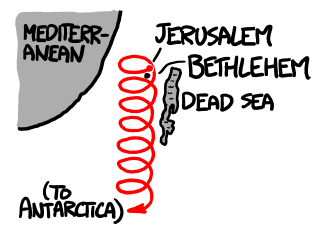
In the previous post I commented that this idea of trying to follow a star to get anywhere (say, Bethlehem) would lead to problems.  Some years ago I had pointed out that trying to do that would send them around in circles:  since the earth is not "fixed" -- it rotates and is in orbit around the sun -- stars are never in the same place in the sky, so "following" one would take you all over the place. After posting on that, I found a hilarious illustration of what would happen if the wisemen followed a celestial body to find Jesus. I have borrowed this (no permission required, only acknowledgment) from here: http://what-if.xkcd.com/25/ Acknowledgement is here: http://xkcd.com/license.html ****************************** Three Wise Men The story of the three wise men got me wondering: What if you did walk towards a star at a fixed speed? What path would you trace on the Earth? Does it converge to a fixed cycle? —N. Murdoch If the wise men leave Jerusalem and walk toward the star Sirius, day and [...]

2025-09-10T13:00:35-04:00December 27th, 2022|Canonical Gospels, Reflections and Ruminations|

O Little Town of Nazareth?

On several occasions on the blog I have discussed the similarities and differences between the accounts of Jesus' birth in Matthew and Luke (Matthew 1-2 and Luke 1-2), most recently, I think, two years ago at this time (check out the archives for December 2020).  I won't go over all that turf again just now, but I do want to hit several of the key points because I think the *discrepancies* between the two accounts that appear irreconcilable tell us something significant about the birth of Jesus.  I think they help show that he was actually born in Nazareth. Both accounts go to great lengths to show how Jesus could be born in *Bethlehem* when everyone in fact knew that he *came* from Nazareth. It is a particular problem for Matthew, because he points out that Jesus fulfilled the prophecy of Micah 5:2 , that a great ruler (the Messiah) would come from Bethlehem (Matthew 5:2).  If you read the account carefully, you'll see that Matthew explains it by indicating that Joseph and Mary were [...]

2025-09-10T13:00:35-04:00December 24th, 2022|Canonical Gospels, Historical Jesus|

Did Jesus Actually Come from Nazareth?

When you ask most anyone where Jesus came from, they will say he was born in Bethlehem.   The reason is not hard to find: the only references to Jesus’ birth in the New Testament squarely place his birth in Bethlehem.  There are, as many of you know, only two passages of the New Testament that narrate the events surrounding Jesus’ birth: Matthew 1-2 and Luke 1-2.  And they both agree in placing it in Bethlehem.  (Neither of the other Gospels says anything about it, nor do any of the other 23 books of the New Testament.) And yet there are compelling reasons for questioning that view, so that a large number of critical scholars – even prominent Roman Catholic scholars – think that it is more likely that Jesus was born in Nazareth.   Let me explain why. The first thing to stress is that  all four Gospels – including Matthew and Luke – agree that Jesus came from Nazareth.  That is to say, Nazareth (not Bethlehem) was his hometown.  In my view, that tradition [...]

2025-09-10T13:00:35-04:00December 21st, 2022|Canonical Gospels, Historical Jesus|

Why Would Scribes Mess with Mark’s Very First Verse?

In yesterday’s post I discussed a textual variant in Mark 1:1 that could be explained either as an accidental slip of the pen or an intentional alteration of the text.   We’re plowing into some heavy waters here, but it involves some intriguing stuff that I can say with assurance you didn't ever learn in Sunday School... Just by way of basic review (basics not involving heavy waters, but that you *also* didn't hear in Sunday School), there are thousands of textual witnesses to the NT (Greek manuscripts, manuscripts of the versions, writings of the church fathers who quote the text); these witnesses attests hundreds of thousands of variants among themselves; the vast majority of those differences are immaterial and insignificant and don’t matter for much of anything; some of them are highly significant indeed.  Most of the changes were made by accident.  Some were consciously made by scribes who wanted to change the text. And in Mark 1:1 we have a variant where it is hard to tell which it is.  At issue are the [...]

2025-09-10T13:00:17-04:00November 19th, 2022|Canonical Gospels, New Testament Manuscripts|

Do We Know How Mark Began His Gospel? Another Scribal Change

I have been talking about different kinds of changes made in our surviving New Testament manuscripts, some of them accidental slips of the pen (that’s probably the vast majority of our textual variants) and others of them intentional alterations.  One of the points that I’ve been trying to stress is that at the end of the day it is, technically speaking, impossible to know what a scribe’s “intentions” were (or if he had any, other than the intention of copying a text).  None of the scribes is around to be interviewed, and so – as with a lot of history – there is a good bit of scholarly guess-work that has to be done. This guess work is not simply shooting in the dark, however.   And it is dead easy for a highly trained expert to tell the difference between informed guesswork and just plain guesswork.   But at the end of the day we are always talking about historical probabilities, not historical certainties, when it comes to figuring out why a scribed decided to change [...]

Did God Mock Jesus on the Cross? A Scribal Change?

I've started to show that scribes sometimes changed the New Testament texts they were copying in ways that certainly seem “intentional” (in addition to making many more simple, accidental, slips of the pen).  I last gave an example from the beginning of Mark's Gospel that appears to be a case where scribes altered a text because it seems to make a mistake. Here I’ll give a second instance, this time from near the ending of Mark, a passage that is exceedingly interesting but for a comletley different reason. One of the most intriguing variations in Mark’s Gospel comes in the Passion narrative, in the final words attributed to Jesus in the Gospel.   Jesus is being crucified, and he says nothing on the cross until he cries out his final words, which Mark records in Aramaic:  “Eloi, Eloi, lema sabachthani?”   Mark then translates the words into Greek:  “My God, my God, why have you forsaken me?”   Jesus then utters a loud cry and dies. What is striking is that in one early Greek manuscript BREAK  (the [...]

2025-09-10T13:00:05-04:00November 16th, 2022|Canonical Gospels, New Testament Manuscripts|

An Error in Mark? Did Scribes Change It?

In a previous post I discussed "accidental" changes of the text by scribes who appear simply to have made a mistake.  There are other changes that almost certainly were not made by a slip of the pen (as when an entire verse is added!) and it seems clear in these instances that scribes changed the text because they chose to do so, for one reason or another.  You can never tell for certain, of course -- the scribes aren't around to interview about the matter; so it's often a judgment call.  And often the judgment is rather difficult to make and involves an interesting issue (or two). I'll be illustrating the issue (how to tell if a change was an accident or made on purpose) by dealing with three of the most interesting textual variants in the Gospel of Mark, one of which is an easy problem to solve, one that is a bit more difficult, and one that has generated a lot of discussion over the years and no firm consensus. The one textual [...]

2025-09-10T13:00:05-04:00November 15th, 2022|Canonical Gospels, New Testament Manuscripts|

Is it Possible Jesus Didn’t Teach the Golden Rule?

Did Jesus actually teach the Golden Rule?  Or was it foisted on his lips after his death by later followers? I have already written a couple of posts on the Golden Rule in the two places it occurs in the New Testament, Matthew 7:12 and Luke 6:31 (see: Little-Known Aspects of The Golden Rule as Found in the Sermon on the Mount and  Did Jesus Give the Sermon on the Mount? ).  Normally the rule is phrased like this:  “Do unto others as you would have them do unto you."  I noted, though, in the Greek clauses are reversed.  A literal translation of Matthew’s version would be “Everything you want other people to do for you, you likewise do for them,” to which Matthew, importantly, adds “for this is the Law and the Prophets” (meaning that if you follow this rule, you will be following the entire will of God as revealed in the Hebrew Scriptures; Matthew 7:12); Luke is quite similar “Just as you wish people to do for you, do likewise for them” (Luke [...]

2025-09-10T13:00:04-04:00October 30th, 2022|Canonical Gospels, Historical Jesus|

Why Do Historians Treat Jesus Differently from Every Other Historical Figure?

I’m starting to think there must be a better way to explain to laypeople – and even to scholars – the best way we can show what the historical Jesus himself said and did.  Since I was a graduate student I have done what every other budding New Testament scholar was doing: name the “criteria” that are used to show which elements of the Gospels are legendary and which are historical, explain their logic, justify them, and then use them.  Now I’m starting to think that just ain’t the way to go. In case you don’t know, scholars use a set of criteria to decide what is authentic to the life of Jesus.  The reason we need to do that is that we don’t have any audio or video recordings of his life, or stenographic accounts of his teachings, or highly reliable, fully documented, authoritative records of his activities.  What we have are accounts written decades later (30-65 years later, at best), by people who did not know him, living in different parts of the [...]

2025-09-10T12:59:48-04:00October 19th, 2022|Canonical Gospels, Historical Jesus|

When Did Jesus Die? Dating Jesus’ Death by the Earthquake

Finally, a scientific dating of Jesus' death.  I was trolling through old posts and came across this one.  Whoa!  Really? ****************************** Geologists claim now that they have established the date of Jesus’ death. It was April 3, 33 CE. Here was the headline: Jesus 'died on Friday, April 3, 33AD', claim researchers, who tie earthquake data with the gospels to find the date http://www.dailymail.co.uk/sciencetech/article-2149750/Jesus-died-Friday-April-3-33AD-claim-researchers-tie-earthquake-data-gospels-date.html For those who don’t know, the date of Jesus’ death has long been in dispute. The reality is, we are not sure when Jesus was executed (i.e., what year). It almost certainly happened during a Passover feast during the reign of Pontius Pilate as the Prefect of Judea. His rule lasted between 26-36 CE. All of our early Gospel accounts agree that the crucifixion happened on a Friday. In Matthew, Mark, and Luke, this Friday was the day after the Passover meal was eaten and so, technically, it was still “Passover Day (see Mark 14:12). According to John the Friday was the day before it was eaten – on the day [...]

2025-09-10T12:59:47-04:00October 9th, 2022|Canonical Gospels, Historical Jesus, Religion in the News|

Understanding the Gospels: Suggested Readings!

I frequently get asked what I would recommend for people to read if they are interested in the study of the New Testament.   In my recent course on the Gospels (www.bartehrman.com/courses) I'm including as part of the supplement to the lectures an annotated list of suggested readings.   The idea is to provide people with some guidance for important books, some to start with and some for more advanced readers.  Here it is, for your perusing enjoyment!   The Unknown Gospels: Matthew, Mark, Luke, and John Annotated Suggestions for Further Reading   Aune, David. The New Testament in Its Literary Environment. Philadelphia: Westminster, 1987. A superb introduction to the genres of the New Testament writings in relation to other literature of the Greco-Roman world. Brown, Raymond. The Birth of the Messiah: A Commentary on the Infancy Narratives in Matthew and Luke. Updated ed. Garden City, NY: Doubleday, 1999. A massive and exhaustive discussion of the birth narratives of Matthew and Luke, suitable for those who want to know simply everything about every detail. Brown, Raymond. The [...]

2025-09-10T12:59:35-04:00September 27th, 2022|Book Discussions, Canonical Gospels|

Big Questions for Studying the New Testament Gospels

In my previous posts I summarized the eight lectures that can be found on my new eight-lecture online course, “The Unknown Gospels: Matthew, Mark, Luke, and John.”  As I’ve indicated before, this course is not connected directly with the blog: it is a separate endeavor run off my personal website for the Bart Ehrman Professional Services.  You can see it here.  https://www.bartehrman.com/courses/. Included in the course packet are questions for reflection, meant to help listeners think through the issues I’ve discussed and reflect on them from their own perspective.  I deal with each of these issues in some depth in the course of the lectures.  If you are interested in these issues, and have trouble answering the questions as fully as you like, or would like additional information about them to go on – take a look at the course and see if it’s your cup of tea!   The Unknown Gospels Questions for Reflection Lecture One To what extent do you think we can understand the Gospels without knowing what scholars say about their [...]

2025-09-10T12:59:35-04:00September 25th, 2022|Canonical Gospels|

Final Lectures in My Course “The Unknown Gospels: Matthew, Mark, Luke, and John”

 This will be my final post providing summaries of my lectures for my new eight-lecture online course, “The Unknown Gospels: Matthew, Mark, Luke, and John.”  As I’ve indicated before, this course is not connected directly with the blog: it is a separate endeavor run off my personal website for the Bart Ehrman Professional Services.  You can see it here.  https://www.bartehrman.com/courses/. I am posting about the lectures simply because I know a number of blog members would be interested.  If you are, check it out.  If you’re not, don’t!   Lecture Six:  Embracing the Differences In this lecture I build on the conclusions I have drawn so far in order to show why recognizing the differences among the Gospels is actually the key to understanding them.  This kind of scholarship that finds alterations and discrepancies is not necessarily negative.  It has extremely important positive effects, allowing the reader to see the point each author is trying to make. I illustrate the point by discussing three kinds of differences.  First, some differences significantly heighten an emphasis [...]

2025-09-10T12:59:35-04:00September 24th, 2022|Canonical Gospels|

More on My New Course: The Unknown Gospels: Matthew, Mark, Luke, and John

I continue here with more summaries of my lectures for my new eight-lecture online course, “The Unknown Gospels: Matthew, Mark, Luke, and John.”  Again, this course is not connected directly with the blog: it is a separate endeavor run off my personal website for the Bart Ehrman Professional Services: you can see it here.  https://www.bartehrman.com/courses/. I am posting about the lectures simply because I know a number of blog members would be interested.  If you are, check it out.  If you’re not, don’t!   Lecture Three: What Are the Gospels? This lecture continues the story by explaining how scholarship developed with the earth-shattering book of David Friedrich Strauss, The Life of Jesus Critically Examined (1834), which claimed that both the traditional Christian supernatural understandings of the Gospels and the Enlightenment opposition to “miracle” (found for example in the work of Paulus) completely misunderstood the Gospels.  Strauss’s controversial claim was that these texts were not meant to present history as it happened but “myths.” When Strauss used that term he did not mean that Jesus “did [...]

2025-09-10T12:59:35-04:00September 22nd, 2022|Canonical Gospels|

My New Course: The Unknown Gospels (Matthew, Mark, Luke, and John)

My new online course focusing on what scholars know about the four Gospels will soon be available on my personal website.  Neither the course nor the website is part of the blog, but I am announcing it here because I know a number of blog members would be interested.  The course is based on a set of remote lectures that some of you attended, and includes additional instructional materials. If you did not come but would like to know more about it, you can check it out here: https://www.bartehrman.com/courses/.  It consists of eight thirty-minute (or so) lectures, with the title:  “The Unknown Gospels: Matthew, Mark, Luke, and John.”  (I call them “unknown” because most people don’t know what scholars say about them.) I’m envisioning the course as part of a long series covering the entire Bible, both Hebrew Bible and New Testament, called “How Scholars Read the Bible.” The series as a whole will be devoted to showing what historical scholars argue, believe, think, and think they know about the Bible, with some attention paid [...]

2025-09-10T12:59:35-04:00September 21st, 2022|Canonical Gospels|

Problems in the Gospels–How do YOU Talk to Believers About Them? What Do You Think?

I recently received this query by a blog member, and it's a question I often get, both on the blog and off.  I'm hoping that maybe you yourself have some wisdom on it.  How do you talk about historical and literary problems (contradictions!) of the Gospels to people who are convinced the Bible has no problems at all? Here the question is articulated very well.  What's your experience and judgment?  Let us know what you think! ****************************** QUESTION from a blog reader: I’m fairly knowledgeable about the historical Jesus. When I find myself discussing the gospels with Christians who are not, I’m always tempted to lead with statements that certain things are not accurate: Matthew, Mark, Luke, and John didn’t actually write the gospels; the four source hypothesis; contradictions in accounts by the gospels; no post-resurrection appearances in the original version of Mark; etc. This seems like a needlessly negative approach to an informal discussion. Christians most often automatically react that I’m asserting some sort of superiority and even dogmatism over them. Do you have [...]

2025-09-10T12:59:08-04:00August 21st, 2022|Canonical Gospels, Reader’s Questions|

Writings of the Apostles in the Canon of the New Testament

How did we get the twenty-seven books of the New Testament?  And why?  I’m in the middle of a thread that is meant to provide a *sketch* of how it happened; I’ll be writing a book on the question, and these are my preliminary thoughts about the topics that I’ll be covering, one at a time. In previous posts I’ve pointed out that the early Christians started out with a canon of Scripture: as Jews they had the Hebrew Bible as an authority for understanding their beliefs, ethics, and religious practices; but as Christianity began to develop its own distinctive views on things, church leaders came to think needed authoritative direction – especially since so many different Christian groups had so many different views on so many issues (not just what to believe but also how to live, how to behave, how to worship together, and so on). What could be decisive authorities? Here’s where I pick up in my thinking:   The Need for Apostolic Authorities It was widely known that Jesus himself had [...]

The Birth of (the Messiah?) John the Baptist? Anniversary Guest Post by James F. McGrath

I continue now with a post that was produced for us by a fellow scholar in celebration of the ten-year anniversary of the blog.  James McGrath has made several intriguing posts for us, and this one is particularly interesting.  Is it possible that stories about Jesus -- especially in the birth narratives were *originally* told about the future messiah, John the Baptist??   That the followers of Jesus took accounts originally told of John and edited them so that they now refer to Jesus?  Very intriguing!  Here's James's post. ******************* The Birth of John the Baptist: Detecting a Source from John’s Followers Behind Three Early Christian Gospels James F. McGrath, Clarence L. Goodwin Chair in New Testament Language and Literature, Butler University, Indianapolis   Anyone who has read my previous guest posts here, or who has read academic publications by Bart and myself, will know we share a great many interests in common: the historical Jesus, the development of Christology, extracanonical texts, and many more. As I have begun to turn my attention to my next major [...]

2025-09-10T12:58:36-04:00August 18th, 2022|Canonical Gospels, Historical Jesus|
Go to Top