Sorting by

×

The Gospel of Jesus’ Wife: Another New Development

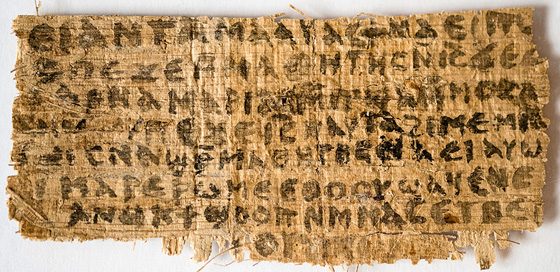
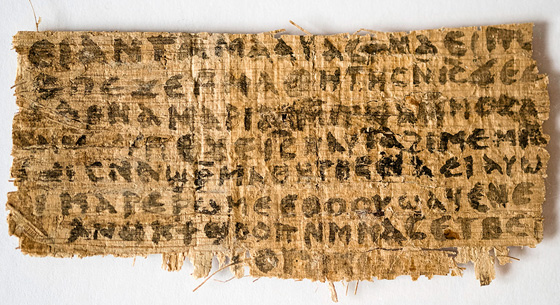
In earlier posts I talked about the “discovery” of the tiny credit-card sized fragment of a Coptic Gospel, with several lines of text on it, in one of which Jesus is recorded as speaking the words “my wife.” The text has been named “The Gospel of Jesus’ Wife.” As I mentioned in a previous blog, there are heated discussions of the fragment’s authenticity, with a large number of experts contending that it is a modern forgery. We will probably not know for certain until the tests on the ink have been conducted and published. But in the meantime there is one interesting development. In my last post on the topic I discussed an article by Francis Watson of the University of Durham, England, and author of Text and Truth, and Gospel Writing, who argues that every word and phrase of this fragment could easily have been lifted from the Coptic Gospel of Thomas – with one exception: the very phrase that everyone is interested in, “My wife.” Watson’s argument is that someone (recently) who is [...]

2025-09-10T12:19:07-04:00October 14th, 2012|Christian Apocrypha, Religion in the News|

Peter, The Smoked Tuna, and the Flying Heretic

IN MY BIBLE INTRODUCTION I INTRODUCE STUDENTS TO NON-CANONICAL LEGENDARY ACCOUNTS ABOUT THE APOSTLES, INCLUDING THIS LITTLE GEM ABOUT PETER. Among the pseudepigrapha connected with the apostle Peter, none is more interesting than the apocryphal Acts of Peter, a document that details Peter’s various confrontations with the heretical magician Simon Magus (cf. Acts 8:14-24). The narrative shows how Peter outperforms the magician by invoking the power of God. Consider the following entertaining account, in which Peter proves the divine authorization of his message by raising a dead tuna fish back to life. FOR THE REST OF THIS POST, log in as a Member. Click here for membership options. If you don't belong yet, JOIN NOW!! But Peter turned round and saw a smoked tunny-fish hanging in a window; and he took it and said to the people, “If you now see this swimming in the water like a fish, will you be able to believe in him whom I preach?”  And they all said with one accord, “Indeed, we will believe you!”  Now there [...]

2025-09-10T12:18:54-04:00September 23rd, 2012|Book Discussions, Christian Apocrypha|

Is the New Gospel Fragment a Modern Forgery?

The so-called “Gospel of Jesus’s Wife” has been publicly available for only three days now, and already New Testament scholars and scholars of Coptic and Gnosticism are hard at work on it. Most of the effort so far has been in deciding whether it is authentic or forged. And it ain’t lookin’ good for those who think it’s authentic! Some have pointed out that the fragment looks too neat around the edges to be believable; others have noted that the writing looks fake; others have argued that there are grammatical problems; and some have thought that it really is just absolutely too good to be true that of eight lines out of an entire Gospel, with only a couple of words surviving per line, two of those surviving words would just happen to involve Jesus saying “My wife”! As this all is unfolding, I am reminded once again that there are some *amazing* scholars out there who can do  brilliant work on very short notice.   The following was sent out by my colleague at Duke [...]

The Gospel of Jesus’s Wife

The new Gospel “discovery,” the fragment of the so-called “Gospel of Jesus’s Wife”: I’m afraid I don’t have anything much to add to the conversations going on among experts and available to you by a simple Internet search. If you’re really interested, read around on the net. But I should say a few things, perhaps, from where I sit. First and most important for this post.  The big initial question is whether or not it is authentic.  I am not a Coptic palaeographer or a papyrologist, and so I cannot render an independent judgment.  A palaeographer is an expert in ancient handwriting, and is the kind of scholar who can look at a manuscript or a fragment of a manuscript (very carefully, magnified, from various angles!) and determine whether it is authentic or forged and if authentic when it probably dates from.   A papyrologist is an expert in ancient papyrus, especially papyrus manuscripts, who also can make judgments – based on the physical specimen rather than on the handwriting – about authenticity.   The initial appraisal [...]

BREAKING NEWS! A Significant New Non-Canonical Gospel Fragment

There is potentially exciting news just out this afternoon. Karen King, scholar of Coptic and Gnosticism at Harvard Divinity School, an expert on the Gnostic Gospels, has just released information about a newly discovered papyrus manuscript – a small fragment the size of a credit card. It is a Gospel fragment of only eight lines. But they are significant lines. On them, Jesus appears to refer … to his wife!! FOR THE REST OF THIS POST, LOG IN AS A MEMBER. IF YOU DON"T BELONG YET -- BETTER JOIN!! Here are the graphics and some links.   This is just breaking news, so I don’t have anything more to say about it. Front of fourth-century papyrus fragment Karen L. King's translation of the 8 lines from the front. Papyrus front text: Karen L. King 2012 Karen L. King's translation of the 6 lines on the back. Fourth-century CE codex in Coptic on reverse side.   Papyrus reverse side text: Karen L. King 2012.   http://www.nytimes.com/2012/09/19/us/historian-says-piece-of-papyrus-refers-to-jesus-wife.html?src=me&ref=general&_r=0 http://religion.blogs.cnn.com/2012/09/18/fragment-suggests-jesus-was-married/ And here’s a draft of [...]

A Christian Forger Caught in the Acts

Next month I will be giving a keynote address at a conference dealing with ancient pseudepigrapha at the University of Laval, in Quebec City.  I have recently been discussing the topic (of ancient authors falsely claiming to be a famous person) on the blog in relation to the letter of James, and as you know, it was the subject of my monography Forgery and Counterforgery ten years ago, and my spin-off popular account Forged.   I haven't worked seriously on the problem since then. But now, because of this upcoming lecture, I'm having to think about it long and hard again, a decade later.  Lots of scholars simply don't (or can't?) believe that ancient people -- especially Christians, but others as well -- would lie about their identities.  It's not that these scholars doubt that there are lots and lots of pseudepigrapha out there, Greek, Roman, Jewish, and Christian.  There are.  But these scholars don't think that the authors were doing anything duplicitous. There are different ways scholars have made this argument, but the basic line [...]

My Apocrypha Seminar at the National Humanities Center: Part 2

In my earlier post I talked about the seminar I am now leading at the National Humanities Center, and mentioned the various primary (i.e., ancient) texts we’re discussing over the course of our three weeks together.  These cover a range of books that did not “make it in” to the New Testament: non-canonical Gospels, Acts, Epistles, and Apocalypses.   Terrific and terrifically interesting books, even if they never did become Scripture in the long run (many of them were in fact considered to be Scripture by one group or another during the early years of the church; that is one of the issues we are discussing in the seminar.) For part of each seminar we are talking about the meaning and interpretation of these texts:  how does one understand the giant Jesus in the Gospel of Peter?  The three – or is it four – Christs in the Coptic Apocalypse of Peter?  The nature of the sayings of Jesus in the Gospel of Thomas (are they best seen as Gnostic?).  The view of Jesus in the [...]

2025-09-10T12:17:37-04:00June 15th, 2012|Christian Apocrypha, Teaching Christianity|

Personal Reflections: My Apocrypha Seminar at the National Humanities Center

If I had a fiver for every time someone who knows I’m a university professor says to me, “So, now you have the summer off!” – I’d buy an apartment on the upper West side. But it’s understandable, I know. The professorial life looks awful darn cushy: teach a couple a classes per semester, for fifteen weeks at a shot, and that’s *it*! 30 weeks of the year on, 22 weeks of the year off. Right? Yeah, well, kinda. To be fair, I should stress that it is indeed an amazing job and an unbelievable privilege to teach at the university level. I have colleagues who take it for granted, but after 27 years at it, I don’t at all. I know very deeply just how lucky I am. But it really is not (at least for anyone I know very well) a year-long boondoggle. Quite the contrary. In one of my “series” of posts I’ve been trying to describe what it is professional scholars do, for those out there who wonder. So far I [...]

2025-09-10T12:17:37-04:00June 13th, 2012|Christian Apocrypha, Teaching Christianity|

Which Bible Translation Do I Prefer?

QUESTION: Dr. Ehrman, most of your readers in the ancient languages that the Bible was written in, therefore must rely on translations. Clearly no one translation is conclusive, but for clarity of reading and reliable research, can you recommend some translations to us? Conversely, do you have any that readers should avoid, because of clear bias or a little too loose?   RESPONSE: When I published Misquoting Jesus, I received a lot of emails from a lot of people asking a lot of questions.  But the one question I got asked more than any other was this one (in various forms):  which translation of the Bible do I recommend?   I should have answered it in the book itself; it would have made my life oh so much easier. There are lots and lots of good translations that are available today.  The first thing to stress about them is that just about every one of them (just about!  I’m sure there are exceptions, although offhand I can’t think of any) has been done by bona [...]

Go to Top