Sorting by

×

The Martyr Perpetua and Her Estranged Family

Yesterday I began to talk about the Martyrdom of Perpetua, one of the most interesting and moving texts to come down to us from early Christianity.   It is an account of a 23-year old Roman matron who is willing to die a gruesome death for her Christian faith.   Among other things, the text shows that her faith is far more important to her than her family.  In particular, she is shown in conflict especially with her father (no husband is mentioned, which has led to considerable speculation: Divorced? Widowed? Unwed mother? Something else?).  And even though it is with regret, she is willing to leave behind her own infant child by being martyred. Family figures prominently in the two excerpts here.  In the first her father begs her to avoid martyrdom, to no avail.  In the second (chs. 7-8) we have an account of her dream and intervention on behalf of her dead brother Dinocrates.  This is the part that I will be most interested in for the next post.  Is it an early adumbration [...]

The Martyrdom of Perpetua

A long time ago now I was pursuing a thread on the development of the Christian views of the afterlife but I got side tracked.  And then I got side tracked from my side track.  And then … well, it’s been a long time.  The thread died.  I need to bring it back to life.  So I’m hoping now to begin on the afterlife of the thread on the afterlife. Over all these months I have continued to read, think, and sketch my thoughts on where the Christian ideas of the afterlife came from – especially the view so common today that when a person dies, their soul goes to heaven for an eternal reward or hell for eternal punishment.  That is not the view of the Old Testament and it is not what the historical Jesus preached.  So where did it come from?  That is the ultimate issue I will be pursuing in my book. But there are other topics of interest as well, such as where did the idea of “purgatory” come from.  [...]

2025-09-10T12:40:36-04:00March 27th, 2018|Afterlife, Early Christian Writings (100-400 CE)|

The Golden Rule

After all the background I gave yesterday, I can now give a succinct answer to the question that was raised by a reader.  Here it is again. QUESTION: I was surprised to see that, in the Didache, the form of the Golden Rule is in the negative. I’ve read that the positive formulation in the Sermon on the Mount may be original to Jesus. If the Didache used Matthew as a source, how does one account for that reversion? RESPONSE: I think this question has a simple answer.   It is that the Golden Rule, which is known to everyone today mainly by the way Jesus said it, was a common teaching but was almost expressed negatively rather than positively (as I’ll explain below).   When the author of the Didache states the rule he does so in the form that he was most familiar with rather than in the form known to Matthew. It is important to recognize that when one speaks of Matthew as a “source” for the Didache it is not the same thing [...]

Once More: The Interesting Text Called the Didache

QUESTION: I was surprised to see that in the Didache the form of the Golden Rule is in the negative.  I’ve read that the positive formulation in the Sermon on the Mount may be original to Jesus.  If the Didache used Matthew as a source, how does one account for that reversion?   RESPONSE I started writing up a simple answer to this question but then I realized that the answer doesn’t make much sense without some more extended background.  Just a few months ago on the blog – this past December -- I talked about the intriguing early Christian writing known as the Didache.  But everything I said then may not be fresh in everyone’s mind (I know it’s not fresh in *my* mind: I had forgotten I even posted about it!!).  So let me explain again what the book is – not in the same terms as I did as before but by way of a general overview, as I lay it out in my undergraduate textbook on the New Testament.  In my [...]

Did They Crucify the Wrong Guy? Jesus’ Identity Switch.

Yesterday I posted about the Coptic Apocalypse of Peter, which clearly differentiated between the man Jesus and the spiritual being, the Christ, who inhabited him temporarily – leaving him at his suffering and death since the divine cannot suffer and die.  That understanding of Jesus Christ is not, strictly speaking, “docetic.”  The term docetic comes from the Greek word DOKEO which means “to seem” or “to appear.”  It refers to Christologies in which Jesus was not a real flesh-and-blood human but only “seemed” to be. In reality, what they saw, heard, and touched was a phantasm. That is not what is going on in the Coptic Apocalypse of Peter.  Here there really is a man Jesus – flesh and blood like the rest of us.  But he is indwelt by a divine being who leaves him at his death, abandoneding him to die alone on the cross.  That is similar to a docetic view, but also strikingly different.  I call it a “separationist” Christology because it separates Jesus from the Christ (who himself separates from [...]

Did Jesus’ Death Matter? The Intriguing View of the Coptic Apocalypse of Peter

From remembering the birth of Jesus (Christmas!), we turn for a moment to remembering his death.  I recently received this question, in response to my statement that some Christians did not think the death of Jesus mattered for salvation, and others maintained that he never actually died.   QUESTION: Can you give some reference to where I can explore this idea of the Crucifixion being unimportant or not happening at all? RESPONSE: I will take two posts to answer this question, since they involve two different sets of “Gnostic” belief, which, in brief, was a distinctive and “declared-heretical” understanding of the Christian faith that stressed that the ultimate divine realm was not closely connected with this material world (the highest God was not the Creator), a world that was to be escaped, not one that would be redeemed.  One document that embraces the view that the death of Jesus had no bearing on salvation is the Coptic Apocalypse of Peter, which provides an alternative understanding of what happened at Jesus’ death – as witnessed by [...]

Is the Didache One Document or Three?

I have been discussing the interesting and important early Christian document called the Didache.  Yesterday I gave a translation of its first part, the “two ways” or the “two paths” section.  After that the topic and tone of the book changes, as it starts to talk about how Christian baptism and eucharist should be celebrated.  It ends on a completely different note, with a one-chapter description of the coming apocalypse.  Scholars have asked whether the book as we now have it was actually created by someone who took several disparate texts and cut and pasted them together. Here is what I say about the matter in my edition of the Apostolic Fathers in the Loeb Classical Library (Harvard University Press, 2003). ****************************************************** The Didache obviously addresses several discrete topics: the two paths, the “church order” (which may comprise two distinct units, one on liturgical practices and the other on the treatment of itinerant “apostles and prophets”), and the apocalyptic discourse.  Moreover, there is no necessary connection between them, except that provided perhaps by an editor, [...]

The Ethical Teachings of the Didache

We have been talking about the Didache on the blog, and it occurred to me that it might be useful to post part of its text, so readers can see what we’re talking about.  The book has several discrete parts: it begins with a discussion of the “two ways” – one that leads to life and one to death.  This is a set of ethical instructions for Christians.  As you’ll see, the author appears to have taken materials from the Sermon on the Mount in Matthew and various other passages chiefly from Matthew and Luke; but he cites other ethical injunctions (some of them unusual) from other, unknown sources. After the “two ways” comes a set of instructions about church life and ritual – for example, how to baptize and what prayers to say at the eucharist meal.  At the end comes a one-chapter “apocalyptic discourse” describing what will happen at the end of time. Here is the opening discussion of the two ways; it is my own translation, which, in a later version, appeared [...]

A Very Strange Saying: From the Gospel of Peter?

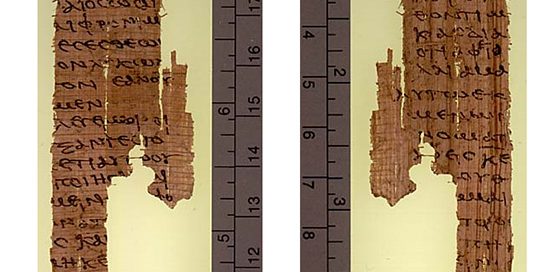
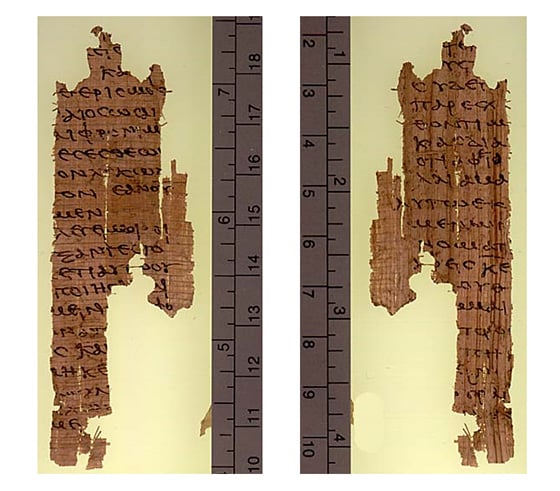
As I pointed out yesterday, the "Gospel of Peter" that we have today, discovered in 1886, is unfortunately, only a portion – the only surviving portion – of what was once a complete Gospel. But was it a complete Gospel? Or was it only a passion Gospel (like the later Gospel of Nicodemus) that gave an account only of the trial, death, and resurrection of Jesus? That has long been debated. I discussed one intriguing view of the matter some years ago on the blog, as follows: In recent years a German scholar named Dieter Luhrmann has argued that other portions of the Gospel of Peter have shown up, in very small fragments of papyrus discovered in Egypt.  It is a controversial claim.  The most interesting possibility, for me, is a papyrus fragment that Luhrmann published called Papyrus Oxyrhynchus 4009 (it is the 4009th papyrus published from the huge find of papyri in the trash heap of ancient Oxyrhynchus Egypt). To understand why this *might* be a fragment of the Gospel of Peter requires a [...]

The Loeb Apostolic Fathers: The Challenges (Again)

This will be the last of my three blasts from past discussions of my translation of the Apostolic Fathers; in it I explain the difficulties involved in producing a "facing page translation" edition of ancient texts ("facing page" means you have the original language text -- in this case Greek -- on one page and then across from it, on the other page, your English translation) ************************************************************************* To continue my thread about translating the Apostolic Fathers for the Loebs…. So, the editor at Harvard Press, Peg Fulton, asked me if I would be interested in taking on the task of doing a new edition of the Apostolic Fathers for the Loebs. She wasn’t offering me the opportunity then and there. She was suggesting that I write up a prospectus that she could take to the board of the Loebs, in which I described the need for a new edition and explained how I would go about making one. After I thought about it for a while, and got advice from my friends, I decided to [...]

Go to Top