Sorting by

×

Jesus as God in the New Testament

One of my personal favorite books (of mine!) is How Jesus Became God.  In my New Testament textbook, The New Testament: A Historical  Introduction, now in its eighth edition with Hugo Mendez, we include a couple of brief discussions of the topic in two of the sidebars.  One of the tricks in writing a textbook is figuring out how to say something in a way that is succinct and interesting, when there is not much space to cover a topic fully  (so, my first box here covers in 326 words what I take an entire chapter to develop in my book!)   But how to make something succinct but also accurate and / or interesting?  It’s always a balancing act. In any event, here are the two boxes. ******************************  Box 19.2  What Do You Think? Humans Exalted to Heaven at the End of Their Lives  What do you imagine the early Christians would think had happened to Jesus once they came to believe that he had not only been raised from the dead but [...]
2025-09-10T13:09:25-04:00October 24th, 2024|Book Discussions, Early Christian Doctrine|

Oral Traditions and the Dates of Our Gospels

As many of you know, this past year I published the 8th edition of my textbook The New Testament: A Historical Introduction to the New Testament (Oxford University Press, 2024), but this time, rather than doing it myself, I asked my colleague Hugo Mendez to join me in editing / updating it, and truth be told, since hey, I believe in telling the truth, he did the vast bulk of the work on this one.  Most of the changes came in his rewriting sections that needed to be brought up to snuff with current scholarship, including the one dealing with the sources of Synoptics, since a lot of scholars (though not the majority, so far as I can tell) are inclined to think the Q source never existed (including Hugo!) and the entire chapter on the Gospel of John, on which Hugo is a major expert and the paradigm of how to understand it has changed significantly over the past five years or so. In ANY event, one of the features I've always liked [...]

2025-09-10T13:09:24-04:00October 23rd, 2024|Book Discussions, Canonical Gospels|

Why CAN’T the Hard Problems Have Simple Answers?

The Bible is not an answer machine to all your questions (despite what billboards on US I-40 tell me); many of our modern questions are not addressed in the Bible (most of them, in fact: think of the issues people are each others' throats about half the time in our country); the Bible often gives a range of answers to various issues; sometimes these contradict one another; and sometimes they simply don't make any sense in our modern context (if you think they do, then look through your closet to see if you have any clothing made out of more then one fabric). These are some of the issues I address toward the tail end of my Introduction in my book God's Problem (HarperOne, 2008), excerpted here. ****************************** It is important, I think, to realize that the Bible has a wide range of answers to the problem of suffering because this realization reveals the problem of thinking that the Bible has one simple answer to every issue. Many people in our world take a smorgasbord approach [...]

2025-09-10T13:09:24-04:00October 22nd, 2024|Reflections and Ruminations|

October 2024 Gold Q&A Replay

Gold & Platinum Members, Thank you so much for submitting your questions and attending the live Q&A yesterday. For those of you who were not able to attend the Q&A live, the replay is ready and available for your viewing. Please find the replay at this link: October 2024 Gold Member Q&A Replay Mark your calendars now. November's Gold Q&A live recording is scheduled for Sunday November 17th at 7pm ET. We will send out a reminder and a link to attend live as we get closer to the date. We hope you enjoy the replay and look forward to seeing you next month! Jen

2025-09-10T13:09:25-04:00October 21st, 2024|Public Forum|

Suffering. Is It Really Worth Talking About? Doesn’t the Bible Give the Right Answer?

People react lots of different ways when trying to deal with the problem of how there can be so much suffering in a world that is said to be controlled by the almighty God who loves people and wants the best for them.  I decided to write my book God’s Problem: How the Bible Fails to Address our Most Important Question – Why We Suffer (HarperOne, 2008) both because many people don’t realize how many different answers the Bible itself gives (some of them at odds about it) and also because in my judgment lots and lots of people (most?) simply don’t take it seriously enough. Here's how I talk about why I think it matters and my approach to it, another excerpt from the book itself.  (Recall: the book was published in 2008, so 16 years ago now). ****************************** Based on my experience with the class, I decided at the end of the term that I wanted to write a book about it, a study of suffering and biblical responses to it. [...]

2025-09-10T13:09:24-04:00October 20th, 2024|Book Discussions, Reflections and Ruminations|

Doesn’t “Free Will” Explain Suffering?

When teaching undergraduate students about the problem of suffering, I have sometimes found it hard to explain to them why it is a “problem” for those who believe in God.  Many people do not find it an insurmountable problem; many others do.  My concern is far less where someone lines up on that issue than on that they realize it is indeed a huge issue that should not be ignored or swept under a rug. It took a while for some of my students at Rutgers to see the problem years ago when I was teaching about it, as I mentioned in my last post.  I continue my reflections here.  Again, this is excerpted from my book God’s Problem (HarperOne, 2008), edited a bit. ****************************** Before the semester was over, I think my students got the point. Most of them did learn to grapple with the problem. At the beginning of the course, many of them had thought that whatever problem there was with suffering could be fairly easily solved. The most popular [...]

2025-09-10T13:09:24-04:00October 19th, 2024|Reflections and Ruminations|

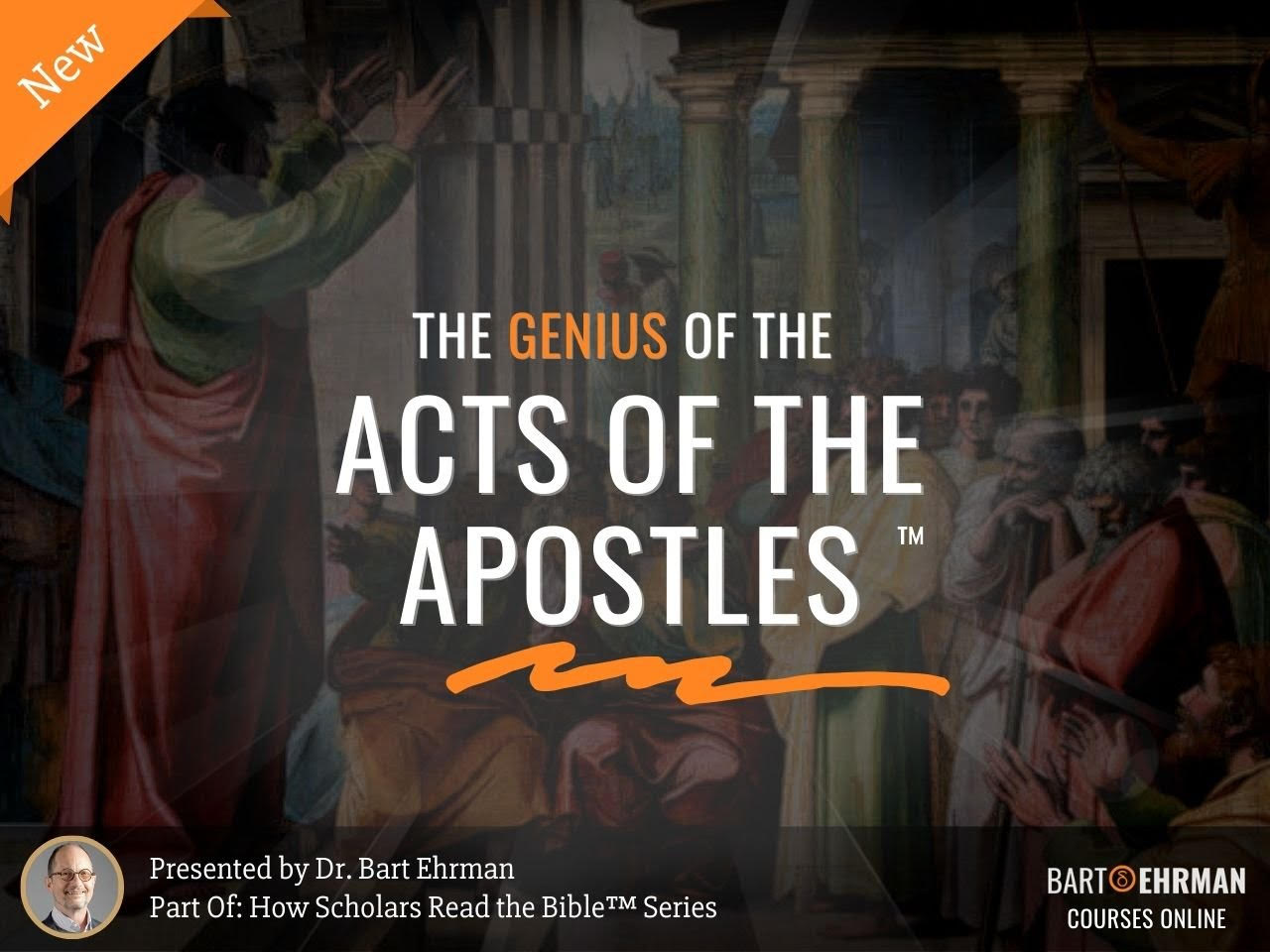
New Course by Bart Ehrman: The Genius of the Acts of the Apostles

Please note: The below course is not affiliated with The Bart Ehrman Blog. We’re sharing it with you because we believe it may be of interest to our members. Thank you for your continued support of the Bart Ehrman Foundation and Blog. *********************************** Hello from Chris Huntley, Did you know that the book of Acts is often seen as a straightforward record of early Christian history? But there’s so much more to it than meets the eye. For example, what if I told you that Acts may actually blend history with theological storytelling in order to illuminate the rise of Christianity? In our new online course, "The Genius of the Acts of the Apostles," bestselling author and renowned New Testament scholar Dr. Bart Ehrman takes you beyond the surface to explore these nuances in depth. Unlock the Complexities of Acts: Is Acts just a historical account, or does it go beyond facts to offer profound insights about the early church and the apostles? How does it reveal the role of divine intervention, Paul's transformative mission, and the [...]

2025-09-10T13:09:24-04:00October 17th, 2024|Public Forum|

The Problem of Suffering? So What’s the Problem?

The “problem of suffering” is especially a problem in the monotheistic religions.   In ancient Greek and Roman religions, with their many, many gods, it wasn’t an intellectual puzzle.  If there’s suffering, it’s because some or all of the gods are ticked off and out to get you.  There are some bad ones up there as well as good ones. Just the way it is. But if there’s only one God, why is there suffering?  Many people have very simply solutions and they don’t see a problem.  But there is a problem.  It just has to be explained.  Here I continue by showing why it’s a problem and to motivate some thinking by trying to explain how deep thinkers have expressed the problem and tried to address it. Again, this is excerpted from my book God’s Problem (HarperOne, 2008).  Just before this excerpt I was explaining my first time teaching about the issue in a class I did at Rutgers in the mid 1980s. ****************************** For the class I had students do a lot [...]

2025-09-10T13:09:24-04:00October 17th, 2024|Book Discussions, Reflections and Ruminations|

How Can We Imagine That God is Active in Our World? (A genuine, not rhetorical, question)

Are there moments when you wonder not just why things are going badly for you, or why they are very badly for others, but more comprehensively about why there needs to be suffering at all?  I certainly have, and I am now doing a thread of posts that explain some of my reflections through excerpts of the opening sections of my book God’s Problem: How the Bible Fails to Explain our Most Important Problem – Why We Suffer  (San Francisco: HarperOne, 2008). In my previous post I explained how these issues eventually led me to leave the faith.  Now I continue by reflecting on a subsequent moment, long after I was no longer a believer, when I was particularly floored by the problem of suffering. ****************************** Only on rare occasions do I go to church now, usually when my wife, Sarah, very much wants me to go. Sarah is a brilliant intellectual-a distinguished professor of medieval English literature at Duke University—and a committed Christian, actively involved in the Episcopal church. For her the [...]

2025-09-10T13:09:24-04:00October 16th, 2024|Book Discussions|

Hurricanes, Suffering, And My Loss of Faith

Two weeks ago I gave a fundraising webinar for the victims of Hurricane Helene, on the topic:  Why Do Disasters Strike: The Bible’s Views.  In preparing for the talk I decided to re-read the opening section of my book God’s Problem: How the Bible Fails to Answer our Most Important Question: Why We Suffer (San Francisco: HarperOne, 2008).  I hadn’t read it for years, and while I was reading it I realized anew just how important the topic is and how glad I am that I addressed it. I’ve decided to excerpt the opening bit from the first chapter and the beginning of the second  to give you a sense of the book.  If you’re interested in more, check it out. It is definitely different from all the others I’ve written, and now that I’ve re-read it, I think it’s the one I’m most proud of personally, not because of the author but because of the topic and its perennial importance. ALSO, if you would like to listen to the webinar (with Q&A) and [...]

2025-09-10T13:09:24-04:00October 15th, 2024|Book Discussions, Public Forum|

And Yet Other Apocrypha: 2 Maccabees and Others, Including Psalm 151!

This will be my final post for now on the Old Testament apocrypha.  In it I discuss the final (and particularly intriguing) book accepted in the Roman Catholic church, and a few others accepted in Orthodox Christian circles. Again this all comes from my textbook, The Bible: A Historical and Literary Introduction (Oxford, 2018).   2 Maccabees The book known as 2 Maccabees is another account of the history of the Maccabean Revolt. Its author did not have 1 Maccabees as a source but was writing independently of it. His interest is principally with the events that transpired under the leadership of Judas Maccabeus, so that the book overlaps mainly with 1 Maccabees chapters 1–7. The author indicates that his work is in fact an abridgment of a much longer five-volume description of the revolt by someone named Jason of Cyrene. He has condensed Jason’s work into a single volume. Unlike 1 Maccabees, this account was originally composed in Greek. Whereas 1 Maccabees is a rather straightforward chronicle of what happened leading up to [...]

2025-09-10T13:09:08-04:00October 13th, 2024|Hebrew Bible/Old Testament|

October Gold Q&A – Get Your Questions Answered!

Gold & Platinum Members, Your moment is here—get ready to fire off those questions for the October Gold Q&A! If all goes according to plan, Bart will be recording on October 20 at 7-8pm ET, with the replay dropping later that week. Got something simmering on your mind, or maybe a curiosity brewing? Now’s your chance to ask anything related to the blog. Bart will give it his best shot! How to submit: Shoot your questions over to [email protected], and we will gather them all up for Bart. Deadline: Make sure to send your questions by Friday October 18, 2023—just before midnight (whatever that means in your time zone). Pro tip: Keep it short and sharp! The clearer and more focused your question, the better chance it has of being featured. And hey—zingers are always appreciated! You can join the meeting here: https://us02web.zoom.us/j/85000509720?pwd=qcT3gyDXphxPii5dVHlSmUTuaGpebJ.1 Looking forward to it!

2025-09-10T13:09:24-04:00October 13th, 2024|Public Forum|

Still More Books of the Apocrypha: Wisdom of Solomon, Sirach, and Baruch

In this post I continue discussing the books of the Apocrypha, accepted as part of Scripture by Roman Catholic and Orthodox churches.  These are important books, historically and culturally – but hardly known among Protestant readers.   Here are three more!  Descriptions are taken from my book The Bible: A Historical and Literary Introduction.   The Wisdom of Solomon The Wisdom of Solomon is a book of positive wisdom (recall Proverbs), which claims to be written by the great king of the United Monarchy. In fact it was written many centuries later, by a Jew in the Diaspora, possibly in the first century b.c.e. or the first century c.e. The book celebrates Wisdom as the greatest gift to humans and insists that it involves proper fear and adoration of God, which will lead to eternal reward. Those who lead ungodly lives, on the other hand “will be punished as their reasoning deserves” (5:10). The exaltation of wisdom recalls Proverbs 8, where Wisdom appears as a female consort with God at the beginning of all [...]

2025-09-10T13:09:08-04:00October 12th, 2024|Hebrew Bible/Old Testament|

Some More of the OT Apocrypha: the Letter of Jeremiah, Additions to Daniel, and 1 Maccabees

The OT Apocrypha/Deuterocanonical books are truly fascinating, even if not widely read.  Few people outside of the Catholic and Orthodox traditions knows about the first one; the other two here though are better known and, in fact, historically significant. Some descriptions from my book The New Testament: A Historical and Literary Introduction. ****************************** The Letter of Jeremiah This is one of the shortest books of Apocrypha—it is only one chapter long, and in the Latin tradition of the Roman Catholic Church it is included as the final chapter of the book of Baruch. The book is allegedly written by the prophet Jeremiah, sent to the Judeans bound for Babylonian exile. In exile they will be among people who worship other gods through idols. This book is nothing but an attack on pagan idolatry. The real historical context of the writing is a situation in which Jews around the world were surrounded by idol worship. It may have been produced in the aftermath of the Maccabean Revolt; it appears to have been composed in [...]

2025-09-10T13:09:08-04:00October 10th, 2024|Hebrew Bible/Old Testament|

Platinum Webinar for October: “The Literacy of Jesus: Could the Christian Savior Read and Write?”

Dear Platinum Members, If you missed the live session of this quarter's Platinum Webinar, fear not. We have recorded the talk and it is now available for you to view. This webinar addressed The Literacy of Jesus: Could the Christian Savior Read and Write? Bart covers a lot of fascinating ground in this talk, including: Why this topic is even a question. Context around literacy in ancient societies. What the Bible says (and doesn't say) about Jesus reading and writing. ...and so much more. Please enjoy the lecture here: Platinum Webinar: The Literacy of Jesus (October 2024) Hope to see you next time! -Jen  

2025-09-10T13:09:24-04:00October 10th, 2024|Platinums, Public Forum|

Some of the Old Testament Apocrypha: Tobit, Judith, and Additions to Esther

In my previous post I began to describe the Old Testament Apocrypha/Deuterocanonical books.  In the several posts that follow I will describe the ones commonly accepted by Roman Catholic and Eastern Orthodox churches.   These are very interesting books, well worth reading, and, as I've said, canonical Scripture for some parts of the Christian church. My summaries here are taken from my book, The Bible: A Historical and Literary Introduction (Oxford, 2018) ****************************** Tobit Tobit is a work of historical fiction —by which I mean it is a fictional tale set within a real historical context. Originally the book was written in Aramaic, either in the late third century b.c.e. or the early second. The narrative is set in the eighth century b.c.e. in the city of Nineveh, where the hero of the story, Tobit, has been exiled from his town in Galilee during the conquests of the Assyrian king Shalmaneser. In other words, the account is allegedly taking place after the destruction of the northern kingdom of Israel. The story involves two subplots that eventually [...]

2025-09-10T13:09:08-04:00October 9th, 2024|Hebrew Bible/Old Testament, Public Forum|

Introducing the Old Testament Apocrypha

Lots of people on the blog seem to be really interested in early Christian apocrypha -- other Gospels, Acts, epistles, apocalypses that did not make it into the New Testament.  It's a major area of fascination for me as well.  But many folk talk about them as "the Apocrypha" and probably that's not quite right -- that is a designation usually reserved for the "Old Testament Apocrypha," which are not Christian books but Jewish. Many years ago I explained what these books are on the blog, and since I still get asked about them by  members, I thought it would be helpful to over that ground again. I begin with a basic overview taken from my textbook on the entire Bible, Genesis to Revelation, The Bible: A Historical and Literary Introduction, 2nd. ed. (New York: Oxford University Press, 2018).   ****************************** In addition to the canonical books in the Hebrew Bible, there was other literature written by other Jewish authors that cannot be found there, but that is of great importance for anyone interested in it. [...]

2025-09-10T13:09:08-04:00October 8th, 2024|Early Judaism, Hebrew Bible/Old Testament|

Was the Apocalypse of Peter Originally Considered Part of the New Testament?

In my previous post I pointed out that our earliest list of which books should be considered Christian Scripture (that is, parts of the New Testament), the Muratorian Fragment from the 180s CE, lists the Apocalypse of Peter as a book that was accepted by some Christians.  I've talked about the book on the blog before.  It's extraordinarily interesting.  It is the first Christian account we have of a journey to the realms of the damned and the blessed, where Peter himself is shown by Christ the torments of the one and the glories of the other.  In my recent academic book Journeys to Heaven and Hell, I devote a chapter to explaining why the book in the end did not get included in Scripture but the book of 2 Peter, which was NOT accepted by the Muratorian canon or even known about then so far as we can tell, did make it in. In this post I'll simply explain what we know about the popularity and acceptance of the Apocalypse of Peter [...]

The First Ancient Christian List of the Books (allegedly) of the New Testament

The first church father to name Matthew, Mark, Luke, and John as the four Gospels in the New Testament is Irenaeus, the bishop of Lyons in Gaul (i.e., the ancient forerunner of Lyon, France), in his five-volume work, "Against Heresies" in 180 CE.   He spent significant time in Rome itself before his appointment in Gaul, and he considered the Roman church to be the center of Christendom at his time, but there are no Roman authors before him who say anything about it.  The important teacher / philosopher Justin (who acquired the epithet "Martyr"), from whom we have three surviving writings about Jesus, Scripture, and the truth of Christianity, quotes the Gospels but never indicates who wrote them. There is another (apparent) witness to the fourfold Gospel of Matthew, Mark, Luke, and John from Irenaeus’s time, and also appears to be connected with Rome -- and as it turns out, it is the first list of canonical NT books that we have from antiquity.  This comes to us in the fragmentary Latin text [...]

Was the New Testament Canon Really Closed in 367 CE?

If we are talking about the earliest Christian writings -- the subject of my previous three posts -- we naturally want to know when decisions were made about WHEN church father settled on our 27-book canon of the New Testament.  Many people -- including tons of scholars -- set a precise date: 367 CE, in the decision written by the famous theologian Athanasius of Alexandria. Is that right? My first academic publication addressed this question and answered: NO.  Here's how I have talked about the issue and my attempt to overturn the widely held view, from long ago! ****************************** My first semester in the PhD program at Princeton Theological Seminary I had a seminar on the “Canon of the New Testament” with Bruce Metzger.   This was a class that focused on the questions surrounding how we ended up with the twenty-seven books in the New Testament.  Who decided that it would be these twenty-seven books, and no others?  What was motivating these people?  What were the grounds for their decisions?  And when did they make [...]

2025-09-10T13:09:07-04:00October 3rd, 2024|Early Christian Writings (100-400 CE), Public Forum|
Go to Top