Sorting by

×

Not a Game-Changer? Why I’d Still Be Thrilled to Have a First-Century Gospel Fragment

Here again, from years ago, some reflections on the importance of having a first-century manuscript -- even if it DID NOT change much of anything we think or know. ******************** In several posts I have been emphasizing – possibly over-emphasizing – that if a first-century fragment of the Gospel of Mark does ever get published, and if it is in *fact*from the first century (which, I should stress, will be almost *impossible* to demonstrate conclusively), that it is very hard indeed to imagine that it will be any kind of game-changer, that it will tell us something different from what we already think.  The reason I have been emphasizing this is because the evangelical Christian scholars who are making the headlines with their declarations about the discovery will almost certainly, once it is published, if it ever gets published, claim that it is evidence for their view that we can know what the original text says.  See!  We have a FIRST-CENTURY MANUSCRIPT!!! So, consider these posts of mine as a kind of prophylaxis [...]

2025-09-10T13:08:16-04:00July 24th, 2024|Public Forum|

How Would a First-Century Fragment of the Gospels Actually Change What We Know/Think?

Here I give a post from 2015, some three years after it was announced that we now have a first-century fragmentary  copy of Mark.  At this point we still had not SEEN the manuscript and no one would give us any reliable information about it.  And I began to wonder, how much difference would it make in how we understand things, assuming it really was a first-century fragment.  Here are my musings at the time. ****************************** Assuming, as it is *relatively*, but not absolutely probable that we should, that the fragment in question is simply of a few verses in the middle of Mark’s Gospel that do not vary significantly from what we already have, I’m still obsessing with the question of why evangelical scholars would be so bound and determined to get their hands on it.   I’ll deal with that question first. It may not be obvious why it is a puzzle.  Here is why. As a rule (a rule to which I do not know a single exception), evangelical scholars of [...]

2025-09-10T13:08:16-04:00July 23rd, 2024|Public Forum|

Would It Matter if We DID Have a First-Century Manuscript of Mark?

I will continue here with select reposts of the first-century copy of Mark fiasco, in light of my recent interview in the topic and my now renewed interest in the issues involved.  (See the previous posts if you're not aware of the claims from 12 years ago that one had been discovered.) I personally think that there are no shenanigans going on when Dan Wallace tells us that a fragment of the Gospel of Mark has been found and that it can, with reasonable certainty, be dated to the late first century.  I’m not saying that I know he is right.  Far from it.  In fact, one of the most disconcerting things about this claim is that they are not making the papyrus available so real experts can study it and let us know what it really is and to what period it can be dated.   But let’s suppose that once it is published – now the date is no longer 2012, as originally stated, or 2015 as stated last week, but 2017 or later, [...]

2025-09-10T13:08:16-04:00July 21st, 2024|Public Forum|

More on the Initial Debacle on First-Century Mark (in relation to the Dead Sea Scrolls)

In my previous post -- originally put up on the blog in April 2012 -- I explained how in a debate I had in February of that year, evangelical New Testament scholar and textual critic Dan Wallace to my surprise (shock!) announced that now for the first time we actually have a copy of the Gospel of Mark from the first century, not long after the book was written, and that it confirms what he has said all along, that we have the original text of the New Testament.  But he wouldn't tell us anything about the copy -- how big it was, who established its date, whether the date had been corroborated, etc. Here I continue, again from the post in 2012, edited a bit. ************************** Over the two months since the debate Dan has been repeatedly asked for more information, and he will not give it. I don’t know if he owns the manuscript, if he has seen the manuscript, if it is his book that will contain information about [...]

2025-09-10T13:08:15-04:00July 20th, 2024|Bart's Debates, New Testament Manuscripts|

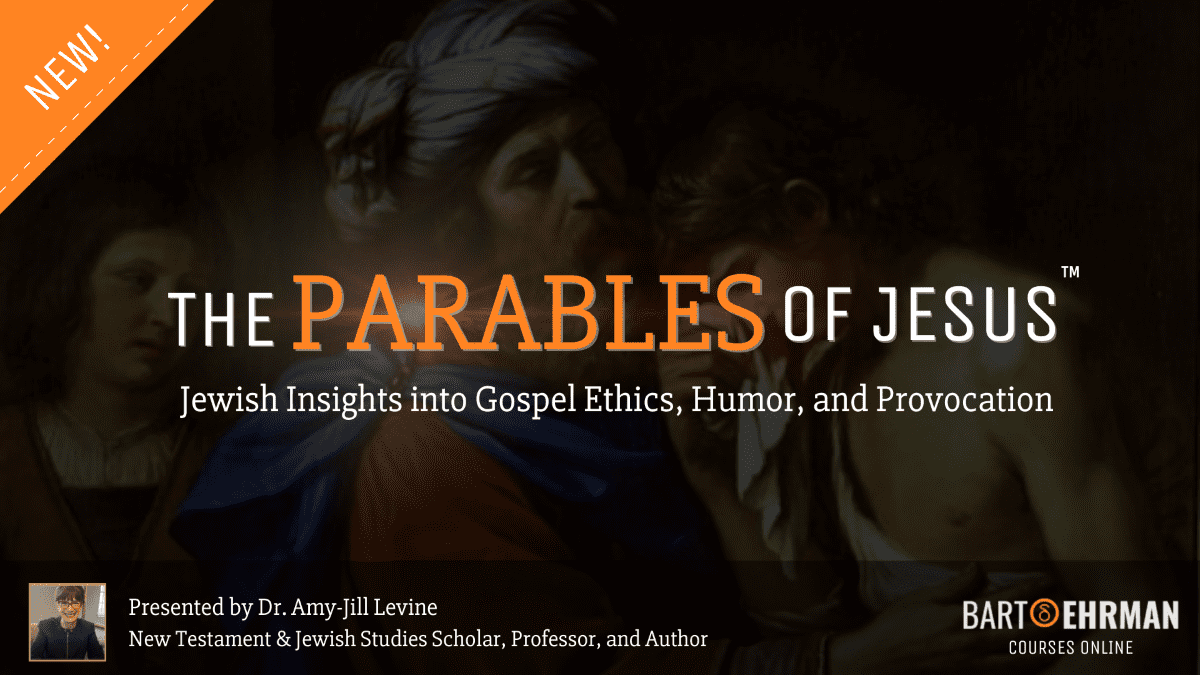
The Parables! Have You Signed up for the Course? (This weekend!)

No time to wait!  If you haven't signed up for the course on Jesus' Parables, you should maybe reflect a bit on Matthew 25:1-13. Well, not exactly.  If you don't come live, you can purchase the course as a recording.  But if you do come live you'll get the recording for life, and why not hear it in the flesh?  I'm tellin' you, this'll be a good one.  Amy-Jill Levine?!  On the Parables of Jesus?!?  How good can it get? Here's my original announcement from last month. ******************** I'm really excited about this one.  We will be presenting a new remote course on the Parables of Jesus, consisting of four lectures by Amy-Jill Levine.   Amy-Jill is one of the top scholars on the historical Jesus and the Gospels on the planet, and is an unusually interesting and dynamic lecturer.  If you heard her at the New Insights into the New Testament last year, or taken a Great Courses/Wondrium course with her, you'll know what I mean.  She is unusually sharp, witty, clear, engaged, challenging, and [...]

2025-09-10T13:08:16-04:00July 18th, 2024|Public Forum|

The Debacle Over the First-Century Copy of Mark

This morning I had a long interview with BBC4 (radio) in London about a new book that is coming out by renowned expert in ancient manuscripts (mainly classical) Roberta Mazza, that deals at length with the debacle over the alleged first-century copy of the Gospel of Mark.  It was a debacle because it was based on bogus claims. I was intimately connected with the beginning of the affair back in 2012, and in looking over the blog see I haven't dealt with it at any length for many years.  I've decided to repost a series of blogs that spanned eight years to show how the whole thing unfolded.  It took that long for the truth to come out.  Here is the first post I made (with a few edits), published about two months after the rather unpleasant business began. ************************** On February 1 [2012] I had a public debate in Chapel Hill with Daniel Wallace, a conservative evangelical Christian New Testament scholar who teaches at that bastion of conservative dispensationalist theology, Dallas [...]

2025-09-10T13:08:15-04:00July 18th, 2024|Bart's Debates, New Testament Manuscripts|

What If Another Christianity Had Won?

If only one form of early Christianity won the contest for domination, what were the results -- what the gains and losses from that "triumph"?  And what would have happened to world history if things had gone in another direction?  This is my third and final post on my book Lost Christianities, taken from its Introduction (Oxford Press, 2003).   ******************************* The Stakes of the Conflict Before launching into the investigation, I should perhaps say a word about what is, or at least what was, at stake.  Throughout the course of our study I will be asking the question: what if it had been otherwise?  What if some other form of Christianity had become dominant, instead of the one that did?[1] In anticipation of these discussions, I can point out that if some other form of Christianity had won the early struggles for dominance, the familiar doctrines of Christianity may never have become the “standard” belief of millions of people around the world – including the belief that there is only one God, [...]

More Lost Christianities

In my previous post I discussed the wide variety of early Christianities and their ranging views.  Here I consider some aspects of the Scriptures known and used by these various groups.  Again, this comes from the Introduction to my book Lost Christianities (Oxford Press, 2003). ****************************** The Lost Scriptures The Gospels that came to be included in the New Testament were all written anonymously: only at a later time were they called by the names of their reputed authors, Matthew, Mark, Luke, and John.  But at about the time these names were being associated with the Gospels, other Gospel books were becoming available, sacred texts that were read and revered by different Christian groups throughout the world: a Gospel, for example, claiming to be written by Jesus’ closest disciple, Simon Peter; another by his apostle Philip; a Gospel allegedly written by Jesus’ female disciple Mary Magdalen; another by his own twin brother, Didymus Judas Thomas.[1] Someone decided that four of these early Gospels, and no others, should be accepted as part of the canon [...]

Lost Christianities

How diverse was early Christianity?  I had been transfixed by this question for a long time when I decided to write a trade book, Lost Christianities.  It was a blast to write and in some ways launched my career of writing for general audiences.  My earlier book Jesus, Apocalyptic Prophet was definitely directed to that crowd, but it was with Lost Christianities that I started kicking broader communication to a wider readership into gear. Here's I'll excerpt by explanation of the book in its Introduction (from Lost Christianities: The Battles for Scripture and the Faiths We Never Knew. Oxford University Press, 2003).  This will take three posts. ********************* It may be difficult to imagine a religious phenomenon more diverse than modern-day Christianity.  There are Roman Catholic missionaries in developing countries, who devote themselves to voluntary poverty for the sake of others, and evangelical televangelists with twelve-step programs to assure financial success and prosperity.  There are New England Presbyterians and Appalachian snake handlers.  There are Greek orthodox priests committed to the liturgical service of God, replete with set [...]

More Lost Scriptures

How did we get our books of the New Testament, and what do we know about the ones that were "left out"?  Here I continue my Introduction to my book Lost Scriptures, as started in my previous post. ****************************** When was this New Testament finally collected and authorized?  The first instance we have of any Christian author urging that our current twenty-seven books, and only these twenty-seven, should be accepted as Scripture occurred in the year 367 CE, in a letter written by the powerful bishop of Alexandria Egypt, Athanasius.  Even then the matter was not finally resolved, however, as different churches, even within the orthodox form of Christianity, had different ideas -- for example, about whether the Apocalypse of John could be accepted as Scripture (it finally was, of course), or whether the Apocalypse of Peter should be (it was not); whether the epistle of Hebrews should be included (it was) or the epistle of Barnabas (it was not); and so on.  In other words, the debates lasted over three hundred years. [...]

A Remembrance of John Shelby Spong–Platinum Post By Ray Zubler

I am pleased to be able to post this post by platinum member Ray Zubler; it is a recollection/commemoration of John Shelby Spong, whom many of you know of as one of the great voices that spread criitical knowledge of the Bible and early Christianity to broader audiences.  Spong was a bishop of the Episcopal Church who nonetheless realized the deep problems posed by the Bible and traditional theological views for modern thinking people.  Spong discussed these issues *within* the context of the Christian church as a Christian church leader, and so he reached a large number of Christians who would pay no attention to critical scholars on the outside.  Ray has here presented some very helpful reflections on him and his work. Remember: you too can present a Platinum Post to Platnium Members as a Platinum yourself!  Anything related to what we do works!  Let me know if you're at all interested -- or just send us a post. ****************************** “Faith can never rest on perceptions that are intellectually unbelievable.” – John Shelby Spong [...]

2025-09-10T13:07:57-04:00July 12th, 2024|Public Forum|

ANOTHER Blog Dinner! Thursday, July 18, Wimbledon. Interested?

The first blog dinner I announced (happening tomorrow, Friday July 12) was oversubscribed, and so I'll be doing a second -- this time on my home-away-from-home turf, Wimbledon Village, on Thursday July 18.    Seats are limited. Want one of them? I'll again limit the table to 8, me and the perfect number 7.    For those who come there are no obligations other than: Being a blog member Showing up Talking Paying for whatever you ingest.  Whatever you exgest is free. If you're interested, do NOT reply here as a comment.  Send me an email at [email protected]. Hope you can come!    

2025-09-10T13:08:16-04:00July 11th, 2024|Public Forum|

Lost Scriptures

I was reluctant to write my first trade book (Jesus the Apocalyptic Prophet: see previous post), and had to be dragged into writing my second.  I just wanted to devote myself to technical scholarship.  But, well, I yielded in the end, and I'm glad I did. My second trade book ended up being two books.  I had agreed to write about the "heretical forms" of Christianity and their Scriptures, but then my publisher, Oxford University Press, talked me into not only doing that study (Lost Christianities) but also an accompanying anthology of texts, Lost Scriptures.  Once again I was reluctant (!) but I lost out again, and again I'm glad.  It's been the better selling of the two books, to my great surprise. Here I'll explain what it contains, taken from the Introduction to it (OUP, 2003).  This will take two posts. ****************** General Introduction Even though millions of people world-wide read the New Testament -- whether from curiosity or religious devotion -- very few ask what this collection of books actually is [...]

2025-09-10T13:07:58-04:00July 11th, 2024|Book Discussions, Christian Apocrypha|

My First Trade Book: Jesus, Apocalyptic Prophet

I have started a thread discussing the books I've written for broader audiences.  My first actual "trade book" was Jesus: Apocalyptic Prophet of the New Millennium (Oxford University Press, 1999) (uh, that would be 25 years ago!).   Here is how I explain the book and it's raison d'etre in the Preface.   In case you wonder -- I still hold the same basic views of Jesus now that I did then, and still find the arguments I adduce convincing. ****************************** Preface When anyone has asked me why I’m writing a book about the historical Jesus, I’ve usually replied, “Well, it’s about time someone did.” Actually, at last count there were something like eight zillion books written about Jesus.  And those are just the ones written by scholars.  A good number of these, mainly the lesser known ones, are written by scholars for scholars to promote scholarship; others are written by scholars to popularize scholarly views.  The present book is one of the latter kind.  I really don’t have a lot to say to scholars who [...]

2025-09-10T13:07:58-04:00July 10th, 2024|Book Discussions, Historical Jesus|

How Can We Possibly Know a Scribe’s Intentions? My Most Important Theoretical Reflection

Can we know what a scribe intended to do when he changed the text? Is it actually possible to know what anyone INTENDS?  Isn't that technically impossible, unless we get into their minds somehow?  I had to deal with this issue in the Orthodox Corruption of Scripture and there I laid out the theoretical premises I have/had, to allow me to say that a scribe intended to change a text.  It's a view that most readers completely overlooked, including a bunch of my critics. *********************** Intentionality as a Functional Category The other theoretical claim that I made in Orthodox Corruption involved the broader concept of what it means to describe a scribal alteration of the text as “intentional.”   I have been deeply interested in the question of “intention” for many years, as a philosophical problem (there is considerable philosophical discourse on it, of course), an issue in literary interpretation (especially since Wimsatt and Beardsley’s famous “Intentional Fallacy”), and, naturally, as it relates to scribes. Most textual critics have unproblematically talked about scribal changes being either accidental [...]

2025-09-10T13:07:58-04:00July 9th, 2024|Book Discussions, New Testament Manuscripts|

Free Lecture on Paul’s Life and Letters, Thursday (July 11)

I will be giving a free remote lecture this Thursday, July 11, at 1:00 pm EST.  You're welcome to come!   Sorry 'bout the time -- but I'm in England and so it'll be early evening here. The lecture is designed to be a lead-in to the annual New Insights into the New Testament (NINT) conference that will be happening on September 21-22.  The conference will feature ten speakers who will each give a 50-minute talk with Q&A, all on topics (of speaker's choice) connected with the life and letters of Paul; the talks will all be geared to a general audience at about the level we address things here on the blog and in my online courses (www.bartehrman.com).   The speakers are some of the top Pauline scholars in the cosmos.   We haven't announced the conference yet, but will soon, with instructions about how to register etc. Whoever registers for it will receive a recording of my Thursday lecture for free.  In it I will be presenting basic background into Paul to help get everyone up [...]

2025-09-10T13:08:15-04:00July 8th, 2024|Public Forum|

The Evolution of Jewish Monotheism–Platinum Post By Daniel Kohanski

Were ancient Israelites and then later Jews actually monotheists?  What would that actually even mean?  Did their belief in the gods/God change over time?  Here is an intriguing and informed discussion by Platinum blog member Dan Kohanski.  What do you think?   ****************************** The Evolution of Jewish Monotheism[1] Monotheism—the idea that there is one and only one divine Being in the universe—is the underlying foundation of Judaism. Jews reaffirm this twice a day by reciting the Shema, the basic statement of the Jewish faith: "Hear, O Israel, the Lord our God, the Lord is One." This belief is said to have started with Abraham and established for all by Moses at Sinai as one of the Ten Commandments: "You shall have no other Gods besides Me" (Ex. 20:3). But is this really the way it happened in history, even in Biblical history? I suggest that the idea of monotheism evolved only gradually among the ancient Israelites, and even after it was generally accepted by their descendants the Jews, it was not completely so until Roman [...]

2025-09-10T13:07:42-04:00July 8th, 2024|Public Forum|

Are Scribes of Texts Actually Authors?

In my overview of the responses to my book The Orthodox Corruption of Scripture in the Afterword I wrote of the 2nd edition, I began to address some major questions.  In the book I argued that scribes of the New Testament intentionally changed the text in places in order to make it more orthodox in its theology or to circumvent its use by "heretics" who had other views.  That raises a question:  are scribes who change the text to make it say something different actually *authors* instead of mere copyists?  Here's how I discuss the issue at the beginning of my Afterword. ************************ I see no need here to restate the original thesis of The Orthodox Corruption of Scripture.  There is one issue connected with it, however, that has not been clear to some of its readers that does need to be addressed.  In the book I never claimed and certainly never meant to claim that the majority of all textual variants in the tradition were “intentional” (a term I will be discussing [...]

2025-09-10T13:07:58-04:00July 7th, 2024|Book Discussions, New Testament Manuscripts|

The Orthodox Corruption of Scripture, 2nd edition

I get asked a lot about my various books, and I often mention one of my books when no one has asked (you may have noticed).  It occurred to me that it might be useful for me to present some blog posts on what each book is about. Probably my best known academic book was The Orthodox Corruption of Scripture (Oxford University Press, 1993).   Twenty years after it was published I was asked to do a second edition, in which I would explain where the thing had originally come from (in my head) and what had happened in the field since it's original publication. Here is the Afterword to the 2nd edition (slightly edited) where I try to explain why I wrote it and what I was trying to accomplish with it.  (It includes reflections on an alleged "original text" of the New Testament). *******************************   The following sketch is intended to reflect on what has been achieved in the field of New Testament textual criticism since I first published The Orthodox Corruption of [...]

2025-09-10T13:07:57-04:00July 6th, 2024|Book Discussions, New Testament Manuscripts|
Go to Top