Sorting by

×

Are the Gospels Anti-Jewish?

I was recently asked if I'd be willing to do a lecture on whether the Gospels are anti-Semitic.  I've dealt with the issue on the blog before, but thought it might be useful to return to a particularly interesting feature of the Gospels that can contribute to an answer. I should say at the outset that I do not think that the Gospel writers, or anyone else in their time, was “anti-Semitic.”   The idea and reality of anti-Semitism are modern, and are based on modern sense of “race” as these were developed by the anthropologists of the 19th century.  The idea that there was a Semitic “race” has been used for all sorts of hateful purposes in the modern period.  As just one example, throughout the Middle Ages – before the modern period -- and on into the nineteenth century, “Jews” were understood to be people who subscribed to and followed the Jewish religion – but not that they had racial characteristics.  There were indeed persecutions of Jews, since the conversion of the Roman Empire [...]
2025-09-10T13:01:02-04:00January 21st, 2023|Public Forum|

What’s So Hard about Translating Ancient Texts?

Publishing a translation of an ancient text ain't at all like writing a book about the text. When the editor at Harvard Press asked me if I would be interested in doing a new edition of the Apostolic Fathers for the Loebs, she wasn’t offering me the opportunity then and there.  She was suggesting that I write up a prospectus that she could take to the board of the Loebs, in which I described the need for a new edition and explained how I would go about making one.  After I thought about it for a while, and got advice from my friends, I decided to go for it.  I had never (ever!) planned doing a serious translation project for publication.  I had lots of other things I wanted to write – scholarly monographs, textbooks, and so on.  But I thought it made sense to do it, both personally and professionally.  So I wrote up the prospectus and the editorial board agreed it was a task that needed to be done – and so they [...]

2025-09-10T13:00:50-04:00January 19th, 2023|Book Discussions, Early Christian Writings (100-400 CE)|

Watching Notes for Jesus of Montreal! (My Favorite Jesus Movie!)

A number of you have signed up to come to our Blog Movie Club discussion this Sunday, January 22, 4:00-5:30 EST, to discuss my favorite Jesus Movie of all time, "Jesus of Montreal."   Some of you who have not yet signed up may be interested in coming once your learn what the movie is about. Below is a note we sent to all those who have already signed up, where I describe the movie and suggest how to watch it. If you decide you want to come to the event after all, there is still time!  Here is the link:  Register here And this is the link to my post describing the event more fully:  My All-Time Favorite Jesus Movie. Wanna Discuss It With Me? - The Bart Ehrman Blog   Watching Notes for “Jesus of Montreal” Blog Movie Club, 2023   I’m glad you’ll be joining me on Jan 22 for a discussion of Jesus of Montreal --- my all-time favorite Jesus movie.   Some of you have seen it already, other not.  No matter, [...]

2025-09-10T13:01:02-04:00January 18th, 2023|Public Forum|

What About Translations of Other Ancient Christian Writings?

I've been talking about translations of the Bible -- especially the King James Version -- and I'd like now to move to a broader issue.  EVERY text from the ancient world needs to be translated in order to be made accessible to a modern audience.  Hey, we're not back in the 19th century when going to university meant learning Greek and Latin!  And texts even then also came from even other languages (Hebrew, Coptic, Syriac, etc.). If you're a graduate student in antiquity, you have to learn to read these texts in their original languages; you simply can't get the nuances of a text -- especially a fairly sophisticated one dealing with, say, philosophy or religion -- in translation.  And translators have to make decisions about how to translate a text.  It's not a mechanical process.  Whether you like it or not  -- most people when they learn of this don't much like it, and even more people have never learned of it -- translation is also an act of interpretation.  You have to know [...]

Do All Modern Translators of the New Testament Translate the Same Greek Text?

If someone translates the New Testament today into English, French, Arabic, or Swahili -- what exactly are they translating?  They must have access to some kind of Greek text.  But what?  Are there lots to choose from out there?  Are they wildly different from one another?  I pointed out in my previous post that the King James and just about all other versions before the end of the 19th century were based on a printed Greek text that is now widely seen as flawed.  So what do folks use today?  Or if someone is just wanting to *read* the Greek -- what options are there?  Is there some kind of "official" version? Blog readers occasionally ask me these questions and luckily there is a fairly standard answer known to almost no one but scholars. When scholars translate the New Testament into any modern language, they almost always (apart from fundamentalists who prefer the Greek used for the King James) use the same Greek text.  It is a printed edition of the Greek New Testament published [...]

Armageddon! My New Book on the Revelation of John.

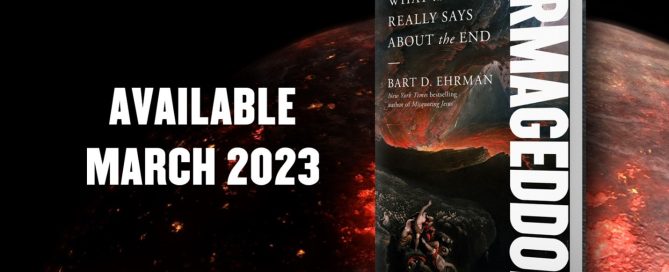
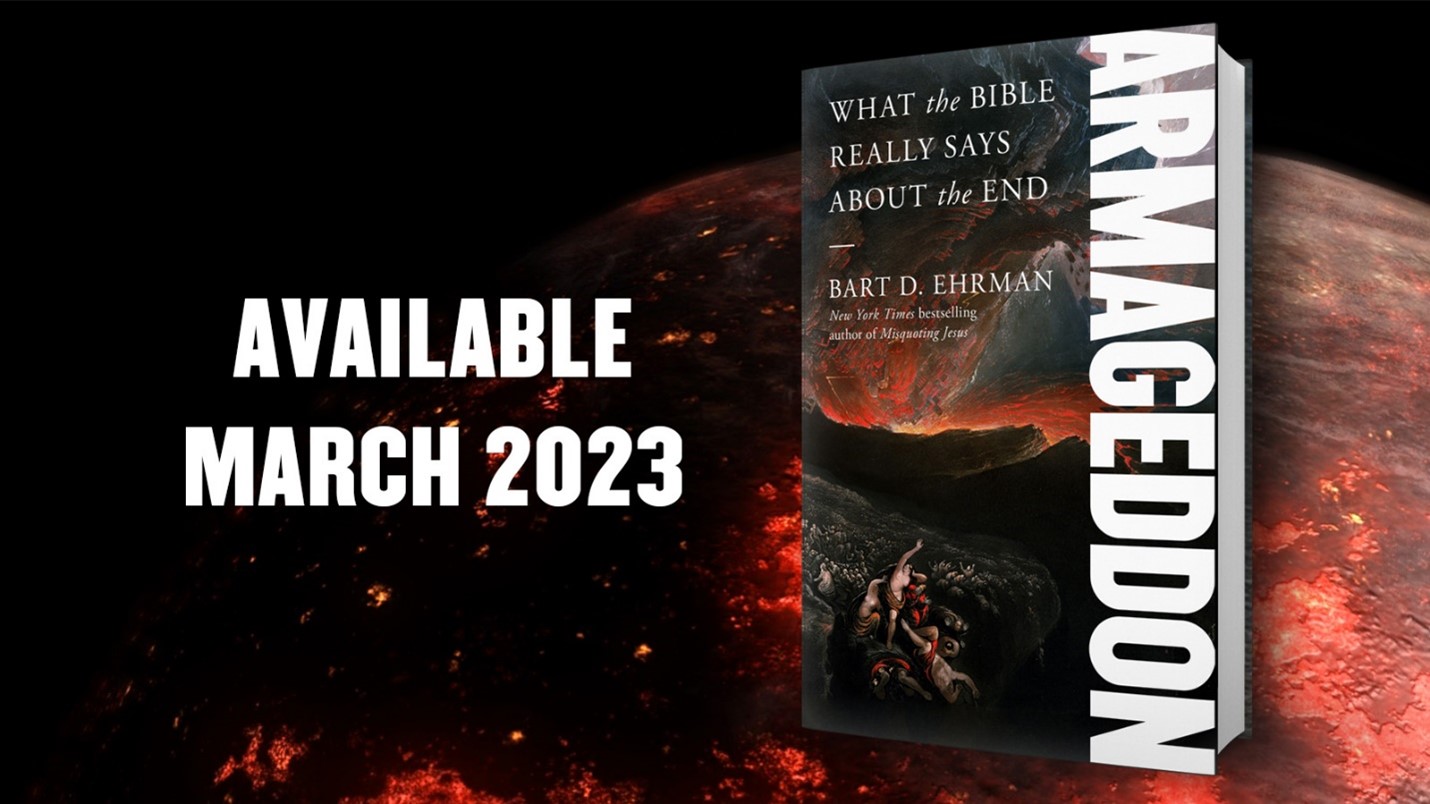
I’m excited to say that my book on the Apocalypse of John (a.k.a. the Book of Revelation) will be published and available on March 21.  The End is Near!     Here is a brief synopsis of what it’s about: ****************************** The Apocalypse of John (Book of Revelation) is the most mystifying and misunderstood book of the Bible, and possibly the most dangerous.  Most readers simply refuse to dip into its pages – it is too bizarre, violent, and incomprehensible. Those who do read it fall into two camps.  Most are conservative Christians who believe the book is describing what is soon to happen in our future; evangelical “prophecy experts” provide detailed explanations to show that the end has now arrived. Liberal historical scholars, on the other hand, argue that when the book is understood in its own historical context the book is instead a metaphorical expression of hope: the world may appear out of control, but in the end the goodness of God will prevail and those suffering now will be rewarded later. Armageddon [...]

2025-09-10T13:00:49-04:00January 15th, 2023|Book Discussions, Revelation of John|

Do Public Debates Do Anyone Any Good? What Do You Think?

Do public debates on controversial topics do anything other than entertain, stir up the blood, and make people more entrenched in their views?  It there any sense of speaking of a “winner” in a debate in which virtually all listeners already have opinions?  Is there any substantive reason to have these events, other than to provide a bit of public spectacle? I’m in London for the holidays, spending most of the time visiting family on Sarah’s side.  But we did have a chance to get to a play on the West End, called “The Best of Enemies.”  I hadn’t heard of it before, but it’s made a big splash, probably because of its obvious ongoing political and social relevance, even though it is about a series of events from 55 years ago. The play is a dramatization of the debates held on ABC between William F. Buckley, famous and outspoken conservative intellectual, and Gore Vidal, famous and outspoken liberal intellectual, during the 1968 Presidential National Conventions.  Some of you will remember these characters well, others [...]

2025-09-10T13:00:49-04:00January 14th, 2023|Public Forum|

Paul and the Gospels: Platinum Guest Post by Ryan Fleming

One of the very big issues of New Testament studies is the relationship between the teaching of Paul and the preaching of Jesus.  Are these basically the same?  Irreconcileably different?  Weirdly unalike?  Understandably similar?  Something else? Here in this Platinum Guest Post, Ryan Fleming provides an intriguing approach to the question, which raises lots of questions and should arouse a range of different opinions.  What do you think? And what do you think of sending in a Platinum post of your own?  It doesn't have to be massively learned or informed: just whatever you want to address to a group of otherwise well-meaning, generous, and similarly-interested human beings.  If you have something, send it along!  Or feel free to ask me about it. In the meantime here's Ryan on Jesus and Paul. ****************************** The seven New Testament letters attributed to the Apostle Paul (Galatians, 1 Thessalonians, 1 Corinthians, 2 Corinthians, Romans, Philippians, and Philemon) are generally believed to have been written between 48 CE and 59 CE, roughly 15 to 29 years after the time [...]

2025-09-10T13:00:50-04:00January 13th, 2023|Public Forum|

Famous Passages that Are Not Original: How Do Modern Translators Deal with Them?

In my previous post I indicated that the King James Version includes verses in some places that are almost certainly not “original” – that is, passages that were not written by the original authors but were added by later scribes.  I chose three of the most outstanding and famous examples: the explicit reference to the Trinity in 1 John 5:7-8; the story of the woman taken in adultery in John 7:53-8:11; and Jesus’ resurrection appearance in the longer ending of Mark’s Gospel, Mark 16:9-20. What about more recent translations?  how are these three passages presented there?   I won't discuss all the translations here, of course (the 29 million of them) but the one that I and most other historical scholars I know, prefer, the New Revised Standard Version, recently updated in the NRSVue (= updated edition.  Catchy, huh?).   Since virtually all scholars (including the translators of this edition) agree these three passages were not original to the New Testament, are they printed there? As it turns out, the three passages are handled differently.   The first, [...]

Problems with the King James Version: What Were the Translators Translating?

I’ve mentioned several problems with the King James Version in previous posts.  Arguably the most significant set of problems has to do with the text that the translators were translating.  The brief reality is that in the early 17th century, Greek editions of the New Testament were based on very few and highly inferior manuscripts.  Only after the King James was translated did scholars begin to become aware of the existence of older, and far better, manuscripts. The manuscripts of the New Testament (and of all books from antiquity) were copied -- prior to the invention of printing -- almost always by scribes who did their best to make faithful reproductions of the copies they were copying, and many of them did a remarkably good job.  Others did a not-so-good job.  Since mistakes can get replicated over time, and introduced over time, in general it is a good idea to consult the *earliest* manuscripts for determining what an author of a book wrote.  The later manuscripts tend to be worse (that’s not an *absolute* rule, [...]

Can We Trust the Bible? The First Published (as opposed to Printed) Greek New Testament

In this thread on Bible translation, I have been talking about what it is translators of the New Testament actually translate.  In order to answer the question, I have had to explain how we started to get printed editions of the Greek New Testament, including the first to come off the printing press, the Complutensian Polyglot (discussed in yesterday’s post).  Today I take the discussion a step further, to talk about the first published (not the first printed!) Greek New Testament.  Again, the discussion is taken from my book Misquoting Jesus. ****************************** The First Published Edition of the Greek New Testament Even though the Complutensian Polyglot was the first printed edition of the Greek New Testament, it was not the first published version.  As I pointed out, even though the work was printed by 1514, it did not actually see the light of published day until 1522.  Between those two dates a famous and enterprising Dutch scholar, the humanist intellectual Desiderius Erasmus, both produced and published an edition of the Greek New Testament, receiving the [...]

My All-Time Favorite Jesus Movie. Wanna Discuss It With Me?

Here's a reminder about a first-time-ever blog event, coming soon.  Interested?  Here's the original announcement. ************************* People often ask me what my favorite “Jesus Movie” is, and they  almost never expect my answer.  For me it’s hands down.  A clear forerunner.  A movie most people have never heard of, but in my opinion, the best of all time: “Jesus of Montreal.”   This is not just my favorite Jesus movie of all time but one of my very favorite movies of any kind of all time. Want to watch it and then have a discussion about it with me? This will be our first ever Blog Movie Club event (BMC)! The main event, the discussion with me, will be on Sunday, January 22, 4:00-5:30 pm EST. The Movie Club viewing will not be that day, but before; and you have two (well three!) massively convenient options.  You can: Watch it on your own at your leisure. Join other blog members in watching it simultaneously in silence, with a brief introduction and discussion afterward (without me) led [...]

2025-09-10T13:01:02-04:00January 9th, 2023|Public Forum|

What Is a Viable Christian Theology? Platinum Guest Post by Joel Scheller

Here is a thoughtful and interesting guest post by fellow Platinum member Joel Scheller.  It deals with something we don't get a lot of on the blog -- reflections on what actually would be an adequate approach to theology by modern, sophisticated believers.  Even if you're not a believer, there is a lot of food for thought here. The title Joel gives to it will make sense when you start reading.  It's an interesting conundrum: in what is Christian theology to be rooted?  John Wesley had ideas about it -- and that is certainly interesting historically.  The system has come to be known as the Wesleyan Quadrilateral.  OK, what's it all about and is it time to rethink it within the Methodist tradition?  As an outsider I find it a fascinating question.  Here are Joel's reflections. ****************************** Is it Time to Revisit the Wesleyan Quadrilateral? The Wesleyan Quadrilateral, a termed coined by American Methodist Albert Outler, is a reflection of what John Wesley viewed as the structural elements that inform theology.  Those elements, as listed in [...]

2025-09-10T13:00:50-04:00January 9th, 2023|Public Forum|

Can We Trust the Bible? The First Printed Greek New Testament

I have started to explain what it is translators of the New Testament actually translate.  They do not translate just one manuscript or another; they translate what they take to be the “original” text as it has been reconstructed by textual specialists (some of whom are the translators themselves).  These reconstructions can be found in printed editions of the Greek New Testament. To make sense of what the translators actually have in front of them when they are translating, I need to give a brief history of the printing of the Greek New Testament.  To that end I will provide in two or three posts the directly relevant material given in my book Misquoting Jesus.  I’ve always thought this is unusually interesting information connected to “how we got our Bible.”  I start at the beginning, with the invention of printing. ****************************** The text of the New Testament was copied in a fairly standardized form throughout the centuries of the Middle Ages, both in the East (the “Byzantine” text) and the West (the Latin Vulgate).   It [...]

What New Testament Do New Testament Translators Translate?

I've been talking about some of the intriguing issues and problems with the King James translation.  The Biggest Problem is one that takes a bit of time to explain, and so will consume a couple of posts even before I explain the issue with the KJV.  The broader context involves Bible translation in general, and revolves around a rather basic and highly important question that very few people know the answer to:  What is it that Bible translators translate when they are translating? Here I will focus on the New Testament, my main area of expertise.   When a translator wants to make an English version of, say, Mark (what I say about Mark will be true of all the books of the NT), what does she actually translate into English? Obviously she cannot take Mark’s original manuscript and translate it, since we don’t have it.  Or the first copy of the original, or a copy of the copy of the original.   We have hundreds of copies of Mark.  Does she just choose one that seems good [...]

A FREEBIE for Gold and Platinum Members Only

Dear Gold and Platinum Members, As you may have noticed (and, well, as several of you have pointed out!) we have had technical difficulties in posting the Gold Q&A's the past several months.  We think we've worked out the kinks now and hope it won't happen again.  But it's been a flippin' nuisance for all involved -- especially YOU, the ones to whom these things are promised! SO, as an attempt at atonement (which does not involve either animal or human sacrifice), I'd like to offer you a blog gift -- for gold members only:  a free webinar. DATE:  Saturday January 28 TIME:  3:00 - 4:30 pm EST TITLE:  "A History of the Devil" DESCRIPTION:   Christians have always believed in the "Devil" (aka Satan, Beelzebub, the Prince of the Power of the Air, or ... name your politician).  But you won't find him in the Old Testament (even though you might think you *have* seen him there.  Hey, ain't he in the Garden of Eden?  Or in the book of Job?).   Where did the idea [...]

2025-09-10T13:00:50-04:00January 5th, 2023|Public Forum|

Infamous Typos in the King James Bible

In some rather minor ways, the King James Version is not simply one thing but is many things.  By that I mean that over the years there have been minor revisions made to it – most of them very minor indeed, picayune alterations of such things as spelling and punctuation – but revisions nonetheless.  Two years after it was originally published, a new edition came out in 1613 that embodied 413 such changes.  In 1769 the translation was modernized a bit; that happened again in 1873. The “New King James Version” that is popular today (the third best-selling Bible on the market behind the NIV and the KJV itself) (these are all popular among conservative evangelicals who, to no one’s surprise, buy the most Bibles) is a somewhat different kettle of fish.  It was commissioned in 1975 and was produced by 130 people that its publisher (Thomas Nelson) indicates included scholars, church leaders, and laypeople. Whether these church leaders and laypeople actually knew any Hebrew or Greek they don’t say.  My guess is....   Well, never [...]

2025-09-10T13:00:49-04:00January 5th, 2023|Public Forum, Reflections and Ruminations|

The King James Bible: Some Intriguing Word Choices

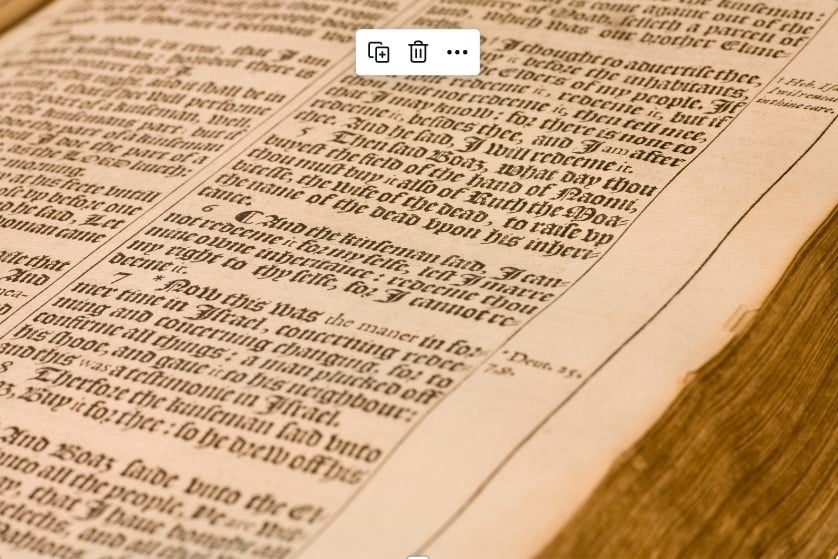
On the first day of my undergraduate classes on the Bible each semester, I tell my students which Bible translations are acceptable for the class.  The basic answer: most any modern translation is fine (though I myself prefer the New Revised Standard Version), but I do not allow paraphrases (such as the ol' favorite, The Living Bible, or the more recent The Message -- which are not actually translations from the original Hebrew and Greek, but are simplifications of previously existing English translations and as a result can be highly interpretive and misleading) or the King James Version. When I tell them I do not allow the King James, I let them know that I think the King James is one of the great classics of English literature.  As a piece of writing, it is arguably the most significant work ever produced in English.  But it is decidedly not a good study Bible.  That is for several reasons.  As I've suggested and will say more about in a future post, one is that the manuscripts [...]

2025-09-10T13:00:49-04:00January 4th, 2023|Public Forum, Reflections and Ruminations|

An Unusually Significant Reference Work: The Encyclopedia of Ancient History

These past few weeks I've been reading up on various issues connected with the Ancient Near East (not my long suit) and have had occasion to make reference to a fantastic reference tool that everyone should know about but (other than scholars of antiquity)  hardly anyone does: The Wiley-Blackwell Encyclopedia of Ancient History.  I posted on it nine years ago and have now realized it would be useful to do so again.  So, for an end of the year special, here it is!  (I've made a crucial addition in bold!) ****************************** I’m pleased to be able to announce (and only a month after the fact  -- this was 9 years ago) that after years of labor, the thirteen-volume Encyclopedia of Ancient History, ed. by Roger Bagnall, Kai Bodersen, Craige Champion, Andrew Erskine, and Sabine Hueber has now appeared, published by Wiley-Blackwell.   It’s not exactly an affordable reference tool for everyone’s library.    The list price is $1995.00!  But you can save $354 on Amazon, if you’re loaded and looking for the most authoritative and up-to-date reference [...]

2025-09-10T13:00:36-04:00January 3rd, 2023|Book Discussions|
Go to Top