
Search
Advanced search
Aren’t You Inconsistent in Your View of the Historicity of the Gospels?
Do contradictions in a story show that it didn’t happen? When I first responded (a few days ago) to Mark Goodacre’s five points calling into question the traditional story of the discovery of the Nag Hammadi Library, I was intrigued to receive a number of comments suggesting I sure seemed to be inconsistent in how I dealt with historical accounts. To wit: Why would I say contradictions in the Nag Hammadi discovery story (that Mark pointed out) DON’T show that the basic account is false — that is, didn’t happen — but I DO use contradictions to call the Gospel accounts of Jesus into question. Is this an agenda-driven inconsistency? All right — fair question. First let me remind you that
October 25, 2023
New Policy on Platinum Guest Posts
You are unauthorized to view this page. Username Password Remember Me Forgot Password
Tags: Platinum
October 16, 2023
Some of the Difficulties in Understanding Gnosticism
Now that I’ve discussed the discovery of the Nag Hammadi Library, I can move into the kinds of religion found among these books, popularly known as the “Gnostic Gospels.” And that will involve laying out the views found among the various Christian groups of the second and third century (principally) that scholars call Gnostic. Gnosticism is a fascinating topic, but it is also widely misunderstood, in no small part because scholarship on Gnosticism over the past twenty or thirty years ago has shown that the widely held views of earlier generations of scholars were based more on assumption than on evidence. There have long been heated debates over even how to define Gnosticism. Until about a hundred years ago, just about the only sources scholars used for understanding Gnosticism were the writings of its most vocal opponents, the proto-orthodox church fathers of the second, third, and fourth centuries. The problem is, as we all know so well (think: American politics!) you can’t really rely on what a group’s enemies say if you want to know […]
October 26, 2023
Gnostic Views in General and the More Specific Views of One Known Group (The Sethians)
I can now describe as succinctly as possible the basic views that appear to have been widely shared among various of the Gnostic groups, before giving a bit more detailed information on one of our best known groups, the Sethians. All this is taken from my textbook The New Testament: A Historical Introduction to the Early Christian Writings (Oxford University Press). ****************************** MAJOR VIEWS OF VARIOUS GNOSTIC GROUPS Despite the many differences among the various Gnostic groups, most of them appear to have subscribed to the following views:
October 28, 2023
The Gospel of Judas: The Most Recently Discovered Sethian Gnostic Gospel
For anyone interested in Gnosticism, the most recent full Gnostic Gospel to appear, the Gospel of Judas, is a real treasure. In my previous post I described the broad contours of Gnostic views and the more specific Sethian understanding of the divine realm, the world, humans, an salvation. Different Sethians, of course, would have different views of things (think of all the Catholics, Episcopalians, or Baptists you know or know of!). The Gospel of Judas presents a particularly intriguing form of the Sethian myth. I have said some things about the Gospel of Judas on the blog, but it’s been a few years, so it’s worth talking about again. You can find a translation, done by my colleague Zlatko Pleŝe, in the volume we co-edited and translated: The Other Gospels: Accounts of Jesus from Outside the New Testament. We also give the following Introduction to the text; I will give the rest of the Introduction and a bibliography, and a bit of the translation itself, in the next post. ****************************** The Gospel of Judas is the […]
October 29, 2023
Reminder: Interesting Lecture on Thursday Oct. 19: Creation Stories not in Genesis!
Hey Blog Folk, Quick reminder of an interesting lecture tomorrow evening (Thursday Oct. 18); it’s free even though we’re hoping for donations (not connected with the blog). Here’s the original annoucement in case you missed, misplaced, misconceived, or misconstrued it: ********************************* Are you interested in the Creation account in Genesis 1? Did you know there are *other* creation accounts in the Hebrew Bible? Different ones? Want to hear about them? And about how they relate to other creation accounts in the ancient world? On October 19, 8:00 pm, my colleague Joseph Lam, professor of Hebrew Bible and the Ancient Near East will be giving a remote public lecture: “Beyond Genesis: The Many Creation Stories of the Bible.” Below you will find a short video that I did with Joseph to explain the event, and a link to sign up for it. This lecture is NOT related to the blog, but it IS a fundraiser for my department (I’m mentioning it here on the blog only because many of you are interested in the topic). The […]
October 18, 2023
The Gospel of Judas: Here’s a Taste of It
Here is the first bit of the Gospel of Judas from the translation of my colleague Zlatko Pleše in our book The Other Gospels. The first paragraph is the explanation of where we got the text from; then the translation of the opening scene. After this bit here, the Gospel gets very strange, at least to most modern readers. But as you can see, it is really interesting. At the end I give the bibliography for further reading that we cite in our book. This translation is based on the Coptic text of Rodolphe Kasser, and Gregor Wurst, eds. The Gospel of Judas: Critical Edition. Washington, DC: National Geographic, 2007. New portions of the Gospel appeared in 2006, when the one-time owner of the manuscript declared bankruptcy and his remaining antiquities collection was turned over to a bank in Ohio; included in this collection were numerous small fragments of the Gospel of Judas. These have been photographed and they have begun to be studied; for our translation of the account here we have been able […]
October 31, 2023
Check Out This Gnostic Myth from the Gospel of Judas!
A lot of people over the years have told me they are drawn to the Gnostic way of looking at things, but it’s pretty clear they’ve never actually read any Gnostic texts. Gnosticism is a lot easier to like in the abstract than in the on-the-ground (or out-of-this-world) reality. When scholars typically describe Gnosticism to general audiences (at least when I do), it usually sounds very weird, rather fascinating, and more-or-less sensible. When people actually read the Gnostic texts, some of them are like that too (weird/fascinating/sensible) – but lots of the texts seem anything but sensible. They are (or seem to be) completely incomprehensible. I thought I’d illustrate the point by giving one form of the Gnostic myth as found in a relatively small but rather dense portion of the Gospel of Judas. Some people find that if they have a basic explanation/sense of Gnostic thought (a weird, fascinating, but sensible one as I tried to several posts ago), it is often possible to get the gist of this kind of myth (although parts […]
November 1, 2023
The Gospel of Philip: An Example of a Valentinian Gnostic Gospel
In my previous post discussing Valentinian Gnosticism I mentioned an intriguing Valentinian text, the Gospel of Philip. Now I’d like to explain what it is and give you a bit of the opening section in translation so you can get a taste of it yourself. I’ve taken all this from the second edition of my book After the New Testament; the introduction is mine but the translation comes from Marvin Meyer, referenced below **************************** INTRODUCTION Even though the Gospel of Philip, also discovered at Nag Hammadi, is easily recognized as Valentinian, the book is notoriously difficult to understand in its details. In part this is due to the form of its composition. It is not a narrative Gospel of the type found in the New Testament or a group of self-contained sayings like the Gospel of Thomas (see Chapter 8). It is instead a collection of mystical reflections that have evidently been excerpted from previously existing sermons, treatises, and theological meditations, brought together here under the name of Philip — presumably Jesus’ own disciple. Since […]
November 4, 2023
A Bizarre Scene in the Gospel of Philip: Jesus Kissing Mary
Did Jesus and Mary Magdalene have an affair? Now that I’ve mentioned the Gospel of Philip, I can’t help but repost a blog from a few years ago, dealing with one of the most intriguing, not to say titillating, passages from this otherwise somewhat obscure Valentinian Gospel. My original post on the topic was in a thread that was discussing whether Jesus was celibate or not, and I argued that the modern idea that he and Mary were intimately involved is … a modern idea (without any foundation other than wild imagination and wishful thinking ) A number of readers responded to my post by pointing out that the non-canonical Gospel of Philip sure does seem to *say* they were intimate! So, what do I have to say about that? I have a reasonably full discussion of the relevant issues in my book Peter, Paul, and Mary Magdalene. In the book I put the discussion in the context of – yes, you guessed it — Dan Brown’s Da Vinci Code, the one source many people […]
November 5, 2023
Want to Sit in on My October Gold Q&A (Monday Oct 30)?
You are unauthorized to view this page. Username Password Remember Me Forgot Password
October 29, 2023
Thomasine Gnostic Christians, and Sundry Others
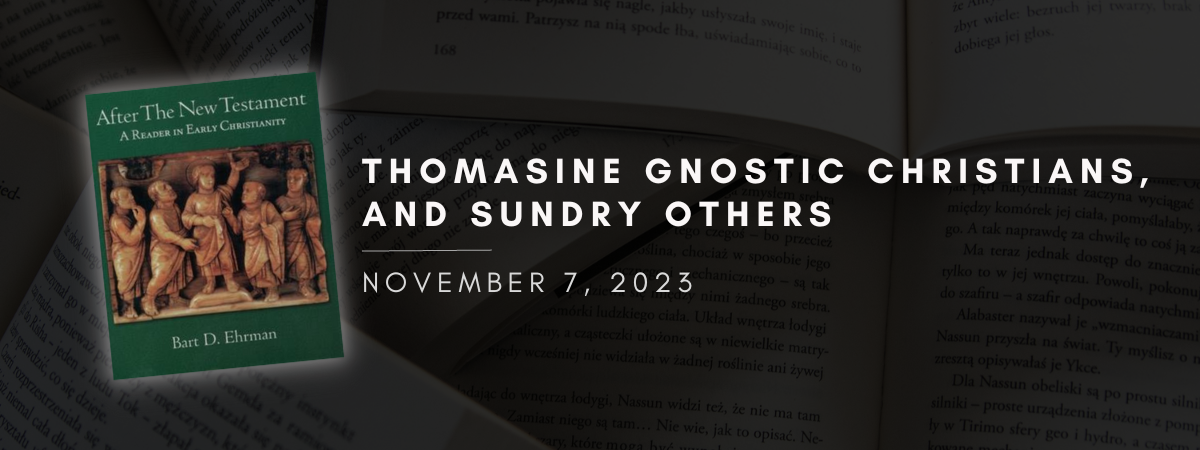
In this thread of posts I have been reproducing my comments on Gnosticism from the 2nd edition of my anthology, After the New Testament. In addition to the Sethians and the Valentinians, scholars talk about the school of Thomas and about yet other Gnostic groups that are not easy to identify with any of the other three or to group together in any meaningful way. Gnosticism was a messy group of religions! Here is what I say in the Introductions to the Thomasines and the Other Gnostic groups in the book. ****************************** Thomasines A number of books from the early Christian tradition are connected with a figure known as Didymus Judas Thomas. The word “Didymus” means “twin” in Greek; so too the name “Thomas” means “twin” in Aramaic. And so this person is Judas, or Jude, the twin. But the twin of whom? In our earliest surviving Gospel, Jesus himself is said to have a brother who is named Jude (for example, Mark 6). And in later traditions, especially from Syria, this Jude was thought […]
November 7, 2023
The Most Famous Non-Canonical Gospel: The Gospel of Thomas
We’ve talked about Gnosticism and in the previous post I mentioned Gnostic groups connected with “Thomas,” allegedly the (twin!) brother of Jesus. There are a number of writings written in the name of Thomas, the most famous of which is the Gospel of Thomas discovered at Nag Hammadi. I haven’t talked at length about it on the blog for several years now, so it seems like a good time to return to it here. This will take three posts. The one today is a broad introduction to what the Gospel is and what it contains. I have taken this from my textbook, The New Testament: A Historical Introduction to the Early Christian Writings. ****************************** The Gospel of Thomas is without question the most significant book discovered in the Nag Hammadi library. Unlike the Gospel of Peter, discovered sixty years earlier, this book is completely preserved. It has no narrative at all, no stories about anything that Jesus did, no references to his death and resurrection. The Gospel of Thomas is a collection of 114 sayings […]
November 8, 2023
What Is the Gospel of Thomas All About? And Did the Author Use the New Testament Gospels?
What is the Gospel of Thomas trying to teach? In my previous post I gave a basic overview of the book; here I go into some more depth (not a huge amount) about what it’s all about, what it’s trying to teach, and whether it depended on Matthew, Mark, and Luke for its sayings.
November 10, 2023
Could the Gospel of Thomas Be Q? Could it Be Older Than the NT Gospels?
A number of blog members over the years have asked about Thomas’s relation to the Synoptic Gospels and the famous Q source — that is, the lost source that both Matthew and Luke used for many of their sayings of Jesus not found in Mark (called Q from the German word Quelle, which means “source”). Here is what I say about those issues in my textbook: The New Testament: A Historical Introduction to the Early Christian Writings (Oxford University Press). ****************************** Thomas and the Q Source. The Gospel of Thomas, with its list of the sayings of Jesus (but no narratives) reminds many scholars of the Q source. Some have maintained that Q was also composed entirely of the sayings of Jesus and that the community for whom it was written was not concerned about Jesus’ activities and experiences, including his death on the cross. If they are right, then something like Thomas’s community was already in existence prior to the writing of the New Testament Gospels. Many other scholars, on the other hand, have their […]
November 11, 2023

A Fundamental Issue: Heresy and Orthodoxy in Early Christianity
I have been talking about various forms of Gnosticism and that now has led me to move into a broader discussion about early Christian “heresy” in general. I’ve talked a lot about non-canonical books, and various forms of Christian belief and practice, and so on over the years, but to my surprise it’s been a very long time since I addressed one of the most fundamental questions of early Christian history, the relationship of “orthodoxy” and “heresy” in early Christianity. The understanding of this relationship has long been much debated, and the debate begins with the terms themselves, which, as it turns out, are notoriously tricky. Part of the issue has to do with their literal or etymological meaning. In terms of etymology, the word “orthodoxy” comes from two Greek terms that mean something like “correct opinion” or “right belief.” The word “heresy” comes from a Greek word that means “choice.” And so someone subscribes to orthodoxy if they hold to the right belief, but they hold to a heresy if they have “chosen” to […]
November 15, 2023
The Most Significant Study of Christian “Heresy” in Modern Times
In my last post I started discussing the terms “orthodoxy” and “heresy,” pointing out that their traditional/etymological meanings are not very helpful for historians. “Orthodoxy” literally means the “right belief” about God, Christ, the world and so on. That means it is a theological term about religious truth. But historians are not theologians who can tell you what is theologically true; they are scholars who try to establish what happened in the past. And so how can a historian, acting as a historian, say that one group of believers is right and that another is wrong? The problem with the two terms came to particular expression in a book written in 1934 by a German scholar named Walter Bauer. The book was auf Deutsch, but its English title is Orthodoxy and Heresy in Earliest Christianity. For my money, this was the most important book on early Christianity written in the 20th century. It completely revolutionized how we are to understand the theological controversies that were wracking the Christian church in its early years. If you […]
November 16, 2023