
Search
Advanced search
BBC Clip on “The Lost Gospels”
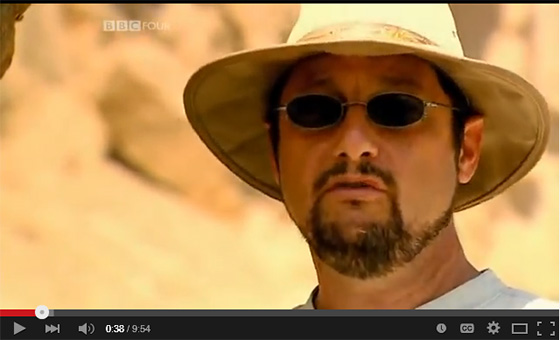
On Tuesday the 21st, September 2010, BBC FOUR aired “The Lost Gospels.” I was one of the talking heads. The presenter was an interesting fellow, an Anglican priest Pete Owen Jones. The show included several on-location discourses. They flew me to Egypt for the taping. Some of it was done near the village of Nag Hammadi, at the spot where the so-called “Nag Hammadi Library” was discovered in 1945. The fourteen books found in a jar in this wilderness area contain 52 tractates, the famous “Gnostic Gospels.” The most famous of these was and is the Gospel of Thomas. The clip here includes a shot in a busy market in Cairo, where we are sipping coffee and thinking deep thoughts together. In the clip I talk about the Gospel of Thomas, and I would like to make one point before you watch it. For over a decade now a lot of scholars of Gnosticism have argued that this Gospel is not actually a Gnostic Gospel. None of the complicated Gnostic mythology that […]
Tags: Gospel of Thomas
April 20, 2015
My Memory Book, Chapter 4 Again: The Death of Jesus
I am in the midst of a thread summarizing my current book project, Jesus Before the Gospels, which I am writing now, even as we speak. The book will have six major chapters and a short conclusion. Yesterday I finished drafting chapter 5, and hope to polish off the final two chapters next week, before revising it and sending it out to readers for comments. In my previous posts I said some things about chapter 4, “False Memories and the Death of Jesus.” This chapter begins with a short summary of what psychologists have discovered about personal memories, and how we remember, since the first experiments were published in 1885 down to the present day. My interest is both in how we as humans tend to remember the “gist” of what happened in the past and how also we “misremember” things. Our memories are faulty, frail, and sometimes even false. The eyewitnesses to Jesus’ life had faulty memories as well – they must have had, if they were human beings. I will be arguing in […]
Tags: death of Jesus, memory
April 15, 2015
Differences Between Oral and Written Cultures
Chapter 5 of my book Jesus Before the Gospels (tentatively titled) is called “False Memories and the Life of Jesus” (tentatively titled). The first part of the chapter deals with a very common misconception about oral traditions in oral cultures – a misconception I hear all the time from lots of people, including my students who get upset when I discuss how traditions about Jesus appear to have been altered in the process of retelling in the years before the Gospels were written. The misconception is that in oral cultures, people had better memories than those of us who live in written cultures, and that they went out of the way to make sure that they preserved their cherished traditions – including their sacred traditions – with great accuracy, since there was no other way to preserve them in a world without writing. You may well have heard that yourself. You may well have believed it. It’s widely believed. But it appears to be wrong. My hunch is that this is one of those modern […]
Tags: false memory, oral culture, written culture
April 16, 2015
“The Same” Traditions in Oral Cultures
As I have been discussing my next book Jesus Before the Gospels, I have been trying to summarize the issues I’ll be addressing and the points I’ll be making, without spilling all the beans and stealing my own thunder. My idea is to get people interested in the book without making them think they don’t now need to read it! I’m not sure how successful I’m being at that, but it’s at least the goal. As I started indicating in the previous post, chapter 5 deals with issues involving oral tradition as preserved in oral culture. It turns out that most of what many (most?) of us have heard about oral cultures, or what has to many (most?) of us seemed commonsensical about them, is wrong. At least in so far as research has been able to show, by actually studying oral cultures. What many of us have heard or thought is that oral cultures were particularly keen to keep their oral traditions intact and preserved without significant (or any) variation. We’ve heard stories about […]
Tags: oral culture
April 17, 2015
On Being Controversial
In this post I am going to take a bit of time out to do some self-reflection. An issue I’ve been puzzling over for some time is the fact that people keep referring to my work as “controversial.” I hear this all the time. And truth be told, I’ve always found it bit odd and a disconcerting. This past week I’ve had two people tell me that they know that I “like to be controversial.” That’s actually not the case at all. One person told me that she had seen a TV show where someone had said that they didn’t believe that Jesus existed, and she thought that was right up my alley. I didn’t bother to tell her that I had written an entire book arguing that Jesus certainly did exist. She simply assumed that this was the sort of view that I myself would have and delight in making public. The reason I find that the idea I’m controversial is that my views about the historical Jesus, the authorship of the books of […]
Tags: controversy
April 19, 2015
My Memory Book: False Memories and the Life of Jesus
As I indicated in my previous two posts, the fifth chapter of the book I’m now writing, Jesus Before The Gospels, deals with “False Memories and the Life of Jesus.” The first part of the chapter shows what we know about how traditions are kept alive in oral cultures, as they are told and retold, either by professionals who are experts or by regular ole folk who are not. And so this part of the chapter summarizes the research into oral cultures undertaken by anthropologists. Of course there are no anthropologists who can study ancient cultures, at least in the way they can study modern cultures, when they can go in to observe how the culture “works,” interview people, and get to know the cultural world first-hand. But it is possible to apply the findings of modern anthropology to long-deceased cultures, such as the Christian communities of the first century. And that’s what I try to do in this chapter. My specific interest is in how Jesus was remembered in these cultures that passed along […]
Tags: born again, historical jesus, memory
April 20, 2015
My Memory Book, Chapter 6 on “Collective Memory”
The sixth chapter of my book Jesus Before the Gospels is tentatively entitled “Collective Memory and Early Recollections of Jesus.” In it I deal with the phenomenon that sociologists call collective memory. This phenomenon is different from the one we normally think of when we think of memory; most of the time we think of the psychological phenomenon of individual memories – either of things we’ve experienced (“episodic” memories, as they are called, as I have pointed out), or or things we have learned about the world (“semantic” memories), or of things we know how to do, such as hit a backhand in tennis or ride a bike (“procedural “ memories). Sociologists for the past 90 years, though, have talked about how social groups reconstruct and imagine and preserve the past. Here is how I introduce the matter in my chapter, before beginning to talk about the sociologists who pioneered the field (Maurice Halbwachs) and developed it (Jan Assmann and Barry Schwartz, for example) ******************************************************************* I first began to see that memory is radically affected by […]
Tags: Collective memory
April 22, 2015
More on Collective Memory
As I discussed in my previous post, the sixth chapter of my proposed book Jesus Before the Gospels will cover the area of “collective memory.” This is a kind of memory that a lot of people don’t seem to be aware of, but it has long been discussed by sociologists. Here is how I summarize the views of the famous scholar who first articulated an understanding of collective memory, Maurice Halbwachs. *************************************************************** The term “collective memory” was coined by French philosopher and sociologist Maurice Halbwachs (1877-1945). His most important and influential book appeared (in French) in 1925 and was called, simply, On Collective Memory. Halbwachs acknowledges the rather obvious point that it is individuals, not social groups, who remember the past (society does not have some kind of enormous hippocampus!). But in his view, individual memories have all be reconstructed based on our relation to society around us, especially our various social groups – for example, our families, friends, towns or cities, nations. It is impossible, in fact, for us to remember without having a […]
Tags: Collective memory, Maurice Halbwachs
April 24, 2015
The Community Behind the Gospel of John
In chapter 6 of my proposed book Jesus Before the Gospels, after I deal with collective memory in theory, I move on to talk about how Jesus was remembered in three different early Christian communities, those behind the Gospels of Mark (our earliest canonical Gospel), John (our latest canonical Gospel), and Thomas (our best known non-canonical Gospel). One thing we have learned from memory studies is that the present affects not only what is remembered about the past, but also how it is remembered. That is true for communities as well as individuals. And so in my treatment of how Jesus was remembered in such different ways in these three communities, I discuss as well what can be established or at least surmised about the historical circumstances that would have made such memories plausible. I don’t want to spill the beans here about what I say for each of these communities, but I do want to show how scholars have tried to establish the historical context for one of them, the one behind the Gospel […]
Tags: Gospel of John
April 25, 2015
The Community Behind the Gospel of John: Part 2
In the last post I began to discuss what we can know about the history of the community that produced (or that produced someone who produced) the Gospel of John. The reason for dealing with this question is this: one of the overarching theses of my book on memory and the historical Jesus is that the things we experience in the present affect how we remember the past. They affect which parts of the past we remember (if they something in the past isn’t relevant for something in the present, we don’t bother to recall it; that’s just how memory works) and they radically affect how we remember. The past is always shaped, in our minds (unconsciously), by the present. My argument in the book is that this is true not only of us as individuals but also for us as social groups. Collective memory reflects the present as well as the past, or rather it reflects the past as it is molded by the present. To illustrate the point here on the blog, I’m […]
Tags: Gospel of John
April 28, 2015
Help! My Views of Memory
I am thinking about ending my book with a kind of Paean to Memory. I expect that some people will find it a bit controversial or even off-putting. Or maybe not! Here is what a draft of the kind of thing I’m thinking about saying. Let me know what you think. (It’s longer than my typical post.) ******************************************************************************* Like most authors, I get a lot of email from people who have read my books. I find one of the comments I repeatedly receive somewhat puzzling and even disheartening. To explain it, I need to provide a bit of background. When I discuss historical understandings of the New Testament and of the historical Jesus, I frequently refer to the problems of our sources. The Gospels were written decades after Jesus’ death by people who were not eyewitnesses and had probably never laid eyes on an eyewitness. They are filled with discrepancies and contradictions. They represent different perspectives on what Jesus said and did. For that reason, to know what actually happened in the life […]
Tags: memory
April 29, 2015
My Final Exam for NT
So, classes are officially over here at UNC, and we are in the Final Exam period. Today I gave my final for the Introduction to the New Testament class. As some of you may recall, back in January 2014 I posted on the blog the pop quiz I give the first day of class for this course. It is here, in case you’re interested: https://ehrmanblog.org/new-testament-pop-quiz/ When I give this quiz on the first day, I tell the students that even if they bomb it (which most of them do), it’s nothing compared to what they’re going to be learning in the class over the course of the semester. Looking at the Final Exam in comparison with this introductory pop quiz pretty much shows it. Anyway, comparisons or not, I thought you might be interested in the exam, to see how you would do. And so I give it below in its entirety For the i.d.s, anything they’ve read or heard during the semester is fair game. I don’t give them […]
Tags: final exam, introduction to the New Testament, pedagogy
May 1, 2015
York Symposium on Early Christian Apocrypha
I thought some of you might be interested to know about a symposium focusing on early Christian apocrypha that will be taking place in the fall. The schedule for the event has just been sent. If any of you is near there, you should think about going! It looks terrific. It is being organized principally by Tony Burke, along with Brent Landau; they are two very active scholars in the field of apocrypha studies. Here’s what the lineup looks like. *************************************************************** Fakes, Forgeries, and Fictions: Writing Ancient and Modern Christian Apocrypha The 2015 York University Christian Apocrypha Symposium will take place September 24-26 at Vanier College, York University. The specific objectives for the 2015 Symposium are: 1. to examine the possible motivations behind the production of Christian Apocrypha from antiquity until the present day, 2. to integrate medieval and modern apocrypha (composed in the 19th to 21st centuries) into the wider study of apocryphal literature, and 3. to reflect on what the reactions to the recently-publishedGospel of Jesus’ Wife can tell us about […]
Tags: Apocrypha, York Symposium
May 2, 2015
Lecture: Jesus and the Historian
On Tuesday, February 25, 2014 I gave a lecture at Dickinson College (Carlisle Pennsylvania) on “Jesus and the Historian,” in the Anita Tuvin Schlechter Auditorium. In the lecture I deal with the historical problems posed by the surviving Gospels for evaluating the evidence for the life and teachings of Jesus. Please adjust gear icon for 720p High-Definition (The quality is not as good as one might hope, but it’s the best we can do given the original source)
Tags: Dickinson College, historical jesus
June 7, 2015
Steps Toward Publishing the (a) Book
I am now nearly done with the draft of my book Jesus Before the Gospels (whatever it will eventually will be called), and want to say sundry things about the actual writing of the book here near the end. (Before I do: if any of you has any questions about the topic I’m covering or anything relevant you would like me to post on, let me know: if I don’t have issues to address involving memory, the historical Jesus, oral tradition, and so on, I’ll move on to other things on the blog.) First, in an earlier post I gave members of the blog an option of reading the book in manuscript form in advance. In case you missed it, here is the offer, which is still open and will be for another three days only. I am using this opportunity as a way of raising money for the blog (well, for the Bart Ehrman Foundation, which, as you know, gives all the money raised by the blog to charities dealing with hunger and homelessness). […]
Tags: publishing a book
May 5, 2015
Another Jewish Miracle Worker
One more post dealing with my memory book before moving on to other things. I thought readers of the blog might be interested in the following passage, where I talk about a famous Jewish teacher who was known, on the basis of eyewitness reports, to heal the sick, cast out demons, and raise the dead. No, I’m not talking about Jesus. I’m talking about the an 18th century holy man, who founded Hasidic Judaism. Here is what I have to say, in the course of my chapter 3. (The following is a relatively unedited draft: it is not polished yet for style or typos, so don’t worry about those…. The discussion occurs in the middle of a chapter on the value of eyewitness testimony; I include the preceding paragraph to give some context) *************************************************************** To sum up the situation, consider the words of one of the world’s leading experts on distorted memory, Daniel Schacter, “Numerous experiments have demonstrated ways in which imagining events can lead to the development of false memories for those events.”[1] But […]
Tags: Ball Shem Tov, eyewitness testimony, Hasidism
May 6, 2015
Truth and History
In my recent post in which I made a paean to memory – which will be the way I end my current book dealing with memory and the historical Jesus — I said the following. MY REMARK: “The comment that I sometimes get from readers that I find puzzling or disheartening is when they tell me that if there is something in the Gospels that is not historical, then it cannot be true, and if it is not true, then it is not worth reading. My sense is that many readers will find it puzzling or even disheartening that I find this view puzzling and disheartening. But I do. Please call me a prophet if you must, but I would like to point out that a number of readers on the blog did indeed find my view puzzling and disheartening. Mainly puzzling. The following was a very well reasoned response from a reader, to which I would like to reply: READER’S COMMENT: Indeed, stories that aren’t true are no less worthwhile to read. The Bible […]
May 8, 2015
What Can We Know about the Life of Jesus?
QUESTION: You have stated in your various works that there are some things that we can accept as likely historically true concerning Jesus’ life; his origin in Galilee, his association with John the Baptizer, his crucifixion, etc. For the rest of the episodes in Jesus’ life do we have to content ourselves with contemplation of what this or that gospel tells us about its author and community? Should we just “get over” this desire to know what really happened two thousand years ago? RESPONSE: Yes, this is a very important question. Of paramount importance! Here is a sample of how I deal with it in my just-finished-and-ready-to-send-to-my-readers book. This is from Chapter 5, “False Memories and the Life of Jesus.” This is the chapter where I discuss what anthropologists have told us about oral cultures and the way they preserve their traditions; it’s a crucial chapter since so many people seem to think that in oral cultures people have better memories that we do, and that they make sure not to change traditions that […]
Tags: historical jesus, oral traditions
May 9, 2015
Year Three on the Blog
QUESTION: If I remember right, you just passed the three year mark of the blog. How much have you raised total? RESPONSE: Right! This will be just a short post to provide an update on the blog. Yes indeed, we passed the three-year mark a month ago, on April 4. I was going to make a post summarizing the year, but other things got in the way and I ended up doing other threads and never got back to it. So I’ll do it now, a month late. The blog is still doing great and getting ever better, in my opinion. First, in direct answer to the question about the money that has been raised. That is the matter particularly near and dear to my heart. It’s my ultimate interest, as I’ve said numerous times, since the entire point of the blog, in one sense, is to raise money for charity. I am very happy indeed to say that we raised $78,000 in our third year of operation. That is significant money, obviously, and […]
My Fundamentalist Beginning
Lately I’ve been thinking a good deal about my completely ambivalent relationship to my past, in particular in relation to my education at Moody Bible Institute. In part my thinking has been set off by an email I received from my roommate and best friend at the time, and for years, who was the best man in my wedding and confidante and most closest male friend I had ever had. He has remained a committed evangelical Christian all these years and continues in ministry. We never have contact any more, but he reached out to me to say hey, and I’ve been flooded with memories and thoughts since. There is a very big part of me – probably the most noticeable part – that is deeply resentful toward my time at Moody. But there is another part that occasionally arises to the surface, which realizes that in many ways those three years were very good for me. Without them, I would not be who I have become and what I am. Sometimes I forget that. […]
Tags: Moody Bible Institute
May 11, 2015