
Sorting by

×

About BDEhrman

Ehrman is the James A. Gray Distinguished Professor of Religious Studies at the University of North Carolina at Chapel Hill, where he has served as the director of graduate studies and chair of the Department of Religious Studies.

A Very Strange Saying: From the Gospel of Peter?

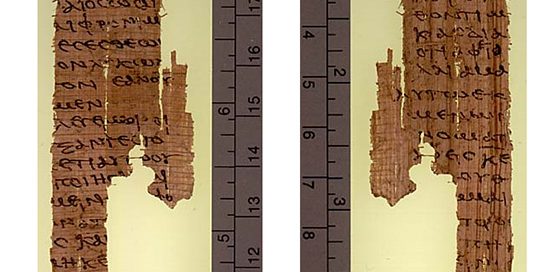
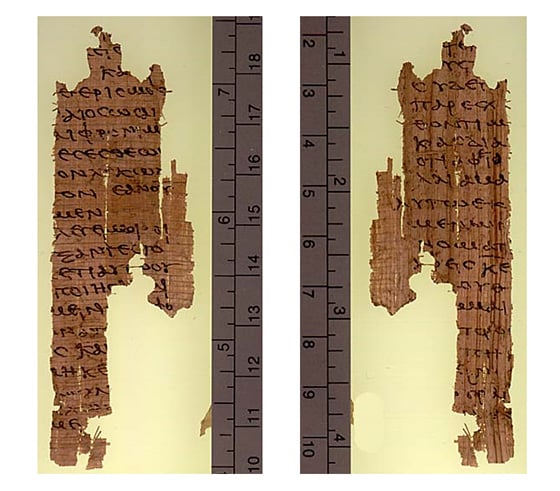
As I pointed out yesterday, the "Gospel of Peter" that we have today, discovered in 1886, is unfortunately, only a portion – the only surviving portion – of what was once a complete Gospel. But was it a complete Gospel? Or was it only a passion Gospel (like the later Gospel of Nicodemus) that gave an account only of the trial, death, and resurrection of Jesus? That has long been debated. I discussed one intriguing view of the matter some years ago on the blog, as follows: In recent years a German scholar named Dieter Luhrmann has argued that other portions of the Gospel of Peter have shown up, in very small fragments of papyrus discovered in Egypt.  It is a controversial claim.  The most interesting possibility, for me, is a papyrus fragment that Luhrmann published called Papyrus Oxyrhynchus 4009 (it is the 4009th papyrus published from the huge find of papyri in the trash heap of ancient Oxyrhynchus Egypt). To understand why this *might* be a fragment of the Gospel of Peter requires a [...]

The Exasperatingly Fragmentary Gospel of Peter: Readers’ Mailbag December 4, 2017

My Readers’ Mailbag is stuffed, and I need to clear out a few questions to make room for others that come in.  So I may be answering more than normal over the next couple of weeks.  Here is one that I find intriguing:   QUESTION If you could choose any currently-fragmentary or otherwise lacunose document from antiquity and magically receive a reconstructed version to read, what would it be?   RESPONSE Wow.   There are lots to choose from.   I would probably come up with different answers on different days of the week, but the first thing that springs to mind is the Gospel of Peter, one of the most interesting of the ancient non-canonical Gospels.  We have only a fragment of the book, which begins smack dab in the middle of an episode and ends, literally, in the middle of a sentence.   To show why that’s so tantalizing, let me first say a bit about what the Gospel is (at least that part of it we still have!). The Gospel comes from one of the [...]

2025-09-10T12:39:31-04:00December 4th, 2017|Christian Apocrypha, Reader’s Questions|

Could Q Have Been Lost? Readers’ Mailbag December 3, 2017

I have received a lot of questions about Q this week.  If you’re wondering about why blog members are interested in a figure from Star Trek, you may want to review this week’s posts.  Here is a question that I find particularly intriguing.   QUESTION: It is hard to believe that Q, if it existed, circulated enough to be used by both but then dropped off the face of the Earth without so much as a mention by an early church father, while references to so many other documents survived (with some being found).   RESPONSE: Ah, this is an interesting observation and involves a set of questions that I’m very interested in but have never published (much of) anything about.  How much of the early Christian literature was lost?  Could early Christians simply have allowed important writings to disappear (even if independent once knew them)? To the historian’s eternal chagrin, the answer appears to be yes.  My guess is that most early Christians simply didn’t see a need to preserve their writings for posterity [...]

Last Minute: Dinner on Thursday?

I will be having dinner with several blog members this Thursday in Durham NC, my home turf.   We have had a cancellation, and so there is one more open spot at the table.   If anyone is interested in coming, please contact me at [email protected]   There are no obligations other than showing up, paying for your dinner, and talking about whatever suits your fancy for a couple of hours!

2025-09-10T12:39:30-04:00December 2nd, 2017|Public Forum|

Redaction Criticism of the Gospels

  In a previous post I explained why scholars have long held to "Markan Priority," the view that Mark was the first Gospel written and that Matthew and Luke both used it for constructing their own narratives.   One great pay-off for this conclusion (it really is significant) is that it is possible, given this result, to see how Matthew and Luke have each *modified* Mark in the stories they received from him.  This approach is called "redaction criticism."  A "redactor" is an editor.  Redaction criticism looks at the editing decisions made by an editor of a source. Years ago I described the method and gave an illustration of how it worked on the blog, in part to show that finding the differences between the Gospels is not necessarily a *negative* thing, but can have very *positive* results for interpreting the message each one has.  This is what I said then: ********************************************************************* I have stressed that knowing that there are differences, even discrepancies, among the Gospels does not need to be considered in a purely negative [...]

And Then There Was Q

After my post yesterday about the "priority of Mark" (the view almost universally held among scholars that Mark was the first Gospel written and that Matthew and Luke used it for many of their own stories) I received a number of queries from readers about the "Q" source.   So I better address that as well. Matthew and Luke obviously share a number of stories with Mark, but they also share with each other a number of passages not found in Mark.  Most of these passages (all but two of them) involve sayings of Jesus -- for example, the Beatitudes and the Lord's Prayer.  Since they didn't get these passages from Mark, where did they get them?   Since the 19th century scholars have argued that Matthew did not get them from Luke or Luke from Matthew (for reasons I'll suggest below); that probably means they got them from some other source, a document that no longer survives. This came to be known as the "Sayings Source."  The scholars who developed this view were principally German, and [...]

2025-09-10T12:39:15-04:00November 29th, 2017|Canonical Gospels, Reader’s Questions|

Arguments for Markan Priority (that Mark was the first Gospel written)

For reasons related to an unusually convoluted thread (I’d be surprised if anyone can even detect the thread!  I myself barely can – it has to do with Jesus’ view of the afterlife) I need to answer a reader’s question about why scholars think the Gospel of Mark was the first to be written (once I do that, I can show how Luke often changed Mark, which will get me back to Luke’s treatment of Jesus’ rejection in Nazareth, which will get me back to the parable of Lazarus and the rich man, which will get me back to the question of whether the parable represents Jesus’ own views….). So far as I can tell, and to my surprise, I’ve never published a blog post showing why scholars – since the 19th century – have typically maintained that Mark was the first of the Synoptic Gospels to be written and that Luke and Matthew both used Mark for many of their own stories about Jesus.   That view is called “Markan priority” (Mark is prior to [...]

2025-09-10T12:39:15-04:00November 28th, 2017|Canonical Gospels, Public Forum|

Jesus’ Death and Resurrection in Mark: Another Blast from the Past

I have been talking about how no one in Mark's Gospel (as opposed to the other Gospels) knows who Jesus is -- not his family, his townsfolk, the Jewish leaders, not even his disciples.  But the reader knows.  Yet  even the reader is not given the full scoop until the end.  Here is how I explain the matter, in a post from years ago. ************************************************************ Jesus' Death as the Son of God It is clear from Mark's Gospel that Jesus' disciples never do come to understand who he is. As we have seen, he is betrayed to the Jewish authorities by one of them, Judas Iscariot. On the night of his arrest, he is denied three times by another, his closest disciple, Peter. All the others scatter, unwilling to stand up for him in the hour of his distress. Perhaps Mark wants his readers to understand that the disciples were shocked when their hopes concerning Jesus as messiah were thoroughly dashed: Jesus did not bring victory over the Romans or restore the kingdom to Israel. [...]

2025-09-10T12:39:14-04:00November 27th, 2017|Canonical Gospels, Public Forum|

Mark’s Suffering Son of God: A Blast From the Past

In my previous two posts I've pointed out that no one seems to understand who Jesus is in the Gospel of Mark.   In this post I want to show how Mark himself understands Jesus.  Here is how I discussed the matter several years ago on the blog. ******************************************************************** Jesus The Suffering Son of God Throughout the early portions of Mark's Gospel the reader is given several indications that Jesus will have to die (e.g., 2:20; 3:6). After Peter's confession, however, Jesus begins to be quite explicit about it. Even though he is the Christ, the Son of God -- or rather, because he is -- he must suffer death. Three times Jesus predicts his own impending passion in Jerusalem: he is to be rejected by the Jewish leaders, killed, and then raised from the dead. Strikingly, after each of these "Passion predictions" Mark has placed stories to show that the disciples never do understand what Jesus is talking about.   FOR THE REST OF THIS POST, log in as a member. If you don't belong [...]

2025-09-10T12:39:14-04:00November 24th, 2017|Canonical Gospels, Public Forum|

Jesus in Mark: Who Knew?

In my previous post I pointed out that Jesus' mother (and brothers) don't seem to know who he really is in Mark.  This is part of a broader theme distinctive to Mark's Gospel, a theme that is considerably downplayed in the other Gospels (and almost completely done away with in John).  Mark wants to emphasize, repeatedly, that no one seemed to understand who Jesus was throughout his entire ministry.  Here is what I say on the theme in my textbook on the New Testament, in the chapter on Mark. *************************************************************** Jesus The Misunderstood Son of God One way to establish "misunderstanding" as a Markan theme is to read carefully through the first half of the Gospel and ask, "Who realizes that Jesus is the Son of God?" The answer may come as a bit of a surprise. Clearly God knows that Jesus is his Son, because he himself declares it at the baptism (1:11). And since this declaration comes directly to Jesus ("You are my beloved Son"), the reader can assume that he knows it [...]

2025-09-10T12:39:14-04:00November 22nd, 2017|Canonical Gospels, Public Forum|

The Women in Matthew’s Genealogy: Answer to a Reader

Yesterday I received this question in response to a post: QUESTION: I have also heard that hints of the possibility of Jesus’ illegitimacy can be found in Matthew’s hereditary narratives. It is a bit of a stretch but Matthew names 4 women in them and all 4 are somewhat” loose” women, giving the hint that illegitimacy can still produce remarkable people. Any thoughts on this? RESPONSE: Ah, great question.  Here is what I say about it in my textbook on the New Testament: There is one other interesting and frequently-noted feature of Matthew’s genealogy of Jesus (actually, not of Jesus, but of Joseph). That is the fact that it makes explicit reference to women among Jesus’ ancestors. That is highly unusual. Women scarcely ever appear in most ancient Israelite and Jewish genealogies;, which invariably trace a person’s lineage from father to son (or vice versa) all the way back through the family line; see, as I pointed out earlier 1 Chronicles 1-9. Where are the women? For ancient genealogists, as a rule, they were not [...]

2025-09-10T12:39:15-04:00November 21st, 2017|Canonical Gospels, Reader’s Questions|

Jesus’ (Young?) Mother and (Half?) Brothers? The Proto-Gospel of James

A few days ago lot of readers made comments on the question (thanks to the Roy Moore newsflashes) of whether Mary was a young girl when she got married; and now I have mentioned Jesus' mother and brothers in Mark's Gospels.  So let me say a few more things about them. The earliest non-canonical source that talks about Jesus' mother (indicating she was a teenager -- not something found in the NT) and his brothers (were they really is brothers?) is in the non-canonical Proto-Gospel of James, from some time in the second century.  I thought it might be useful for me to re-post a discussion of the matter from a number of years ago, here: ************************************************************** The Proto-Gospel of James was very popular in Eastern, Greek-speaking Christianity throughout the Ages, down to modern times; and a version of it was produced – with serious additions and changes – in Latin, that was even more influential in Western Christianity (a book now known as the Gospel of Pseudo-Matthew).   In some times and places, these books [...]

Jesus’ Mother and Brothers in Mark

A brief tangent on Mark’s account of Jesus’ rejection in his hometown (Mark 6:1-6), as summarized in my post.  As I indicated there, Jesus’ townspeople are incredulous that he can deliver such an impressive address in the synagogue.  They ask: “Where did he get such these things?  What what is this wisdom that has been given to him?  And how can such miracles be worked through his hands?  Is he not the carpenter, the son of Mary, and the brother of James, Joses, Juda and Simon?  And aren’t his sisters here with us?” In other words: the townsfolk knew of Jesus as an unimpressive member of the community, who worked a day job with his hands (say, a construction worker) – not great miracles (with his hands).  And his family was all there. The comments on the family are interesting and have prompted a lot of discussion over the years. To begin with, Jesus is here said to be “the son of Mary.”  As frequently noted, that’s a bit odd.  Normally ... To read the [...]

2025-09-10T12:39:15-04:00November 19th, 2017|Canonical Gospels, Historical Jesus, Public Forum|

Jesus Rejected by His Own Townspeople in Mark

I want to show in some depth why I think the parable of Lazarus and the rich man in Luke 16:19-31 does not originally go back to Jesus himself, but is a story that Luke either came up with himself or inherited from the oral tradition.   Recall:  the rich man feasts sumptuously; Lazarus is impoverished and desperate for the crumbs from the man’s table.  They both die.  Lazarus is carried by the angels to “Abraham’s bosom” where he is in blessed and satisfied; the rich man is sent off to Hades to be tormented in the flames.  When the rich man pleads with Abraham to have Lazarus come and provide him some temporary relief, Abraham indicates it is not possible.  When he asks for him to go and warn his five brothers to repent, he is told that there is no point: if the brothers don’t listen to Moses and the prophets, they won’t listen “even if a person is raised from the dead.” The parable is found only in Luke (so it is not [...]

2025-09-10T12:39:15-04:00November 17th, 2017|Canonical Gospels, Public Forum|

Paul’s Exalted Self-Image: The Fulfillment of Ancient Prophecy

I am off today to Boston for a week of various professional activities.  Tomorrow morning I will be filming a documentary with an independent film maker on some aspect of the New Testament.  After that I’ll be having lunch with about a dozen members of the blog, and then dinner with three or four.   Following that, on Friday, I will be giving a talk at the Biblical Archaeology Society FEST (a gathering of interested lay folk to hear lectures by scholars for a couple of days).  And then it’s off to my annual professional meeting, with thousands of other biblical scholars from the U.S. and around the world, the Society of Biblical Literature meeting. My talk at the Biblical Archaeology Society will be about Paul and his understanding of his mission.  About a year ago I realized something I had never thought of before.  Paul actually understood himself, personally, to have been predicted by the prophets of the Old Testament as the fulfillment of God’s plan.  Wow.   Here is how I have thought about and [...]

2025-09-10T12:39:15-04:00November 15th, 2017|Paul and His Letters, Public Forum|

What Is the Original Text of the Gospels?

QUESTION: When it comes to the gospels, how do we define the ‘original text’? Do we define it as the original manuscript that was first penned by the author, or do we define it as the gospels in their most settled canonical form?   RESPONSE: As it turns out, this is a complicated and endlessly fascinating question that, so far as I have been able to work out over the past twenty years of thinking about it, has no clear and obvious answer! By way of very simple background for readers not completely on top of the textual situation we are confronting when it comes to the Gospels (or any of the other books of the New Testament) (or of any ancient Christian writings at all) (or, in fact, of any writings of any kind at all that come down to us from antiquity) we do not have the “originals” (however we define that term: see below!).  What we have are copies made from copies, which were themselves made from copies.  Most of these copies [...]

2025-09-10T12:39:14-04:00November 14th, 2017|Canonical Gospels, New Testament Manuscripts, Public Forum|

How Do I Read Books? A Blast From the Past

Here is an interesting and always germane question I received five years ago.  I would answer the same way today! QUESTION: How do you go about reading books? Which methods do you use in order to read as much as possibile? How do make plans how much to read? Do you highlight things in books? Do you you’re your own comments? Summaries? Any other tips? RESPONSE: Ah, this is an interesting question. As it turns out, there’s not an easy answer. That’s because there are many different ways I read books, depending on what kind of book it is. I realize we’re talking about books dealing with scholarship – not Victorian novels! But I read different books differently depending on what it is, what it’s about, and what I want/need to get out of it. When I was in graduate school I had a friend who insisted that anyone should be able to read an entire book of scholarship every day. I had trouble believing him, but in fact it’s true. In fact, when you [...]

2025-09-10T12:39:14-04:00November 14th, 2017|Book Discussions, Reader’s Questions|

Getting Together and Speaking Gigs

On this post I would like to announce a couple of unusual opportunities for you and me to meet face to face, and to let you know what speaking gigs I’ll be having in the future, as planned so far.. FIRST: I have decided to have a Blog Dinner at a nice restaurant in Durham NC (where I live) with any 3-5 members of the blog who want to come on Thursday December 7. I am keeping the numbers at this level to allow me a chance to talk to everyone there (too large a group and it’s … a large group).    It will be organized simply: I’ll book a table and everyone will meet me there.  Your only expenses are getting there and paying for your meal.  We would talk over the course of drinks and dinner about … anything you’re interested in! Are you interested?   This will be strictly first come first served: the first five members to respond are *in*.  If there is more interest than that, I may schedule a second [...]

2025-09-10T12:39:14-04:00November 12th, 2017|Public Forum|

Ehrman vs Licona Debate on the Resurrection

On April 16, 2011 I had a kind of radio debate with Mike Licona, a conservative Christian apologist and professor at Houston Baptist University.  The venue was the English radio broadcast, "Unbelievable," hosted by moderator Justin Brierley, and the main question under discussion was whether there is "evidence" that Jesus was raised from the dead. Mike had just published his (large) book, called The Resurrection of Jesus: A New Historiographical Approach and wanted to talk about it. He is also the author of The Case for the Resurrection of Jesus.  The debate careens among different topics as the conversation escalates into scholarly challenges. Here it is, for your listening pleasure.

2025-09-10T12:38:58-04:00November 11th, 2017|Bart's Debates, Public Forum, Video Media|

Why Do Translators Include Passages They Know Are Not Original?

Based on what I have said about the textual variant of 666 and 616 in the book of Revelation, several readers have asked a distantly related question.  Here is how one of them phrased it:   QUESTION: If the biblical scholars know with certainty that Mark 16:9-20 and John 7.53-8.11 were added by later scribes, why are they still in the modern bibles, that is, why are they not *completely* removed? I know these verses were removed in the RSV but added back in the NRSV.   RESPONSE: This is a great question.  On one level it doesn’t make sense.  If textual scholars go to all the trouble of trying to figure out what the “original” text of the New Testament was, and they decide that some passages were not originally there in the originals, why do translators (who are often themselves the textual scholars who have made these decisions!) include such passages in their translations? The problem is exacerbated by looking carefully at what translators have done, because strictly speaking they are not consistent.  [...]

2025-09-10T12:39:14-04:00November 8th, 2017|New Testament Manuscripts, Public Forum|
Go to Top