Sorting by

×

About BDEhrman

Ehrman is the James A. Gray Distinguished Professor of Religious Studies at the University of North Carolina at Chapel Hill, where he has served as the director of graduate studies and chair of the Department of Religious Studies.

Lost Christianities

How diverse was early Christianity?  I had been transfixed by this question for a long time when I decided to write a trade book, Lost Christianities.  It was a blast to write and in some ways launched my career of writing for general audiences.  My earlier book Jesus, Apocalyptic Prophet was definitely directed to that crowd, but it was with Lost Christianities that I started kicking broader communication to a wider readership into gear. Here's I'll excerpt by explanation of the book in its Introduction (from Lost Christianities: The Battles for Scripture and the Faiths We Never Knew. Oxford University Press, 2003).  This will take three posts. ********************* It may be difficult to imagine a religious phenomenon more diverse than modern-day Christianity.  There are Roman Catholic missionaries in developing countries, who devote themselves to voluntary poverty for the sake of others, and evangelical televangelists with twelve-step programs to assure financial success and prosperity.  There are New England Presbyterians and Appalachian snake handlers.  There are Greek orthodox priests committed to the liturgical service of God, replete with set [...]

More Lost Scriptures

How did we get our books of the New Testament, and what do we know about the ones that were "left out"?  Here I continue my Introduction to my book Lost Scriptures, as started in my previous post. ****************************** When was this New Testament finally collected and authorized?  The first instance we have of any Christian author urging that our current twenty-seven books, and only these twenty-seven, should be accepted as Scripture occurred in the year 367 CE, in a letter written by the powerful bishop of Alexandria Egypt, Athanasius.  Even then the matter was not finally resolved, however, as different churches, even within the orthodox form of Christianity, had different ideas -- for example, about whether the Apocalypse of John could be accepted as Scripture (it finally was, of course), or whether the Apocalypse of Peter should be (it was not); whether the epistle of Hebrews should be included (it was) or the epistle of Barnabas (it was not); and so on.  In other words, the debates lasted over three hundred years. [...]

ANOTHER Blog Dinner! Thursday, July 18, Wimbledon. Interested?

The first blog dinner I announced (happening tomorrow, Friday July 12) was oversubscribed, and so I'll be doing a second -- this time on my home-away-from-home turf, Wimbledon Village, on Thursday July 18.    Seats are limited. Want one of them? I'll again limit the table to 8, me and the perfect number 7.    For those who come there are no obligations other than: Being a blog member Showing up Talking Paying for whatever you ingest.  Whatever you exgest is free. If you're interested, do NOT reply here as a comment.  Send me an email at [email protected]. Hope you can come!    

2025-09-10T13:08:16-04:00July 11th, 2024|Public Forum|

Lost Scriptures

I was reluctant to write my first trade book (Jesus the Apocalyptic Prophet: see previous post), and had to be dragged into writing my second.  I just wanted to devote myself to technical scholarship.  But, well, I yielded in the end, and I'm glad I did. My second trade book ended up being two books.  I had agreed to write about the "heretical forms" of Christianity and their Scriptures, but then my publisher, Oxford University Press, talked me into not only doing that study (Lost Christianities) but also an accompanying anthology of texts, Lost Scriptures.  Once again I was reluctant (!) but I lost out again, and again I'm glad.  It's been the better selling of the two books, to my great surprise. Here I'll explain what it contains, taken from the Introduction to it (OUP, 2003).  This will take two posts. ****************** General Introduction Even though millions of people world-wide read the New Testament -- whether from curiosity or religious devotion -- very few ask what this collection of books actually is [...]

2025-09-10T13:07:58-04:00July 11th, 2024|Book Discussions, Christian Apocrypha|

My First Trade Book: Jesus, Apocalyptic Prophet

I have started a thread discussing the books I've written for broader audiences.  My first actual "trade book" was Jesus: Apocalyptic Prophet of the New Millennium (Oxford University Press, 1999) (uh, that would be 25 years ago!).   Here is how I explain the book and it's raison d'etre in the Preface.   In case you wonder -- I still hold the same basic views of Jesus now that I did then, and still find the arguments I adduce convincing. ****************************** Preface When anyone has asked me why I’m writing a book about the historical Jesus, I’ve usually replied, “Well, it’s about time someone did.” Actually, at last count there were something like eight zillion books written about Jesus.  And those are just the ones written by scholars.  A good number of these, mainly the lesser known ones, are written by scholars for scholars to promote scholarship; others are written by scholars to popularize scholarly views.  The present book is one of the latter kind.  I really don’t have a lot to say to scholars who [...]

2025-09-10T13:07:58-04:00July 10th, 2024|Book Discussions, Historical Jesus|

How Can We Possibly Know a Scribe’s Intentions? My Most Important Theoretical Reflection

Can we know what a scribe intended to do when he changed the text? Is it actually possible to know what anyone INTENDS?  Isn't that technically impossible, unless we get into their minds somehow?  I had to deal with this issue in the Orthodox Corruption of Scripture and there I laid out the theoretical premises I have/had, to allow me to say that a scribe intended to change a text.  It's a view that most readers completely overlooked, including a bunch of my critics. *********************** Intentionality as a Functional Category The other theoretical claim that I made in Orthodox Corruption involved the broader concept of what it means to describe a scribal alteration of the text as “intentional.”   I have been deeply interested in the question of “intention” for many years, as a philosophical problem (there is considerable philosophical discourse on it, of course), an issue in literary interpretation (especially since Wimsatt and Beardsley’s famous “Intentional Fallacy”), and, naturally, as it relates to scribes. Most textual critics have unproblematically talked about scribal changes being either accidental [...]

2025-09-10T13:07:58-04:00July 9th, 2024|Book Discussions, New Testament Manuscripts|

Free Lecture on Paul’s Life and Letters, Thursday (July 11)

I will be giving a free remote lecture this Thursday, July 11, at 1:00 pm EST.  You're welcome to come!   Sorry 'bout the time -- but I'm in England and so it'll be early evening here. The lecture is designed to be a lead-in to the annual New Insights into the New Testament (NINT) conference that will be happening on September 21-22.  The conference will feature ten speakers who will each give a 50-minute talk with Q&A, all on topics (of speaker's choice) connected with the life and letters of Paul; the talks will all be geared to a general audience at about the level we address things here on the blog and in my online courses (www.bartehrman.com).   The speakers are some of the top Pauline scholars in the cosmos.   We haven't announced the conference yet, but will soon, with instructions about how to register etc. Whoever registers for it will receive a recording of my Thursday lecture for free.  In it I will be presenting basic background into Paul to help get everyone up [...]

2025-09-10T13:08:15-04:00July 8th, 2024|Public Forum|

Are Scribes of Texts Actually Authors?

In my overview of the responses to my book The Orthodox Corruption of Scripture in the Afterword I wrote of the 2nd edition, I began to address some major questions.  In the book I argued that scribes of the New Testament intentionally changed the text in places in order to make it more orthodox in its theology or to circumvent its use by "heretics" who had other views.  That raises a question:  are scribes who change the text to make it say something different actually *authors* instead of mere copyists?  Here's how I discuss the issue at the beginning of my Afterword. ************************ I see no need here to restate the original thesis of The Orthodox Corruption of Scripture.  There is one issue connected with it, however, that has not been clear to some of its readers that does need to be addressed.  In the book I never claimed and certainly never meant to claim that the majority of all textual variants in the tradition were “intentional” (a term I will be discussing [...]

2025-09-10T13:07:58-04:00July 7th, 2024|Book Discussions, New Testament Manuscripts|

The Orthodox Corruption of Scripture, 2nd edition

I get asked a lot about my various books, and I often mention one of my books when no one has asked (you may have noticed).  It occurred to me that it might be useful for me to present some blog posts on what each book is about. Probably my best known academic book was The Orthodox Corruption of Scripture (Oxford University Press, 1993).   Twenty years after it was published I was asked to do a second edition, in which I would explain where the thing had originally come from (in my head) and what had happened in the field since it's original publication. Here is the Afterword to the 2nd edition (slightly edited) where I try to explain why I wrote it and what I was trying to accomplish with it.  (It includes reflections on an alleged "original text" of the New Testament). *******************************   The following sketch is intended to reflect on what has been achieved in the field of New Testament textual criticism since I first published The Orthodox Corruption of [...]

2025-09-10T13:07:57-04:00July 6th, 2024|Book Discussions, New Testament Manuscripts|

Finishing and Publishing My Dissertation

This is the third and final post I'll do on my dissertation on the Gospel quotations in the writings of Didymus the Blind, advised by the great New Testament scholar Bruce Metzger. Different dissertation advisors have different approaches to supervising a dissertation. Some are extremely hands on, to the point of working over every thought and every sentence. Not too many are like that, because if they were, they would never do anything else with their life. Plus, the idea is for the student to figure it out and get good at it. That takes some trial and error. Other advisors go for the big picture and like to talk over the big ideas. Others basically don’t give a rip how the dissertation is coming along – they want to see it at the end, and when it’s done, they’ll tell the student whether it’s good enough or not. Others … well, there are lots of other approaches. Metzger took an approach that other students may have found frustrating, but that was absolutely [...]

How I View the Bible as Both a Critical Scholar and a Christian: Guest Post by Judy Siker

This is the second guest post by Judy Siker, who explained in her previous post about her upbringing as a Christian in the South and then her move into the academic study of the Bible from a critical perspective.  If you recall, Judy was my student in the (very secular!) graduate program in New Testament/Early Christianity here at UNC, where she did both a Masters and PhD in the field, focusing, in her dissertation, on the socio-historical background to the Gospel of Matthew, in particular as that involved the relations of Jews and Christians in the author's community.   She then had a rich and varied teaching career in a range of schools -- private liberal arts, Catholic university, and Baptist seminary, among them! In this follow up post Judy lays out her understanding of what the Bible is (among other things, a book that asks compelling questions about matters of faith) and is not (a book that gives us all the incontrovertible answers), partly in response to comments and questions she received.  She is willing [...]

2025-09-10T13:07:57-04:00June 30th, 2024|Reflections and Ruminations|

Is It Possible To Continue Believing? Guest Post by New Testament Scholar Judy Siker

Aren't critical scholars of the NT more or less bound or driven to stop believing?  I've decided to provide two reposts on the question, since I continually get asked about it.   First: my introduction to the issue and the guest poster. ****************************** One of the questions I get asked the most frequently from blog members is how someone can possibly continue to be a believing Christian if they understand the enormous problems presented by the critical study of the New Testament.  I always tell them that in fact it’s not only possible – it happens all the time.  Sometimes they are incredulous, but it’s not only true, it’s so true that my friends who know everything I know about the Bible and are still believers often find the question / issue completely puzzling.  They have trouble understanding why anyone thinks it’s a problem.  As we learned from "Cool Hand Luke" (a great movie, btw, with tons of Christ-images), “What we have here is a failure to communicate.” I have asked my former student and long-time [...]

2025-09-10T13:07:57-04:00June 29th, 2024|Reflections and Ruminations|

The Reason for Detailed Work on Textual Criticism

Here is the second of three posts on my first book-length study -- my dissertation on a particular aspect of how we can determine what the original words of the New Testament were and how they came to be changed over time.  The dissertation was directed by Bruce Metzger, and it dealt more directly with the rather technical issue of the Gospel quotations of the fourth-century church father Didymus the Blind. When I first started thinking about how to write up this second post, I remembered one of my clearest pieces of advice that I ever gave to myself, many years ago now, based, already then, on substantial experience.  Never , ever, EVER ask a graduate student what s/he is writing the dissertation on.  They invariably will tell you, and it will take a half hour, and your eyes will glaze over in 30 seconds.  So just don’t do it.  With that principle in mind, I think I had better not go into all the ins and outs of the dissertation.  I’ll just go into some [...]

2025-09-10T13:07:57-04:00June 27th, 2024|Public Forum|

My First Book! A Dissertation on Textual Criticism of the New Testament

Last night someone asked me about my very first book.  My answer wasn't what they were hoping for; the book was not an insightful discussion of Jesus or the Gospels or how we got the Bible for a general audience.  It was my published dissertation, a work of scholarship on the Greek manuscript tradition of the NT written for the six people in the world who would care. But it's kind of an interesting story anyway, in part because it deals with the fundamental issue of how scholars try to decide what the authors of the NT originally wrote.  It went at the issue in a highly specific and detailed way, that one probably would not think of off the bat.  I talked about it on the blog many years ago, and will devote to it three posts again. ****************************** I have talked about Bruce Metzger, my mentor in graduate school, for both my Master's degree and my PhD,  a number of times on the blog. When I entered my PhD program at Princeton Theological [...]

2025-09-10T13:07:57-04:00June 26th, 2024|Book Discussions, New Testament Manuscripts|

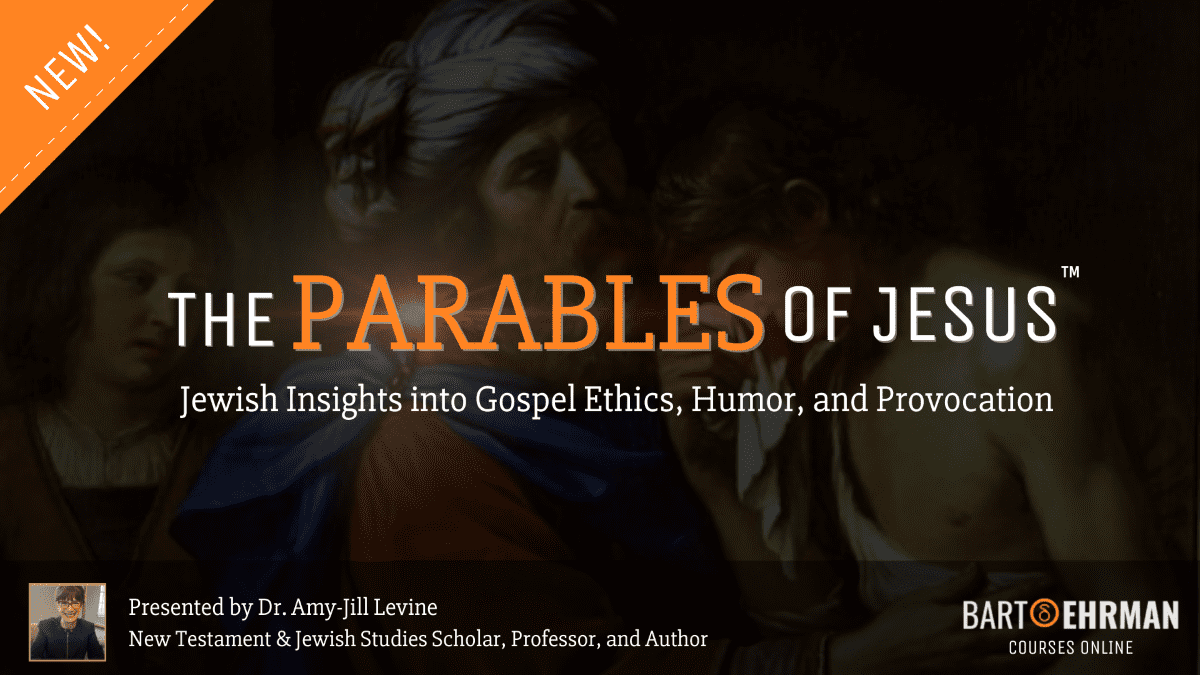
NEW COURSE! “The Parables of Jesus” with Amy-Jill Levine

I'm really excited about this one.  Next month we will be presenting a new remote course on the Parables of Jesus, consisting of four lectures by Amy-Jill Levine.   Amy-Jill is one of the top scholars on the historical Jesus and the Gospels on the planet, and is an unusually interesting and dynamic lecturer.  If you heard her at the New Insights into the New Testament last year, or taken a Great Courses/Wondrium course with her, you'll know what I mean.  She is unusually sharp, witty, clear, engaged, challenging, and funny.  Really, they don't get any better. The Parables course will consist of four lectures over the course of two days, July 20-21, with Q&A's on each day.  They will be given before a live/remote audience (who get to ask the questions) and you can be there yourself.  If you register, you will get the video of the course itself, with additional written materials, whether you attend live or not. Below is the description of the course and information about Amy-Jill herself, as found on the [...]

2025-09-10T13:07:57-04:00June 24th, 2024|Public Forum|

Does Altruism Even Exist? Some Personal Reflections Based on a Crazy Anecdote

In my book on altruism (yet to be finished!), I'm thinking about including the following as a way to begin reflecting on the question of whether anything like "pure" altruism exists (where someone acts entirely for the sake of another with no benefit at all for the self).  Let me know your thoughts. ****************************** One might think that “altruism” is a non-problematic term.  It comes from the Latin word “alter” which means “other,"  and so refers broadly to actions that benefit someone other than oneself.  It stands in contrast with “egoism,” based on the Greek word “ego,” meaning “I” or “myself,” and therefore referring to actions that benefit oneself. That all seems simple enough: the terms differentiate between doing things for others and doing things for ourselves.  But it turns out that in practice it is difficult – possibly impossible – to establish clear boundaries between altruism and egoism.  As a result, philosophers, psychologists, and evolutionary biologists perennially debate how to understand the terms. I’ll illustrate the problem by telling a strange personal anecdote. Did [...]

2025-09-10T13:07:42-04:00June 23rd, 2024|Reflections and Ruminations|

The New Book I’m Writing About Altruism: Putting It In a Nutshell

As I've been writing my new book, tentatively called "The Invention of Altruism: How the Teachings of Jesus Transformed the Conscience of the West," I've been thinking about how I might summarize the basic argument.  Here's what I've got to this point.  I'd be happy to hear your reactions. ****************************** Most people I know are moved by news of tragedy.  A terrible earthquake, a drought, a famine, a flood, displaced people, innocent victims of military aggression, -- we feel pity for those who pointlessly suffer and sense a desire, even an obligation, to help, for example by donating to disaster relief.   Almost never do we know the people in need; they are complete strangers, often in far-off lands, whom we will never meet and possibly wouldn’t like if we did.  Yet we – at least multitudes of us – want to help. This sense of moral obligation to strangers in need is unnatural.  It is not written into the human DNA nor did it exist in the ancient roots of our Western cultural [...]

Can You Disprove the Existence of God?

Is there a way to “disprove” the existence of God?  I’m not asking what the best arguments are; I’m asking whether an argument is possible. Just now I’m on a tour of some of the Greek Islands (Andros, Naxos. Amorgas, Santorini, and Crete) giving lectures for a group of unusually interesting people from a striking range of backgrounds – doctors, psychologists, scientists, financial advisers, business owners of various kinds, and so on, most of them one-time religious, some still committed to a religious tradition, some for whom religion never has made sense. Most of the conversations we’ve been having so far are Q&A: someone asks me me about some historical/literary issue connected with the NT or early Christianity and I tell them what I know (or at least think).  But some discussion topics don’t have historical answers.  Including whether it is possibly to prove God does not exist. That particular conversation has involved how we know what we know, as opposed to how people before the modern period thought they could know what [...]

2025-09-10T13:07:42-04:00June 20th, 2024|Public Forum|

Toe-to-Toe with Evangelical New Testament Scholar Peter Williams: Can We Trust the Gospels?

I recently reposted a debate I did with Peter Williams about the signficance of textual variants for the New Testament.   It reminded me of another debate we did some five years ago, on an even more pressing question, whether the Gospels can be seen as completely trustworthy.  This one was televised.  I thought it was particularly interesting because  Peter is not a simply a Christian apologist who uses other peoples' scholarship to promote his religious beliefs; he himself is a bona fide scholar with a PhD from Cambridge, and one of the leading experts on the ancient Syriac version of the New Testament. Peter has been a friend for a long time, and is also a committed evangelical Christian who does not believe there are mistakes in the Gospels.  I *so* disagree with that.  Our debate was on the Christian Radio program "Unbelievable" under their new series "The Big Conversation" Season 2-Episode 3, hosted by Justin Brierley. It was a long and interesting debate.  Peter has written Can We Trust the Gospels? and C S [...]

2025-09-10T13:07:42-04:00June 19th, 2024|Bart's Debates, Canonical Gospels|

A Debate with Peter Williams on Textual Variants

To put an end to this thread on the textual variants of the New Testament, and whether they matter, and thought that it might be good to give an alternative perspective that I first posted, well, ten years ago.  Earlier than that, on January 3rd, 2009,  Peter J. Williams and I appeared as guests on  "Unbelievable," a weekly program on UK Premier Christian Radio, moderated by Justin Brierley.   For this show we discussed my book "Misquoting Jesus" (In the UK the book, for some reason, is titled is "Whose Word Is It?"). Peter Williams is a British evangelical Christian scholar -- a very smart one, who knows a *lot* about the manuscripts of the NT -- who believes in the reliability of the New Testament and that thinks that my position is too pessimistic and extreme.  He did his PhD at Cambridge.  Peter is the author of Can We Trust the Gospels? and C S Lewis vs the New Atheists. Here's our back and forth.  See what you think! Please adjust gear icon for 720p High-Definition: [...]

2025-09-10T13:07:42-04:00June 16th, 2024|New Testament Manuscripts, Public Forum, Video Media|
Go to Top