Sorting by

×

About BDEhrman

Ehrman is the James A. Gray Distinguished Professor of Religious Studies at the University of North Carolina at Chapel Hill, where he has served as the director of graduate studies and chair of the Department of Religious Studies.

The Gospel Before the Gospel: The Proto-Gospel of James

In this thread I've been talking about some of the more famous Gospels that are not in the New Testament. I move now to one that I've talked about on the blog before, but it's been a few years so it's worth talking about again. It is arguably the most influential Gospel outside the canon: the Proto-Gospel of James (which scholars call the Protevangelium Jacobi -- a Latin phrase that means “Proto-Gospel of James,” but sounds much cooler….). It is called the “proto” Gospel because it records events that (allegedly) took place before the accounts of the NT Gospels. Its overarching focus is on Mary, the mother of Jesus; it is interested in explaining who she was. Why was *she* the one who was chosen to bear the Son of God? What made her so special? How did she come into the world? What made her more holy than any other woman? Etc. These questions drive the narrative, and make it our earliest surviving instance of the adoration of Mary. On the legends found [...]

2025-09-10T13:05:00-04:00October 11th, 2023|Christian Apocrypha|

But If It Didn’t Really Happen, Who Cares?

Whenever I have talked about the story of Jesus and the leper in Mark 1:40-44 on the blog -- most recently a week or so ago -- I have gotten a number of comments from readers that made me realize that I wasn’t being at all clear about what I was talking about. These comments came from people who appear to have thought I was talking about a historical event that really happened, one way or the other, and that I was trying to figure out which it was. Did Jesus really get angry or did he really feel compassion? In response to my view that Mark 1:41 originally indicated that Jesus got angry, some comments stressed that what really mattered was not his emotion but the fact that he did what he did. Others wanted me to know that it didn’t matter to them which emotion was ascribed to Jesus, because in their opinion the whole thing never actually happened at all. Both of these views (they’re obviously at the opposite ends of [...]

2025-09-10T13:05:00-04:00October 10th, 2023|Canonical Gospels, Historical Jesus|

Is Christ *Merely* the “Adopted” Son of God?

If Jesus wasn't God from eternity past, but was "adopted" to be the Son of God at some point of his existence, wouldn't that be a pretty watered-down understanding of his divinity? A lot of people find this kind of "adoptionist" Christology (Christ wasn't "inherently" God but "made" divine by adoption) completely unsatisfying and, well, pretty wimpy as far as Christologies go. I mentioned in the previous post that one could well read Luke as adoptionistic, and as I reflected on it some more, I recalled that the first time I wrestled seriously with the issue was ten years ago, when I was doing my research for my book How Jesus Became God. Here's what I ended up thinking about it, and saying about it in the book. And in case you wonder -- mirabile dictu! -- I still think the same today! ****************************** Part of what has convinced me that an [adoptionistic] understanding of Christ should not be shunted aside as rather inferior involves new research on what it meant to be “adopted” [...]

If Luke Didn’t Originally Have a Birth Story — Then What?

In my previous post, ostensibly on the genealogy of Luke, I pointed out that there are good reasons for thinking that the Gospel originally was published – in a kind of “first edition” – without what are now the first two chapters, so that, after the Preface of 1:1-4, the very beginning was what is now 3:1 (this is many centuries, of course, before anyone started using chapters and verses). If that’s the case, Luke was originally a Gospel like Mark’s that did not have birth and infancy narratives. These were added later, in a second edition (either by the same author or by someone else). If that’s the case then the Gospel began with John the Baptist and his baptism of Jesus, followed by the genealogy which makes better sense here, at the beginning, than it does in the third chapter once the first two are added. But is there any hard evidence that a first edition began without the first two chapters? One of the reasons it is so hard to say [...]

2025-09-10T13:04:45-04:00October 7th, 2023|Canonical Gospels|

Did Luke Originally Have the Birth Narrative (chapters 1-2)?

In my previous post I pointed out that some scholars, myself included, think that the original Gospel of Luke did not have the birth narrative recounted in chapters 1-2 (the annunciation of Mary's virginal conception, the trip to Bethlehem from Nazareth, the worship of the shepherds, etc. etc.). In this view the Gospel started with what is now 1:1-4 and then the next verse was what is now 3:1, and the Gospel went from there. I posted on this issue some years ago, but I think it's worthwhile addressing it again in the context of the current thread, on just how "messy" the situation was in the first couple of centuries when different Gospels were all in circulation (not just our four), saying different things, and sometimes in different versions themselves. What's the evidence that there was an earlier version of Luke without the familiar birth narrative (which, in case you don't recall, differs hugely from Matthew's). One place to start to explain the matter is with what comes *after the birth narrative in [...]

2025-09-10T13:04:45-04:00October 5th, 2023|Canonical Gospels, Public Forum|

Early Gospels in Circulation: An Even Messier Scenario

When it comes to the early Christian Gospels, most people simply assume that there were four Gospels from the first century (those in the NT), and no others, and that they were written as they are found now, and that they circulated in that form, and that later Gospel writers (say in the second century) who used earlier written sources about Jesus must have borrowed their stories from those Gospels. Their other stories they just made up, or heard about from oral traditions, or both. In my last post I suggested why I don’t think that view is particularly plausible, and tried to imagine something a bit more realistic; there I proposed a “messier scenario" in which there were numerous early Gospels, some earlier than others (e.g., Matthew, Mark, Luke, and John are the earliest that survive, but that doesn’t mean they were the earliest). In this view, Gospels later than the canonical four (e.g., Papyrus Egerton 2) may or may not have used the canonical four for their information (with additional legendary materials); [...]

2025-09-10T13:04:45-04:00October 4th, 2023|Canonical Gospels, History of Biblical Scholarship|

Reading the Bible in a Secular Age: Guest Post by Prof. Julius-Kei Kato

I am pleased to publish this guest post by Dr. Julius-Kei Kato, a scholar and professor of New Testament (and other things!) at King’s University College at Western University, London, Ontario, Canada, and, luckily for us, a member of the blog.  You can learn more about him here: Dr. Julius-Kei Kato (uwo.ca) Just over a month ago Julius-Kei published a book of relevance and surely of interest to members of the blog:  Reading the Bible in a Secular Age:  The New Testament as Spiritual Ancestry (Eugene, OR: Cascade Books, 2023).  I asked him to write a blog post about it, to explain what it is and to indicate where, if you're interested, you can get a copy.  He has happily complied, and here is his post. If you have any comments/questions, he will be happy to reply. ****************************** The burning question of this book is: Why still read the Bible in a secular age? My answer, briefly stated: For us who are located in the West, the Bible is an important part of our “spiritual ancestry,” [...]

2025-09-10T13:04:44-04:00October 3rd, 2023|Book Discussions, Public Forum|

The Creation Stories in the Hebrew Bible (outside of Genesis!). A Lecture You May Be Interested In

Are you interested in the Creation account in Genesis 1?  Did you know there are *other* creation accounts in the Hebrew Bible?  Different ones?  Want to hear about them?  And about how they relate to other creation accounts in the ancient world? On October 19, 8:00 pm, my colleague Joseph Lam, professor of Hebrew Bible and the Ancient Near East will be giving a remote public lecture:  "Beyond Genesis:  The Many Creation Stories of the Bible." Below you will find a short video that I did with Joseph to explain the event, and a link to sign up for it. This lecture is NOT related to the blog, but it IS a fundraiser for my department (I'm mentioning it here on the blog only because many of you are interested in the topic).  The donations will go to the departmental efforts to fund graduate students for research trips for their dissertations and professional conferences to present the results of their research. Both are crucial features of a graduate education, unusually important for anyone who wants [...]

2025-09-10T13:05:00-04:00October 2nd, 2023|Hebrew Bible/Old Testament, Public Forum|

The Messy World of the Early Christian Gospels. Who Is Copying What?

Many people who think about how the Gospels circulated in early Christianity have a pretty simple -- or rather, overly simplified (in my view) -- understanding of how it all worked.  I include among those "many people" a number of Gospel experts.  In fact, including a lot of the top experts.  The issue is this: what earlier accounts of the life, sayings, deeds, death, and resurrection were in circulation and used in the production of later accounts (say at the end of the first and into the second century).  I’ll talk about it here with reference to Papyrus Egerton 2, about which I’ve only said a few things. Scholars have traditionally thought of the four canonical Gospels as THE Gospels that were available, so that when a new Gospel like the Unknown Gospel in Papyrus Egerton 2 appeared the question always was: WHICH of the canonical Gospels was the author familiar with (and which did he use).   I challenged that view in my earlier post.   We shouldn’t think that there were basically FOUR, and everything [...]

2025-09-10T13:04:45-04:00October 1st, 2023|Canonical Gospels, Christian Apocrypha|

Why Would Jesus Get Angry at this Poor Leper?

So far in this thread I have argued that Mark 1:41 originally said that Jesus got angry when the leper asked him to heal him; and I have shown that elsewhere in Mark’s Gospel Jesus gets angry in context involving healing. And so: if Jesus got angry when the leper asked for healing in Mark 1:41 – what exactly was he angry about? Over the years numerous interpretations have been proposed, and some of these explanations are highly creative. Some interpreters have argued that Jesus became angry because he knew that the man would disobey orders, spreading the news of his healing and making it difficult for Jesus to enter into the towns of Galilee because of the crowds. The problem with this view is that it seems unlikely that Jesus would be angry about what the man would do later -- before he actually did it! Others have suggested that he was angry because the man was intruding on his preaching ministry, keeping him from his primary task. Unfortunately, nothing in the text says [...]

2025-09-10T13:04:44-04:00September 30th, 2023|Canonical Gospels, Public Forum|

Why Is Jesus So Angry?

Jesus never laughs in the New Testament Gospels.  But he does get angry. In my previous post I tried to show that it happens in the "original" text of Mark 1:41:  when a leper asks him to heal him, he (Jesus) gets angry.  Later scribes, understandably, changed the verse to say Jesus felt "compassion."  But if Mark actually said he got angry, uh ....  what was he angry about? To answer the question we need to consider a feature of Mark that very few readers have ever noticed.  Unlike in Matthew, Luke, or John, Jesus gets angry on several occasions in Mark’s Gospel. How do we explain that? Scholars have sometimes noticed that it happens in Mark.  But rarely has anyone pointed out that in every instance it appears to involve Jesus’ ability to perform miraculous deeds of healing. In Mark 9 we find the account of a man pleading with Jesus to cast an evil demon from his son, since the disciples have proved unable to do so: “Often,” he tells Jesus, “it casts [...]

2025-09-10T13:04:44-04:00September 28th, 2023|Canonical Gospels, Public Forum|

Jesus and Another Leper: Getting Angry at the Poor Fellow?

In my previous post I mentioned the interesting story found in the Unknown Gospel (as it is called – even though part of it is now known...) contained in the second-century manuscript Papyrus Egerton 2.  There’s an intriguing aspect of that story that I wanted to post on today, but I realized that first I need to discuss a bit of important background. So here’s the deal.  There is an interesting textual variant in Mark’s story of the man cured of leprosy by Jesus – that is, some of our textual witnesses have one way of reading one of the verses, and other textual witnesses have a different way.  And it really matters.  Here is the passage (Mark 1:39-45) in a literal translation.  The textual variant I am interested in is in v. 41 (there are lots of other textual variants among our manuscripts in this passage; this particular one is the only one I’m interested in here): 39 And he [Jesus] came preaching in their synagogues in all of Galilee and casting [...]

2025-09-10T13:04:44-04:00September 27th, 2023|Canonical Gospels, Public Forum|

Was Jesus Conceived out of Wedlock by Mary and a Jewish Relative, Pantera? Part III Guest Post by James Tabor

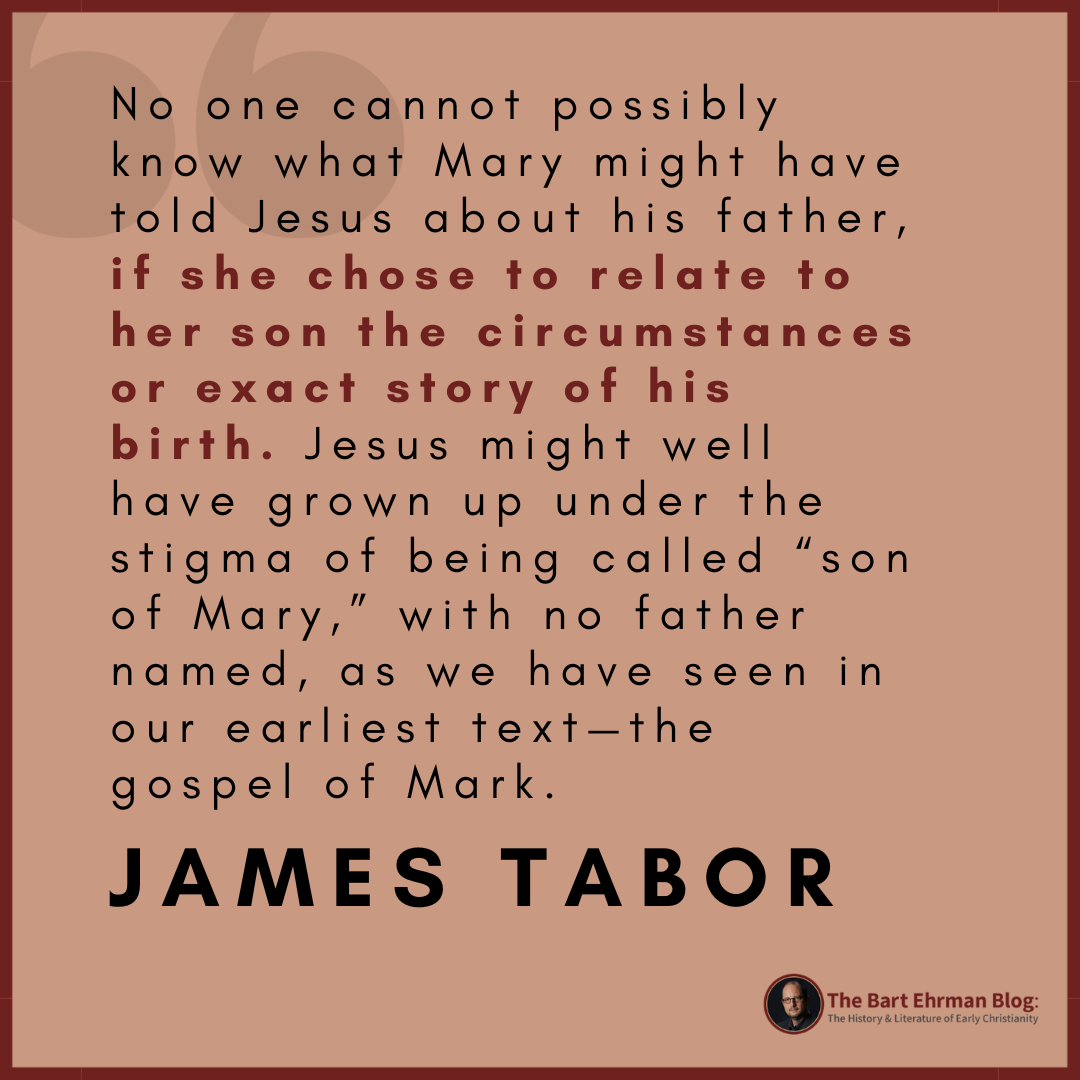
We come now to the third part of James Tabor's guest post thread on the biological father of Jesus, where he proposes a controversial solution that will surely spark some reactions!  Are you convinced?  Inclined to be convinced?  Not at all convinced?  Let us know what you think! Again, these posts are tied to James's forthcoming book The Lost Mary: How the Jewish Mother of Jesus Became the Virgin Mother of God (Knopf). ****************************** Part III These earliest references to Pantera stand in the sharpest contrast to several dozen much later references in rabbinic literature that slanderously charged that Jesus was the illegitimate son of a man named Pantera, with whom his mother had committed adultery.[1] And it was this story that then got passed on beyond Jewish circles—including to the philosopher Celsus, who identifies it as a tale passed on by Jews. Several early Christian writers, responding to these charges that Jesus was the adulterous “son of Pantera,” a Roman soldier, counter with the explanation that the name Pantera was an ancestral name in Jesus’ [...]

2025-09-10T13:04:44-04:00September 26th, 2023|Public Forum|

Was the Father of Jesus … Pantera? Part II Guest Post by James Tabor

Here James Tabor continues with his discussion of Jesus' actual,  biological father.  There are ancient indications that it was a man named Pantera.  How do evaluate these statements.  Could they possibly be true? ****************************** Part II The Jewish term for such a child born of any sexual relationship forbidden in the Torah is a mamzer, often mistakenly translated as “bastard,” but it is a legal term, not a term of profanity in Hebrew.[1] It refers to the child born of any sexual union forbidden in the Torah (Deuteronomy 22:13-30; Leviticus 18). This could include incest, adultery, or any forbidden union (Deuteronomy 22:13-30; Leviticus 18). Along with the term mamzer, there was a related term the rabbis use that might be translated a “hushling” or a “silenced one.” This is one who knows his mother but not his father. There is also the term “foundling,” used for one who knows neither father nor mother.[2] The child of a single woman and a man she could lawfully have married is not a mamzer. Also, any child born to [...]

2025-09-10T13:04:44-04:00September 24th, 2023|Historical Jesus|

Who Was Jesus’ Biological Father? Part I. Guest Post by James Tabor

I have received a number of queries over the past  year about what we can actually know about Jesus' father.  Can we know if it was actually Joseph?  What about the rumors that Jesus was born out of wedlock?  That his father was actually a Roman soldier?  Whose name was Pantera?  Is this latter simply a slander against Jesus and Christianity?  Could it be historical? My friend, New Testament scholar, and occasional guest poster James Tabor (about whom you can read here: TaborBlog – Religion Matters from the Bible to the Modern World (jamestabor.com) is just now finishing a new book of some relevance to the question, called:  The Lost Mary: How the Jewish Mother of Jesus Became the Virgin Mother of God (Knopf).  James has agreed to write a three-part thread on the question of Jesus' biological father. I'll run the three posts back-to-back-to-back.  Here's #1.  You may find these views convincing or controversial, but you should certainly find them informative and interesting! ****************************** Was Jesus’ Biological Father a Roman Soldier? James D. Tabor   Part [...]

2025-09-10T13:04:44-04:00September 23rd, 2023|Historical Jesus|

The Gospel according to Mel (Gibson)

As I've indicated, this semester I'm teaching my course on Jesus in Scholarship and Film; in it we read and analyze a number of Gospels (the canonical four and six others); we discuss how scholars have reconstructed the life of Jesus; and we seen how Jesus has been portrayed on film.  One of the ultimate goals of the class is to show that every Gospel, every scholar, and every film presents Jesus in a *different* way.  There's not One Jesus out there, but a large number of Jesuses. Most of the students have not seen any of the films we're discussing in class (from Cecil B. DeMille's King of Kings up to Jesus of Montreal).  And they will have an assignment to write a film critique of other films we don't deal with directly.  I give them the choice of Scorsese's Last Temptation of Christ or Mel Gibson's “The Passion of the Christ.”  If experience is any guide, most of them will choose Gibson.  And most of them will find it deeply moving.  It certainly [...]

2025-09-10T13:04:44-04:00September 21st, 2023|Jesus and Film|

Is It Better to Follow Christ or to Live a Contented Life? Paul vs. Epicurus

What would other deep thinkers in the ancient world have thought of Paul’s teachings?  Short answer: not much. Earlier this year I posted on one of my favorite Greek philosophers, Epicurus (341 – 270 BCE).  Epicurus acquired a bad reputation already in antiquity, and still has one among many people today, mainly because his views are widely misunderstood and often simply misrepresented.   As it turns out, he advocated views that have widely become dominant in our world, and for good reasons.  For that reason I’ve always read him as remarkably prescient, entertaining ideas that would not become popular for two thousand years. And they stand precisely at odds with the views of the apostle Paul.  I’ve recently begun to think about this more deeply -- especially since they talk about the same *topics* but take completely different stands on them.. Unfortunately, we do not have very many of Epicurus’s writings.  In fact, the most important sources we have are simply three long letters, quoted in toto by a significant but little-read author named Diogenes Laertius, [...]

One of our Earliest Gospels from Outside the New Testament: The Egerton Papyrus.

In my previous post I mentioned the peculiar story of Jesus and a leper found in the non-canonical (very!) fragmentary text known as Papyrus Egerton 2.  I've decided to give you a fuller scoop on this intriguing and mysterious little Gospel fragment -- and a full translation of its four (brief) stories.  I have taken this directly from my book The Other Gospels, co-authored and edited with my colleague Zlatko Plese.  Both the Intro and the Translation in this instance were done by me. ****************************** P.Egerton 2 (and PKöln 255) One of the most significant publications of early Christian texts in the first part of the twentieth century was H. I. Bell and T. C. Skeat, Fragments of an Unknown Gospel and Other Christian Papyri.  The “Unknown Gospel” is preserved in Papyrus Egerton 2, which consists of four fragmentary papyrus leafs, two of which are too fragmentary to be reconstructed (one of them has simply one letter on one side).  The other two (9.2 x 11.5 cm and 9.7 x 11.8 cm) contain four narratives [...]

2025-09-10T13:04:43-04:00September 19th, 2023|Christian Apocrypha|

That’s in the New Testament, Right? An Interesting Non-Canonical Story.

Here's a Gospel story about Jesus and a leper.  Does it sound familiar? And behold, a leper approached him and said, “Teacher Jesus, while I was traveling with some lepers and eating with them at the inn, I myself contracted leprosy. If, then, you are willing, I will be made clean.”  Then the Lord said to him, “I am willing: be clean.” Immediately the leprosy left him. Jesus said to him, “Go, show yourself to the priests and make an offering for your cleansing as Moses commanded; and sin no more....” This may sound like the Bible, but it’s not. This is one of the stories found in a document known to scholars as Papyrus Egerton 2. This papyrus consists of four small pieces of papyrus manuscript, written on front and back (so it comes from a codex, not a scroll). It contains four different stories: (1) an exhortation by Jesus for his Jewish opponents to “search the Scriptures” (in terms similar to John 5:39-47 and 10:31-39); (2) a foiled attempt to stone and then [...]

2025-09-10T13:04:43-04:00September 17th, 2023|Canonical Gospels, Christian Apocrypha|

About Those Ebionites and Their Peculiar Gospel

There are other interesting features of the Gospel of the Ebionites, known from the quotations of Epiphanius, the fourth-century heresiologist (= heresy-hunter). We wish we had the whole Gospel. We have only these eight fragments that Epiphanius quotes. We wish we knew who actually used the Gospel. We wish we knew how long it was, what it contained, and what its theological slant was. It is almost impossible to say from what remains. One big question is whether, since it was used by the Ebionites according to Epiphanius, it had a particular bias in its reporting of the words and deeds of Jesus. The term “Ebionite” was widely used in proto-orthodox and orthodox sources to refer to “Jewish-Christian” groups, or at least one group (it is likely that there were lots of these groups, and it may be that the church fathers assumed they were all the same group when in fact they had different views, different theologies, different practices, and so on). Some of the church fathers indicate that the name came from [...]

2025-09-10T13:04:43-04:00September 16th, 2023|Christian Apocrypha, Heresy and Orthodoxy|
Go to Top