Sorting by

×

Am I About To Become Muslim?

I often get asked about the Qur'an (on which I have zero expertise) and my views of Islam (which I admire as one of the great religions of the world with lots of problems involving how it sometimes gets interpreted and used, just like every other great religion of the world).  I was just thinking about that this morning and remembered a post I did a long time ago answering a question a reader had raised with me.  Is it true I am about to convert to Islam?  Well, it hasn't happened yet, but I thought I would be worthwhile repeating the post:   READER COMMENT: I received a message on Facebook a couple of weeks ago from a person who has been proselytizing to me about the Muslim faith. This has happened a few times with others on your FB page. I guess that's what they do. Anyway, the other day I asked him if he was on your blog. He responded with a yes. Then he said that we (the members) were going [...]

2025-09-10T13:01:03-04:00February 4th, 2023|Bart’s Biography, Book Discussions|

Evidence of Forgery. More Reasons the Martyrdom of Polycarp Was Not Written by Someone There

In my previous post I began to lay out my case that the Martyrdom of Polycarp, our (allegedly) first full narrative account of a Christian martyr, who died 155 CE, written (allegedly) by an eyewitness, in fact was written decades later, by someone who wanted his readers to think he was an eyewitness and to that end (falsely) claimed to be one. Here I move from the intriguing fact (from the last post) that the author asserts his eyewitness authority precisely at the points that are, well, rather difficult to believe to other historical problems in the text that suggest the author was not living at the time or privy to what actually happened. Again, this is from my book Forgery and Counterforgery: The Use of Literary Deceit in Early Christian Polemics (Oxford University Press, 2013).   *****************************   Apart from the miraculous elements of the text – which include the martyr’s blood gushing forth in such profusion as to douse the flames of his pyre, and a dove emerging from his side and flying [...]

Do Eyewitnesses Prove Miracles? Can They Be Faked? The Martyrdom of Polycarp

For over two hundred years scholars of antiquity have worked diligently to determine which ancient writings by pagans, Jews, and Christians were actually produced by their alleged authors and which are by authors merely claiming to be some other famous person, as well as which originally anonymous writings were wrongly ascribed to one famous author or another.  If a book is wrongly ascribed, it’s not the author’s fault.  If Matthew, Mark, Luke, and John did not write Matthew, Mark, Luke, and John, that would not make these books “forgeries.”  A “forgery” is when an author intentionally takes the identity of another (famous or important) person with the intent of deceiving her or his readers.  There were lots of reasons for doing that in antiquity, and I discuss all such matters on a popular level in my book Forged (HarperOne, 2011), where by and large I focus on the writings of the New Testament (e.g., the six letters that claim to be written by Paul but appear not to have been; and also letters by Peter; [...]

What’s So Hard about Translating Ancient Texts?

Publishing a translation of an ancient text ain't at all like writing a book about the text. When the editor at Harvard Press asked me if I would be interested in doing a new edition of the Apostolic Fathers for the Loebs, she wasn’t offering me the opportunity then and there.  She was suggesting that I write up a prospectus that she could take to the board of the Loebs, in which I described the need for a new edition and explained how I would go about making one.  After I thought about it for a while, and got advice from my friends, I decided to go for it.  I had never (ever!) planned doing a serious translation project for publication.  I had lots of other things I wanted to write – scholarly monographs, textbooks, and so on.  But I thought it made sense to do it, both personally and professionally.  So I wrote up the prospectus and the editorial board agreed it was a task that needed to be done – and so they [...]

2025-09-10T13:00:50-04:00January 19th, 2023|Book Discussions, Early Christian Writings (100-400 CE)|

What About Translations of Other Ancient Christian Writings?

I've been talking about translations of the Bible -- especially the King James Version -- and I'd like now to move to a broader issue.  EVERY text from the ancient world needs to be translated in order to be made accessible to a modern audience.  Hey, we're not back in the 19th century when going to university meant learning Greek and Latin!  And texts even then also came from even other languages (Hebrew, Coptic, Syriac, etc.). If you're a graduate student in antiquity, you have to learn to read these texts in their original languages; you simply can't get the nuances of a text -- especially a fairly sophisticated one dealing with, say, philosophy or religion -- in translation.  And translators have to make decisions about how to translate a text.  It's not a mechanical process.  Whether you like it or not  -- most people when they learn of this don't much like it, and even more people have never learned of it -- translation is also an act of interpretation.  You have to know [...]

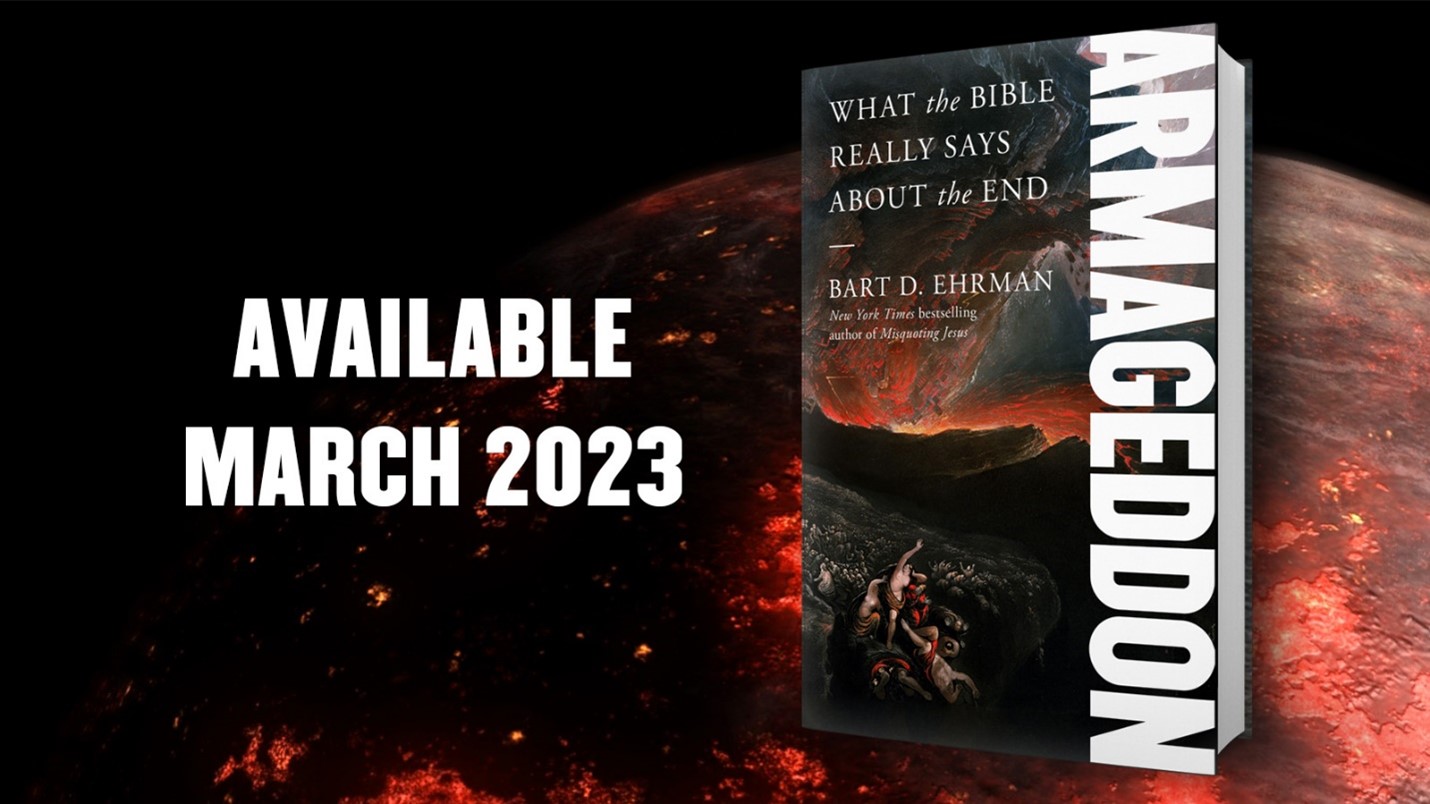
Armageddon! My New Book on the Revelation of John.

I’m excited to say that my book on the Apocalypse of John (a.k.a. the Book of Revelation) will be published and available on March 21.  The End is Near!     Here is a brief synopsis of what it’s about: ****************************** The Apocalypse of John (Book of Revelation) is the most mystifying and misunderstood book of the Bible, and possibly the most dangerous.  Most readers simply refuse to dip into its pages – it is too bizarre, violent, and incomprehensible. Those who do read it fall into two camps.  Most are conservative Christians who believe the book is describing what is soon to happen in our future; evangelical “prophecy experts” provide detailed explanations to show that the end has now arrived. Liberal historical scholars, on the other hand, argue that when the book is understood in its own historical context the book is instead a metaphorical expression of hope: the world may appear out of control, but in the end the goodness of God will prevail and those suffering now will be rewarded later. Armageddon [...]

2025-09-10T13:00:49-04:00January 15th, 2023|Book Discussions, Revelation of John|

An Unusually Significant Reference Work: The Encyclopedia of Ancient History

These past few weeks I've been reading up on various issues connected with the Ancient Near East (not my long suit) and have had occasion to make reference to a fantastic reference tool that everyone should know about but (other than scholars of antiquity)  hardly anyone does: The Wiley-Blackwell Encyclopedia of Ancient History.  I posted on it nine years ago and have now realized it would be useful to do so again.  So, for an end of the year special, here it is!  (I've made a crucial addition in bold!) ****************************** I’m pleased to be able to announce (and only a month after the fact  -- this was 9 years ago) that after years of labor, the thirteen-volume Encyclopedia of Ancient History, ed. by Roger Bagnall, Kai Bodersen, Craige Champion, Andrew Erskine, and Sabine Hueber has now appeared, published by Wiley-Blackwell.   It’s not exactly an affordable reference tool for everyone’s library.    The list price is $1995.00!  But you can save $354 on Amazon, if you’re loaded and looking for the most authoritative and up-to-date reference [...]

2025-09-10T13:00:36-04:00January 3rd, 2023|Book Discussions|

The Greek Manuscripts of the New Testament

I have begun to explain the field of “textual criticism,” the academic discipline that tries to establish what an author actually wrote if you don’t have his original but only copies made from later times. In this post I begin to summarize some of the most important information about the textual “witnesses” to the text of the New Testament.  I won’t be going into this information at any serious length.  We could have many, many, many posts on virtually every single detail that I mention.  You don’t want that.  Trust me. There are three kinds of witnesses to the text of the New Testament, that is to say, three kinds of documents that can help us establish what the authors actually wrote. First, obviously, are the Greek manuscripts of the New Testament.   These are copies of the New Testament in the language in which the books were originally written, produced by later scribes, who were copying earlier copies that had been made by scribes who were copying earlier copies that were made by scribes….  [...]

2025-09-10T13:00:04-04:00October 29th, 2022|Book Discussions, New Testament Manuscripts|

The Strange World of Textual Criticism

I've been asked a good bit lately by readers of the blog and random emailers how we can know, or if we can know, what the authors of the New Testament actually wrote -- if we don't have their original copies.  By far my best selling book (Misquoting Jesus) is about that, as is my best known scholarly book (The Orthodox Corruption of Scripture).  It's the issue I first got most interested in (as an 18 year old!) when it came to serious scholarship, and its the field of study I devoted nearly twenty years to it as a scholar.  So, well, I'm interested! It's been over seven years since I gave anything like a full explanation of the entire field of New Testament "textual criticism" (which does not mean what a lot of people think!), and I've decided it's high time I go over it again.  This will take a number of posts! ****************************** The first thing to emphasize is that the term “textual criticism” is a technical term with a very specific meaning.  [...]

2025-09-10T13:00:04-04:00October 27th, 2022|Book Discussions, New Testament Manuscripts|

How Serendipity Changed My Life: The Apostolic Fathers

I decided that it might be fun to talk about how serendipity completely shaped my academic career, maybe doing a post now and then on the topic.  I seem to have had more than my share of fortuitous moments that have changed my life in ways I never would have expected.  When I just now sat down to do a first post on it, I suddenly seemed to remember I did that once.  And lo and behold, I did!  Over ten years ago.  So I'll start with this one and toss a new one in every now and then. Here's what I said before: ****************************** It seems that much that has happened in my professional life has been because of serendipity.  Back when I was a believer, we called it Providence.  (!)   It’s how I got my first job at Rutgers in 1984; how I got my current position at UNC in 1988; how I got asked to write something other than a technical study involving the Greek manuscript tradition of the New Testament – [...]

2025-09-10T12:59:47-04:00October 12th, 2022|Bart’s Biography, Book Discussions, Proto-Orthodox Writers|

Understanding the Gospels: Suggested Readings!

I frequently get asked what I would recommend for people to read if they are interested in the study of the New Testament.   In my recent course on the Gospels (www.bartehrman.com/courses) I'm including as part of the supplement to the lectures an annotated list of suggested readings.   The idea is to provide people with some guidance for important books, some to start with and some for more advanced readers.  Here it is, for your perusing enjoyment!   The Unknown Gospels: Matthew, Mark, Luke, and John Annotated Suggestions for Further Reading   Aune, David. The New Testament in Its Literary Environment. Philadelphia: Westminster, 1987. A superb introduction to the genres of the New Testament writings in relation to other literature of the Greco-Roman world. Brown, Raymond. The Birth of the Messiah: A Commentary on the Infancy Narratives in Matthew and Luke. Updated ed. Garden City, NY: Doubleday, 1999. A massive and exhaustive discussion of the birth narratives of Matthew and Luke, suitable for those who want to know simply everything about every detail. Brown, Raymond. The [...]

2025-09-10T12:59:35-04:00September 27th, 2022|Book Discussions, Canonical Gospels|

Why I Want to Write a Book on Christian Love

Over the past couple of weeks I have been explaining how I have reimagined my next trade book, written not for scholars but for general readers.  As I've pointed out, my initial idea that I floated before readers of the blog was to have a book devoted to how Christianity revolutionized how people in the Roman world understood wealth and what to do with it.   My argument was that as a Jew Jesus insisted that those with resources help those who were in need – a virtually unheard-of ethical principle in Greek and Roman antiquity.  His followers were Jews as well, for whom this was a familiar message, but as they converted non-Jews to become Jesus’ followers, they convinced them as well.  So this became the standard Christian view, leading to the invention of the public hospital, the orphanage, the use of governmental assistance for those in need, private charities, and so on. My previous posts have explained how I have now expanded the vision of the book, to show that these new views of [...]

Love. How I’ve Shifted the Focus of My Book on Charity.

As I've indicated, my plan is, or rather was, to write a book that argued that Christians radically changed the understandings of wealth and the practices of "giving" once they took over the empire.  They, in effect, invented what we think of as "charity." As I have talked it over with my literary agent and the editors at Simon & Schuster,  I have decided that my study needs to be placed in a broader cultural context.  Rather than focusing exclusively on the transformation of ancient understandings of wealth and the concomitant social practices of giving in isolation from their larger ideological contexts, the book will address an even more transformative Christian innovation in ancient ethical discourse, one that provided the impetus for these understandings and use of wealth. It will take several posts to explain the shift in my thinking.  Here's the starting point: Ethics were just as important to inhabitants of the Greek and Roman worlds as they are to people today.  But the criteria for evaluating “proper” behavior were very different, focusing almost [...]

2025-09-10T12:59:21-04:00September 10th, 2022|Book Discussions, Greco-Roman Religions and Culture|

Another Book by “Peter” That Could Have Become Scripture

In this thread I’m discussing several Christian books that were considered by some early groups of believers and church leaders to be bona fide Scripture – written by apostles and inspired by God.  All of the books I’m discussing were written by authors who were claiming to be Jesus’ closest disciple, Peter.  But eventually church fathers became convinced otherwise, and the books were relegated to the trash heap of Christian curiosities. Here’s one that has become known only in modern times and that has intrigued readers – both scholars and lay folk.  What exactly did church leaders find objectionable about it?  It was an account of Jesus’ life, a Gospel.   ******************************   The Gospel of Peter:  A Book That Had Some Supporters One of the other books found in the small anthology discovered in Akhmim also claimed to be written by Peter, and it too was considered a book of Scripture by at least some Christians.  But, like the Apocalypse, it also lost favor and disappeared from sight.  This one, however, was a Gospel. [...]

2025-09-10T12:59:06-04:00July 31st, 2022|Book Discussions, Christian Apocrypha|

A Book That Nearly Became Scripture: The Apocalypse of Peter

As I indicated in my previous post, I’m planning to write a book (after the one on charity in early Christianity) explaining how we got the canon of the New Testament.  Who choose the books?  On what grounds?  And when? I continue the thoughts I’m laying out in my prospectus here, in the first of four case studies – a book that almost made it in.   ******************************     Four Vignettes to Explain the Issues To illustrate some of the major issues, to show how the process worked, to give a sense of the historical disputes, and to show their inherent interest, I here provide four vignettes, all involving books that explicitly claim to be written by the apostle Peter.  Peter is Jesus’ closest disciple and confident in the Gospels.  No one could carry more authority for explaining Jesus’ teachings and his plans for his followers after his death.  It comes as no surprise, then, to find a number of early Christian books that claim to be written by Peter.  Two of them are [...]

2025-09-10T12:59:06-04:00July 28th, 2022|Book Discussions, Christian Apocrypha, Public Forum|

And Then My NEXT Book Project: How Did We Get the Canon of the NT?

In my most recent thread I laid out my thoughts on my next book (what I *think* will be my next book) on how Christian views of charity helped revolutionize ancient (and as a consequence, modern) society. Now I will begin a series on my thoughts for my book after that.  Throughout the past ten or fifteen years I’ve always thought two books ahead; that way when I’m writing a book, in my down time I can be thinking a bit about the next one.  It’s kind of pleasant, actually, since there is no pressure on my thoughts – I haven’t even starting to work on it yet! As I may have mentioned already, I will probably propose a two-book deal to my publisher, that is to have a contract for two books instead of one.  That way my thinking can be even more serious about #2.   I’ve done that a couple of times before.  The first time, it happened (Triumph of Christianity and Heaven and Hell) and the second time, the publisher didn’t go [...]

2025-09-10T12:59:06-04:00July 27th, 2022|Book Discussions, Christian Apocrypha|

Yeah, Those Are Contradictions. My Response to Firth.

Matthew Firth came up with interesting responses to my examples of contradictions in the Gospels (in the previous post); here now I try to show how his explanations simply don't work. ****************************** Thanks, Matt, for your thoughtful comments on the four contradictions I discussed in my opening post.  I agree – this form of debate is much better than the oral back-and-forths I’m used to on a stage in front of an audience, where it’s so easy to say something unwittingly that is completely stupid or wrong.  With this format I’m able to think about it a bit before saying something completely stupid! I appreciate your attempts to reconcile the contradictions.   For years I wished I could reconcile all the ones I found – and did my best to do so, using many of these kinds of arguments.  I ended up thinking it just didn’t work.  I’ll try to explain below why I think so, step by step.  I’ve decided that it would be easier for readers of the blog to be able to compare [...]

2025-09-10T12:58:35-04:00June 26th, 2022|Book Discussions, Public Forum|

The Invention of Charity: My Prospectus for the Book

I have started drafting a prospectus for my next book on Christian charity, as I have discussed recently on the blog.  At this early stage, I am giving it (at least in my head) the tentative title: The Invention of Charity: How Christianity Transformed the Western World.  In this post I’ll show how I’m *thinking* about starting the prospectus (which will have no bearing on how I, later, start the book). Before I do so, I should explain how the process works.  My last three trade books have been with Simon & Schuster, and as a (standard) part of my contract with them, I’m obliged (and willing and eager) to to discuss with them what I’d like to do for the next book, to give them the opportunity to sign a contract with me for it, before, say, I propose the book to other publishers. The first part of process is that I draft a prospectus that explains what the book is, why it is needed, and how I will approach the task . For [...]

My book: Literary Forgery and Counterforgery in Early Christianity!

I have been posting all ten of my April 18 posts from previous years in celebration of the ten-year anniversary of the blog on April 18 of *this*  year.  Here now is a post from 2018 that focused on a book I had written years before that!  The book I've always thought was my best piece of scholarship. Enjoy! ****************************** I am in Houston for a few days, giving talks at Rice University on the use of literary forgery in early Christianity.  To prepare for the talks I decided to read through my 2013 book Forgery and Counterforgery: The Use of Literary Deceit in Early Christian Polemics.  Of all the books I’ve written, I am proudest of this one.  It is the very best I can do in terms of real scholarship.   I don’t believe I’ve talked about it much on the blog, since it’s not a book for general audiences.  But I thought it might be worthwhile to say something about it in a post or two, and there’s no better way to do [...]

2025-09-10T12:58:21-04:00June 18th, 2022|Book Discussions, Forgery in Antiquity|

Another Historical Scholar’s Understanding of the Resurrection

I am reposting the ten blog posts made on April 18 (or thereabouts) in celebration of our tenth anniversary of the blog.  Here now is a particularly important one from 2017; at the time I was working on my book How Jesus Became God and thinking hard about how to understand the early Christian claims that Jesus had been raised from the dead. ****************************** One of the first books that I have re-read in thinking about how it is the man Jesus came to be thought of as God is Gerd Lüdemann’s, The Resurrection of Christ: A Historical Inquiry (2004). Lüdemann is an important and interesting scholar.  He was professor of New Testament at Göttingen in Germany, and for a number of years split his time between there and Vanderbilt Divinity School in Nashville.  He is a major figure in scholarship, and is noteworthy for not being a Christian.  He does not believe Jesus was literally, physically, raised from the dead, and he thinks that apart from belief in Jesus’ physical resurrection, it is not [...]

2025-09-10T12:58:21-04:00June 14th, 2022|Book Discussions, Historical Jesus|
Go to Top