Sorting by

×

Our Most Important Gospel from Outside the NT: The Gospel of Thomas

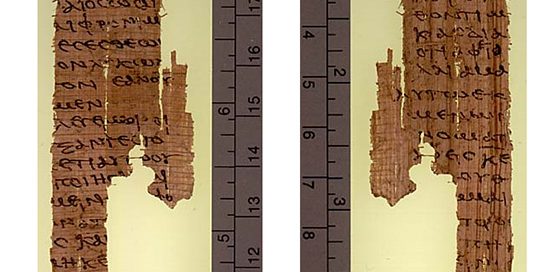
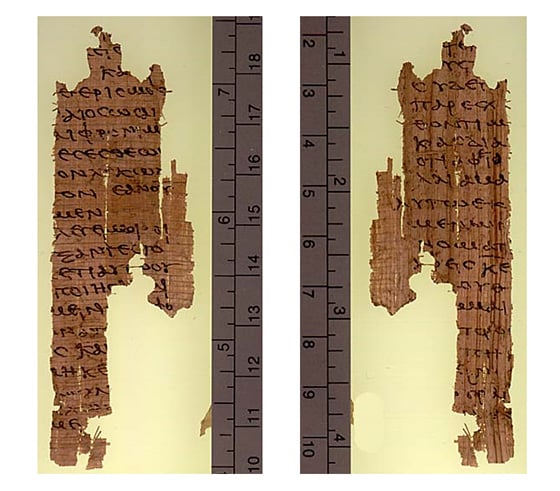
This week in my graduate seminar we will be discussing the Coptic Gospel of Thomas, not to be confused with the Infancy Gospel of Thomas that I mentioned in a post last week, with which this one has no relation, apart from the fact that both claim to be written by Thomas, a.k.a. Didymus Judas Thomas, i.e., Jesus’ brother Jude. By far this Gospel of Thomas is the best known, most read, and most significant Gospel from outside the New Testament.  It was accidentally discovered in 1945 near Nag Hammadi Egypt as one of the 52 documents contained in a set of twelve books, with part of a thirteenth, now widely known as the Nag Hammadi Library.  Most of these documents are Gnostic. Like all the others, this one is written in Coptic and is a Coptic translation of a Greek original.  The book that contains it was produce in the mid-fourth century CE.  But the Gospel itself was originally composed in the early second century CE.  It is hard to say when after this [...]

2025-09-10T12:50:46-04:00September 14th, 2020|Christian Apocrypha, Early Christian Writings (100-400 CE)|

The Earliest Infancy Gospel: Some of the Critical Problems

In my previous post I gave some of the early chapters from the Infancy Gospel of Thomas.  It seems like a pretty straightforward and entertaining set of early legends about the boy Jesus.  But it turns out the scholarship on the text is complicated.  Here is how I describe some of it in the edition I co-authored with my colleague Zlatko Pleše, The Other Gospels.  I have omitted here some of the more technical discussion (mainly about manuscripts in other ancient languages, that are so different from one another that we are not sure even what the Gospel was originally called); but this should give you a taste of some of the key issues scholars wrestle with. ******************************************** The so-called Infancy Gospel of Thomas presents some of the most intractable textual and historical problems of the entire corpus of early Christian literature.  On the most basic level, we do not know the scope and contents of the original version of the book, if we can even speak about an “original.”  This Gospel, in its various [...]

2025-09-10T12:50:45-04:00September 6th, 2020|Christian Apocrypha|

Jesus as a Boy? The Infancy Gospel of Thomas

This coming week in my graduate seminar we will be discussing the Infancy Gospel of Thomas.  Do you know it?  Fantastic book! I often get asked which non-canonical book would I include in the New Testament if I were given the choice.  I sometimes mischievously answer, The Infancy Gospel of Thomas. “Mischievously” is an appropriate term.  This is a set of legendary stories about Jesus as a child, starting when he was five and going up to twelve, ending with the story found (only) in Luke’s Gospel about Jesus as a twelve-year old in the Temple discussing the Law with Jewish teachers (the unknown author of Infancy Thomas got the story from Luke).  Many of the stories do seem to portray him in a mischievous light, especially to modern readers.  Is this Jesus the Super Brat?  Many readers (especially the first time through) think so.  Others argue there are more serious things going on. There were probably a number of reasons for someone to write this book.  In part, of course, it was to satisfy [...]

2025-09-10T12:50:26-04:00September 4th, 2020|Christian Apocrypha|

My Early Christian Apocrypha Seminar

I am teaching a PhD seminar this semester on the early Christian apocrypha; it's a little hard to define what those are, though hundreds of people have tried!.  The way I define them are as non-canonical books that are similar in genre and contents to those that did make it into the canon.  Or something like that.  They comprise Gospels, Acts, Epistles, and Apocalypses, they can be "orthodox" or "non-orthodox" (= " heretical"); most of them claim to be written by apostles (but not all); the ones I'm most interested in date from the second to the fifth centuries. It's a fairly but not crazily heavy-hitting class.   It meets once a week for three hours.  Here, for your amusement and reading pleasure (especially if you do the assignments!) is the syllabus: To see what follows, you will need to belong to the blog.  Not a member yet?  Now's the best time ever to join.  Why?  Because you can't join in the past.     Reli 801: Early Christian Apocrypha Instructor: Bart D. Ehrman Fall 2020 [...]

The Opening Section of the Gospel of Judas

Here is the first bit of the Gospel of Judas from the translation of my colleague Zlatko Pleše in our book The Other Gospels.  After this bit here, the Gospel gets very strange, at least to most modern readers.   But as you can see, it is really interesting. The first paragraph is the explanation of where we got the text from; then the translation of the opening scends, and after that I give the bibliography for further reading that we cite in our book.   ************************************** Our translation is based on the Coptic text of Rodolphe Kasser, and Gregor Wurst, eds. The Gospel of Judas: Critical Edition.  Washington, DC: National Geographic, 2007.   New portions of the Gospel appeared in 2006, when the one-time owner of the manuscript declared bankruptcy and his remaining antiquities collection was turned over to a bank in Ohio; included in this collection were numerous small fragments of the Gopsel of Judas.   These have been photographed and they have begun to be studied; for our translation of the account here we have [...]

What is the Gospel of Judas About?

I have said some things about the Gospel of Judas in my previous posts, but not much, really, about what is actually in it.   You can find a translation, done by my colleague Zlatko Pleŝe, in the volume we co-edited and translated: The Other Gospels: Accounts of Jesus from Outside the New Testament.  We also give the following Introduction to the text; I will give the rest of the Introduction and a bibliography, and a bit of the translation itself, in the next post.   ***********************************************************   The Gospel of Judas is the most recently discovered Gospel to be published, and is arguably the most important and intriguing Christian text to appear since the discovery of the Nag Hammadi Library in 1945.  Details of the discovery and the mishandling of the manuscript by antiquities dealers are provided in the exhaustive account of Herb Krosney.  The manuscript containing the Gospel preserves three other gnostic works as well: the “Letter of Peter to Philip,” known in a slightly different version from the findings at Nag Hammadi; the [...]

2025-09-10T12:50:05-04:00August 5th, 2020|Christian Apocrypha, Heresy and Orthodoxy|

A Very Odd Story about the Baby Jesus

Over the past few days I have been working on my syllabus for the graduate seminar I will be teaching this term, on Early Christian Apocrypha -- that is, other Gospels, Acts, Epistles, and Apocalypses that did not become part of the New Testament.  As chance would have it, I was also just now browsing through some old blog posts, and came across this one, posted on this date seven years ago.  It is about one of the most historically influential and downright interesting Gospels from outside the New Testament.  In the Middle Ages, this book was sometimes *treated* as Scripture:  it inspired a good deal of Christian art, for example, and provided people with "information" about Jesus' birth and what happened before it. So I thought I should post it again.  Here it is: ********************************** In my graduate class on non-canonical Gospels, we typically analyze the Proto-Gospel of James (which scholars call the Protevangelium Jacobi -- a Latin phrase that means “Proto-Gospel of James,” but sounds much cooler….).  It is called the “proto” Gospel [...]

2025-09-10T12:50:05-04:00July 29th, 2020|Christian Apocrypha|

Seeing the Gospel of Judas for the First Time

In a couple of posts last week I talked about how I came to learn about the discovery of the Gospel of Judas through a phone call from a representative of National Geographic who wanted me to be on the team that established its authenticity, back in the fall of 2004.  I let her know that I wouldn't be of any use in authenticating the thing, but I could talk about its historical significance.  I had agreed to find a Coptologist to come along to Switzerland and she was to find a scientist to perform a Carbon-14 dating. When we hung up, I called Stephen Emmel, and American who teaches in Muenster Germany, one of the world's leading Coptologists.  I asked him if he had heard that National Geographic thought they had their hands on the Gospel of Judas?  He had indeed heard a rumor and was dying to see it.  I said I was too.  Hey, wanna fly to Geneva? Before going, I learned a great deal more about the text and its discovery.  [...]

2025-09-10T12:50:04-04:00July 27th, 2020|Christian Apocrypha|

When I Learned the Gospel of Judas Had Been Discovered

As I said in my last post, after receiving an out-of-the-blue query about the Gospel of Judas I looked it up to refresh my memory: it was allegedly a book used by a group of Gnostics named the Cainites, a book that told the story of Jesus from the perspective of Judas Iscariot, his betrayer – not in order to malign Judas but, evidently, to celebrate his deed, since it was (somehow) to Jesus’ advantage. Soon after reading up on the Gospel (there was very little to read about it, since we didn’t have it; all we had were some comments in the writings of church fathers who opposed it, principally Irenaeus), I received a second phone call, this one from a person at National Geographic, asking what I knew about the Gospel of Judas.  I obviously realized that something was up. So I told her what little we knew about the Gospel as probably a Gnostic text.  In my mind, I wasn’t sure – before this – that the text actually *ever* existed.  Some [...]

How I First Learned About the Gospel of Judas Iscariot

Over the past few weeks I’ve had a thread dealing with Judas Iscariot and another thread dealing with claims from the second century that Christians were highly immoral (sexual reprobates, murderers, and cannibals).  Or at least that some Christian heretics were.  As it turns out, these two threads are closely related in a way one would not expect – at least in a way I never expected until I got involved with the “Gospel of Judas” that was discovered in recent times.  I posted on this many years ago but it would be interesting to do so again. This will take several posts.  I begin with how I first found out about the Gospel of Judas, back when experts in early Christianity knew virtually nothing at all about a Gospel of Judas. In the Fall of 2004 I was in my study minding my own business (well, talking with a graduate student) when the phone rang.   It was a woman named Sheila, whom I had known for years.  Sheila had sponsored a number of archaeological [...]

Jesus Kissing Mary Magdalene: A Bizarre Scene in the Gospel of Philip

A number of readers responded to my post about whether Jesus and Mary Magdalene were intimate by pointing out that the non-canonical Gospel of Philip sure does seem to *say* they were!   So, what do I have to say about that? I've dealt with the issue on the blog before, but a lot of you were just a twinkle in our eye at the time, so here I'll deal with it again.   I have a reasonably full discussion of the relevant issues in my book Peter, Paul, and Mary Magdalene.   In the book I put the discussion in the context of – yes, you guessed it --  Dan Brown’s Da Vinci Code, the one source many people turn to for the Gospel of Philip (!).  Few people who talk about the relevant passage have actually read the book.  It strikes many readers today as unusually strange.  But in any event, this is what I say about the book and the Kissing Passage there. ************************************************************** Some of the historical claims about the non-canonical Gospels in the [...]

The Gospel of Thomas and the Other Gospels

Here's a post from seven years ago that is still very important and intriguing to anyone interested in the NT and early Christianity.   It's mainly about the most influential and historically important Gospel from outside the New Testament.  I've inserted a couple of explanations [in brackets] to update the post. ******************************************************************* One of the benefits of teaching at a research university with a graduate program is that – at least where I am – there are periodic reading groups with other faculty members and graduate students. I go to a couple of these a month, including one that I organize. As it turns out, last week I went to two. The first was mine, the (other ) CIA, in which we typically read someone’s work-in-progress. That week’s presentation was a paper by my former student and soon-to-be faculty member in early Christianity at Duke Divinity School, Maria Doerfler, an exceptionally bright and erudite human being [who now is teaching at Yale], who gave a paper on a virtually unknown letter by the famous fourth-century bishop [...]

My Lecture in Quebec: Did Ancient Authors Try To Deceive Their Readers?

I have decided to go ahead and post the address I gave last week to an academic conference in Quebec on "Pseudepigraphy" in the ancient world.  If you're not familiar with the term (why would you be??) it refers to a book written by an author who falsely claims to be someone else (like if I wrote a book and claimed to be Stephen King) (which maybe I should do....).   Most scholars seem to think this was an acceptable practice in the ancient world.  I don't.  My lecture was meant to show why. This will take about four posts.  Here's the beginning of the lecture (it came as the keynote at the end of two days of meetings/papers).  In the post itself I have translated the foreign language terms I use. *************************************************************************************** Over the past three days we have enjoyed a wide range of papers on numerous important texts, specific instantiations of ancient pseudepigraphy.  In this final address I will not be discussing a specific text but rather the broader phenomenon of pseudepigraphy itself, with [...]

A Readable Edition of the “Lost” (i.e. non-canonical) Gospels

As I have pointed out before on the blog, the topic of the last post, the edition of the non-canonical Gospels (The Apocryphal Gospels: Texts and Translations), which I published with my colleague Zlatko Plese, was meant for academics – professors of New Testament and early Christianity and their graduate students.   Most other people, of course, have no need or desire to see the original Greek, Latin, or Coptic of a text along with a translation.  People generally just want an English translation. But having a facing-page translation is a great thing for scholars and budding scholars.   The only way really to understand a foreign language text in its many nuances is to read it in its own language.  And since these are texts that deserve to be studied carefully, minutely, with full attention to all the fullness of their meaning, they really need to be read in the Greek, Latin, and Coptic languages in which that they have come down to us. For some scholars, the book would be useful because it provides the [...]

2025-09-10T12:46:13-04:00September 4th, 2019|Book Discussions, Christian Apocrypha|

The Scholarly Edition of the Apocryphal Gospels

In my last couple of posts I began to describe how my edition of the Apocryphal Gospels came about.   After having done the Apostolic Fathers in two volumes for the Loeb, I had decided never to do another translation project again.  Too hard!  But then, forgetting my decision, I thought it would be useful to have a Greek/Latin – English version of the early Christian non-canonical Gospels.  And at the urging of the editor at Harvard, submitted a proposal also for the Loeb Classical Library.  But the editorial board decided that they did not want to start publishing new editions of Christian texts in the series, since that would detract from its typical focus on Greek and Roman classics.   And so I was now interested in a project without an publisher. I should say – this may not be widely known – that most of the time a scholar writes a book, s/he does not know who will be publishing it, or even if *anyone* will be.  This can be a source of real anxiety, [...]

2025-09-10T12:46:12-04:00September 3rd, 2019|Book Discussions, Christian Apocrypha|

How Views of the Afterlife Changed

I’ve been explaining how the tours to heaven and hell – both of them Near Death Experiences – in the Acts of Thomas are meant to show the Christian alternatives to Greek and Roman views of the afterlife.   For early Christians it would not be a dull and boring, powerless and mindless existence for all eternity, as it is depicted in the oldest Greek sources, and it would not require hundreds of years of “purging” where the stains of wickedness are washed out through painful cleansing (e.g., through being thrust into fire or a violent whirlpool for centuries), as in Plato and Virgil.  It would be eternal joy or eternal punishment, one or the other, depending on whether you believed in Christ or not. Christians thus provided the ultimate and rather simply answer for life to the ultimate question about death.  But even here there was more than a simple binary (one or the other).  The punishments in hell in the Acts of Thomas for example, appear to be graded in order to be commensurate [...]

2025-09-10T12:45:58-04:00August 14th, 2019|Afterlife, Christian Apocrypha|

An Ancient Author Trying to Justify His Deceit

Yesterday I talked about one Christian forger who got caught red handed who had to explain himself.  Well, justify himself.  Well, bend over backwards to make himself look innocent.  We've been seeing a lot of that these days.  It goes way back.  Humans are humans. Here is my assessment of the situation, not in terms of our own front-page news but in terms of this obscure little controversy, which highlights my obscure little academic point: in the ancient world, readers simply did not *like* it when they found out someone had written a book claiming to a be a famous person.  They condemned it.  That should be borne in mine when thinking of other instances of the phenomenon, such as those found in far more familiar books from the early Christian tradition.  (And this is the point the riles a number of my scholar friends, who just can't *believe* ancient authors would do something deceitful....) I'll start this post with a bit from the end of the previous one, to remind you about it.  If [...]

2025-09-10T12:45:58-04:00August 12th, 2019|Bart's Critics, Christian Apocrypha, Forgery in Antiquity|

A Christian Forger Caught in the Act

Next month I will be giving a keynote address at a conference dealing with ancient pseudepigrapha at the University of Laval, in Quebec City.  I have recently been discussing the topic (of ancient authors falsely claiming to be a famous person) on the blog in relation to the letter of James, and as you know, it was the subject of my monography Forgery and Counterforgery ten years ago, and my spin-off popular account Forged.   I haven't worked seriously on the problem since then. But now, because of this upcoming lecture, I'm having to think about it long and hard again, a decade later.  Lots of scholars simply don't (or can't?) believe that ancient people -- especially Christians, but others as well -- would lie about their identities.  It's not that these scholars doubt that there are lots and lots of pseudepigrapha out there, Greek, Roman, Jewish, and Christian.  There are.  But these scholars don't think that the authors were doing anything duplicitous. There are different ways scholars have made this argument, but the basic line [...]

Some Very Strange Journeys to Heaven and Hell

This post is free for everyone, but most posts come only to blog members.  Joining the blog is easy and it gives you access to tons of material for very little expense.  All the money goes to charity.  so why not join. Last week I was in Marburg, Germany for the annual conference for the Society of New Testament Studies.  This is an international society at the top tier of NT scholars in the world, a closed society that no one can actually *join*.  You have to be nominated and voted in, and there are strict academic guidelines (in terms of qualifications and numbers of books and articles published, etc.).  I’m not saying I’m in favor of that system, but as we say these days (or at least were saying a year or so ago) it is what it is. I’ve been a member since the 1990s but actually haven’t been to one of the meetings since 1995.   But I went to this one because I was asked to read a paper and I’m really [...]

2025-09-10T12:45:58-04:00August 7th, 2019|Afterlife, Christian Apocrypha|

Was James the Actual Brother of Jesus?

I’ve started talking about the epistle of James, first in relation to Paul (yesterday) and then in relation to … James, the man himself, Jesus’ brother (today).   My ultimate goal is to explain why I’m sure James himself did not write the letter (later).  But in the meantime I’ve received a question that I should probably address first: did Jesus really have a brother named James?   Uh… don’t a lot of Christians think that Jesus never had any siblings (since his mother remained a virgin)?  How do you explain him having a brother? I’ve talked about this on the blog before, but in the current context, it’s worth talking about again.  Here’s the question and my response:   ************************************************************   QUESTION: In what way was the James you are talking about here, the “brother” of Jesus? Was he another one of Mary’s sons from Joseph? Was he another one of Joseph’s sons from a previous relationship?   RESPONSE: One of the non-canonical books from early Christianity that I regularly teach is called the Proto-Gospel of [...]

2025-09-10T12:45:38-04:00July 15th, 2019|Christian Apocrypha, Historical Jesus|
Go to Top