Sorting by

×

How the Heavenly Lights and the Resurrection of the Phoenix Reveal God’s Will

I’ve indicated that the book of 1 Clement is rather long and seems a bit rambling in places to many of its readers, when its only real goal is to tell some usurpers in the church of Corinth to give the reins of power back to the duly appointed church leaders. I read it differently.  I think that it makes rather marvelous connections between things that one would normally think of as unrelated in an extended effort to show the wayward upstarts in Corinth that they have taken over the church illicitly. Who woulda thought that the sun, moon, and stars, the seasons ,the boundaries of the sea, and the winds reveal that God wants the original leaders given their authority back? Or that the Myth of the Phoenix (first discussed in the western tradition six centuries earlier by Herodotus) would have any relevance? This author thinks so! Here are two passages that make the point.  The first (ch. 20) expounds on the regularity of nature as established by God, in order to [...]

2025-11-07T10:46:03-05:00November 8th, 2025|Early Christian Writings (100-400 CE)|

Was 1 Clement Written BEFORE Some of the New Testament?

This will be my final post on the book of 1 Clement.  Now that I’ve summarized what the book is about and said something about its author, I can turn to the question of when it was written.  The time of its writing is an important question, for a reason you might not suspect. It is almost always said – I myself regularly say this, as a kind of simple “short hand,” knowing that it’s probably not literally true -- that the books of the New Testament are the “earliest” Christian writings we have.  In fact, if, as is often thought, Revelation was written around 95 CE, and 2 Peter around 120 and Acts possibly (?) around them as well, then a couple of other Christian books may have ante-dated them, including 1 Clement and the Didache, two of the apostolic fathers.  The letters of Ignatius of Antioch were almost certainly written around 110 CE. So, the big question here is: when did this anonymous author from Rome write the book of 1 Clement?   This [...]

2025-11-03T11:52:10-05:00November 6th, 2025|Early Christian Writings (100-400 CE)|

1 Clement in a Nutshell

I begin this thread of posts on "The Apostolic Fathers in a Nutshell"  (see yesterday's post) with the book of 1 Clement, which was almost certainly the first of these non-canonical proto-orthodox texts to be written.  I will devote several posts to 1 Clement itself: this one will provide a brief overview. I begin with a fifty-word one-sentence summary: 1 Clement is a letter from the church of Rome to the church of Corinth that objects at length to its recent coup of leadership, urging the rival leaders to yield power back to the duly appointed original elders out of humility and  obedience, for the health of the church.   Now a fuller exposition.  I have taken this from the Introduction to 1 Clement in my edition, The Apostolic Fathers vol. 1 (Harvard University Press, 2003) ****************************** The “First Letter of Clement” is a misnomer, as no other letter from the author survives:  “Second Clement,” which is not a letter, comes from a different hand (as I will show in my post to come on Second Clement).  [...]

2025-11-03T11:28:08-05:00November 4th, 2025|Early Christian Writings (100-400 CE)|

A New Thread! The Apostolic Fathers: In a Nutshell

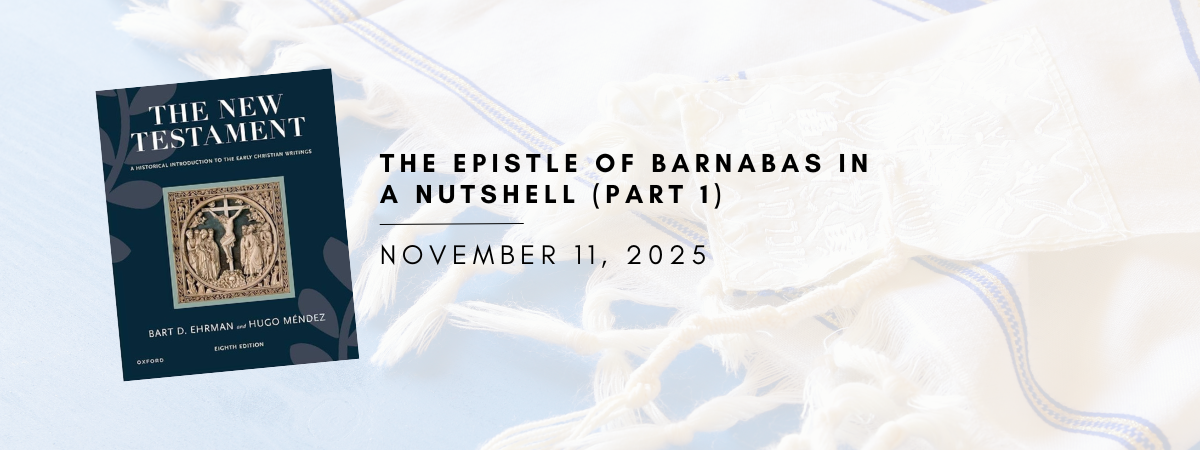
Now that I’ve completed the “New Testament in a Nutshell” series, with posts summarizing each of the twenty-seven books, explaining their major themes and emphases; when, why, and by whom they were written; giving suggestions for further reading; questions to reflect on; and summaries of the summaries – it is time to move on. And where better to move than to the early Christian writings from outside the New Testament – some of which were considered to belong to the New Testament by various church leaders and authors, for centuries.  Really? Yup.  One of our earliest manuscripts of the New Testament (codex Sinaiticus; from around 375 CE) includes the Shepherd of Hermas and the letter of Barnabas; another (codex Alexandrinus; from around 400 CE) includes 1 and 2 Clement. Some church fathers thought the Didache should belong; or the Apostolic Constitutions, or the Apocalypse of Peter; or …. But what are these books?  One thing we can say about all of them: they are less well known among the general populace than [...]

2025-11-03T11:10:41-05:00November 2nd, 2025|Early Christian Writings (100-400 CE)|

Why Wasn’t Peter’s Apocalypse Included in the New Testament?

As I indicated in my previous post, I’m planning to write a book (after the one on charity in early Christianity) explaining how we got the canon of the New Testament.  Who choose the books?  On what grounds?  And when? In this post I thought I'd show the kind of think I'll be interested in, by explaining a particularly intriguing issue of "what got in" and "what got out" that I worked on a good bit a few years ago when writing my book Journeys to Heaven and Hell  (Yale University Press), and then blogged on. It involves one of the books that did not make it into the canon (there are several!) allegedly written by Peter.  Unlike most of the others, though, this one nearly made it.  In the end, it was axed.  But why?  Not for a reason most anyone would suspect (or at least no one had suggested in writing before my book). Here's how I explain it all in the prospectus I sent to my publisher, Simon&Schuster when I was proposing to [...]

Will Everyone be Saved? (Everyone??)

There has been an extraordinary range of views in Christianity about who will be “saved,” whether people have any say in the matter, what it requires, whether salvation can be lost, and … most everything else connected with this central teaching of the religion.  It may seem odd that disagreements among Christian thinkers would involve the very core message, rather than other issues of less significance and centrality, but, well, there it is. In my previous post I pointed to passages in the letter to the Hebrews that seem pretty clearly to indicate that a person could well lose their salvation.  At the extreme other end of the theological spectrum was/is the view that in fact everyone will be saved. That’s a view more commonly thought to reside on the margins of Christendom, but it’s always been around – and is getting stronger now than ever – and can easily be traced, again, back to the New Testament, all the way back to its most revered author, the apostle Paul. It can be [...]

The Death of Peter

In my previous post I discussed the legendary account (the earliest we have) of the martyrdom of Paul.  In it I mentioned as well the martyrdom of Peter (also legendary, though better known) (many people have heard he was crucified “upside-down”), and realized I may as well post on that as well, since I’ll certainly be getting some questions on it. Here is what I say about it in my book Peter, Paul, and Mary Magdalene (Oxford University Press).   ******************************   By the end of the first and into the second century it was widely known among Christians that Peter had suffered a martyr’s death.  The tradition is alluded to in the book of 1 Clement: “Because of unjust jealousy Peter bore up under hardships not just once or twice, but many times; and having thus borne his witness (or “having been martyred”) he went to the place of glory that he deserved” (5:4). And a hundred years later Tertullian speaks of Peter enduring “a passion like the Lord’s” -- possibly referring [...]

The Transformation of Paul’s Teaching: The Apocalypse of Paul

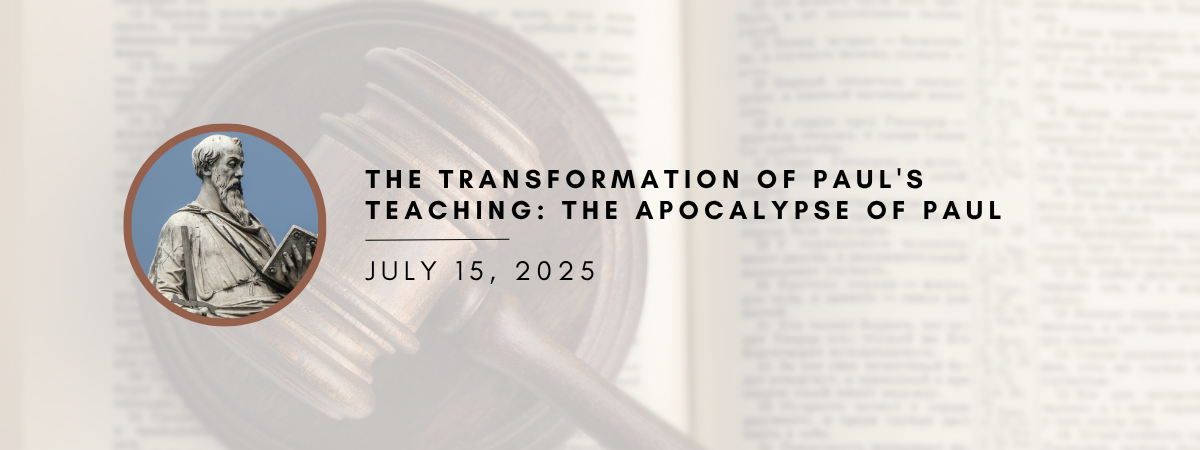
In my previous post I began to discuss the non-canonical Apocalypse of Paul, a legendary tale that describes what Paul saw when he had his vision after being taken up to the “third heaven”  (see 2 Corinthians 12:1-6).  He was actually taken to see what was experienced by the dead in the afterlife.  For some lucky souls, it was fantastic.  For others, well … read on. He first sees two souls being taken to their eternal destiny, one is happy, and the other miserable.  The one is carried by angels before the throne of God to be given an eternal reward; the other is dragged off by some very angry angels to face eternal damnation. Paul then is shown the actual places of bliss and torment.  The bliss is amazing—a glorious utopian place of goodness, where Paul meets with the saints of the Jewish tradition and converses with them in paradise.  The torment, on the other hand, is horrific.  Here are all sorts of punishments arranged for all kinds of sinners, Christian and [...]

Paul’s Vision of Heaven and Hell

I now turn to another non-canonical text connected with Paul, one of the most famous throughout the Middle Ages, an account of his journey to observe the fate of souls in the afterlife, both the glories of the saints in heaven and the torments of the sinners in hell.   This tale is not simply meant to convey factual information about what happened to Paul once.  It is intended to teach a clear lesson.  Isn’t all interesting history like that? Here's how I discuss it in my book Peter, Paul, and Mary Magdalene (Oxford University Press).  This will take two posts.   The Apocalypse of Paul   Is anyone ever interested in the past for purely antiquarian interests – that is, they just want to know what happened but for no other reason?  Well, not usually.  Most people think about the past because they are interested in the present. One of the ways that people who are interested in the present use history is by making the past itself present—that is, by making it relevant to [...]

Chastity Within Marriage? Paul Taught THAT?

In my previous post I summarized the legendary account of Paul and his most famous female disciple Thecla, and ended by quoting the “gospel message” that he preaches in the tale.  It’s not at all what you would expect.  He says no word about believing in Christ’s death and resurrection.  It is all about remaining sexually chaste, even when married.  No sex.  That’s what God is most interested in.  Here are some snippets by way of reminders. Blessed are those who have kept the flesh chaste, for they will become a temple of God. Blessed are those who are self-controlled, for God will speak to them. Blessed are those who have renounced this world, for they will be pleasing to God. Blessed are those who have wives as if they did not have them, for they will be the heirs of God. Blessed are the bodies of the virgins, for these will be pleasing to God and will not lose the reward for their chastity   If (since!) this is not the main gospel message [...]

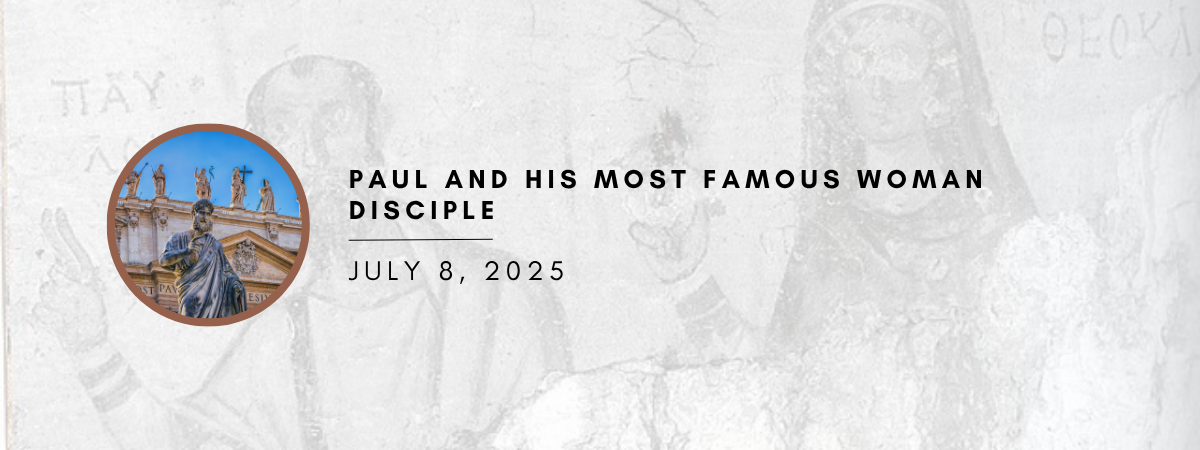
Paul and His Most Famous Woman Disciple

I have now finished my summaries and discussions of each of the thirteen Pauline letters, "In a Nutshell."  In this long thread we have now covered 18 of the New Testament's 27 books, which, by my math, means we are two-thirds of the way through this thread.  Nine more gems to go. I'd like to pause at this stage and provide a few other posts on Paul and his writings, specifically by talking a bit about Paul as found in early Christian writings outside the New Testament.  I have a fuller discussion of the historical and legendary tales about Paul in my book Peter, Paul, and Mary Magdalene: The Followers of Jesus in History and Legend (Oxford University Press, 2006).  This post and the next will contain excerpts discussing Paul and his female follower Thecla, one of the most famous early Christian women of all history (though widely forgotten today, she was virtually a household name throughout the Middle Ages.) ****************************** The Acts of Paul and Thecla One of the most popular legends about the [...]

Was the Apocalypse of Peter Originally Considered Part of the New Testament?

In my previous post I pointed out that our earliest list of which books should be considered Christian Scripture (that is, parts of the New Testament), the Muratorian Fragment from the 180s CE, lists the Apocalypse of Peter as a book that was accepted by some Christians.  I've talked about the book on the blog before.  It's extraordinarily interesting.  It is the first Christian account we have of a journey to the realms of the damned and the blessed, where Peter himself is shown by Christ the torments of the one and the glories of the other.  In my recent academic book Journeys to Heaven and Hell, I devote a chapter to explaining why the book in the end did not get included in Scripture but the book of 2 Peter, which was NOT accepted by the Muratorian canon or even known about then so far as we can tell, did make it in. In this post I'll simply explain what we know about the popularity and acceptance of the Apocalypse of Peter [...]

The First Ancient Christian List of the Books (allegedly) of the New Testament

The first church father to name Matthew, Mark, Luke, and John as the four Gospels in the New Testament is Irenaeus, the bishop of Lyons in Gaul (i.e., the ancient forerunner of Lyon, France), in his five-volume work, "Against Heresies" in 180 CE.   He spent significant time in Rome itself before his appointment in Gaul, and he considered the Roman church to be the center of Christendom at his time, but there are no Roman authors before him who say anything about it.  The important teacher / philosopher Justin (who acquired the epithet "Martyr"), from whom we have three surviving writings about Jesus, Scripture, and the truth of Christianity, quotes the Gospels but never indicates who wrote them. There is another (apparent) witness to the fourfold Gospel of Matthew, Mark, Luke, and John from Irenaeus’s time, and also appears to be connected with Rome -- and as it turns out, it is the first list of canonical NT books that we have from antiquity.  This comes to us in the fragmentary Latin text [...]

Was the New Testament Canon Really Closed in 367 CE?

If we are talking about the earliest Christian writings -- the subject of my previous three posts -- we naturally want to know when decisions were made about WHEN church father settled on our 27-book canon of the New Testament.  Many people -- including tons of scholars -- set a precise date: 367 CE, in the decision written by the famous theologian Athanasius of Alexandria. Is that right? My first academic publication addressed this question and answered: NO.  Here's how I have talked about the issue and my attempt to overturn the widely held view, from long ago! ****************************** My first semester in the PhD program at Princeton Theological Seminary I had a seminar on the “Canon of the New Testament” with Bruce Metzger.   This was a class that focused on the questions surrounding how we ended up with the twenty-seven books in the New Testament.  Who decided that it would be these twenty-seven books, and no others?  What was motivating these people?  What were the grounds for their decisions?  And when did they make [...]

2025-09-10T13:09:07-04:00October 3rd, 2024|Early Christian Writings (100-400 CE), Public Forum|

Why Were Some of the Earliest Christian Books Left OUT of the NT?

How did church leaders decide which books would be included in the New Testament canon?  Why were some let in, but others left out?  Here I continue my discussion as excerpted from the Introduction in my anthology:  The New Testament and Other Early Christian Writings: A Reader, 2nd ed. 2004 (Oxford University Press.) ****************************** The literature that was produced by early Christians served to bind the various Christian communities together. Leaders and groups from one congregation wrote to others; books written in one place for one purpose were taken to another place, copied there, and read by Christians completely unknown to the author and his or her own community. This earliest Christian literature thus provided spiritual, intellectual, and emotional cohesion for communities that were geographically separated. The literature that was produced by early Christians served to bind the various Christian communities together. Leaders and groups from one congregation wrote to others; books written in one place for one purpose were taken to another place, copied there, and read by Christians completely unknown to [...]

ALL the Christian Writings of the First Hundred Years

In 1996 I was struck by the thought that it would be really useful for professors of New Testament to have an anthology of ALL the Christian books written in the first century of the religion, not just a translation of the NT itself.  I looked around and couldn’t find one.  I told my editor at Oxford Press, and he couldn’t believe it.  But lo and behold. So we agreed I should produce one.  I decided that it should be all the surviving books written by Christians during its first hundred years, so 30-130 CE (though the first surviving book was probably not written till 20 years after Jesus’ death), that I would use the NRSV translation for the NT (with permission), and then include all the other books that could be plausibly dated to the period. The idea is that the New Testament contains *some* of the earliest Christian literature, not all of it.  And if anyone is interested in a historical study of the NT, they need to read it in light of [...]

2025-09-10T13:09:07-04:00September 29th, 2024|Book Discussions, Early Christian Writings (100-400 CE)|

Jesus’ Followers in History and Legend

I continue here describing my book Peter, Paul, and Mary Magdalene  (Oxford University Press, 2005), with a final excerpt from the Introduction.  In my previous post I discussed how historical accounts and literary fictions mix in the accounts we have of these three key followers of Jesus.  I pick up from there: ****************************** Some scholars would argue that we ourselves are not so different from the storytellers of the ancient world, that when we recount what happened in the past, we too do so not merely to show what “really” happened, but because what happened is important to us, today, for our own lives.  That is to say, at the end of the day, no one has a purely antiquarian interest, an interest in the past for its own sake.  Instead, we are interested in the past because it can help us make sense of the present, of our own lives, our own beliefs, values, priorities, of our own world and our experience of it.  If this view is right -- and I [...]

My Book on Peter, Paul, and Mary Magdalene

The only book I've written because I wanted to use the title is Peter, Paul, and Mary Magdalene: The Followers of Jesus in History and Legend.  It was a blast to write.  One could argue that in one respect or another these three were historically the most significant followers of Jesus (whether they were in their own day or not is another question).  In my view they are the only followers of Jesus that we can say with relative certainty that they *claimed* to have seen him raised from the dead (a controversial view on all sides).  And most intriguing, there are lots of extraordinary legends about them that survive and that, in fact, are still believed by many people today, for example that Peter was crucified upside down; Paul was beheaded; and Mary was a prostitute.  And those are just among the more tame accounts. It's also interesting to figure out what we can actually know about them historically.  Hence my book, which devotes six chapters to each figure. Here is how I describe the book [...]

My Edition of the Apostolic Fathers

Since I often get asked about topics I've written about, I have been doing a long thread discussing the various books I've published.  For the next several posts I'll talk about my edition of the "Apostolic Fathers Volume 1" and "Apostolic Fathers Volume 2" for the Loeb Classical Library (Harvard University Press, 2003).  The "Loeb" series provide bi-lingual editions of ancient Greek and Latin writings.  "Bi-lingual" means that the original (Greek or Latin) text of the writing is on one side of the page with an English translation on the other side.  These are designed for students and scholars who know the ancient languages at least to some extent, as a way of helping them study the texts even if their knowledge of the languages is not as good as it could be (when is it ever?). So these volumes are probably not for most blog readers!  But the General Introduction I provided to the two volumes is reasonably accessible and explains what these writings are, where they came from, and why they are important.  [...]

Competing Interpretations of Scripture in the Early Church

Early Christians interpreted their sacred texts in a variety of ways, some of them a bit bizarre to many modern readers, as I pointed out in my previous post.  Here I discuss two different views of the matter, one by a Gnostic Christian named Ptolemy and the other by the most famous opponent of the Gnostics, Irenaeus. Here are the Introductions to their discussions that I give in my book After the New Testament (2nd edition, Oxford University Press, 2014); after the introductions, in the book I give modern English translations of their discussions themselves, one translated from the Coptic and the other from Latin.  If your interest is piqued in what they actually say, and in the dozens of other ancient Christian writings I provide in the book, check it out! ****************************** Ptolemy's Letter to Flora One of the most famous disciples of (the Christian gnostic) Valentinus (see the Gospel of Truth) was Ptolemy, a renowned gnostic teacher who lived in Rome in the mid-second century.  From Ptolemy's own hand comes one of the [...]

Go to Top