Sorting by

×

Ancient Ways of Interpreting Scripture

Did the earliest Christians interpret texts the way people do today?  I'm not asking if they always had the same interpretation; I'm asking if their approach to and methods of interpretation were the same.  It's a surprising answer.  In particular, the various ways texts got interpreted may not be expected. I deal with it in my book After the New Testament (2nd edition, Oxford University Press, 2014), the anthology of early Christian texts that I discussed on the blog a week or so ago. The book presents modern translations of Christian writings from right after the New Testament roughly up to the conversion of Constantine (so, the second and third centuries, 100-300 CE).  I organized them according to topics and for each topic I gave an explanatory introduction, then gave a brief introduction for each of the writings themselves as they occurred. Here is the introduction for the section dealing with how early Christians interpreted the Bible. Text and Meaning:  The Interpretation of Scripture in Early Christianity The Bible was important from [...]

More Major Issues Confronting the Early Christians.

What were the major issues, concerns, and debates confronting the earliest Christians?  My book After the New Testament: A Reader in Early Christianity (Oxford University Press, 2nd ed, 2015) addresses these issues.  I've explained the book in my two previous posts.  Here is my third, again giving an excerpt from the General Introduction, explaining the rubrics I used in the book to cover the vital topics of Christian Origins, chapter by chapter.  At the end I provide a bibliography for further reading, books that cover the history of the period broadly and competently. ****************************** Christians of all theological persuasions in the second and third centuries realized that having a set of books deemed authoritative or “scriptural” could not, in itself, provide guidance over what to believe or how to behave.   Books needed to be interpreted in order to be understood, and to be understood correctly.  And the early centuries of the church witnessed numerous debates over just how books were to be read and used.  Among the debates was the question of whether a [...]

Major Issues in the Earliest Christian Centuries (In my Book After the New Testament)

What were the key issues, controversies, developments, and concerns of the Christian communities of the first three centuries?   These are the topics considered in my book After the New Testament:  A Reader in Early Christianity (Oxford University Press, 2nd ed, 2015). In the previous post I explained that the book is a collection of most of the most important writings from the second and third centuries -- the period right after the books of the New Testament were themselves written.  Here I talk about the various themes that I used to organize my collection, themes that I judged to be the most significant for anyone trying to understand Christianity in earliest times.  This will take two posts. ****************************** By way of introduction to this collection of ancient Christian writings, I should say a word about the nature of the rubrics I'll be using and the logic of their sequencing.  This need not entail a lengthy discussion: each chapter begins with a sketch of the important historical aspects of the topic, and each individual [...]

My Most Helpful Book? After the New Testament: A Reader in Early Christianity

What happened in early Christianity just *after* the period of the New Testament?  It's an unknown period for most people, but of vital importance for anyone interested in the Christian religion.  For the next three posts I'll explain by discussing my book devoted to the topic, After the New Testament: A Reader in Early Christianity (Oxford University Press, 2nd ed, 2015) In some ways, I think After the New Testament is the most *useful* book I've ever done.  It is an anthology of important ancient Christian texts in readable English translations, each with introductions that explain what they are about and why they matter.  Some of these are texts you may have heard of.  Some, I bet not!  But they are all important and intriguing. In these posts I will explain my book by excerpting the General Introduction, which introduces readers to the fascinating world of Christian Origins and shows it's importance and the problems its study poses for scholars. ****************************** General Introduction (Part 1) Over the past century and a half, archaeological [...]

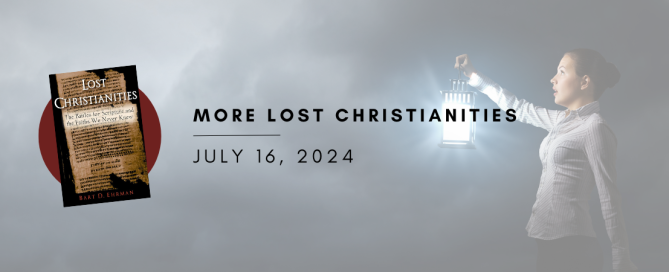
More Lost Christianities

In my previous post I discussed the wide variety of early Christianities and their ranging views.  Here I consider some aspects of the Scriptures known and used by these various groups.  Again, this comes from the Introduction to my book Lost Christianities (Oxford Press, 2003). ****************************** The Lost Scriptures The Gospels that came to be included in the New Testament were all written anonymously: only at a later time were they called by the names of their reputed authors, Matthew, Mark, Luke, and John.  But at about the time these names were being associated with the Gospels, other Gospel books were becoming available, sacred texts that were read and revered by different Christian groups throughout the world: a Gospel, for example, claiming to be written by Jesus’ closest disciple, Simon Peter; another by his apostle Philip; a Gospel allegedly written by Jesus’ female disciple Mary Magdalen; another by his own twin brother, Didymus Judas Thomas.[1] Someone decided that four of these early Gospels, and no others, should be accepted as part of the canon [...]

More Lost Scriptures

How did we get our books of the New Testament, and what do we know about the ones that were "left out"?  Here I continue my Introduction to my book Lost Scriptures, as started in my previous post. ****************************** When was this New Testament finally collected and authorized?  The first instance we have of any Christian author urging that our current twenty-seven books, and only these twenty-seven, should be accepted as Scripture occurred in the year 367 CE, in a letter written by the powerful bishop of Alexandria Egypt, Athanasius.  Even then the matter was not finally resolved, however, as different churches, even within the orthodox form of Christianity, had different ideas -- for example, about whether the Apocalypse of John could be accepted as Scripture (it finally was, of course), or whether the Apocalypse of Peter should be (it was not); whether the epistle of Hebrews should be included (it was) or the epistle of Barnabas (it was not); and so on.  In other words, the debates lasted over three hundred years. [...]

Three Early Christian Writings Spliced Together Into One: The Didache

Is it possible that some of the writings of the New Testament are cut-and-paste jobs, where several writings have been combined together, instead of one writing done by one author at one time?  I decided to get to this question by referring to another early Christian writing, outside the New Testament, for which this is almost certainly the case, the Didache (Did-ah-kay). Yesterday I reminded (or minded) y'all what the Didache is all about.  Today I want to explain why scholars widely think that our surviving version is in fact several texts that were written by different authors that have been cut and pasted together. Here is what I say about the matter in my (Greek-English) edition of the of Didache in the first volume of the Apostolic Fathers in the Loeb Classical Library (Harvard University Press, 2003). ****************************** The Didache obviously addresses several discrete topics: the two paths, the “church order” (which may comprise two distinct units, one on liturgical practices and the other on the treatment of itinerant “apostles and prophets”), and the [...]

2025-09-10T13:07:26-04:00May 23rd, 2024|Early Christian Writings (100-400 CE)|

An Important Early Christian Writing

  I have been doing a thread in response to a reader who asked how we know we have the originals of the books of the Bible.  On one hand, the question involves how we know the words the authors originally wrote.  I've been dealing with that question over a number of posts.  But the question has another interesting and less talked about component: what is the "original" for a book that appears to have had chapters or passages added to it here or there?  Or when a book appears in fact to have been several books that were later combined into one book even before scribes started copying what we have today? There are few examples of that in the New Testament, but before dealing with those, I thought it might be useful to mention a less controversial case -- less controversial because hardly anyone has read this particular early Christian writing and even fewer people would regard it as sacred Scripture.  It is one of the "Apostolic Fathers" (the proto-orthodox writers who produced [...]

Is That a Portion of a Famous Lost Gospel?

Here is an intriguing and mysterious fragment of an ancient Gospel (that is to say: the manuscript of this book was entirely lost, EXCEPT for this little bit that just happened to turn up).  I’ll bet my bottom dollar (but none of my other dollars) that you will think it is a fragment of one of the Gospels of the New Testament.  WRONG!   It is a clever combination of various Gospel accounts into one narrative, a “Gospel Harmony.” Scholars have long debated: is it a portion of the most famous ancient Gospel Harmony of them all, the massive work known as the Diatessaron (I’ll explain below), which we are desperate to get our hands on but probably never will?  (It has been completely lost; no manuscripts survive). Here's the tiny fragment of the something we have, with a discussion to follow:  Both the translation (it’s mine) and the introduction (slightly edited) are taken from my book, done with Zlatko Pleše, The Other Gospels (Oxford University Press, 2014).  There you can also find translations [...]

Was Jesus Opposed to Women and Childbirth? The Lost Gospel of the Egyptians

Now here are some conversations between Jesus and one of his women followers I bet you’ve never seen before! When Salome asked, “How long will death prevail?” the Lord replied “For as long as you women bear children.”  But he did not say this because life is evil or the creation wicked; instead he was teaching the natural succession of things; for everything degenerates after coming into being.  (Clement of Alexandria, Miscellanies, 3, 45, 3) Why do those who adhere more to everything other than the true gospel rule not cite the following words spoken to Salome?  For when she said, “Then I have done well not to bear children” (supposing that it was not necessary to give birth), the Lord responded, “Eat every herb, but not the one that is bitter.”  (Clement of Alexandria, Miscellanies, 3, 66, 1-2) And when the Savior said to Salome, “Death will last as long as women give birth,” he was not denigrating birth -- since it is, after all, necessary for the salvation of those who believe.  (Clement [...]

Jesus and Mary Magdalene Seen Kissing??

While I'm on the "Jesus and Mary Magdalene" question (see my earlier posts), what about the claims that some (lots) of people have heard, that there is a story in a later Gospel that talk about them kissing? The later Gospel in question is the Gospel of Philip, one of the "Gnostic Gospels" discovered in 1945 near Nag Hammadi Egypt.  Does it actually talk about this moment (or repeated moments) of intimacy? I have a reasonably full discussion of the relevant issues in my book Peter, Paul, and Mary Magdalene (Oxford University Press 2006).   In the book I put the discussion in the context of that one-time-source-for-all-things-bibical,  Dan Brown’s Da Vinci Code.  Back 20 years ago, (nearly) everyone had read it and (most of them) thought the fictional account was, as Brown himself claimed at the outset, based on historically factual information.  Sigh....   In any event, here's what I say about it all in my book: ****************************** Some of the historical claims about the non-canonical Gospels in the Da Vinci Code have struck [...]

Wasn’t Early Christianity Basically Unified? Why Fret About Occasional Diversity?

I have spent three posts talking about the terms “orthodoxy” and “heresy” and why they are problematic; in doing so I have been explaining both the traditional view of the relationship of orthodoxy and heresy (as found, for example, in the writings of Eusebius) and the view set forth, in opposition, by Walter Bauer.   So, where do we now stand on the issue, some 90 years after Bauer’s intervention? As I indicated in my last post, there are some problems with Bauer’s analysis, but also much positive to say about it.   Conservative scholars continue to hold to a more traditional view (e.g., conservative Roman Catholic and evangelical scholars); others find it *basically* convincing, even if they would write the details up very differently from Bauer. I am very much, and rather enthusiastically, in this latter camp.  It was when I was in graduate school, as a committed evangelical myself, but as one who was moving away from my conservativism based on my detailed research into the New Testament and the history of the early Christian [...]

What Is the Gospel of Thomas All About? And Did the Author Use the New Testament Gospels?

What is the Gospel of Thomas trying to teach?  In my previous post I gave a basic overview of the book; here I go into some more depth (not a huge amount) about what it's all about, what it's trying to teach, and whether it depended on Matthew, Mark, and Luke for its sayings. ****************************** The Overarching Message of the Book.      The meanings of many of Thomas's sayings are in no way obvious. If they were, they would not be called secret! Even though the book contains nothing like the Sethian or Valentian myths, some of the sayings do seem to reflect roughly analogous understandings of the world and the human’s place in it (see earlier posts on Gnosticism). Within the hearer is an element of the divine—a soul—that had a heavenly origin (it originated “in the place where the light came into being”). This world we live in is inferior at best, and is more appropriately thought of as a cesspool of suffering, “a corpse.” A person’s inner being (the “light” [...]

The Most Famous Non-Canonical Gospel: The Gospel of Thomas

We've talked about Gnosticism and in the previous post I mentioned Gnostic groups connected with "Thomas," allegedly the (twin!) brother of Jesus.  There are a number of writings written in the name of Thomas, the most famous of which is the Gospel of Thomas discovered at Nag Hammadi.  I haven't talked at length about it on the blog for several years now, so it seems like a good time to return to it here. This will take three posts.  The one today is a broad introduction to what the Gospel is and what it contains.   I have taken this from my textbook, The New Testament: A Historical Introduction to the Early Christian Writings. ****************************** The Gospel of Thomas is without question the most significant book discovered in the Nag Hammadi library. Unlike the Gospel of Peter, discovered sixty years earlier, this book is completely preserved. It has no narrative at all, no stories about anything that Jesus did, no references to his death and resurrection. The Gospel of Thomas is a collection of 114 sayings [...]

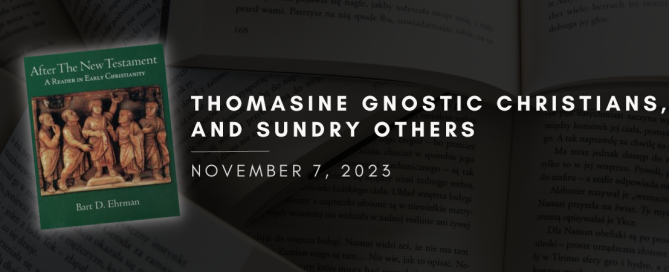
Thomasine Gnostic Christians, and Sundry Others

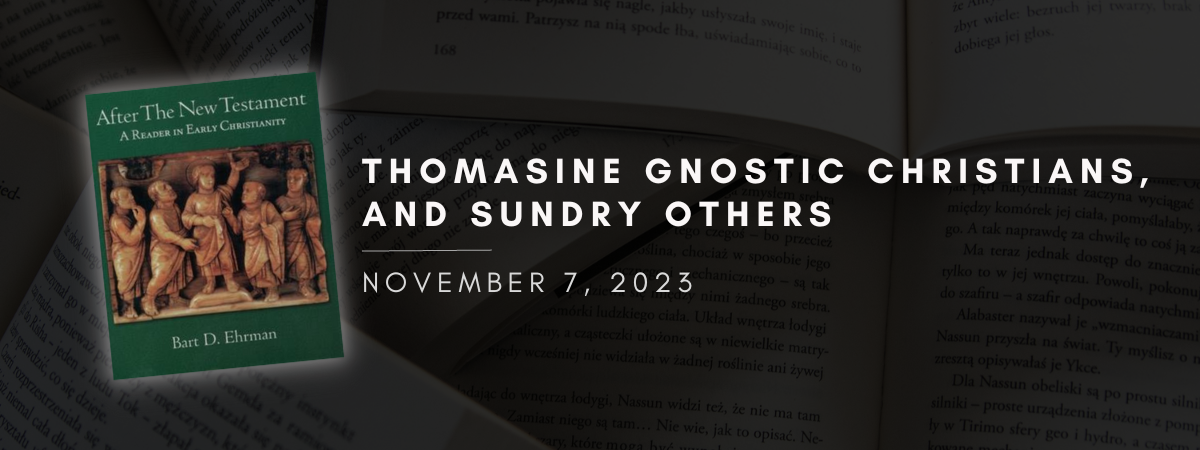
In this thread of posts I have been reproducing my comments on Gnosticism from the 2nd edition of my anthology, After the New Testament. In addition to the Sethians and the Valentinians, scholars talk about the school of Thomas and about yet other Gnostic groups that are not easy to identify with any of the other three or to group together in any meaningful way. Gnosticism was a messy group of religions! Here is what I say in the Introductions to the Thomasines and the Other Gnostic groups in the book. ****************************** Thomasines A number of books from the early Christian tradition are connected with a figure known as Didymus Judas Thomas. The word “Didymus” means “twin” in Greek; so too the name “Thomas” means “twin” in Aramaic. And so this person is Judas, or Jude, the twin. But the twin of whom? In our earliest surviving Gospel, Jesus himself is said to have a brother who is named Jude (for example, Mark 6). And in later traditions, especially from Syria, this Jude was thought [...]

The Gospel of Philip: An Example of a Valentinian Gnostic Gospel

In my previous post discussing Valentinian Gnosticism I mentioned an intriguing Valentinian text, the Gospel of Philip. Now I'd like to explain what it is and give you a bit of the opening section in translation so you can get a taste of it yourself.   I've taken all this from the second edition of my book After the New Testament; the introduction is mine but the translation comes from Marvin Meyer, referenced below **************************** INTRODUCTION Even though the Gospel of Philip, also discovered at Nag Hammadi, is easily recognized as Valentinian, the book is notoriously difficult to understand in its details.  In part this is due to the form of its composition.   It is not a narrative Gospel of the type found in the New Testament or a group of self-contained sayings like the Gospel of Thomas (see Chapter 8).  It is instead a collection of mystical reflections that have evidently been excerpted from previously existing sermons, treatises, and theological meditations, brought together here under the name of Philip -- presumably Jesus' own disciple.  Since [...]

Check Out This Gnostic Myth from the Gospel of Judas!

A lot of people over the years have told me they are drawn to the Gnostic way of looking at things, but it’s pretty clear they’ve never actually read any Gnostic texts.   Gnosticism is a lot easier to like in the abstract than in the on-the-ground (or out-of-this-world) reality. When scholars typically describe Gnosticism to general audiences (at least when I do), it usually sounds very weird, rather fascinating, and more-or-less sensible.   When people actually read the Gnostic texts, some of them are like that too (weird/fascinating/sensible) – but lots of the texts seem anything but sensible.  They are (or seem to be) completely incomprehensible. I thought I’d illustrate the point by giving one form of the Gnostic myth as found in a relatively small but rather dense portion of the Gospel of Judas. Some people find that if they have a basic explanation/sense of Gnostic thought (a weird, fascinating, but sensible one as I tried to several posts ago), it is often possible to get the gist of this kind of myth (although parts [...]

The Gospel of Judas: Here’s a Taste of It

Here is the first bit of the Gospel of Judas from the translation of my colleague Zlatko Pleše in our book The Other Gospels. The first paragraph is the explanation of where we got the text from; then the translation of the opening scene. After this bit here, the Gospel gets very strange, at least to most modern readers.   But as you can see, it is really interesting. At the end I give the bibliography for further reading that we cite in our book. This translation is based on the Coptic text of Rodolphe Kasser, and Gregor Wurst, eds. The Gospel of Judas: Critical Edition.  Washington, DC: National Geographic, 2007.   New portions of the Gospel appeared in 2006, when the one-time owner of the manuscript declared bankruptcy and his remaining antiquities collection was turned over to a bank in Ohio; included in this collection were numerous small fragments of the Gospel of Judas.   These have been photographed and they have begun to be studied; for our translation of the account here we have been able [...]

The Gospel of Judas: The Most Recently Discovered Sethian Gnostic Gospel

For anyone interested in Gnosticism, the most recent full Gnostic Gospel to appear, the Gospel of Judas, is a real treasure.  In my previous post I described the broad contours of Gnostic views and the more specific Sethian understanding of the divine realm, the world, humans, an salvation.  Different Sethians, of course, would have different views of things (think of all the Catholics, Episcopalians, or Baptists you know or know of!).  The Gospel of Judas presents a particularly intriguing form of the Sethian myth. I have said some things about the Gospel of Judas on the blog, but it's been a few years, so it's worth talking about again.  You can find a translation, done by my colleague Zlatko Pleŝe, in the volume we co-edited and translated: The Other Gospels: Accounts of Jesus from Outside the New Testament.  We also give the following Introduction to the text; I will give the rest of the Introduction and a bibliography, and a bit of the translation itself, in the next post. ****************************** The Gospel of Judas is the [...]

Interesting Questions About the Books From Nag Hammadi

There are a lot of unsettled questions about the "Gnostic Gospels," that is, the books of the Nag Hammadi Library. After my recent posts I received some interesting questions that *can* be settled, and here I deal with two of them: one that’s a zinger and the other that has been asked by several readers. First the zinger. The reader noted that I indicated that the books of the library were manufactured in the fourth century; we know this because the leather bindings on the books had their spines strengthened with scrap papyrus (and is therefore called cartonnage) and some of these papyri were dated receipts. And so the reader’s question: QUESTION: Just out of curiosity – what form of dating did the compilers of the books use, that would correspond to our “341 CE” and so on? I’m assuming they weren’t using Roman dates. But were the Romans themselves, in that era, still using dates “ab urbe condita”? RESPONSE: This is a great question, and I have to admit, I had [...]

Go to Top