Sorting by

×

Time to Vote: Help Choose the Next Platinum Post!

Dear Platinum Members, Let’s call this a humble moment of accountability: we’ve fallen behind on something important. As many of you know, one of the special privileges of Platinum membership is the opportunity to submit guest posts to the blog — and then, every four submissions, we open it up for a Platinum vote. The post that gets the most votes is published to the entire blog for all members to enjoy and comment on. In theory, this happens every time we get four new Platinum posts. In reality... we now have a backlog of over a dozen. That means we’re multiple rounds behind on voting. But never fear — we’re setting things right starting now. Over the coming weeks, we’ll be rolling out a new vote every couple of weeks until we’re all caught up. After that, we’ll return to our regular rhythm. Today, we begin with the first group of four. These posts were published in chronological order, and we’re asking you to choose one to be featured on the main blog. Please [...]
2025-09-10T13:12:18-04:00June 9th, 2025|Public Forum|

2 Thessalonians: Who Wrote It, When, and Why?

In my previous post I explained the major theses and emphases of 2 Thessalonians, and pointed out that in many ways it is very similar in its concerns and themes to 1 Thesssalonians.  But I also said that it is commonly considered by scholars to be "Deutero-Pauline," that is, written by a later author only *claiming* to be Paul.  How can we know?  As I said there, the problem from a historian’s point of view is that someone who had decided to imitate Paul would no doubt try to sound like Paul. If both Paul and an imitator of Paul could sound like Paul, how could we possibly know whether we are dealing with the apostle himself or one of his later followers? Here's how I deal with the matter in my textbook on the New Testament (Oxford University Press, ch. 23). ****************************** There is, in fact, a way to resolve this kind of historical whodunit, and it involves looking at the other side of the coin, that is, at the parts of 2 Thessalonians [...]

2025-09-10T13:12:17-04:00June 8th, 2025|Forgery in Antiquity, Paul and His Letters|

2 Thessalonians in a Nutshell

In this series of “nutshell” overviews of each of the books of the New Testament, we move now to one of the most intriguing instances of a book that claims to be written by Paul, but was apparently, instead, written by someone else who wanted his readers to think he was the apostle. 2 Thessalonians is an intriguing case because the book certainly sounds a lot like Paul’s other letters and does indeed appear to be a kind of follow-up letter to 1 Thessalonians.  It also has numerous word-for-word similarities to 1 Thessalonians.  It too, for example, is written by “Paul, Silvanus, and Timothy” (1:1)  and is addressed “to the church of the Thessalonians in in God our Father and the Lord Jesus Christ" (2 Thessalonians 1:2) – both verses being virtually identically to 1 Thessalonians. Moreover, its contents are closely related to the other letter: both are concerned about the suffering the Thessalonian Christians are experiencing through persecution and especially about their misunderstanding about when Jesus is to return on the Day of Judgment.  [...]

2025-09-10T13:12:17-04:00June 7th, 2025|Paul and His Letters|

Interesting Questions from Readers (5/27/2025)

Here are some particularly sticky questions I've gotten recently, with expanded answers to share with all of you:   QUESTION: Bart, what should we understand by “exousia” in I Cor 11.10?   RESPONSE: Ah, right. A woman is to have an "authority" (exousia) on her head. It’s a confusing verse in a confusing passage.  The verse: For this reason a woman ought to have authority over her head, because of the angels.  It's sometimes translated "veil" though it clearly does not mean veil, per se. But in the context Paul is talking about why women should wear head coverings in church and so in some sense apparently the veil is seen as an “exousia” or “authority.”  His opening explanation is that since God is the “head” of Christ and Christ is the head of a man then the man is the head of a woman.  Does “head” here not refer to the thing sitting on your shoulders but something like “chief authority” (as in “the head of the department”)? Exousia itself means [...]

2025-09-10T13:12:16-04:00June 5th, 2025|Reader’s Questions|

1 Thessalonians and the Coming Rapture

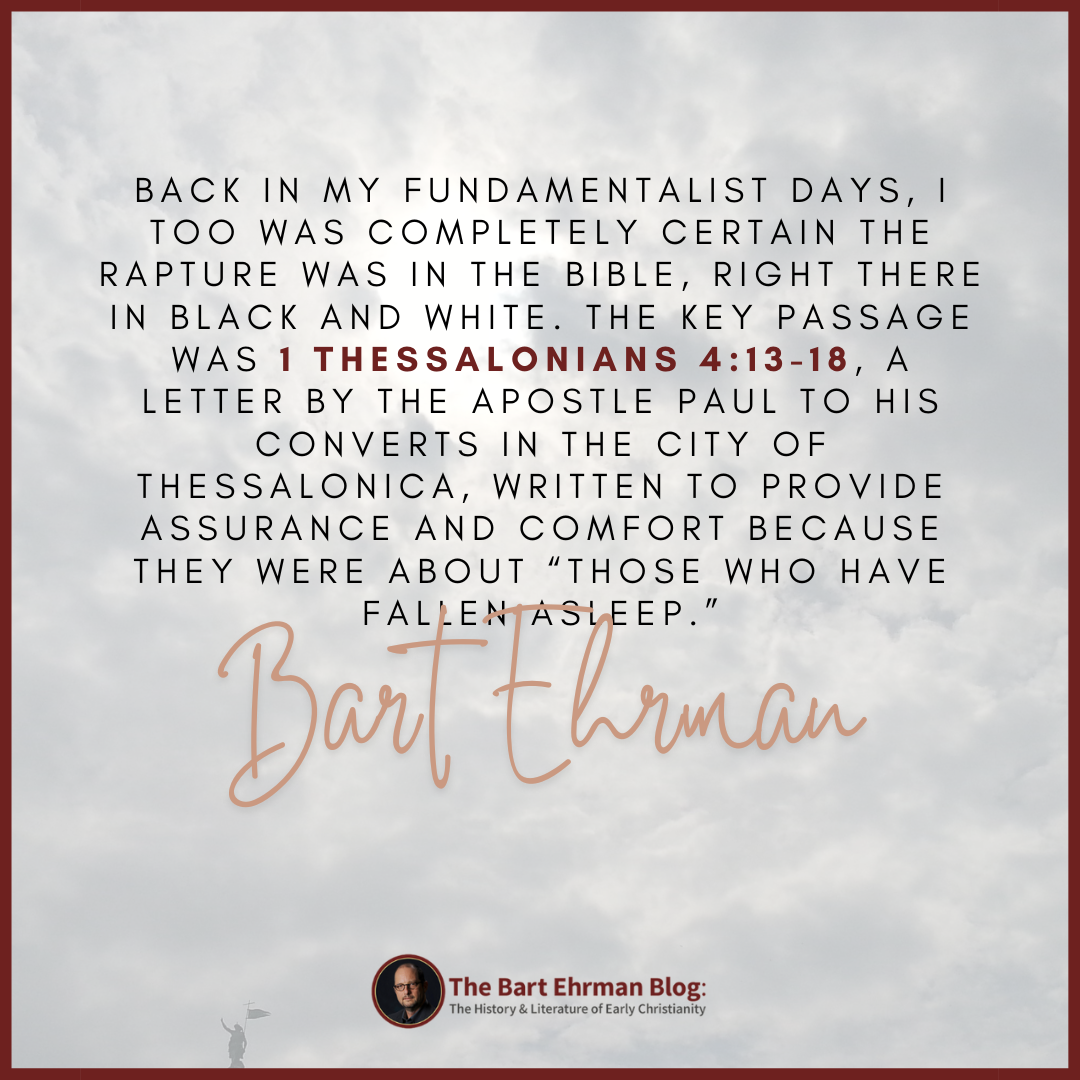
One of the most intriguing passages of 1 Thessalonians is also  both the most widely referred to (these days) and the most universally misread.  It is the passage that conservative Christians cite to support the idea of the coming “rapture,” when Jesus will allegedly arrive from heaven to take his followers out of the world before the appearance of the Anti-Christ and the horrendous period of disaster and “tribulation” that must take place for seven years before the Final Day of Judgement. The “rapture” is one of the firmest beliefs of conservative evangelicals.  And it is not found in the Bible. Here is what I say about it, in relation to 1 Thessalonians 4:13-18 in particular, in my book Armageddon. *********************************   Here is an interesting factoid that, in my experience, almost no one knows:  No one had even thought of the idea of a “rapture” until the 1830s.   Of the many, many thousands of serious students of the Bible throughout Christian history, who pored over every word – from leading early Christian [...]

2025-09-10T13:12:16-04:00June 4th, 2025|Paul and His Letters|

1 Thessalonians. For Further Reading

Here is a list of readings on 1 Thessalonians, most of which are relevant to all the undisputed Pauline epistles, with a couple of commentaries specifically on this significant, short letter.  One benefit of serious commentaries is that they always begin by discussing major critical issues in understanding a book: authorship, date, historical context, major themes, disputed issues, and so on. I devote a fuller discussion of 1 Thessalonians (an entire chapter) in my textbook, Bart Ehrman and Hugo Mendez, The New Testament: A Historical Introduction to the Early Christian Writings, 8th ed. (Oxford University Press, 2024), ch. 20.  That’s a good place to start for a fuller exposition of what I have given here in my nutshell posts.  If you have an earlier edition of the book, it will be pretty much the same, except for the expanded bibliography.    ****************************** Aune, David. The New Testament in Its Literary Environment. Philadelphia: Westminster, 1987. Includes a superb discussion of the practices of letter writing in Greco-Roman antiquity as the social context for Paul’s epistles. [...]

2025-09-10T13:12:16-04:00June 3rd, 2025|Paul and His Letters|

1 Thessalonians: Who, When, and Why

Now that I have given an overview of the major themes and emphases of 1 Thessalonians, I can say a few more things about what we know about its authorship, when it was written, and why. The book, of course, is always called “Paul’s” first letter to the Thessalonians but as you’ll notice, the opening verse indicates that it comes from “Paul, Silvanus, and Timothy.”  And throughout the letter the first-person plural pronoun predominates “WE give thanks” “WE know” “OUR visit” and so on. So, was this a letter written by committee?  If so…how does that work exactly? Aspects of the letter make it pretty clear that the three named authors did not take turns writing (Silvanus writing one passage, Timothy another, Paul yet another) but that it comes from one hand, and the hand was Paul’s.   Timothy in particular does not appear to be involved in the writing of the letter, since in chapter 3 the author(s) indicate that when they were in Athens they were distressed not knowing what was [...]

2025-09-10T13:12:17-04:00June 1st, 2025|Paul and His Letters|

1 Thessalonians in a Nutshell

I now move on in my “New Testament in a Nutshell” series to the letter of 1 Thessalonians, which for-roughly-ever has been one of my favorite books of the New Testament.  It is not one of the most widely read as a rule, but I think it is both unusually important and interesting.  For one thing, it is the first letter of Paul that we have and, therefore, the very first piece of Christian writing of any kind that we have.  That in itself makes it unusually significant in my view.  THE earliest words from any Christian!  Whoa. When I taught Greek at Princeton Theological Seminary (some millennia ago) this was the book we had beginning students first translate once they had all the important elements of Greek grammar down.  It’s not excessively hard Greek, but it is challenging for first-timers, and it’s the kind of book that if you read carefully – as you have to do when you’re basically going one word at a time trying to figure out the Greek – you [...]

2025-09-10T13:12:02-04:00May 31st, 2025|Paul and His Letters, Public Forum|

June 2025 Gold Q&A

Hello Gold & Platinum Members, It’s that time again—Bart’s monthly Q&A is just around the corner! Have a burning question about the history of early Christianity? Curious about a blog post or topic we’ve covered recently? This is your chance to ask Bart directly. He’ll respond to as many member-submitted questions as possible during a one-hour, Gold & Platinum members-only recorded session. The next Q&A will be recorded live on Sunday, June 22 at 1pm ET. Can’t make it? No problem. A full recording will land in your inbox shortly afterward. To submit a question, just email Jen at [email protected] by the end of the day Thursday, June 19—no matter where in the world you are. We can’t wait to hear what you’re wondering about! Zoom Meeting Link: https://us02web.zoom.us/j/89470277770?pwd=9mrbO1OeGBlKaT6mCb0muBU45mnZD0.1 Meeting ID: 894 7027 7770 Passcode: 540933

2025-09-10T13:12:17-04:00May 30th, 2025|Public Forum|

Interesting Questions from Readers

Here are three interesting questions I've recently received, and my attempts to answer....   QUESTION: I’ve been wondering about the passage in Romans where Paul expresses his fear about returning to Jerusalem on account of opposition because he wanted to take the money that he raised there before leaving for Spain. I used to couple this account with Paul’s final leg of his third mission out of Corinth back to Jerusalem, and there he indeed faces opposition Acts chapter 20 and then finds himself in Rome, in prison Acts 28? The passages seem to fit well together, but how? History, hearsay, looking at the letter itself expanding the details? What do you think? RESPONSE: I think the big problem is the whether we can accept the book of Acts as providing a reliable account of Paul's arrest and trials.  I don’t think we can.  So reconciling it or conflating it with Paul’s own account(s) just doesn’t work. In Acts, the arrest itself is meant to show that Paul has never done anything contrary [...]

2025-09-10T13:12:01-04:00May 29th, 2025|Reader’s Questions|

Colossians: For Further Reading

Here is an annotated list of books on Colossians, most of them relevant to all the Deutero-Pauline epistles (that is, the letters that are assigned a “secondary” standing in the New Testament collection of Paul’s letters because scholars doubt they were actually composed by Paul himself) with a couple of commentaries specifically on Colossians.  One benefit of serious commentaries is that they always begin by discussing major critical issues in understanding a book: authorship, date, historical context, major themes, disputed issues, and so on. ****************************** Beker, J. Christiaan. The Heirs of Paul: Paul’s Legacy in the New Testament and in the Church Today. Philadelphia, PA: Fortress, 1991. A clear assessment of the theology of the Deutero-Pauline, especially in light of the views embodied in the undisputed Paulines. Ehrman, Bart D. Forged: Writing in the Name of God—Why the Biblical Authors Are Not Who We Think They Are. San Francisco: Harper One, 2010. An account of the phenomenon of literary forgery (pseudepigraphy) throughout the early Christian tradition that asks how and why a Christian author would [...]

2025-09-10T13:12:01-04:00May 28th, 2025|Paul and His Letters|

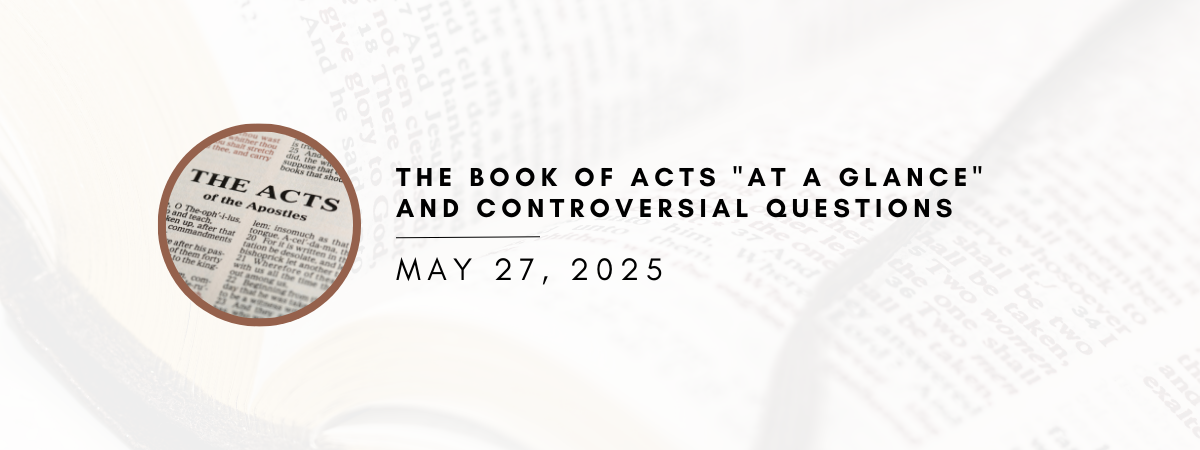
The Book of Acts “At a Glance” and Controversial Questions

In addition to my nutshell summaries of each book of the New Testament, I have been providing a post that gives additional materials I present in my New Testament textbook.  These are (a) rapid fire summaries of each book that I call “At a Glance” and (b) a set of study questions that challenge students to take a position on key aspects of the book, that I call “Take a Stand.” Here they are now for the book of Acts.  I hope the summary "at a glance" makes sense, and that you can nail the questions. BOX 17.8 The Book of Acts The book of Acts is the second of a two-volume work by the author of Luke. Like the first volume, it is dedicated to an otherwise unknown “Theophilus.” These books have been traditionally ascribed to Luke, the traveling companion of Paul; there are, however, reasons to suspect this tradition. Like the Gospel of Luke, the book was probably written around 80–85 c.e. A thematic approach to the book reveals several prominent themes:  The [...]

2025-09-10T13:12:01-04:00May 27th, 2025|Acts of the Apostles|

Did Paul Write That Letter? Getting Into the Weeds…

A few days ago I published a post trying to show why many critical scholars do not think Paul wrote the letter to the Colossians even though its author claims to be Paul.  It's pretty easy to put the matter in simple, easy-to-understand terms for non-experts: all you have to say is that the writing style, theology, and presupposed historical circumstances don't match up with what we know about Paul otherwise.  But, well, that's really not very convincing.  It's just informative. So I provided a few of the details connected with writing style and theology, but tried to do it still in fairly simple terms.  As I've done sometimes before, I thought it might be useful to (some of?) you to see how I would argue that for scholars without having to mince words, just so you can see how it might be done.  To do it fully would take many pages, but here is the discussion I devote to the matter in my academic book Forgery and Counterforgery: The Use of Literary Deception in [...]

2025-09-10T13:12:01-04:00May 25th, 2025|Forgery in Antiquity, Paul and His Letters|

The Letter to the Colossians: Who, When, and Why?

Now that I have summarized the major themes and emphases of Colossians, I can talk about who wrote it, when, and why.   The book, as we have seen, claims to be written by Paul.  But there are good reasons for doubting it. In a number of ways, this letter does look very much like those that Paul himself wrote. The prescript written in the names of both Paul and Timothy, the basic layout of the letter, and the closing all sound like Paul; and a number of important Pauline themes are sounded throughout: the importance of suffering in this world, Jesus’ death as a reconciliation, and the participation of believers in Jesus’ death through baptism.  On these grounds, one might think that Paul may well have written this letter. There are, however, solid reasons for questioning Paul’s authorship of this letter. One of the most compelling arguments depends on a detailed knowledge of Greek, for the writing style of Colossians differs markedly from that found in Paul’s undisputed letters. Whereas Paul tends [...]

2025-09-10T13:12:01-04:00May 24th, 2025|Forgery in Antiquity, Paul and His Letters|

The Letter to the Colossians, in a Nutshell

We continue in this series that explains each book of the New Testament “in a nutshell” by turning to the letter to the Colossians.  This is a book that claims to be written by Paul, but as we will see in the next post, there are very good reasons for thinking Paul himself did not write it, but that it was written in his name by a later follower claiming to be Paul. For now, we are interested in the letter itself, it’s major themes and emphases. I begin by trying to explain the book in 50 words. The letter to the Colossians, allegedly written by Paul from prison, praises the Christians in Colossae and warns them against false teachers who urge them to follow the Jewish law, live strictly ascetic lives, and worship angels; for this author, Christ alone represents the godhead and deserves to be worshiped. Here now is a fuller account of the main features of the book. ****************************** “Paul” is in prison for preaching the gospel (Col 4:3). While there, he [...]

2025-09-10T13:12:01-04:00May 22nd, 2025|Paul and His Letters|

Some Interesting Questions of the Week

I've started posting questions and responses from readers.  Here's another set of particularly good ones.   QUESTION: I recently read your book Jesus Interrupted and have become interested in your work. In it you discussed the potential forgeries contained in the Pauline letters and New Testament but it didn’t seem to mention much about the Old Testament. I noticed you did say that the New Testament was your specialty but was wondering if there was any evidence you were aware of that the Old Testament contains similar situations and which books. RESPONSE: Yes, my book was just about the NT, not the entire Bible.  Most of the books of the OT are either anonymous (Genesis through 2 Kings, e.g.) or written in the authors’ actual names (most of the prophets starting with Isaiah).  Others are attributed to a person who didn't write them.  Proverbs, for example, does not claim to be by Solomon.  In cases like this, since the author himself doesn't claim to be the person to whom the book is later [...]

2025-09-10T13:12:00-04:00May 21st, 2025|Reader’s Questions|

How Athens Made Me Rethink….

I am in Athens just now, heading out on a tour giving lectures on ancient Greek philosophers in relation to the teachings of Jesus and Paul.  I came over a couple of days before the tour to spend some time looking around on my own, and had a lovely afternoon at the fantastic Acropolis Museum. Every time I come to Athens I think of my first time here, for several reasons, but one in particular.  It was when I was struck by a realization about the relationship of the highly cultured, sophisticated Greek world and the rise of earliest Christianity, a realization that led to my book The Triumph of Christianity.  In many ways it was a sad realization.  I talk about it in the Afterword of the book.  This is what I said there. ****************************** The idea for this book struck me twenty years ago during my first trip to Athens.  For my trip I was particularly keen to explore the archaeological wonders of the city, and most especially the Agora and the Acropolis.  In [...]

Some Intriguing Questions about Paul’s Letters

QUESTION: I was wondering how scholars look at situations like Galatians 2:6-10 , specially the part of the text that states “they added nothing to my message” or “all they asked is we should continue remembering the poor”. My primary question is do scholars like yourself believe that the early disciples & James/Jerusalem Church saw eye to eye with Paul on all matters? As a secondary, why does Paul go into disputes later in Galatians 2 if they agreed on everything as mentioned in Gal 2 earlier? The passage of “adding nothing to my message” makes it seem like Paul had some gospel and read every single point to the disciples of which they agree with it all, large and small, and then lived happily ever after. What is the historical context?   RESPONSE: We obviously have only Paul's side of the story. But it seems pretty clear that he is speaking about his main concern/issue connected with his gospel, that gentile converts do not have to convert as well to Judaism, [...]

2025-09-10T13:12:00-04:00May 18th, 2025|Paul and His Letters|

Is the “Christ Poem” of Philippians Really a Poem? When Did Jesus Really Become “Equal” With God?

This is my second and final post on the "Christ-poem" of Philippians 2.   Many years ago when I talked about the poem, a reader (who apparently knew Greek!) objected that the poetic lines I suggested don't actually work. Below I'll give his question and my response.  But then I'll move on to an even more important issue: how the poem understands who Christ was before he became human and after his resurrection.  If Christ was divine before the incarnation, how could he be made more divine afterward?   First, the question I received about whether this is some kind of poem.  Or rather, the objection that was raised? This ‘rhythmic structure’ just does not work in Greek. The first ‘stanza’ with three ‘lines’: Who, although he was in the form of God Did not regard equality with God Something to be grasped after; In Greek the ‘third line’ is only one word and it appears in the middle of the ‘second line’, after only the first word of the so-called second line. There are a few [...]

2025-09-10T13:12:00-04:00May 17th, 2025|Early Christian Doctrine, Paul and His Letters|

The Death and Afterlife of Jesus: A Historical Reconstruction Part II – Guest Post by Platinum Member Mark Reichert

Here now is Platinum blog member Mark Reichert's second part of his two-part reflections in which he offers his own reconstruction of what might have happened after the crucifixion. So what do I think really happened? There is no way to know for sure but I can put together a story that seems plausible and makes sense to me. I believe Jesus and his following traveled to Jerusalem for Passover during the governorship of Pontius Pilate. How large a following I do not know though enough for it to be considered a “following.” Once there, he came to the attention of Roman and/or Jewish authorities in a negative way. Either he said, or someone accused him of saying, that he was “King of the Jews.” I highly doubt the account in Mark that states Jesus was bound by Jewish priests and elders and brought before Pilate. This would be like Palestinian authorities turning a Palestinian man over to the Israeli army for execution, unlikely to happen. If Jewish authorities had a problem with Jesus, they [...]

2025-09-10T13:11:59-04:00May 16th, 2025|Public Forum|
Go to Top